Greetings from CR: Operation Berkeley

May 21st, 2013

Californians, hark! On June 6, our esteemed poetry ed., Don Bogen, returneth to Berkeley. Don is a Cal graduate himself, and he is skulking back to what he terms “the scene of the crime” to host yet another event in our Greetings from Cincinnati series. For those unfamiliar, this is a stealth operation whereby we infiltrate cities near and far (mostly far) to stage surprise literary gatherings that are sort of like poetry explosions, only without the fire and smoke and, actually, without the element of surprise—because we are telling you about it now.

Our Berkeley edition will take place at Mrs. Dalloway’s Bookstore, which must be an amazing place, because every time we google it, McAfee warns us it is a DANGEROUS SITE. Well, poetry explosions do happen there. Or one will happen, anyway, on Thursday, June 6, at 7:30 p.m. We leave you with a list of the combustible contributors that will be poetically present that fine eve:

Geoffrey Brock is the author of Weighing Light: Poems, the editor of The FSG Book of Twentieth-Century Italian Poetry, and the translator of several books from Italian. His versions of twelve poems by Patrizia Cavalli appeared in CR 9.1 (Summer 2012), and two of his own poems appeared in CR 2.2 (Winter 2005). He teaches at Arkansas.

Randall Mann’s third poetry collection, Straight Razor, is forthcoming from Persea Books in October 2013.  His work has appeared in the Winter 2011 and Winter 2013 issues of CR. He lives in San Francisco.

D. A. Powell is the author of five books of poetry.  Prizes for his work include the Kingsley Tufts Award, the California Book Award, and, for his most recent book Useless Landscape or A Guide for Boys (Graywolf, 2012), the National Book Critics Circle Award.  He has poems in the Summer 2008 and Summer 2010 issues of CR.

Mira Rosenthal is the author of The Local World, which won the Wick Poetry Prize, and the translator of two volumes by Polish poet Tomasz Rozcyki, most recently his sonnet cycle Colonies. She has received fellowships from the NEA, the PEN Translation Fund, the Fulbright Commission, and the ACLS. Her work has appeared in numerous journals and anthologies, including Ploughshares, Harvard Review, Slate, A Public Space, and The Cincinnati Review (Winter 2009, Winter 2011). She is a Wallace Stegner Fellow in Poetry at Stanford.

Kathleen Winter’s poems appeared in CR in 2007, 2008, and 2010 (Issues 4.1, 5.2, 7.2). Her book Nostalgia for the Criminal Past (Elixir Press, 2012) won the Antivenom Poetry Prize, as well as the 2013 Bob Bush Award from the Texas Institute of Letters for Best First Book of Poems. Winter’s poems also were published by Tin House, The New Republic, Agni, and Field. She teaches at the University of San Francisco.

Why We Like It: “Olentangy River”

May 13th, 2013

We’re sad to say goodbye to our hardy, super-duper volunteer Lisa Summe—who just graduated with an MA in creative writing from UC and is headed to Virginia Tech for an MFA in the fall. Our loss is their gain. The office won’t be the same without her brightly colored clothing, strong work ethic, and trenchant remarks on veggie burgers. (Which one tastes like a hockey puck? Which has the best blend of vegetables? How great is corn?)

Before she goes, though, this future Hokie wanted to share one last thought: why she likes Erin Belieu’s poem “Olentangy River,” which appears in Issue 10.1, due out next month.

Lisa Summe: From the start of Erin  Belieu’s “Olentangy River,” one is aware of the striking lack of punctuation. Ultimately, the poem is one long sentence broken up by a series of colons. More interesting than the absence of traditional punctuation, however, is the way Belieu uses spaces to effect separation and emphasis in a way that commas and semicolons cannot. These spaces slow the poem at all the right moments, turning it into a potent pile of little fragments, each one raw and deliberate, each one needing the weight Belieu confers on it.

The form beautifully enhances the poem’s content: the fragments convey the speaker’s desire for and obsession about a past love: ” you’ve never been     imagined    as / I     imagined     you:     today   with a  wife   sleeping / in Ohio   and babies     down the hall.” The self-awareness and vulnerability of this consciousness, together with universal longing and sadness conveyed in the poem’s details, drew me in. The speaker reminisces about nights driving past the former love’s house, nights the speaker calls inevitable because “there   was you   there / somewhere   sleeping   or     toasting bread     or / staring   tired at TV   and   ending lost:   always lost.”  What are our old lovers doing without us? Regular things, perhaps, like making toast. Or not. How does our understanding of how they moved on vary from reality? We will never know.

Our Contributors, Knocking It Out of the Park

May 6th, 2013

We’ve heard some good news this spring about our contributors!

Joshua Weiner (Issues 2.2 and 9.1) won a Guggenheim fellowship. You can read his commentary on the poem “Outrageous Fortune” here.

Jessica Hollander (Issue 8.1) won the 2013 Katherine Anne Porter Prize in Short Fiction. Her book, In These Times the Home Is a Tired Place, will be published by UNT Press in 2014. Katherine Dunn was the judge.

Dawn Lonsinger (Issue 5.2) won the 2012 Idaho Prize for Poetry for her book Whelm, which will be published by Lost Horse Press. (The judge for that contest was Nance Van Winckel, whose poems appeared in issues 6.2 and 8.2, and her art in 9.2.)

Christopher Merkner’s story “Last Cottage” appeared in Issue 7.1, as well as in Best American Mystery Stories 2011—and now it will appear in his first collection of stories, The Rise and Fall of the Scandamerican Domestic, available in January 2014 from Coffee House Press. Here’s our appreciation of the story.

We’re honored to have published these writers’ work!

Anniversary Initiative

April 23rd, 2013

We at CR are excited to announce that composers from UC’s acclaimed College-Conservatory of Music have set to music some of the poems in our pages. They will be performing these pieces, with the help of CCM musicians and vocalists, in a special concert tomorrow, April 24, at 2:15 p.m. in room 3250 (the Masterclass Room) of Mary Emery Hall.

The works were created through the CCM class Explorations in Art Song. One composer, Steven Weimer, was inspired by Kathleen Winter’s “Eve, Seducing the Apple” (CR 4.1). A second composition by Sarah Hutchings took as its source Jeff Gundy’s “March Ode.” And there’s a kicker: Our own departing associate editor Lisa Ampleman’s poem “My Internal Count” also received the CCM treatment. If you’re in the area, come check out this unique performance opportunity.

Music. Poems. Music-poems. We LOVE this idea. Why stop with this one performance? As part of our upcoming tenth-anniversary year, we are continuing collaborations between our CR poets and composers from the College-Conservatory of Music. In our Winter issue (due out in November), we’ll be featuring an insert of “Eve, Seducing the Apple” that includes Weimer’s score. AND we’ll offer a podcast of the performance on cincinnatireview.com. In fact, we hope to follow up with several more poem-composer collaborations, mailed as wee booklets to our valued subscribers throughout the year (with, of course, accompanying podcasts of the performances on our website). It’s our anniversary. Let the band play on!

CR and Facebook

April 22nd, 2013

Oh yes, we are on Facebook. If you like us . . . then LIKE us. You’ll find bonus goofy fun on our page. Right now, for example, there are new photo albums featuring staff, volunteers, and community supporters involved in Word Without End (our annual reading-series extravaganza) and our end-of-year cryfest (yesterday’s party, at which we mourned the loss of graduating staffers Becky and Lisa).

Irrelevant Questions for Relevant Writers: Felonious Assault Edition

April 17th, 2013

Returning guest blogger Don Peteroy learned something from his interview with upstart novelist Marjorie Celona. If you mess with her, she will first outthink you, then put you in the hospital, then head to the kitchen to scramble some eggs.

Marjorie Celona’s first novel ,Y, was published in 2012 by Hamish Hamilton/Penguin Canada and in 2013 by Simon & Schuster (US), Faber & Faber (UK), and Suhrkamp (Germany). Y is forthcoming from Gallimard (France), De Bezige Bij (Netherlands), and Juritzen (Norway). Marjorie is the recipient of the John C. Schupes fellowship and Iowa Arts fellowship from the Iowa Writers’ Workshop, the Olive B. O’Connor fellowship from Colgate University, and was recently writer-in-residence at Hawthornden Castle in Scotland. Her stories have appeared in The Best American Nonrequired Reading, Harvard Review, Glimmer Train, Crazyhorse, and elsewhere. Born and raised on Vancouver Island, she lives in Cincinnati with her fiancé, Brian, and their dog, Betsy Lou.

Question: Let’s make believe I have extraordinary powers. I decide to travel back in time to April 9, 2003. My mission: complicate your life. Before you wake up that morning, I move everything on Earth, except for you, over one inch to the left. How would this alter your life as a writer? Consider causality, and the butterfly effect.

MC: Why not just move me—but nothing else—one inch to the right? If you move everything but me one inch to the left, you’ll have to travel all the way back to the 90s in order to complete the task by the time I wake up on April 9 (a Wednesday, i.e., a work day, so we can assume I’ll be getting up ’round 7).  That’s early!  And who wants to relive the 90s? You?  No, you do not. You might also remember that April 9, 2003, was the day that the Iraqis, with the help of some US Marines, slung a noose around Saddam Hussein’s giant bronze neck and pulled the big man down. I suggest, then, not moving everything over by an inch (who wants to “complicate,” as you say, the fall of one of history’s most notorious war criminals? You?  No, you do not), but, rather, slipping into my bedroom circa 6:59 and giving me a gentle, one-inch nudge. I’ll tell you what happens next: I tell you to get the fuck out of my bedroom. I spray your face with mace. I beat you with the baseball bat I keep under the bed. Nothing changes for me, but a lot changes for you. Paralyzed and toothless, you beam yourself back to 2013, Don, while I wash the blood from my hands and go downstairs to make breakfast.

What We’re Reading

April 15th, 2013

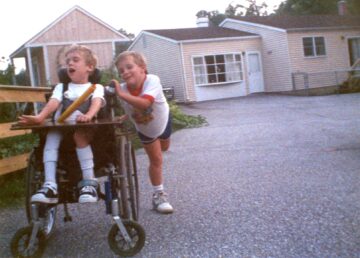
Brian Trapp: It’s often said that fiction make us feel less lonely. However, growing up with a disabled twin brother, I often found novels to be a lonely place. Where were the stories about brothers like mine? Families like mine? Stories that depicted the severely disabled as more than objects of pity? This year, I made it a point to read a lot of fiction about disability and discovered Jayne Anne Phillips’s wonderful novel Lark and Termite (2009), a National Book Award finalist.

The novel mostly follows Lark, a headstrong teenage girl, and her wheelchair-bound, disabled half-brother, Termite, as they grow up in an isolated town in late 1950s West Virginia. Another narrative strand transports us back nine years to a tunnel in Korea as Termite’s father slowly dies in one of the first massacres of the Korean War. What makes this novel fascinating is Phillips’s rich exploration of non-normative consciousness. We follow the father as he goes from strong and able soldier to a dying and dependent man, time slowing, his senses shutting down. But Termite is the real achievement, named so because, as his sister says, he moves his fingers like an insect with antennae, “in himself like a termite’s in a wall.” His thoughts rendered in a lyrical close third based on rhythm and sound, Termite notices things that the other characters don’t: the sounds of ants, the color of the sky, the warm rush of air. He cannot talk, only repeating what others say, but Phillips is mysterious with just how much he understands and communicates, as he interacts with people with his eyes and a bell on his wheelchair.

If you haven’t already suspected it, this is very much a rewriting of Faulkner’s The Sound and the Fury, and hits some of the same themes: a sister’s sexual awakening, suicide, a disabled brother threatened with institutionalization. Except in Phillips’s hands, this story is much more accessible and affirming. And instead of Benjy’s simple-sentence narration, a “tale told by an idiot . . . signifying nothing,” Phillips writes Termite’s POV with a Morrison-like lyricism, making you want to experience the world through his mind. If all this weren’t enough, there’s also some magical-realist elements. You guys like ghosts, right? But for me, the best moments were in the breathtaking intimacy between the siblings. As Lark says about her brother: “I’m so used to being with Termite, he feels like alone to me. He’s like a hum that always hums so the edge of where I am is blunt and softened.”

Putting the Period on Our Reading Period

April 12th, 2013

Nicola Mason: As they say in the auction world when something is about to go, Fair warning! In this case, our Submission Manger is about to go offline  for the usual issue-filling bits of poetry and prose. If you want to shoot us something for consideration, do it this weekend.  The hammer falls on April 15. Please note, however, that we will open up on June 1 for submissions to our contest, The Robert and Adele Schiff Awards. Important info: You can submit and pay the entry fee online AND ONLY ONLINE.

As we’ve mentioned in blog posts past, our reading period has shifted this year for the first time since the mag was born. Wanna know why? Read our apologetic explanation.

I should emphasize that we actually read year round; there are just fewer of us poring over submissions during the summer. If anything, reading is more fun then because there are fewer interruptions, so I can really get in a groove with it, and also because, without a staff to oversee, I can spend time with your stories and poems on my porch swing, in coffee shops, even (oh glory) at the beach. I happily recall the moment, last July, when I first read D. J. Thielke’s “Frantic Hearts,” upcoming in our May issue. I was in the passenger seat of my mother’s car. She had picked me up from the Raleigh airport, and I was getting a bit of reading in during the three-hour ride to my folks’ house on the NC coast. I picked up a new submission—an actual sheaf of paper, not an electronic submission—and encountered these lines:

The funny thing about the mastectomy was that Laine had already lost a part of her left breast, years earlier, to a brown recluse spider bite. While the right remained resiliently healthy and slightly larger, that treacherous left now housed a small collection of tumors, like bright porcelain trinkets shelved in the vaporous gray mammogram images.

“Some luck,” Dr. Kirzinger said after giving her the news. He didn’t specify whether he thought it good or bad.

She knew it wasn’t funny, but the more he talked, the funnier everything seemed: the flyers he forced on her for all-female gyms and one-sided bras. The name of a tattoo parlor with an artist who specialized in fake nipples. The way he casually reached across his desk and patted her breast, like a small, naughty child they were talking about.

I admire “Frantic Hearts” for myriad reasons: the skillful and affecting way Thielke blends the comic and tragic, her gift for metaphor and telling detail, the care with which she explores the nuances of character, and the way she sneakily turns what one initially thinks of as a cancer story into a searching struggle between older mother and adult daughter. “Frantic Hearts” succeeds in presenting not just a fraught situation, but in revealing a complex consciousness thrust into an uncertainty and granted, finally and through harrowing difficulty, a slant sort of grace.

Word Without End: Slouching Toward York Street

April 10th, 2013

The lineup for Word Without End is set. In addition to the fab folks Don Peteroy lauds below, we’ve nabbed Sheri Allen, Brian Brodeur, Kiley Cogis Brodeur, Les Kay, Michael Peterson, Sarah Strickley, Sara Watson, Dietrick Vanderhill, and Kathy Zlabek. How fun is this going to be? Um, very.

Don Peteroy
(from his Facebook status update): This Friday, from 7 till 10 p.m. at York Street Cafe in Newport KY, come to The Cincinnati Review’s annual Whatever It Is We Do At These Annual Things thing. My band, The Knife Incident will provide deafening interludes between readings by some of the finest local writers, including the nationally admired rock star/poet/founder and editor of the nationally admired magazine Forklift, Matt Hart. Local comedian and writer Ben Dudley will do something funny or he won’t. I haven’t talked to him in a long time. Danielle Deulen, also nationally admired for her poetry and nonfiction, will read something. Or she’ll show us her model dinosaur collection. Michael Griffith, known for three awesome works of fiction, many reviews, weird projects, years of being an editor at the Southern Review, for inventing the word “Fantastic” and the phrase “There’s a lot to admire in this story,” will read something ambitious. Maybe a segment of his upcoming novel, “The Secrets of the Weeping Eye Thief’s Princess.” Alli Hammond might read something both ambitious and fantastic, but word around McMicken says she’s planning on staging a full-scale WWII naval battle on the roof. Charley Henley, known for his ability to write fantastic and admirable realism and science fiction, will probably read something nationally admired, but I have a sense he might try that old “Let me see if I can build a wormhole out of shoelaces, five dollar bills, phlegm, and a burning burrito” trick. Jay Twomey, known for his good looks, will pose for 20 minutes while Barry White’s “I can’t get enough of your love” plays on repeat. The event is free and open to the public. I will also be selling copies of my book, Wally, out of my truck. I feel like a real writer now!

Game of the Month: The Emerson Method

April 8th, 2013

For the past several weeks the University of Cincinnati has had the pleasure of hosting Claudia Emerson, Pulitzer Prize winner and author of, most recently, Secure the Shadow (LSU, Southern Messenger Poets, 2012), as Elliston Poet-in-Residence. This past Friday Claudia gave a talk on the importance of measured syntax, during which she described her unusual writing process: She spools out sentences in paragraph form and then prunes them into what become the lines of her poems.

This so piqued our interest, we decided to honor Claudia’s process—which we’ve termed The Emerson Method—in our game of the month. The game’s also an homage to spring. And to the daffodil, the first flower to rear its head in Cincinnati every year.

So: We’ve provided some facts about the daffodil below. Channel your inner Dickinson or Wordsworth  by making the following technical information—well, pretty. Prune sentences (pun intended), change words, add words, rearrange phrases—really, do whatever you want; we’re flexible—to make a stanza, haiku, or piece of microfiction. Form and word count is up to you. The writer of the best entry will win his or her choice of free back issue, slingpack, or CR thermos. And, as a special bonus, we’ll also publish the winning entry on Twitter.

Click on the post’s title to leave your entry as a comment. Good luck!

Daffodils: Species information (from kew.org).

Scientific name: Narcissus pseudonarcissus L.

Common name(s): daffodil, common daffodil, wild daffodil, Easter lily, Lent lily, downdilly.

Conservation status: Locally abundant and not considered to be threatened.

Habitat: Woodlands, coppices, open meadows and grassy slopes.

Known hazards: The leaves, stems, seed pods and bulbs contain toxic alkaloids. If eaten they can cause dizziness, abdominal pain, diarrhea and occasionally also convulsions. The toxins are usually most concentrated in the bulbs. Rather surprisingly, daffodil bulbs have been eaten on occasion after being mistaken for onions. The sap can cause dermatitis, and the leaves are poisonous to livestock.

About this species: This well-known European flower brings bright swathes of color to woods and grassland in early spring. Although the daffodil is sometimes known as the Easter lily, it is actually a member of the Amaryllidaceae (the plant family that also includes snowdrops) and hence is not a true lily.

The Latin name for daffodil is thought to have been inspired by Narcissus, who was a figure in Greek mythology said to have fallen in love with his reflection in a pool of water. The nodding head of the daffodil is said to represent Narcissus bending down and gazing at his reflection. Daffodils suffered a rapid decline in England and Wales in the mid 19th century, and are now considered rare in some areas, although they are often still abundant in areas where they remain.