The Moonbeam Elf
4 Minutes Read Time
Today, contributor Gordon Taylor, whose “Memory Foam” is free to read on our site, sends us this delightful dispatch from his family archives.
The Moonbeam Elf
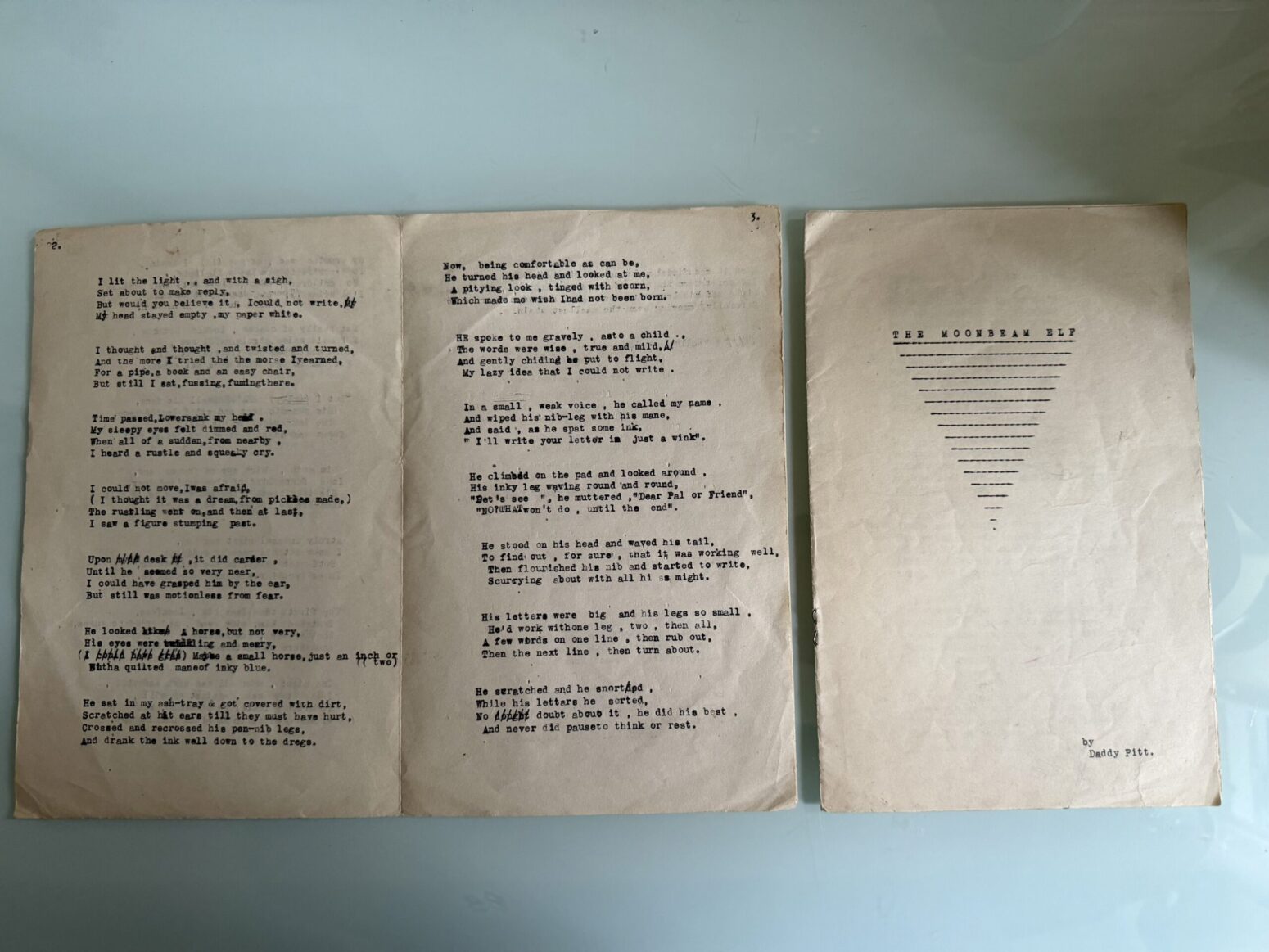
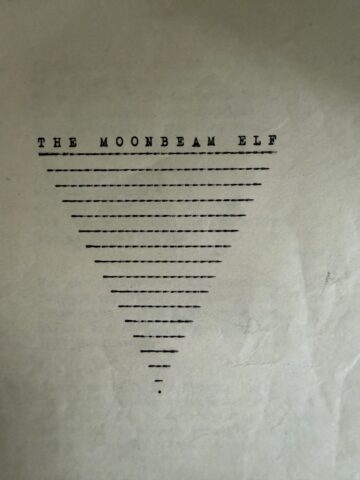
In a recent conversation with my mother, we discussed my passion for poetry in spite of how other members of our family are not overtly literary. My mother is a voracious reader with a command of the English language, but she doesn’t write. She shared that her father, who was an accountant, wrote poems in his spare time. This was a surprise! I want to honor him and the duality between the left and right hemispheres of the brain! And so, here are snippets of his work from the 1940s, targeted toward a children’s book in verse he was creating, titled, The Moonbeam Elf. It was interesting to make this discovery about my grandfather, because writing has never been my full-time job. I’ve engaged in technology and health care jobs to feed and shelter myself. It’s neat to know, whether by nature or nurture, there is poetry in the personal history of my ancestors.
I didn’t know my grandfather very well. I remember he wore velvet bow ties, read large-print mystery novels, had multiple subscriptions to Time magazine, and slurped his soup. When I was six, he and my grandmother were involved in a serious car accident that for him resulted in a traumatic brain injury and, unfortunately, ended my grandmother‘s life. My grandfather never fully recovered from this accident, and lost a significant portion of his memory, including the details of the accident itself. He was often confused as to why his wife was not present at our family get-togethers.
Looking at his poetry gave me an insight into his mind in a way that I had never experienced. Until then I had looked at him through the eyes of a child; I had been frightened of a man who often couldn’t figure out who I was. The discovery that he wrote poems was a way of rounding out my idea of him as a person. His poems also allowed me a glimpse into his relationship with his own children: the playful father I never saw, a man who was trying to please his family with his own chosen words, his own imagination. The discovery of his writing connected me to another part of my mother, whom I knew as a caretaker, a breadwinner, a stoic support. My mother as a child, and as a daughter, is someone I would never have seen otherwise. I imagine her listening to her father read this book to her at bedtime. I imagine her as the inspiration for The Moonbeam Elf.
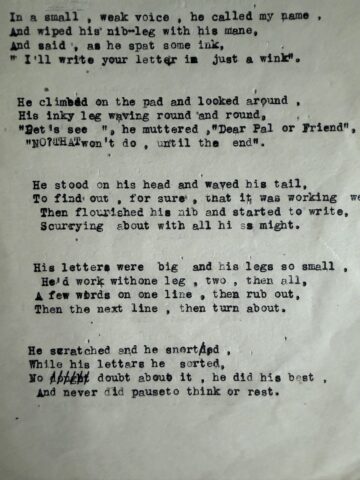
My grandfather never published this children’s book, and was never published at all, as far as I know. In speaking with my mother further, I learned that he built his house himself, lost his mother at a young age, and had a sister who’d disappeared during World War II. There is so much below the surface of any person, any story. I feel a sense of satisfaction in showing his work to a readership forty years after his death, and perhaps realizing a dream that he may have had of being a published writer, or of being read outside his own family. For me, this crystallizes a discovery—obvious to some, perhaps—of the reason we write: to connect. To connect either to a part of yourself that you don’t know yet, or that you do know but want to explore. To connect with members of your inner circle, or the world at large. To add your voice to the beautiful blend of human sound.
Long Description of Third Photo
Typewritten poem on old typewriter paper:
In a small, weak voice, he called my name,
And wiped his nib-leg with his mane,
And said, as he spat some ink,
“I’ll write your letter in just a wink.”
He climbed on the pad and looked around,
His inky leg waving round and round,
“Let’s see,” he muttered, “Dear Pal or Friend,”
“No? That won’t do, until the end.”
He stood on his head and waved his tail,
To find out, for sure, that it was working well,
Then flourished his nib and started to write,
Scurrying about with all his might.
His letters were big and his legs so small,
He’d work with one leg, two, then all,
A few words on one line, then rub out,
Then the next line, then turn about.
He scratched and he snorted,
While his letters he sorted,
No dought doubt about it, he did his best,
And never did pause to think or rest.