Emerging Writers: Gavin Garza
8 Minutes Read Time
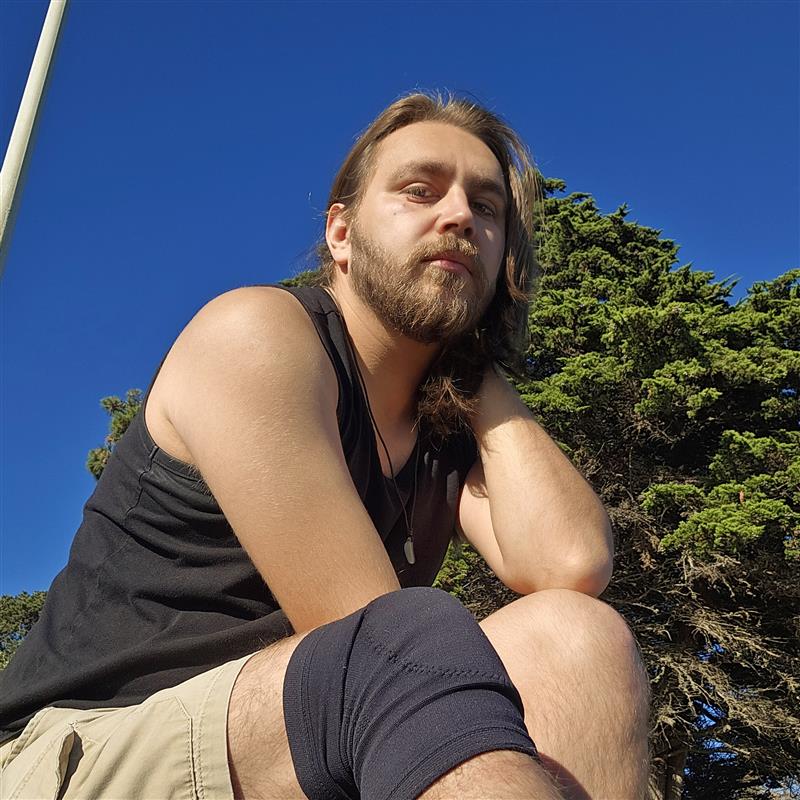
Associate Editor Andy Sia: We noticed a number of writers in our recent issue who are in relatively early stages of their publishing career, and reached out to chat with them as a part of our emerging writers series. In a sense, writers are always “emerging,” given the constant self-discovery and self-transformation that happen throughout any craft process. For the purposes of this interview series, we focused on the scope of professional affiliations—institutional support to date, range of publications—though we recognize that ultimately, emergence is an ineffable state that exceeds easy definitions. More broadly, our curiosity about emergence extends to the work itself: How does a poem or story take shape from amorphous origins and, indeed, emerge? Here’s my interview with Gavin Garza, whose poems “Fresno: Ars Poetica” and “Meeting David Berman at the Welfare Office” appear in the issue.
Take us back to the start, before you’d begun drafting. What set the stage for “Fresno: Ars Poetica” and “Meeting David Berman at the Welfare Office”?
It was during my second semester as a transfer to UC Berkeley where I began to question if poetry was what I wanted to dedicate myself to. Every poem I’d written up to this point was some inexplicable betrayal of my person, like the poetry I was studying and emulating wasn’t aligned with what I wanted to tell. Maybe more importantly, how I wanted to tell it. The Modernist aesthetics, figurative language and the like weren’t capable of holding my pathos, let alone rage. Every poem read as a status symbol, a kind of posturing within a literary, bourgeois elite that I wasn’t born into. “Look how pretty my metaphor is” type shit. At the same time I had a stalker in the English Department whom the university had denied my request for a no-contact directive. She’d wait outside my seminar door and show up unannounced to places I’d frequent. I’ve had to report her or her friends at least once a semester since.
I seriously thought about dropping out, maybe going back home to the Central Valley and working a trade. The institution that othered me was the same that abandoned me. I was taking a workshop with Cecily Nicholson when all of this was happening and thought, “Well, if this is going to be my last semester, then I’m going to write what I wanna write.” I was really drawn to the vignette, plain-speech as the anchor as that’s the vernacular of the working-class; I was homesick for my own tongue. Simple language, massive undercurrents of tension. I began braiding the rhetorical meanings within my images and let that dialogue be the heart of the poem. The first piece to come out of this was “Fresno: Ars Poetica,” then “Meeting David Berman at the Welfare Office.” I wanted my final pieces to paint the most vivid portraits I could conjure of the California I was raised in, my community and our epistemologies. It’s funny. What were supposed to be my final poems ended up being my first. This is really where I found my voice. Why I was afraid of lucidity before is beyond me. I’m glad I stuck with poetry.
Tell us about the process of writing “Fresno: Ars Poetica” and “Meeting David Berman at the Welfare Office.” Did the poems change significantly since their inception? How did you land on the structure and overall trajectory of these poems?
I’d liken writing the first draft of “Fresno: Ars Poetica” to Chan Marshall writing the first drafts of Moon Pix. Y’know, alone at night and scared shitless because a bunch of ghosts are clawing at your window. The first line came to me like an epiphany and I just followed what my subconscious was trying to say. It’s the kind of poem that comes from rare, sudden necessity. Summer break was when I started playing with it more. I’ve since broken it up into line breaks and stanzas but not without scrutiny. To me, a line break has to justify itself the way a simile or image must during revision; form is the function of the poem, and I’m not gonna start disrespecting the sentence just because line breaks are the standard within the craft.
On that note, it’s why I’ve kept “Meeting David Berman at the Welfare Office” in prose. Claudia Rankine once said that a prose poem begins to take on its own shape after a while. As easy as it was to write and revise that poem, it’s really claustrophobic. The prose form only accentuates that feeling. It starts looking like a clusterfuck after a while because it feels like one despite being this seemingly mundane encounter. It’s why I’ve kept around the prose version of “Fresno: Ars Poetica.” Both versions are doing something different. One keeps to that claustrophobia while the other illuminates the emotional movement happening within the confined space. A poem can live two separate lives. I can’t wait to share the lineated version in a collection one day.
Describe the first poem you wrote. What’s the most recent poem you wrote?
My first poem was born in Michael Meyerhofer’s class back in community college. It was for a discussion post actually. It had something to do with memory, and the prompt was written in a way where he clearly wanted us to answer with a poem. I wrote about this dream I had in high school where I woke up in a random beach house and started making breakfast for whom I presume was my wife. I didn’t see her face before I woke up, but what stuck with me was how in peace I was in my body when I did wake, which is to say I was reminded that I have a body. I’ve tried rewriting that poem at least ten times now. I think that hunt of putting the dream onto the page and doing it justice was what got me into poetry. Anyone new to writing should enjoy that period for as long as they can. I made breakfast for a lover the other morning and felt that peace again while cooking. I’m feeling my rage now so I can live that peace later. Poetry has always felt like a means to normalcy if I’m being honest.
The last poem I wrote is called “The Armpit of California.” It was for a workshop I’m currently in with Cathy Park Hong. I’m surprised about how long it is since I’m normally all about concision. I can’t say much but I’m 90% sure I’ll be naming my debut collection after it, whenever that is. It kinda goes back to what I said about respecting the sentence. A poem should never solely feel like a beautiful, aesthetical object, so it’s an “ugly” poem about an “ugly” part of California. It’s also a poem in response to “prosaic” and “didactic” as euphemisms for white aesthetics within the industry — it’s very angry. I’m trusting it.
What is something you’ve been learning or practicing of late, whether that’s related to writing or not?
Leonard Cohen in his poem “Thousands” warns of poets who “hang around the sacred precincts trying to look like the real thing.” I’ve always read these “precincts” as the pedagogical standard, and it’s made me realize how self-involved the world of poetry can be. For as much as I complain about poetry being a symbol of status in our time of political and economic precarity, I do believe in its power. It’s just that I didn’t build a methodology that I can be confident in by just reading poetry. Rather, it’s been my consumption of multimedia over the years. Lately I’ve been revisiting video essayists like F.D Signifier and Lindsay Ellis, how they analyze music in relation to American culture and its political moment. For as much as we uphold the poetic lyric we don’t study enough musical lyrics; David Berman, Chan Marshall, Kristin Hayter, Haley Heynderickx, and Robin Pecknold haven’t gotten their flowers the way they deserve. Kendrick Lamar only just got his. I plan on teaching the new Slayyyter album at NYU as part of my MFA.
I’m also finishing up my thesis on professional wrestling as working-class theater and learning how to play Pokémon TCG with my sister. So, I guess I’ve been practicing how to be a poet in “non-poetic” spaces. It seems silly, but questioning how the body tells a story or how you can learn more about a person through holographic cardboard are ideas you can investigate and fold back into other disciplines. Poetry is multidisciplinary, it must be. You just have to allow yourself to be curious and to trust in those impulses to guide you.