

The World Is Going to Sh*t, but We Can Still Be Grateful for Tomatoes
3 Minutes Read Time
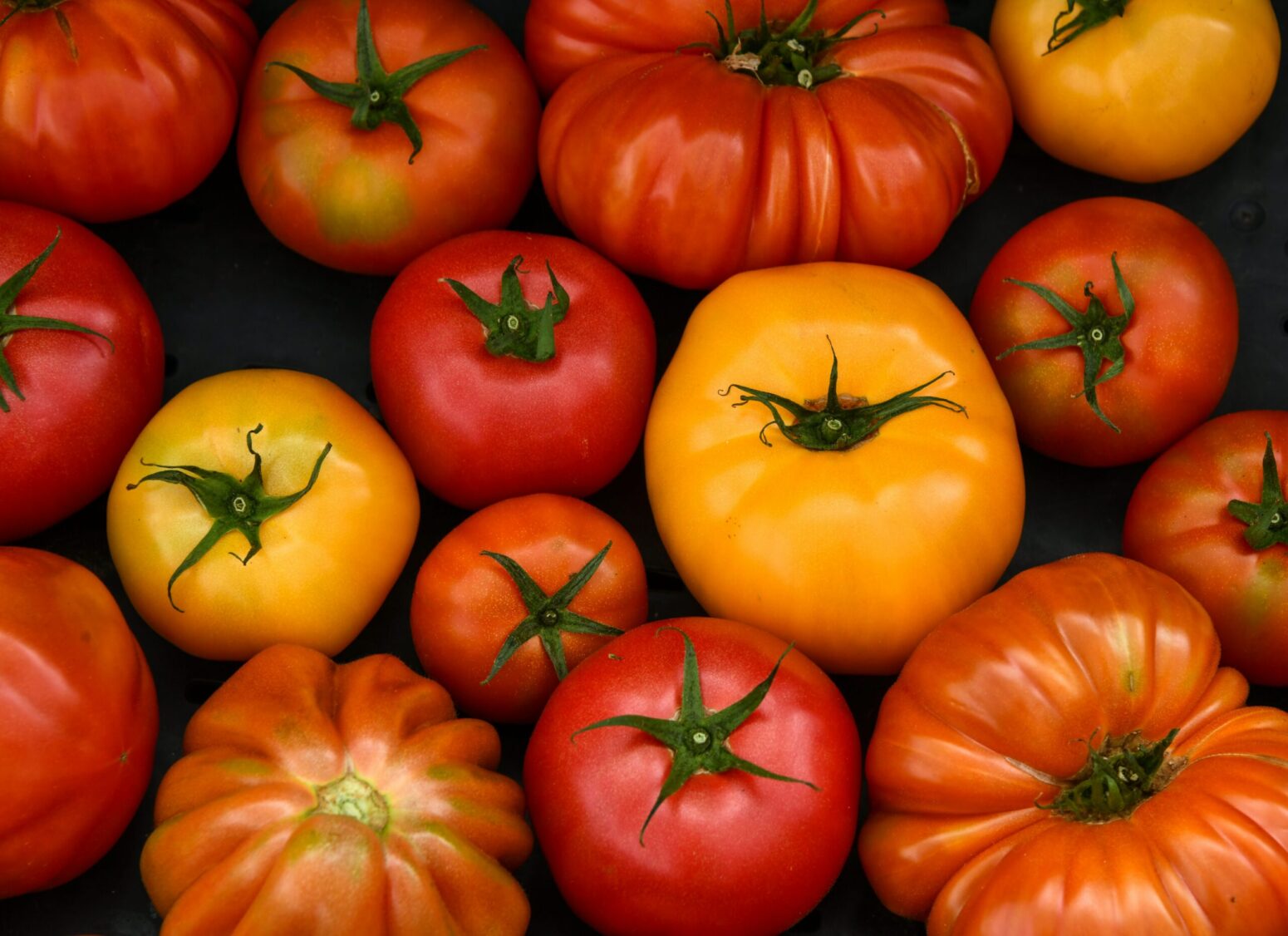
Web and Media Editor Bess Winter: Is there anything better on a summer’s day than a sliced tomato, preferably salted and peppered? D. Dina Friedman’s piece extols the beauty and diversity of the tomato, one of the garden’s most complex crops. We don’t think too much about blending a bushel of tomatoes, each specimen completely unique, into a delicious sauce, but the act is an apt metaphor for the American melting pot.
Listen to D. Dina Friedman read her piece below:
The World Is Going to Sh*t, but We Can Still Be Grateful for Tomatoes
He lived a full life, of sorrow and suffering as well as joy and love. He was acquainted with alienation and oppression, with persecution and exile; he also knew the glories of tomatoes.
—Huck Gutman writing about Pablo Neruda
The tomato, red-faced, flushes like a child angry for the first time. But other than red, color of love and hearts, anger has nothing to do with tomatoes. Anger pinks the cheeks, while the tomato defaults to hues of orange. Except for Purple Cherokees, Green Zebras, and other alien species the human world is now going after, scraping our country’s innards, the way we might scoop out the flesh of a tomato and stuff it
with something bland and white. If I were a tomato, holding all that in might burst the thin membrane that rests outside the flesh, cellophane-like but without the plastic glow. The flesh itself so hard when a tomato’s harvested before it’s ready. And so slimy when gone rotten. I’m wondering whatever happened to compassion
for that box of seconds picked up at the farmers market to make into sauce—a unique compilation of flavors that can never quite be reproduced. Because in a hundred varieties of tomatoes there are 230,000 differences in DNA—a DEI jackpot. And a tomato, while biologically a fruit so perfect it can fertilize itself, knows its true identity is vegetable. And you know what? No one gives a shit. Like Neruda, we extol the glories of tomatoes, even if our odes may never be as good. Let’s bring our neighbors, the ones afraid to leave their houses, some tomatoes: a bag, a bushel, a pizza, a jar of salsa, a pot of sauce. Because we must hold on—to sharing our love of the tomato for exactly what it is. And to our vision of all a tomato can become.