Specs
Special web feature
23 Minutes Read Time
Literary Nonfiction Editor Kristen Iversen: In “Specs,” Ismael Rodriguez gives us a powerful and compassionate essay about family, inheritance, and the fragile, imperfect bond between father and son. He examines the weaknesses and shortcomings of family—especially fathers—and how they shape the narrator, as these things shape us all. Rich with vivid details of character and place, the story brings the narrator, his father, and his family fully to life. The tenderness of those details makes the piece deeply moving and profoundly human, revealing the redemptive power of reflection and connection.
Writer’s note:
I started writing this essay in a creative nonfiction workshop at school in the fall, completely absorbed by Annie Ernaux’s A Girl’s Story (which I quote in my epigraph) and the way she explored the intricacies of memory, obsessively deconstructing it like a clockmaker splaying all the pieces on a table to see exactly how they fit together. This, as all truly great literature tends to do, led to my own humble attempt to deconstruct certain memories of my father and, in doing so, to better understand a few things about myself. What you are reading is the result of that process, and I am deeply grateful to The Cincinnati Review staff for wanting to share it.
Specs
“And what desire that exceeds the desire to understand fuels the relentless determination to find, among thousands of nouns, verbs, and adjectives, those that will provide the certainty (the illusion) of having attained the greatest possible measure of reality?”
—Annie Ernaux, A Girl’s Story
This man is short and bald and bursting at the seams. His round face is sometimes clean-shaven and sometimes prickly, and to be honest, I’ve never seen him without the chevron mustache that hugs and curls under his upper lip, a gray-black bush that resembles roadkill these days. If you happen to drive on any given Friday at noon along the loop on West Twentieth Avenue that borders the Palmetto Expressway in Hialeah, or perhaps look out the window of a store tucked in the Gratigny Shopping Center, you might catch him pushing a grocery cart from Sedano’s along the narrow sidewalk toward the side entrance of Los Arboles Condominium, where he’s lived for the past twenty-four years. His clothes, almost always ill-fitting, as they are never his own, might have dark streaks of sweat on his back and underneath his belly and sometimes down the crack of his ass.
It’s a long walk from the Sedano’s supermarket, approximately two and a half miles. He has a car, two of them, old but functional, though he refuses to waste gas money (waste is part of his lexicon, a word that’s cannibalized spend). If you shout out his name, he might wave and offer a distracted smile, might give you an “Oye, qué bola,” but for the most part he’ll be scowling, consumed by his thoughts, those fleeting things he tries so hard to grapple with. He has places to be, things to do. If you stick around, you might even catch him in the alley behind Los Arboles, digging like a raccoon through surplus donation bins the Goodwill store keeps back there. His apartment is full of other people’s broken knickknacks and junk, most of it having replaced trophies, plaques, and ribbons, the toys and clothes and shoes left behind in the now-spare bedroom my younger sister and I once called ours. This man is my father.
In an album my mother keeps at my sister’s house in Kendall, where she now lives and shares a room with my young niece and nephew, there’s a sepia-toned photo of the day my father and I met. Taken in 1994, the photo captures my father stooped and thinner than I’ve ever seen him, with a stubborn head of hair parted at the side in a comb-over. I am two years old and sitting on his shoulders, dressed in a pinstripe baseball onesie and cap, wrapped around his neck with my hands slightly blurred as I drum on his head. He looks malnourished and uncomfortable, stiff like a palitroque or pretzel stick,with my weight on him, all twenty-eight pounds of me. His coarse chest hair fills up the wifebeater more than the meat on his bones, and his eyes, an enviable green that neither my sister nor I inherited, seem wild, agitated, like those of a lemur.
The photo was taken in my maternal grandparents’ living room in Santos Suárez, Havana. I can tell by the cracked terra-cotta floor and the old wooden box of a DuMont TV set from 1958, from before the Revolución. My mother and I lived here for those first two years. We had our own dilapidated house up the road, but my mother dreaded being there all alone while my father served out his sentence in a Guanabacoa prison for “tráfico de personas.” He’d been caught trying to flee on a makeshift raft he and a friend had built and hid in a mangrove forest along the coast of Marianao. Like his younger brother—who’d fled a few years before and wound up in New York, where he married a Puerto Rican divorcée, had a kid, and carved out a decent living as a truck driver—my father wanted to join the rest of his family in La Yuma. Most of them had arrived in Miami during the 1980 Mariel boatlift, my grandparents and great-uncles and -aunts, many of them building small fortunes from real estate ventures and car dealerships. I suspect my father carried a profound sense of abandonment as a result, and despite my mother’s family seeing through his contrived behavior, this greedy need for approval is palpable in my earliest memories of him.
Each evening, around seven, this man sits in a recliner squeezed between the mirrored closet doors and the unkempt king-size bed my mother tidies up once a week after he picks her up at my sister’s place to come do the household chores. “She’s not a Roomba,” my sister likes to remind him, but she knows the inveterate power he possesses, cultivated over a fifty-year stretch that’s left her, our mother, without a personality. Before him, a tray with a heap of congri and papas fritas in a bowl, flanked at the sides by Tupperware with leftovers of overcooked steak or pork chops drenched in lard, two of his favorites. Noticiero Univision and FOX en Español drone above him on a flat-screen mounted on the wall beside a framed portrait of La Virgen de la Caridad del Cobre, or as most of us Cubans refer to her, Cachita. Foreign wars and catastrophes, murders, tariffs, and the rising price of goods mingle with guttural sounds as he mauls his food with the fervor of someone who’s known starvation, his body hunched over the tray, elbows out, protecting it.
He comes up for air now and then, wets his lips, the grease of the chops making them gloss in the light of a fan above the bed. After he’s done he walks the tray to the kitchen, which is decked in new granite counters and lacquered cabinets he installed a couple of years ago, thinking they would increase his property value. He disposes of bones and gristle, sets the rest in the dishwasher, and returns to the recliner. He removes his shoes and tube socks and kicks his legs up. It’s just him these days, the pungent odor of his athlete’s foot no longer a concern. He wiggles his toes, picks his nose, and reaches for his iPhone to spend the next two hours watching TikTok videos. His attention span, diminished over time by the benzodiazepines prescribed for his anxious rage, keeps him from focusing on anything but the world at large, never on the minutiae of his personal life, where all of us who know him orbit on mute.
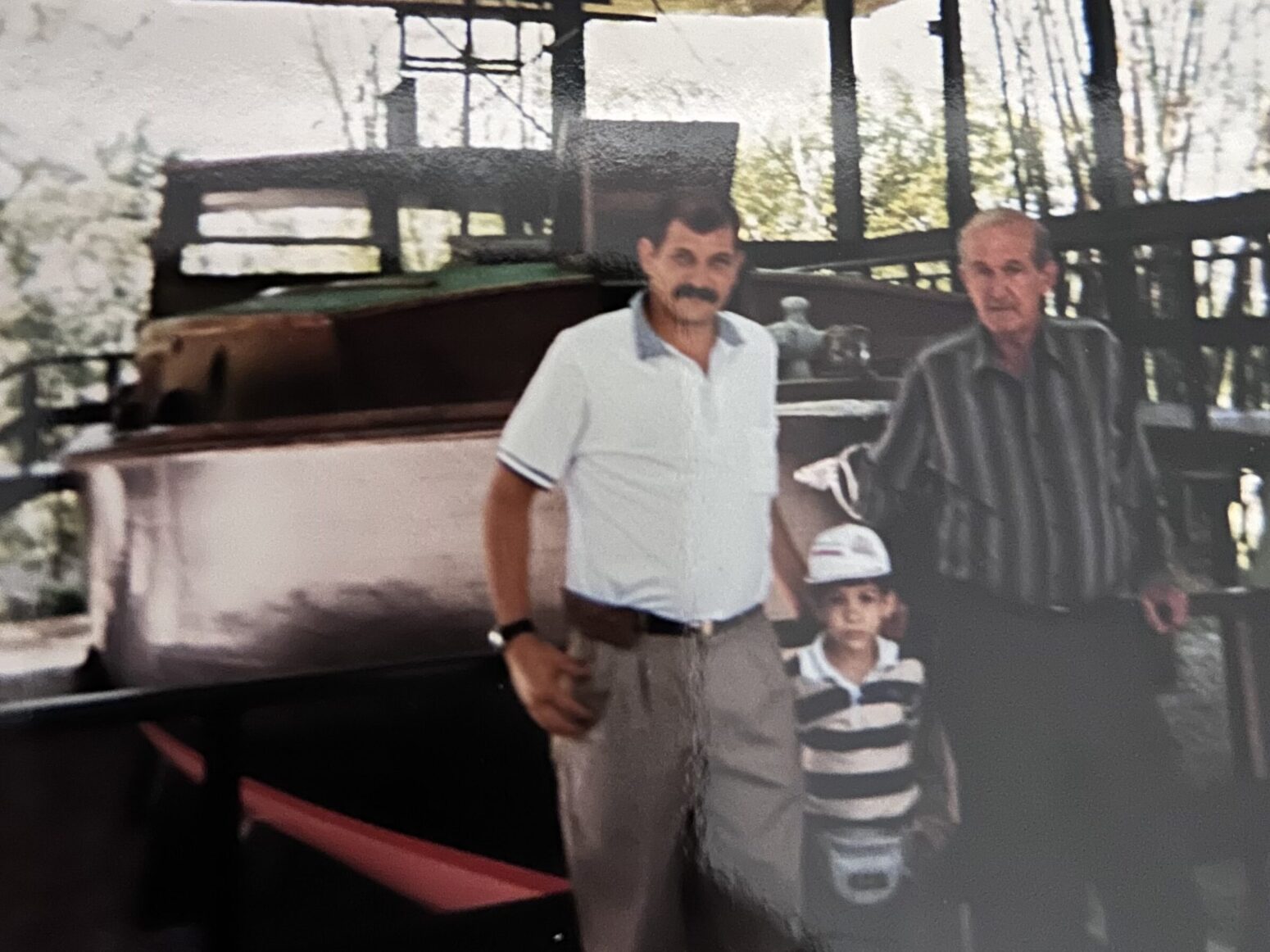
Another sepia-toned photo. This one was taken in 1998, less than a year before our family boarded a plane for Miami International Airport. In it, I am six years old and standing at waist level between my father and his father, whose name I inherited, our backs to the bleached Caribbean sunlight reflected off the smooth mahogany body of Ernest Hemingway’s Pilar boat. The thirty-eight-foot Wheeler sits on keel blocks inside a carport-style enclosure, under a roof made of sheet metal supported by heavy wooden beams and metal panels. My father and I are dressed in new clothes his parents have brought from La Yuma on their visit: he in a white polo tucked into his khaki slacks, the leather case of his sunglasses latched to his black belt, and I in a white baseball cap and striped Lacoste polo, jeans already scuffed at the knees, and a fanny pack. He is thirty-three, as old as I am now, and metamorphosing into the man on my left, his belly on its way to a paunch, his hair thinning, strands of brittle black barely covering the scalp.
The two Ismaels, if I may, appear in sync, both of their left hands on the wooden rails, their bodies leaning on them, faces unsmiling, aloof. My father stands inches ahead of us, his face undecided on a smile, his right hand hovering over the pocket of his khakis, fingers tensely spread and pressed into the fabric. Moments before my father’s half sister, a tour guide at Hemingway’s Finca Vigía on the outskirts of Havana, took the photo, my grandfather had berated him about my behavior, particularly my wanting to touch and play with everything. While my aunt held my hand and guided us toward Pilar along a path scattered with low-hanging trees, the two men hung back and argued. I could hear my father’s whining rise to a crescendo, followed by a clap that sent birds off the trees, their squawks leaving a trail of unspoken tension.
This man calls around 5:15 p.m. his time, which is different from mine in Kansas City. I am on the second floor of The Foundation in Westport, between supersets of bench press and pull-ups, my arms swelling, my breath spiked. I let the phone vibrate to death, then it stops and records a voicemail. I do another superset and see the notification. I lean my elbow against the arm of a treadmill and brace myself for his voice, for what sort of barrage this will be, emotional warfare or an incoherent, anxious rant, differentiated from one another by the pitch and resonance of my father’s voice. His heavy breathing greets me, like howling wind being wrestled into a tornado, those unpredictable natural disasters I am just now starting to grasp, having lived in the tropics for most of my life.
“Oye, singao, contéstame ahora, repinga,” he blurts out, agitated, his anger knocking at his throat. “I am here con tu Abuela, remember her? She’s the one who brought your ungrateful ass here so you can go live en casa de la pinga.” This harangue goes on for six minutes, reminding me she is old and slowly dying in a nursing home all by herself, that I am the same way with my mother, that I don’t care what happens to any of them, that all I care about is myself.
A fulgurating guilt bursts in my stomach. I delete the voicemail, slip the phone in my pocket to resume my workout, and try to douse the vitriol in music. But I feel nauseated, heady. In these moments, I am convinced my father is the man responsible for driving my mother into a mental breakdown she has never recovered from, my sister into antidepressants, into the arms of every narcissistic asshole that believes what they own is who they are.
And where does that put me? I am a cat, always running away on instinct. Since graduating high school in 2010 I have tried to put as much physical distance between us as possible, sometimes at the expense of others. I can recall a late August afternoon in 2011 before I left Miami the first time, for a junior college in Oregon and an opportunity to play for its basketball team. My father, displeased, stormed out of the apartment, slamming the wrought-iron screen door behind him. About an hour later I went downstairs to the Palmetto Auto Tire Service, a stone’s throw from our apartment balcony, and found him sitting with the owner in a claustrophobic office tucked behind the service bays. I knocked, and the owner, whose name I never could remember, smiled and waved me in, then nodded toward my father, who was unwilling to look up from a magazine he couldn’t read because he doesn’t understand English.
“I heard you’re leaving,” the owner said, a smile stretching the contours of his face. “Couldn’t wait to get far away from your father, eh?” I laughed because it was meant as a joke. These men at the shop sometimes joked at each other’s expense. My father didn’t laugh, though. There was something there for him to unpack, something I myself have come to realize now that I’m older: Most of my life has been an adverse response to his own.
When I was in the third grade, my father quit smoking cigarettes cold turkey. He’d been a smoker for more than two decades, since his early teens in Havana. This happened in October. We’d been in the States about a year, the four of us crammed into a bedroom in my grandparents’ shotgun house in East Hialeah while we saved up for our own place. My mother worked at a factory making school uniforms and American flags, and my father had taken out a loan from one of his uncles and bought his brother’s old Peterbilt to haul asphalt three days a week for a company in Pompano Beach. They had found a convenient day-care service that stayed open late and transported kids to the local elementary and back, so they would drop us off in the mornings and pick us up in the evenings. We were usually the last ones to leave.
On his days off, my father borrowed my grandmother’s Camry and picked me up after school instead, sometimes taking me around Miami to visit old friends from Cuba before picking up my sister at day care. The day he quit smoking, I spotted him across the street from school, just beyond the row of yellow buses filling with the first wave of children spilling out of the front gate. He leaned against the car in the shade of some palm fronds drooping over the fenced yards behind him, talking into his black-and-yellow Motorola, cigarette in hand. I crept between two buses, looked both ways, and dashed across the road to hug him, to comfort myself in the familiar mixture of cheap cologne and stale cigarette smoke, in the coarseness of his mustache scraping at my cheek as he kissed it (we never kissed in front of his father, who believed it was not something men did, except in his final years, when all he wanted were kisses from his grandchildren).
In the car, my father lowered the windows and continued to smoke, his thumbs drumming on the steering wheel to some bolero playing on the radio. It was a Thursday, a fact I remember because on those days the D.A.R.E. program brought police officers to lecture us on drugs, and because on that day, for the first time, I acknowledged cigarettes as being something harmful.
“Pa,” I said, the photos of tarred lungs and cancer still fresh in my mind. “You’re not only killing yourself when you smoke, but you’re killing us.”
My father glanced at me and asked where I’d heard that. I dug into my backpack and showed him the pamphlet, tried to translate it for him in Spanish. He must have understood. He flicked his cigarette out of the window and kept driving in silence, then moments later hurled the carton out.
This man shows up unannounced the day before I have to return to Kansas City. He sits beside me on a plastic patio chair under the carport of my sister’s place in Kendall, the two of us bathed in LED light and the smell of meat as my brother-in-law flips sausages and burgers on a small electric grill a few feet in front of us. I sip bourbon and take short, deliberate puffs off the Cohiba my brother-in-law gifted me for my thirtieth birthday, the reason I’m here. My father winces each time I blow the smoke toward him, its gray veins curling away into the night sky. He doesn’t smoke or drink, so he bludgeons us with lessons on both. My brother-in-law ignores him.
The two of us had been out on a boat with a few friends when my father called earlier in the day. I told him to come to my sister’s house if he wanted to see me before I left, but he demanded I come to him in Hialeah, that he didn’t want anything to do with my sister and mother y el sapingo, as he refers to my brother-in-law.
“Why?” I asked him, and he fired back, “Ask your sister, esa malparida.”
I didn’t have to ask. It’s always about him feeling disrespected, treated as less than what he assumes he is: a patriarchal figure.
Now he talks about bourbon he’s never had and asks my brother-in-law, with whom he almost came to blows just days before, a litany of questions about his new Tesla, slithering toward a request, a favor. He won’t ask how I’m doing, how my wife is doing, or why she doesn’t bother coming down to visit anymore. I stopped forcing him into these intimate conversations to avoid disappointment. The last time I tried was a couple of years ago, over a FaceTime call that began with him bashing my sister for not paying him to babysit his grandchildren while she, in turn, took our mother to a specialist about a lump on her left breast.
“They’re your grandchildren,” I said in a casual tone to avoid confrontation, and he, chin folded over a row of fat on the screen, sighed the sigh of the aggrieved. “Pa,” I said, “Don’t you realize what you’re doing? Don’t you care about us?”
He furrowed his brow and pinched his bottom lip with his thumb and index finger, his breath slowing, relaxing. His TV was on in the background. I imagined Cachita listening on his wall, waiting for a response. And for a moment, the man who’d cut cigarettes to keep us from the dangers of secondhand smoke glimmered in the tear that shot down his left eye. He started to heave and grunt and scrape at his tears with meaty hands, the tiny brown age spots on their backs kicking at my stomach, bringing the reality of our relationship to sharp focus.
“I used to jump on you with nothing but love,” I said, starting to cry myself. Behind me, on the sofa, my wife turned away from an episode of Love Island and asked if I was okay. It felt good to cry, to breathe as if a lead foot had been lifted off my chest.
And then it was over, just like that. My father cleared his throat, and disillusionment seeped in like a bitter aftertaste. I hovered over my phone, which I clung to in a death grip, hoping his words would carry some antidote.
“Papi,” he said, “This is who I am. I’m too old to change.” Then he dragged me further into disappointment, pretended someone in his empty home was calling out to him, and said he would call me back in a few but never did, not for two months, and then to ask for a favor.
From the rooftop on the fifth floor of Los Arboles, at night, the Palmetto Expressway resembles a slithering asphalt snake swallowing headlights like shooting stars. I discovered this view when I was thirteen and hiding from my father, whom I’d pictured walking around with his thick leather belt clenched so tight in his left hand it blistered, my name foaming in his mouth. I’d run from our apartment on the second floor and up the stairs, all the way to the top, where I came to a dead end at a communal trash chute, unable to go anywhere else but back. Apartment doors lined one side of the hallway, and a five-foot wall ran along the other. The opening between the top of the wall and the ceiling was too narrow for him to fit, so I climbed the wall, slipped onto the tarred rooftop, and sat behind an HVAC unit facing the highway.
I deserved the beating I was putting off. I’d stolen two hundred dollars from a secret stash in a manila envelope my father kept buried in a sock drawer and bought Air Jordans for the upcoming basketball season. When my mother asked where the money had come from, I told them I’d found it downstairs, in the shaggy community gardens between the buildings. This happened at the dinner table as the four of us ate my mother’s cooking and watched Noticias Telemundo on the living room TV.My father must have known, because he wouldn’t look at me. While my mother and sister gushed about my shoes, he ran his fingers through the stubble on his face and forked his ropa vieja and rice, a grunt here and there as he inhaled his food, stopping only to wet his mouth with a sip of cold Heineken.
From the rooftop I thought about those Jordans and cried at the image of them lying carved up on my bed. My father had gone into my bedroom and taken scissors to the fabric, his panting excessive as he struggled to cut into the patent leather, making me laugh out of fear, which only infuriated him further. My mother consoled my crying sister and shouted at him to stop. The panic in her voice never could penetrate his rage.
After he finished with the shoes, he tore up the two pairs of basketball shorts I’d bought with the leftover money. He kept saying this was a lesson I had to learn before it was too late. I jumped off the bed and tried to leave, but he blocked the door, my mother and sister getting caught between the TV stand and his shoulder. That’s when I slapped him. I didn’t mean to do it. My father tugged at my elbow in such a way that it recoiled, and my palm slammed into his face.
Time seemed to stop for a moment. Only the blue light of the muted TV danced around the dark room I shared with my sister. My mother’s eyes had shot open with fear. My father held his hand over the part I’d hit, his jaw clenched so tight I could see its sharp outline through all the fat. My body was like a soda can dropped too many times, the suds ready to burst with energy. At his first muscle twitch, I swung again, this time cracking my knuckles on his nose. He barked and shoved me against my bed, the bottom side rail taking a piece of my ankle, and started removing his belt. My mother and sister remained in place, frozen. As my father charged with his belt, I juked him, elbowing him in the ribs, and bolted for the front door. I flew up the stairs to the fifth floor and stopped at the end of the hallway, my basketball conditioning not enough to keep me from folding like a lawn chair over my knees.
Sometimes my wife and I stroll along the Missouri River at Berkley Riverfront Park in Kansas City. These days she wears ankle weights and pushes a stroller with our one-year-old daughter, whose birthday is the day before my mother’s. It is unseasonably warm for mid-October. We walk past the new women’s soccer stadium toward the ASB Railroad Bridge, which appears to be on fire in the blood-orange light streaked across the sky.
Our daughter swings her toy around and passionately converses with herself in a language I wish I could understand. I smile at my wife who feigns hers.
“What,” I ask, and she sucks in her lips, which means she has something to say that I might not like to hear. I love her because she will say it anyway, always does.
“They haven’t even tried to come see their granddaughter,” she says in a low and concerned voice. “Doesn’t that bother you?” My wife comes from a large German-Swedish family, her parents having welcomed their eighth grandchild with the arrival of our daughter. Since my wife introduced me to them months into our dating, we’ve spent every major holiday on their farm in Haven, a small town near Wichita, Kansas. You can feel the warmth of her mother’s oven when you walk into their home, can feel the comfort in the worn furniture, in her father’s hand on your shoulder, his boisterous voice saying, “How’s it going, kiddo? How’s life been?”
I shrug at my wife and give her the answer given to me, the one I’ve accepted: This is who they are. And to add levity, I say, “I turned out all right, didn’t I?”
My wife’s scowl eases, her blue eyes soften, and she looks at me the way I’ve seen her look at stray dogs we pass on Independence Avenue on our way home. “You turned out all right despite them, not because of them,” she says, with something like authority.
I smile and concede, but a part of me disagrees, a part that wants to explain that my father, for all his flaws, kept me from turning out like some of my closest friends growing up, those guys who to this day sleep on my chest, the ones whose faces remain like phosphenes when I close my eyes. They were the ones who had no fathers, who wound up shot fifteen times or killed someone in a desperate attempt to flee a misunderstanding, who got hooked on selling or doing drugs, who robbed out of desperation, who sat up in their childhood bed after a night of drinking and put a bullet through their dome because they thought it would never get better than this and does it? Does it get better than this?
I walk with my head down, oblivious to the sunset, which has slipped away to lavender, its orange streaks now plumes of smoke, extinguished. The lights on the sand volleyball courts flicker on, and our daughter reaches for them as if they could surrender to her grasp.
Read more from Issue 23.1.