Pigeon Language
16 Minutes Read Time
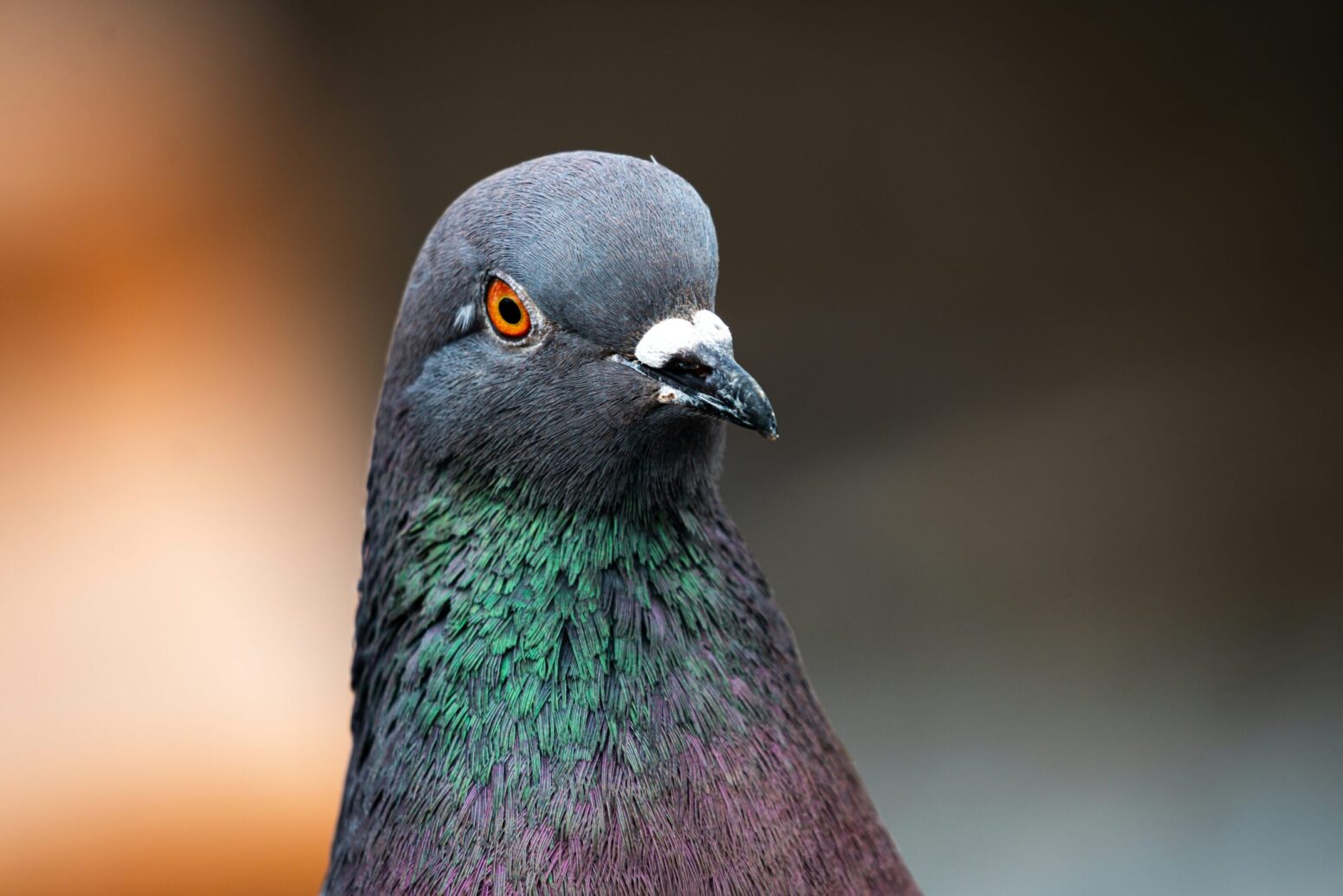
Today, Cheryl is five: The number is startling, a near impossibility. Last night, roosting in her nest of unraveled mittens, in the stone alcove under the metro’s vaulted ceiling, Cheryl had considered her age with pride. Five! Most urban-dwelling pigeons didn’t live past the tender age of two. Both her parents had died when she was a fledgling, her father’s neck snapped by a speeding car and her mother poisoned by a cube of cheddar meant for a colony of stray cats. Five is a miracle, a mark of resilience among the birds.
But this morning, with the roar of the first train reverberating in Tunnel’s belly, and a damp Outside wind rushing down to the platform, Cheryl is morose. Her body aches. A cramp seizes her left foot, which has been weak since she lost a toe to frostbite. For the first time, she notices white feathers on her belly.
High above, beyond the humming escalators and in view of the clanking turnstiles, Faye is singing. Her voice is bright and warbly as a robin’s. Faye can sing for hours without a break. No guitar, not even a drum or ukulele. Just her voice like a spring breeze in the dank underground. She begins at dawn and sings until midday, or so Cheryl guesses. Here, hours are measured by the ebb and flow of crowds, by the mechanical noises of metal hitting metal.
Cheryl shuts her eyes and tries to memorize Faye’s voice, which has be-come as familiar as her own coo. Soon, she knows, her friend will be gone.
“I bought my bus ticket,” Faye revealed the day before, beaming. “One-way trip, Montreal to Vancouver.” It was Sunday and they were sharing a bag of salted peanuts on the deserted platform. She patted the zippered pouch that was always belted to her waist, hidden beneath a billowy sweatshirt. “I leave tomorrow, and in three days, I’ll be with my sister. Fucking finally.”
Tomorrow. The word curdled in Cheryl’s stomach. Betrayal was something she had never felt, and it was worse than the frostbite that took her left toe. Worse than the loss of Sun and Sky.
All winter, Faye had talked about leaving—“in the spring,” she’d said vaguely, gesturing to the world above. She talked about her sister, Kami, a tattoo artist and bartender who lived in the West End with her blue-haired girlfriend. Kami was nineteen, just old enough to be Faye’s legal guardian, and while they hadn’t spoken in months, Faye believed her sister would take her in. She had her address memorized. “I’ll surprise her,” said Faye. “It’ll be great!” But Cheryl, who was prone to inertia, had never believed that her friend would leave. How could she? A pigeon’s roost is her home. In her brief year Outside, Cheryl had built many nests: in the crooked O of a neon sign, in the leaky roof of a kickboxing gym. But eventually a truck would trundle down the street, filled with rattling cages and bird-catching nets, and Cheryl would be evicted. Animal control, wildlife removal. These were phrases she’d come to recognize and fear. She’d never been caught, but there had been close calls. Wings bruised, tail feathers lost. And after the men left with the bagged remains of her roost, she’d be untethered in the world, homeless again.
“You look like a Cheryl.” These were among the first words Faye said to her. She appeared in the metro after the first big snowfall, when the stairs were slick with boot slush. A short, mangy child wearing layers of men’s clothes. Whistling, she unrolled her sleeping bag, frayed at the corners, beneath Cheryl’s nest. Cheryl peered down and saw the girl’s hair, strands dark and knotted as tree bark. When she smelled the salt-and-vinegar fries, she fluttered down and approached with her most compelling strut. Faye cocked her head and laughed. Her eyes were the color of dirt in summer. She tossed over a fry. “Hey, pretty lady. I’m Faye. You look like a Cheryl.”
From then on, Faye spent most days at the metro turnstiles, singing for change. In the afternoons she’d enter the ground-floor Tabagie and swap her quarters for fives, which she’d then roll up and store in her secret zipper pouch. Soon, it was deep winter. Weeks passed and the weather changed. Frigid gusts of wind descended from the pivoting door, carrying the scents of frost and hunger.
In the afternoons, Faye ventured Outside to buy paper-bag food and use the toilets across the street. She made sure that Cheryl was fed, and in return, Cheryl listened. Faye liked to tell jokes: “Where did the king keep his armies? In his sleevies! Why shouldn’t you pick a fight with a dinosaur? You’ll get jurass kicked!” Cheryl didn’t understand most of them, but she bobbed her head and cooed encouragingly. Faye told her she wanted to do stand-up comedy. “I’m funny,” she assured her. “My English teacher always said so.” But she also had moments of seriousness. She worried about getting tetanus, rickets, and scurvy. “Clementines,” she’d lament. “Why doesn’t anyone give me clementines?” She worried about Julien, the belligerent metro cop, who often patrolled Tunnel for feral humans like her. At night she slept at the women’s shelter two blocks north. But she was always back by dawn, as predictable as the clang-clang of night maintenance on the tracks.
Sometimes, she talked about her mother, who had died when Faye was six. “I remember her smell,” Faye once said. “And the way she braided my hair.” Cheryl’s memories of her own mother are like that, warm but dim: the softness of her belly feathers, the tap-tap of her beak. After the poisoning, in a last-ditch effort to recover, her mother had curled into the warm air vent of a Chinese restaurant, in the mulchy remains of a squirrel’s nest. She died promptly at sunrise. Or so Cheryl heard from the neighborhood crows.
While Faye sings, Cheryl does her exercises. First, a gentle warm-up in Tunnel, above the platform, then a more difficult flight path upward, wings punching stagnant air, propelling her above the escalators, wingtips sometimes brushing a person’s tuque or exposed crown of hair, their yelp echoing behind as she flies up and up, to the door leading to the cold and unforgiving Outside. There, she barrel-rolls into a landing. For a moment Cheryl rests, perched on the lip of a trash bin, and peers through the dirty glass. She glimpses a line of sidewalk, skinny trees, and blurred cars.
Cheryl knows from watching Faye that the door pivots around its axis. To open it, strength and momentum are required: body sideways, shoulder jutting out. The door remains open for three to four seconds, plenty of time for Cheryl to leap and soar into the world. But instead, she only listens to the streets’ grim cacophony, her feeling of distaste threaded with longing. The spaces between buildings reveal patches of Sky.
On the flight down, Cheryl coasts. Always, this descent feels to her like a rising, as if the world has been flipped over. The air grows warm and pillowy, like thermals, and for a moment she remembers how they once felt beneath her feathers. Pale sunlight gives way to bright electric beams, cement to brick the color of a sparrow’s wing.
“Oh, Cheryl,” Faye will sometimes sigh. “I wish you could talk. We’d have the best conversations.” What Faye doesn’t know is that Cheryl has a firm grasp of English. She’s good with human languages, which are rude and raucous, not unlike Birdspeak. Outside, humans speak many languages. From the moment she emerged from the egg, Cheryl could distinguish them by their mouth-sounds and rhythms. Cheryl recognizes English by the coo-like roundness of its vowels, and the frequent wuh-wuh-wuhs that mimic beating wings. This is the language that Faye speaks, with a barely audible lisp.
Unfortunately, Faye has proven terrible at learning Birdspeak. When Cheryl sidesteps or bows or inflates her iridescent throat, Faye only stares. “Weirdo,” she’ll say. “Where’d you learn that dance?” Wuh-wuh-wuh. But they’ve developed a kind of code, a cobbling together of gestures and bird flaps. Faye has learned to make wing movements with her hands, thumbs pressed together, fingers splayed. Sometimes, when Faye is quiet or upset, or if her eyes drip saltwater, Cheryl will settle in the curve of her neck and preen her matted hair. In these moments, Cheryl knows that they understand each other perfectly.
Faye is a runaway. Runaway is a human word that Cheryl learned from Faye. She likes the sound of it, three syllables cascading like water over rocks. And while she never planned to abandon Outside, or to live in a place without Sun or Sky, Cheryl feels like a runaway too. One morning she darted through the metro door on impulse, drawn by the smell of an overripe apple, the fruit brown and soft under a plastic bench. Cheryl was small for a pigeon, and she’d lost her toe to frostbite that winter, giving her a lopsided waddle. Tunnel was warm and covered. It held the comforting smell of decomposing food. So she stayed. One day, then three. A week, then a month. She’s heard from the visiting crows that the other pigeons call her Rat. They say that without Sun or Sky she’s not a bird at all. Just the ghost of a bird.
“Julien is upstairs,” Faye worries, when she returns to the platform with a can of Orange Crush. “Giving everyone the stink eye, like he’s a real cop.” Her laugh is strained. She takes a long glug of soda and wipes her mouth with her sleeve. Cheryl flutters down from her roost to the bench, where Faye has scattered some of her lunch, a fistful of muffin crumbs. Cheryl, who has been on a hunger strike since Faye’s revelation, ignores the food in protest.
“What if he searches me?” Faye wraps an arm around her waist, covering the bump of her concealed zipper pouch. “I’ve seen him do that. Last week I saw him take a homeless guy’s boot. A single boot.” She crushes the empty can beneath her boot, crink-crink.
It’s true. Cheryl has seen Julien take many things, sometimes by stealth but other times by force. A pair of cheap sunglasses, a digital watch, a paperback book with fanned-out pages. What does he do with them? Cheryl doesn’t know. Even before she met Faye, she was wary of Julien. He’s cunning but lazy, like a bullying seagull. Short legs, hair blond with streaks of gray, and a paunch that sags over his belt. Even his gait is gull-like, the slight waddle belying his natural speed. And she can see, with the inherent wisdom bestowed on all birds, that Julien is cruel. In the daylight hours, she’s seen him chase and tackle dozens of turnstile jumpers, his body hurtling through the air with sharp, hungry purpose. At night, when the trains are spread out and people are scarce, he’s bored and restless. He yells at the buskers and kicks over their instrument cases. He drags sleeping forms from benches and digs through their pockets. Cheryl wonders if Julien was once kind. If his kindness has, over time, been eroded by boredom and misery. After all, he is also living without Sun or Sky. Faye is quick and alert and has so far avoided him. But with every successful escape, her fear seems to grow.
“He’s seen me around,” Faye says. “What if he swipes my ticket?”
Cheryl puffs her chest. She coos reassurance. But her friend’s betrayal is still fresh and bitter in her gut, mingling with her hunger, and part of her hopes that he will.
In her long life, Cheryl has heard of only two other pigeons with human names. When she was a fledgling, her father revealed that he was the direct descendant of a famous homing pigeon and war hero, dubbed Speedy Phil after the famous Olympic runner. During the Second World War, Speedy had flown an incredible distance, from France to Britain, a note tied to his ankle for his beloved General. Then there was Ruby, Cheryl’s third cousin, who’d been groomed in a backyard loft for acrobatic flight and won competitions in the deserts of Alberta and Nevada.
Cheryl, in comparison, is average. No special skills or remarkable talents. But Faye has given her a name. It belonged to a girl she’d known in rehab—a place that Cheryl imagines as a home for sick humans. “Cheryl was bitchin’,” Faye said wistfully. “Like, really brave.” Brave is another word that Cheryl is still deciphering. Something like fear wrapped in anger, wrapped in love. All winter, she has learned the joy of hearing her name spoken aloud. She has felt important and singular—feelings she hasn’t had since her mother died. And when Faye leaves Tunnel, Cheryl will lose that part of herself. She will change back into what she was before. A simple street pigeon. A dirty city bird.
“I hate goodbyes,” says Faye as she climbs the stairs from the platform. It’s late afternoon, in the quiet pocket before rush hour, and Faye is leaving Tunnel for the very last time. Cheryl is hidden beneath Faye’s hood, wings tucked beneath a curtain of hair. Her talons grip the folds of her shirt as if she can hold her in place by sheer force of will.
“I wish you’d come with me.” Faye keeps saying this like it’s a real possibility.
From her hideout, Cheryl catches sight of a scrim of blond hair. A yellow-and-black vest. It’s Julien up ahead, obscured by a knot of people waiting to buy tickets.
“I’ll tell the driver you’re my pet,” Faye insists. “They let dogs in buses, and cats. Why not birds?” She hasn’t seen him, and Cheryl considers sounding an alarm. She inflates her chest to do so, then slowly deflates.
“Or you can fly next to the bus. Don’t worry, I know you can keep up.” Faye marches past the fare booth, caught up in wild conjectures. A few yards away is the final escalator, which will carry them up to the pivoting door. But even beneath the hood, Cheryl can hear Julien rushing after them, huff-huff-huff, and the slap of his boots on orange tile. In a half second he will catch them, but Cheryl stays quiet. Her tail feathers quiver against Faye’s earlobe.
Like a true seagull, Julien attacks from above. Without a word he yanks down Faye’s hood. Cheryl flutters wildly, momentarily blinded.
“Hey!” Faye swivels. She swats at Cheryl’s wings, which are getting tangled in her hair.
“Toi,” Julien says. The French word comes out like a squawk. He sticks out his paunch and leans back, like he’s gloating. “J’te reconnais, toi et ton oiseau.” He jabs a thumb in Cheryl’s direction but seems otherwise indifferent to her. Cheryl has never been this close to him and notices, for the first time, the wrinkles that carve his face, lines deep and severe as if drawn with the tines of a fork. Around them, people are staring. “Is that a pigeon?” a boy asks.
Unlike Faye, Cheryl understands French. On its surface, the language is nasally and sharp, but its underlying form is not so different from English: subjects and actions strung together in the same order. She knows that reconnais is the same as recognize.
“T’as un permis pour chanter dans le métro?” Julien’s cadence is light and falsely amicable. Faye looks bewildered. She raises her dirty palms as if to surrender. “Hey, man. I was just leaving.” A nervous laugh dislodges from her throat as she turns away.
“Hé!” Julien’s speed is dazzling. He seizes the back of Faye’s sweatshirt and jerks her back, briefly revealing the zipper pouch cinched at her waist, then twists her around to face him. Faye shrieks. “Petite droguée,” he caws cheerfully. “Tu veux que j’appelle la police?” The handful of onlookers has grown to a veritable crowd.
Cheryl clings to Faye, whose shoulder bones have gone stiff and motionless. Her eyes have the glassy stare of an alley mouse or cornered rabbit. Julien, still gripping her sweatshirt, is unclipping his radio. Regret and despair fill Cheryl’s hollow bird bones. The word police clang-clangs inside her. She knows that if they come, with their angry sirens and Tasers, they’ll take Faye somewhere she won’t be able to follow.
In the microcosm of time before she takes flight, Cheryl thinks of Speedy Phil. Did he travel the distance between countries without being seen, blending in with the trees, circumventing danger? Or did he find himself cornered, the way Cheryl is now? It isn’t in her nature to cause harm, but she moves instinctively. Her wings press flat. Her beak points like an arrow.
She aims for his left eye.
Julien releases Faye and claws at his face. An animalistic yowl tears through his throat. Blood wells up like muddy creeks between his fingers. A chorus of alarmed cries fills the air.
“Oh my God,” a girl screams.
“Rabid pigeon!” shouts another.
Cheryl ricochets upward, her mind clear, her body electric. She tastes the man’s blood, the iron saltiness of it, and feels shame and pride in equal measure. Is this what it means to be brave, she wonders, angling her wings. Is this what it means to be Cheryl? On the ground, Julien is mewling. A woman is on her knees pressing napkins into the pooling blood. Beyond, Faye is already tearing up the escalator, taking two, three steps at a time. Cheryl swoops after her, thrusting herself upward. Soon the shouting recedes and blends with the distant roar of trains.
Up and up and up they go.
The pivoting door is propped open, as it sometimes is in warm weather. A breeze rushes in, smelling of car exhaust and planter-box tulips and freshly thawed excrement. Without pause Faye barrels Outside, and Cheryl, incapable of breaking the string that ties her to Faye, follows. Light and noise spill over her, and at first there is only terror and a queasy sense of overexposure. But as she flies higher and catches a rising thermal, she notices the warmth of Sun on her wingtips, and sees the pale cumulus clouds scudding across Sky. She hears the tin whistle of wind and the coos of nearby rooftop pigeons. Far below, she sees Faye, small and beckoning on the slab of sidewalk. And it’s like Cheryl’s hatching for the very first time.
Read more from Issue 23.1.