Handprints
Special web feature
27 Minutes Read Time
Literary Nonfiction Editor Kristen Iversen: What I admire most about this essay is the author’s courage in confronting a subject that is both deeply personal and, regrettably and even tragically, part of a wider cultural experience. Montgomery’s memories, lyrical style, skillful metaphors, and forthright engagement with a persistent and often frightening cultural problem are especially powerful.
I also have a personal connection to this essay. When I was nineteen—close to the age of the author in the early part of this essay—I dated a young man whom I thought I might one day marry. Fate and circumstance eventually took us in different directions, but I have never forgotten the moment, over dinner on one of our first dates, when he told me his sister had disappeared. She was in her early twenties. Eventually, her body was found in a mineshaft. Her murder was initially thought to be connected to Ted Bundy, though that was never proven, and it turned out that there were several men who could have committed that terrible act. The case remains unsolved.
That story—and the experience of hearing it—has haunted me my entire life. I applaud the work of writers like Sarah Fawn Montgomery, who are willing to take on difficult and terrifying subjects and help us try to make sense of the world we live in.
Handprints
Handprints mark the paths, pressed firm against pavement across my college campus. They remind me of impressions of my feet in the nearby ocean sand, marking my existence before the sea eventually washes me away to nothing.
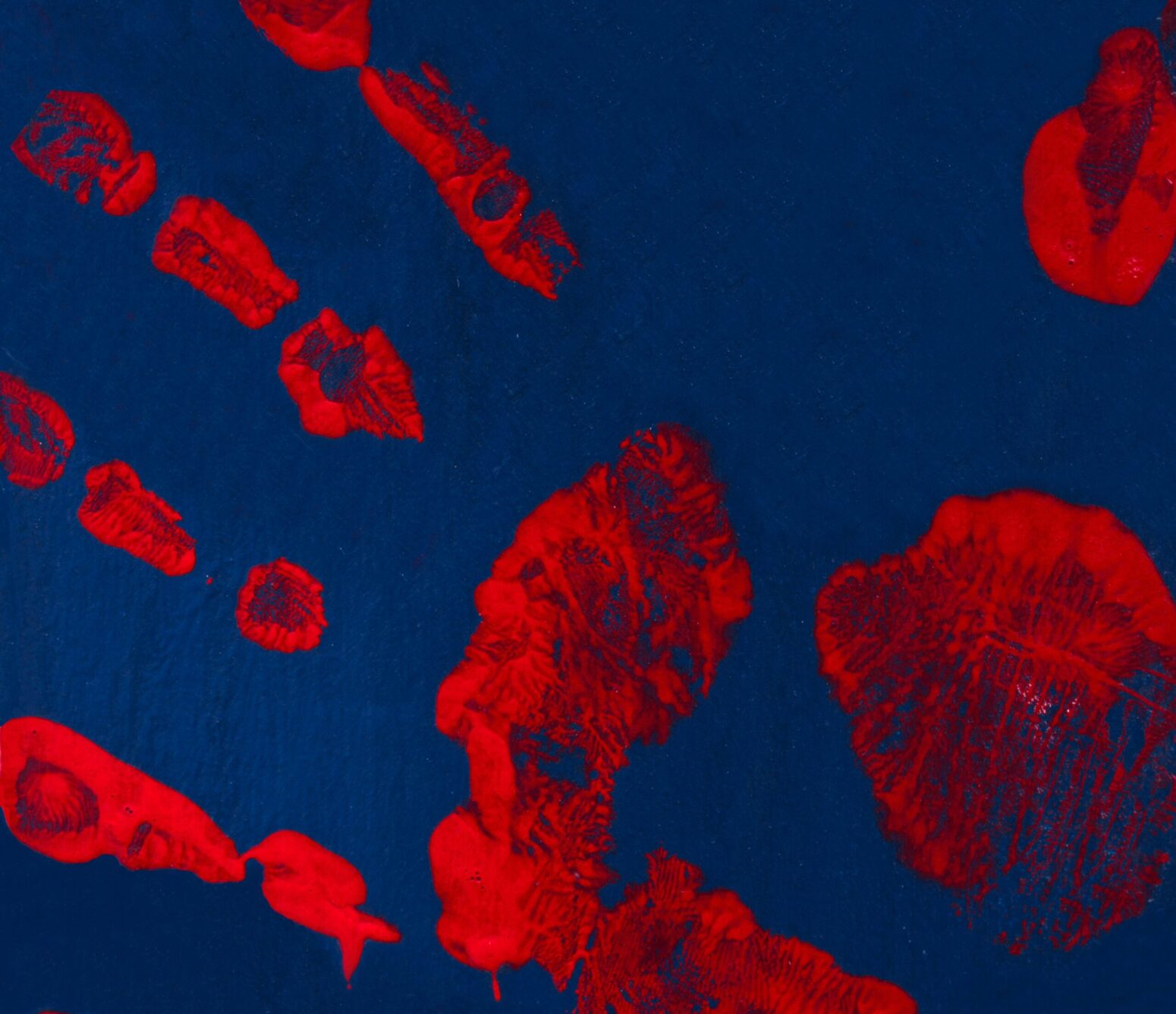
At first we do not know what the red painted handprints symbolize, and we think they might be a welcome game for college freshman orientation, like the ones we’ve played all week. Hands line the sidewalks, but many are also hidden, tucked underneath bushes or the windows of academic buildings. Some are in the dorm parking lots and others outside the dining halls. Some are on staircases while others dot the bleachers. All week, we stare at the ground and point them out to each other, wondering what the prize will be for solving the mystery.
After our parents leave and the games are over, we learn the truth. It comes like a slap in the face. Each handprint represents a campus rape. These are small memorials, reminders of what will happen if we do not stay alert.
In elementary school, we press our palms against construction paper and trace the outlines like chalk bodies.
Because we are still young girls, we spread our fingers wide to take up as much space as we want. We choose brightly colored paper—neon fuchsia, electric green, acid blue—because we are not yet afraid to be visible. We have not learned the precision required of our gender, so we trace our hands, then cut the shapes out roughly, jagged edges and mistakes, our carelessness on display.
Our teacher then pierces us through with holes, stitching us together with rainbow yarn until all our hands line the string. She hangs the garland overhead, a welcome banner that greets us every day as we enter our classroom. We try to figure out which hand belongs to which body. But we fail and instead watch as the palms flutter overhead, divided from their makers.
We don’t talk about the missing girl.
Our high school math teacher tells us about algebra, the unifying thread of most mathematics. It is a reunion of broken parts, a study of variables and the rules for determining these variables. All the problems we are tasked with solving involve uncovering what is missing.
He explains the problems using colored markers, drawing elaborate equations in rainbow on the projector. Sometimes he walks in front of the screen, and equations cover his body, a division sign hovering over his face, missing variables scattered across his limbs.
We are used to being invisible in math classes. As early as elementary school, mathematics erased us, all the problems about trains or trucks, billiards or bowling, boys named Bobby and Dave. Even when we knew the correct answer, we weren’t loud enough to be called on, or we were interrupted by our male classmates, who corrected our methods, who said we didn’t understand. After, they asked us on dates.
He is the first math teacher to encourage girls to participate. He calls on us before the boys and then quiets them when they try to interrupt and call out the answer first. He allows us to be the first to solve the problem.
Still we know a local girl is gone—that after years no one has been able to solve the problem of her disappearance—because her face appears each night on the local news.
Her body is buried beneath the performing arts center. She was dumped into the wet concrete at night and sank to the bottom of the foundation in the dark. At least, that’s one of the rumors I hear about the missing girl who vanished from my small college campus a few years before I began studying there. I picture her frozen in time, drowning in concrete.
Other theories are that she is buried on the hill overlooking the dorms, the one kids climb so they can smoke pot and make out with a view of the tiny town’s glittering lights . Some say she ran away, but because she disappeared after a college party, most believe she was raped and murdered.
I pass the performing arts center each day. My best friend and I live on opposite sides of campus, so when we meet for dinner, I must make the long walk alone to her dorm in the dark. Along the way, I sense danger in every shadow, in every dense hedge lining the path, as though the attacker will jump out at me next. Sometimes I pass a safety siren lit up cold fluorescent blue, but RAs and campus police tell us time and again that we are only supposed to sound these in case of real danger.
I try to determine which route is safest. The shortest route is the darkest, winding through parking lots and dorm buildings, trees hiding it from view of the road. The path along the road is the brightest, the main route through campus, but it moves past the dorm where the missing girl lived, past the building where her body is believed to be buried.
My friend’s father is the head of construction at our small university. He doesn’t talk about the girl much because the investigation is ongoing, but he says surely someone would have noticed if she were buried. But surely someone should have noticed when she vanished from a crowded campus, yet after all these years she is still gone.
I walk as fast as I can to my friend’s dorm. Sometimes I move so quickly I am out of breath upon arrival and she asks me what is wrong. It is foolish to be afraid of the very freedom this place grants us, so I make a joke about being out of shape.
We laugh as we step over the red handprint in the front doorway.
The concrete captures my handprint, freezing it forever.
My father does construction for a living, building fences up and down the California coast. He builds the boundaries that keep people in and out, posting signs that say No Trespassing or Danger.
Even as a child, I’m afraid of disappearing. I watch Unsolved Mysteries at night and wonder why bad things are allowed to happen, why no one can solve the cases. The show often features girls and women who did not follow rules, who misspoke or misstepped and ended up where they didn’t belong. I decide that I will mind my business and stay in place. I decide that I will never reach out to grasp more than I already have.
My father tries to embolden me by taking me with him to job sites. We wander through the hollowed husks of buildings on their way to becoming something permanent. The wood beams look like bones, like the skeletons of houses hoping to become alive.
When my father sets a fence post deep in concrete, he lets me place my handprint next to his. He can easily grasp mine, make it vanish beneath his own. But in safety, I am brave enough to spread my palm, make myself big enough to see. In the concrete, I will never go missing. I will never disappear.
On May 25, 1996, Kristin Smart, a freshman enrolled at California Polytechnic State University in San Luis Obispo, California, vanishes. She is an architecture student at a school known for mathematical excellence, known for the many men—and very few women—who graduate as engineers. She is white and blond and beautiful, with the kind of rosy youthfulness that makes her disappearance spark national attention, unlike those of the countless women of color and queer and trans women that vanish every day.
Over Memorial Day weekend, Smart attends a birthday party at a fraternity house just off campus. Students pass this house all the time. It is as familiar as the school’s welcome sign. Smart goes to the party alone and doesn’t know anyone there. The walk is secluded and dark, the area near the college sparsely lit and silent, most students studying in their dorms or joining the many parties on fraternity row, boys then, as now, convinced that turning into men requires binge drinking, wrestling on floors, and sleeping with girls, whether they consent or not.
Around 2 a.m., two students find Smart passed out on the neighbor’s lawn. After waking her, they decide to walk her back to her nearby dorm room. Another student at the party, Paul Flores, offers help. Flores, who police will later learn had been stalking Smart, looks like many of the male students who attend the college—white, average height and build, mediocre but with a visible arrogance. When police interview him three days after Smart goes missing, he will also have a black eye, which he will say is from playing basketball with his friends, who deny the account. Eventually, he will change his story and say the black eye is from bumping his head while working on his car.
One of the students, who lives off campus and drove to the party, departs first. When Flores and the other student reach campus with Smart, they split up to go back to their dorms. Flores, who lives closest to Smart’s dorm room, walks her alone. He later tells police he walked Smart as far as his dorm building. This is the last known sighting of her. Two days later, Kristen’s roommate reports her missing.
The walk from Flores’s dorm to Smart’s dorm is only a few steps, but the path is shrouded in darkness, winding its way through trees and bushes that obscure sight from dorm windows and the roads. Later—after they fail to act quickly, assuming Smart is on vacation, though her friends insist she is not, though her parents say she would never go on a trip without informing them, though her money, credit cards, and ID are in her dorm room, after they fail to interview Flores promptly, giving him ample time to dispose of any evidence—campus police will install lights and emergency sirens on the path where Smart was last seen. They will cover these, and similar spots on campus and in the surrounding community, with posters of her face, smiling out for the remainder of the late 1990s and early 2000s. For years, female students will pass these brutal reminders and consider themselves grateful.
In my 1990s elementary school, we go around the room in a circle and share the things that make us thankful. Thanksgiving is about being happy, even if you are not, and most of us girls are uncomfortable sitting cross-legged on the floor because the boys try to look up our skirts or elbow us in the ribs to make us scream.
Each year we complete the same art project: our hand traced on paper to resemble the body of the turkey, construction paper feathers attached for added flare. The boys circle around us while we craft, pinching us or pulling our hair. The teacher blames all the excitement on sugar.
“Stop screaming,” the teacher and boys insist.
After a few years, we learn to hold still as the predators advance. We learn to trace our outlines in silence.
When I come home for Thanksgiving my freshman year of college, I am whittled to brittle bone.
It starts simply enough. The handprints all around make me feel powerless, so I try to reclaim my power by being the one to erase myself. I believe danger is all around so much that I become a danger to myself.
Soon my clothes drape my body like a shroud. My bones jut underneath the surface of my skin. Sometimes I don’t eat at all, and my body feasts on itself and smells like decomposing.
The more I disappear, the more I am desired. I am coveted because this is the way kindness works—we value something only once it vanishes. Suddenly I am popular with girls who demand my secrets, desired by boys and men who like to wrap their arms around the cage of my body.
At dinner we go around the table and give thanks. I am thankful I am home. I am grateful I have nearly survived the first semester of college. When we are done giving thanks, my mother carves the bird and watch the body and bones splay open.
She saves a bone for me to make a wish. For weeks it dries in the windowsill while I finish my courses, ace my finals on an empty stomach. I return home, exhausted and emaciated, convinced this is success.
I am so weak, I forget to make a wish when I snap the bone.
The word algebra comes from the Arabicالجبر (al-jabr), which means “reunion of broken parts” or “bonesetting.”
The word first appeared in The Science of Restoring and Balancing, an early ninth century book written by the Persian mathematician and astronomer al-Khwarizmi. He theorized ways to balance mathematical equations. To locate what is missing.
In the early months of investigating Kristin Smart’s disappearance, authorities use careful calculus to lead them to the body. At first, they look for flesh, but as the months, then years pass, they search for bones.
Nearly a month after Smart’s disappearance, campus police turn the case over to local city police. They examine the hill behind the university dorms for evidence of digging. They examine construction sites around campus. They investigate the local backyards of Paul Flores’s parents. Hundreds of volunteers search the city for the missing girl. The college town is small—just 13.25 square miles and about forty thousand residents—but the search reveals nothing.
Dissatisfied with campus police’s negligence and the investigations’ lack of urgency, Smart’s father, Stan Smart, begins his own search.
“I crawled through a lot of culverts. I looked through a lot of dumpsters,” he later tells Deputy District Attorney Christopher Peuvrelle, adding that campus police seemed “ill equipped” to investigate missing persons.
His search would have taken him through the campus, where he would have heard music and television, laughter and screams, voices layered over one another until it was hard to be certain what was happening. His search would have taken him into the surrounding neighborhoods, raucous parties most nights and even during the day, drunk students stretched out on lawns just like his daughter the night she disappeared.
There is no one to hear me scream.
We’re on our way back from the dining hall late at night when my friends cut away from the path winding its way through the dorms so they can head to the library. I never walk by myself: I’m afraid of the dark, of the red handprints glowing fluorescent at night, that eerie blue light of the emergency stations flickering like a premonition. But suddenly I’m alone, making my way past the dorm Kristin Smart lived in before she vanished.
I hasten my steps, walking as fast as I can without jingling my keys or backpack loud enough to call attention myself. Because I am so thin, already starting to disappear, I lose my breath quickly with the effort of trying to make my way to safety. Struggling under the weight of my many books, I’m an easy target.
It happens before I have time to realize. A man jumps from his hiding spot in the bushes just outside my dorm. He comes from behind, wrapping his hands around my arms and chest to immobilize me. I’m so frightened, so weak, I barely struggle.
Surely, I scream, but it is late and the crickets are loud and so is the music competing from the many open dorm-room windows. No one hears, but if they do, pausing their homework to peer outside, they might assume it is friendly flirting, a harmless student picking up the object of his desire.
In fact, the man believes this nothing more than a flirtatious gesture. When he finally sets me free, I turn around to glimpse my attacker.
It is my friend. He is surprised by my anger. He believes he has done nothing wrong. He has been waiting for me, he says, defensive. He was bored with his math homework and needed some company, and because I did not answer his text messages, he decided to come to my dorm room. When he saw the lights were out, he figured he’d wait.
“You’re so cute when you’re scared,” he says, and laughs.
The boys laugh when I struggle to make sense of high school math. The equations are complicated, a language the boys seem to recognize because they are the only ones who have ever really been taught. There are just a few girls in my advanced math class, and we sit together, silent and unsure of ourselves.
During class we solve problems on the board, complicated equations the teacher writes in different colors. X stands for one thing, Y for another. It’s like I’m looking at a bunch of clues and expected to solve a mystery. But I feel divided when I go up to the board, unsure of myself, and my body on display. I don’t know how to solve the problem; I don’t know how to discover the remainder. When I return to my seat, a boy who laughed at my insecurity has left his phone number on a piece of paper on my desk.
Math can be dull, but our teacher is not. He calls on the girls, corrects the boys, creates problems about gardens and cooking to try and solve the gender gap. His room is full of colorful art, photos of students and projects. When he writes on the projector with his colored pens, he draws little pictures too. He draws a smiling face, a flower, a hangman’s body.
Sometimes at the end of class, we play a game. He asks us to solve one final problem, and the first one to finish gets a prize. After someone calls out the correct answer, he sprays down the projector elaborately with water and places a brown paper towel gingerly on the glass, tapping his fingers over the water and ink. When he removes the towel, the equation has blurred, transforming the symbols into watercolor. Only those of us who witnessed it know what is hidden.
My university is nationally recognized for engineering, so when I tell students I’m an English major, they often say I’m silly for wanting to tell stories when they build the bridges and buildings that make up the world.
I take a class called The History of Modern Mathematics, the easiest one, with a reputation for being designed for humanities majors. But I love learning about the history of mathematical concepts, how everything can be traced back in time. I love fractals best of all, because they are found in nature like the ocean seashells near my college. When I talk about fractals, my male engineering friends laugh, referring to images that are more cutting edge, sharp and glinting as broken glass.
My other required math class in college, statistics, is a kind of narrative, a mystery where you solve the problem to figure out a story. Still, male students dominate class conversations, and most of the scenarios focus on male characters in business and technology, with just a few rare problems featuring female characters and questions about nutrition or family budgets. I try to ignore gender in the textbook so I can solve the problem quickly and correctly, but male classmates at my table are always interrupting to insist on walking me back to my dorm even though I don’t want them to know where I live.
Sometimes, when their flirtation is particularly bothersome, I go to the bathroom in the math building. When I close the stall door, flyers tell me other statistics: More than one in four female undergraduate students will experience rape or sexual assault through physical force, violence, or incapacitation. Around 5.8 percent of students have experienced stalking since entering college. Only 20 percent of female student victims will report to law enforcement.
He rapes me in my college apartment.
It is my last semester of school and I am asleep. He leaves my roommate’s room, where they have been completing engineering homework, opens the door to my room, and slides into my bed.
After it is done, I blame myself for letting it happen despite all my years of caution on campus. Despite the handprints warning me this would happen. I do not know what to say to my roommate or law enforcement, so I drive home for the weekend. On the drive, I pass a highway billboard about Kristin’s Smart’s disappearance. It has been there for over a decade and no progress has been made on her case. I convince myself I am lucky. At least I survived.
When I return to school, he is waiting. He comes over unannounced, lingers outside my classrooms, trails me in his car while I am walking to school. He taps on my window late at night, leaves threatening notes on my car. He hides and then jumps out of bushes and off roofs to scare me. When I’m driving in my car, he follows, speeding up and flashing his brights to make me crash. He threatens to hurt me if I do not obey orders, and I listen because I am afraid.
One day he drives me out to the ocean, where he and his classmates have been tasked with redesigning the shoreline. He spouts off mathematical terminology, equations he knows I will not understand, and he brags about how he has the power to reshape the land with his plan.
After he shows me the design plans, he leads me to an ocean cave. It is deep and dark; it smells of kelp and my fear. He blocks the cave entrance as the tide begins to rise, first past my knees, then to my waist. He will not let me go and I do not know how to escape. I am not a strong swimmer and I begin to panic, lifting my dress up from the water.
When I look down at my pale body, I see bruises and welts. They are purple and deep red; they sting in the cold air and salty water. For the six months that he stalks and rapes me, he leaves these marks—handprints—across my body.
Twenty years after Kristin Smart’s disappearance, investigators will return to the case after a true-crime podcast garners national attention. Though over 250,000 girls and women go missing in the United States each year, the vast majority unreported by national news outlets, the resurgence of interest in the Smart case reveals that beautiful blond girls from wealthy beach towns will always be of interest. Entertainment demands justice.
Eventually authorities arrest Paul Flores, now middle-aged. During a search of his home, police discover date-rape drugs and videos of him raping other women. Authorities also arrest his father, Ruben Flores, who is believed to have aided his son all these years, covering up the crimes everyone has always suspected Paul committed. Authorities will get a warrant once again to search their homes. They will announce, shortly after arresting both men, that there is evidence that Kristin Smart was once buried under the deck of Paul Flores’s home but that the body was moved and likely hidden elsewhere.
Paul Flores will be found guilty of first-degree murder after a sexual assault and sentenced to twenty-five years to life in prison. Ruben Flores is found not guilty of accessory after the fact. Even if convicted, however, Ruben Flores would have faced a maximum sentence of only three years in prison for his help concealing a body.
Kristen Smart’s remains are never found. Even after the case is closed, the girl is still missing.
Early in this reinvestigation—decades after Smart’s disappearance and a decade after my graduation from the same university—police excavate the hill behind the dorms. Students watch out their windows between classes. I used to stare out the windows too, lonely and afraid, at the moon shining over the hill, casting shadows on our dorms and the walkway, the same one where she disappeared.
For many years, I examined all the variables in the equation and believed my rape to be the result of my failure to protect myself, my failure to become invisible. But eventually, I came to understand that most of my encounters with men at the university involved a lack of consent.
There was the stranger who followed me from bar to bar, insisting I give him my phone number, later confronting me on the sidewalk to say that I had given him an incorrect number and demanding I amend this while he watched, calling to verify, calling me repeatedly afterward because I couldn’t block his number on my phone back then. There was the man who kissed me with no warning because he thought I looked sad. There were the men who followed me after classes back to my dorm room; I learned to hang out in the campus bookstore instead until they grew bored.
There were friends who tried to grab me suddenly, insisting I’d been a tease, that I owed them my body since they’d feigned friendship for months. There was the man I dated briefly who entered me without asking one night. There was my rapist’s roommate, a man who witnessed my fear and offered to drive me home one night, to protect me, only to refuse to let me out of the car until I gave him a kiss.
In nearly all these encounters, I considered myself lucky that something worse hadn’t happened. But eventually I realized that the vanishing happened anyway—I disappeared in my mind each time, until it was over and I returned to my body.
The body of work my students submit in creative writing workshop is overwhelming in its violence. Time and again, students write about sexual assault, about casual cruelty and brutal attacks.
In the nearly twenty years since my time as an undergraduate, I’ve taught at universities across the United States. No matter the location or the prestige of each university, the stories remain the same. Students write about assaults by partners, friends, casual acquaintances. They write about strangers at parties, in the dorms, bars, and parking lots. They write about themselves, about their friends, their coworkers. They write about the frustrating process of reporting campus rape—the way they must meet with their attackers for mediation, the burdens of proof they are expected to provide, the way, no matter the specifics, justice is never served. One student writes about how her rapist filed counter charges against her for tarnishing his name. Another student writes about how her assaulter was allowed to continue living in their shared dorm building. A female student writes about the trauma of walking in on her roommate getting raped. She struck the man to make him stop and was later charged with assaulting him. A male student writes about the pain he feels because he witnessed a rape and did nothing. He does not write about the guilt he feels for failing to intervene but rather his grief over witnessing such violence and the way the images haunt him. In the essay, he is the victim.
Restroom stalls on campus still include flyers about the prevalence of sexual assault, the same frightening statistics. It is rare for students to report, and as I walk through the crowded halls, I wonder how many students are struggling to stay afloat the way I did in the aftermath, drowning in my shame. I try to solve the ever-present equation, to carefully calculate the number of students who disclose to me each semester, factoring in the variable of students who do not report, in order to produce the result.
After I teach night classes, I wind my way through campus. I pass the art building where charcoal figures are hung like bodies in the windows, the math building where complicated equations litter the sidewalk in chalk. I pass the endless construction on campus, yellow caution tape and freshly poured concrete. When I pass the dorms, men wolf whistle at me in the dark.
When I visit my university after many years, the handprints are gone. In my memory, the handprints and what they signified defined my entire experience there, yet I am stunned to discover they were removed after my freshman year, before my sexual assault happened, before I became fully aware of how much danger was underfoot.
Added around campus a few months before Kristin Smart’s disappearance, the handprints were part of a 1995 project to increase awareness around sexual assault on campus. Though it seemed like the handprints were everywhere, there were only twenty-three around campus, all of them painted outside dorms, as if to suggest rapes happen just at home, as if to remind female students to be cautious on their own doorsteps. Yet as Cal Poly came under increased scrutiny for a growing number of sexual assaults and rapes, students and parents became increasingly disturbed by the symbolic reminders, and administrators decided to paint over the handprints in 2005.
I walk silently through campus the way I did as a student nearly twenty years ago. I am still alert, still aware of my vulnerability in this kind of place. Kristin Smart’s dorm is on the way to my former dorm, and I look down at the sidewalk to try and find what others have tried to erase.
The sound of music and laughter and shouting echoes all around, as I locate the stain, the shadow of what once was. A handprint stretched wide and faintly red. It never vanished; you just need to look hard enough.
Read more from Issue 23.1.