Clare Island: A Prologue
30 Minutes Read Time
What’s past is prologue.
—Shakespeare, The Tempest
1. 365
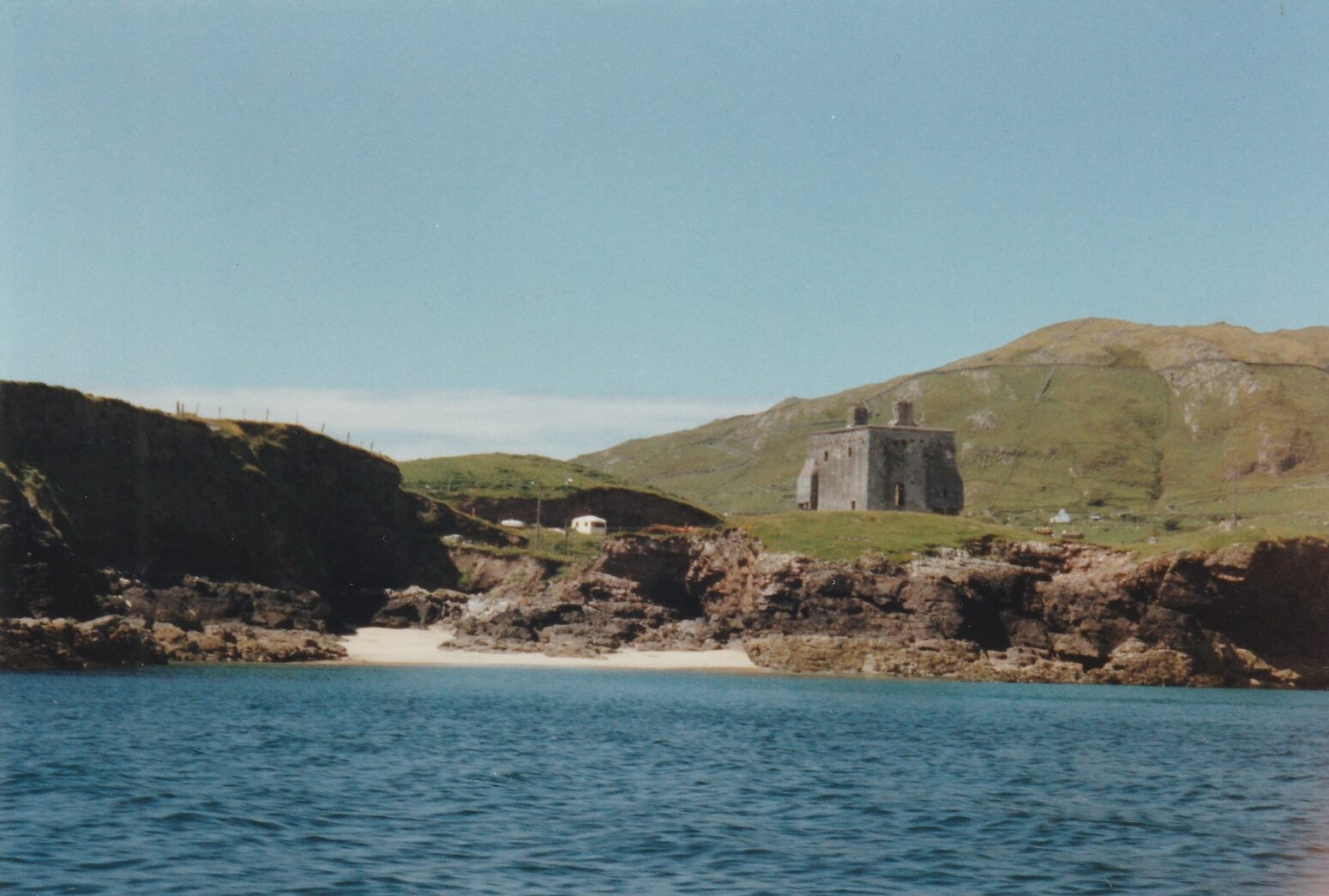
Clare Island rises like a rumpled green wizard’s hat at the edge of Clew Bay, a single slouching mountain off the Irish coast framed by the open Atlantic. My backpack and I are gliding toward the island’s quay on the afternoon ferry, under wildly bright August sun. We pass a ruined castle, said to be a former haunt of pirate queen Grace O’Malley. Along with stories about Grace dating to Shakespeare’s time, her surname lives on here: I’ve already met several O’Malleys who run the ferry. As one island native will put it to me, “You can hardly walk around here without tripping over an O’Malley.” Since my grandmother was born with the name, in a way I am one too.
This is about as far west as Europe stretches. The next stop is New York, goes a local saying. There, another family of islands awaits inside the city limits: Manhattan and Staten and Ellis, dozens more. For nearly a decade I lived in Manhattan, until I abruptly moved to California a few months ago—and let that glinting knife of island slip away from me, probably forever as my home.
But islands fill the horizon here: Clew Bay is said to contain 365 of them. This perfect coincidence with the days in a year has got to be blarney, but who wouldn’t want to believe it? And anyway, the number of islands changes over time and can shift throughout the seasons, even the time of day. With the tides, some islets rise gently above the surface, seeming to multiply, then submerge again, like vast, warm-blooded sea creatures. Like singular, if complex organisms. As if each island has a life of its own.
I’ve always been drawn to islands as if to puzzles or mysteries, each one a novel experiment in nature and culture, their coastlines framing helpfully perceivable wholes. I’m fascinated by the way their landscapes roughly resemble clockfaces, like sundials writ so large they’re environmental. By how islands tell time differently, seem to sharpen time, stretch time, make mischief with time, reorganize or highlight or disappear time, making all of time’s movements feel more open and exposed.
I’ve come to Clare Island to explore its rare window on time as the site of two of the vastest island studies ever conducted, revealing how people inhabited this sea-locked spot over several hundred generations, in a setting that was itself always changing—hosting idyllic golden ages, geological dramas, species drift, decimating famine, and much ingenious survival.
That’s my official, above-surface reason for being here. And on my own—the first real travel I’ve undertaken solo.
But my real, deeper reason is to get—very simply—away. To slip below the surface of another world. To allow the island’s histories to absorb me, dazzle me away from my own. Time always tells a story, and I need a break from mine. What better reason to go to an island but to escape?
At the harbor a white-bearded man is waving to me; I’m the only person left on the quay after a few holidaying families disembarked. Smiling all the way to his blue eyes and firmly shaking my hand, he introduces himself as Robert, the host of my stay, and says, “Welcome to Clare Island! This is real Ireland, not Disney Ireland. No shamrocks or shillelaghs here!” Then he ushers me into his mud-splattered Land Rover, and soon we are speeding toward the lighthouse a mile off that he and his wife run as a B&B. We chat about his accent—Belgian, not Irish—and how I’ve left my rental car on the mainland since no one but residents can drive here. Beyond the windows, vivid green bogland is bare of trees but lined with ancient potato ridges that permanently stripe the earth—as if the island itself is ruled like writing paper.
2. Three Years
Three years earlier, on that “next stop west”—Manhattan, the modern world’s most mythical island—I was living through the worst experience of my life. The weirdness of my father’s death was sticking in my throat, left me squinting as I reached for my keys as if toward an unreachable distance: He was over. Losing a person you love, forever, is many things: wrenching, regret-filled, confusing, but also strange. Death is as common as dirt and not strange at all; I just hadn’t felt its voiding power so near. After the world performed this great disappearing act for me, it hadn’t felt completely solid. Or maybe that was me: my sense of self mistier, my borders raw and permeable, shot through with live wires of pain.
After my father died—of alcoholism, after two years of drinking in a way that he must have known would kill him—I dutifully attempted to metabolize the hurt and the strangeness. This looked like nothing new from the outside: I kept working, taking the subway, meeting people for dinner or a show or at some club. I kept walking down Manhattan’s streets like everybody else. The island’s three-dimensional labyrinth ribboned with thousands of people often in audible vicinity soothed and numbed me. I picked destinations that made sense—bodega for milk, newsstand for a magazine, the Strand for yet another yellowed book bought on impulse—just to rejoin that flux. As for my numbness, my sliding-scale therapist said I wasn’t depressed; I was in mourning. Americans are bad at mourning, he told me. I told him I’d never felt more American in my life.
Because despite the busy-ness, all the people, the weekly therapy sessions, I tried not to notice a spectral element that now followed me: despair. Like a color in the sky I’d never put a name to. The world was so hopeless sometimes, speeding along this death-track, it almost made me laugh; after all, if we start at despair, there isn’t much further to fall. So I just kept walking down those streets. It did feel unbelievable that this is how it works, that we—most of us, anyway—simply keep going. An emptiness that was my father now existed exactly nowhere. And there I was, walking in the aftermath, around an island, like a maze of never finding him again.
Three years passed, and I left Manhattan for San Francisco. Now I was functioning, yes; gainfully employed, sure; keeping regular hours, pretty much. But part of me kept wandering around and around the story of my father’s death. I’d found no way to avoid the freshly slicing incision of just the word suicide.
Time heals all wounds, or so they say. But who first said this, exactly? And why should anyone believe them? I have not been able to find a clear original citation for this little truism: It’s apparently a sui generis sentiment meant to provide solace. And one hard to argue with, since pain will inevitably dull.
But what is it to heal well from a wound that exists only in your mind? Thinking my way through it, talking it over, reading about it, writing in my journal, working out, doing all the yoga and the therapy I could handle—none of these oft-recommended pursuits over three years had healed much, or not for long. I always tumbled back into the hard metal box of that ending, a story so heavy that its pull, like gravity, had reshaped everything around me to orbit around it.
So here I am trying out a classic if unfashionable strategy: to run away. To artfully dodge my own story, drop myself into a different world, and see what happens.
3. Sunset
Monique, Robert’s wife, a brisk blond woman about my mother’s age, is showing me around the lighthouse’s sprawling compound. She waves to the tower—hailing from 1818, long decommissioned of its light, and closed for repairs—then says there are only three guest rooms, each painted a different color. “Green is occupied. Blue is pretty but it doesn’t have a view. I think you’ll like Red,” she tells me.
So we stroll over grass under full sun, the cloud-white stucco buildings giving a Mediterranean air—more sultry Spanish village than moody Irish outpost. Monique shares how she and Robert bought the lighthouse after a trip here, and for very little money, then spent two years rehabbing the place. “It was in ruins. But an American woman, an artist, had squatted here about a decade earlier. That was before electricity came to the island, so it was like living at a campground!” Monique shoots me an appraising look, as if thinking: Another solo American woman come to Clare Island, maybe they’re all a type? “B. still lives here, married to an island man. She runs a traditional loom from their home, weaves handmade fabrics, spins her own wool. Lovely pieces, scarves and such, sells them to the tourists. I’ll tell you where to find her if you’d like.”
I tell her yes, I’d love that. We’ve reached an adjoining cottage and a red door, which opens to a room with its own terrace and huge views. Monique asks about my travel here, and I tell her I landed on the red-eye just yesterday, drove left-hand side for the first time in my life from Shannon Airport to a Westport inn—a four-hour drive—then caught the ferry here today. She shakes her head and says, “Well, you’ll sleep like a baby tonight! The sound of the ocean knocks everyone out.”
After she leaves, I pull my new blue Clairefontaine notebook from my backpack, fill a few lines across its smooth, sturdy pages: This inexpensive brand used by French schoolchildren is my favorite for exactly this paper—each trip, each year warranting a fresh Clairefontaine in a different color from the last. Then I head outside to watch the sun set.
After latching the compound gate behind me, I hike an incline where a dozen sheep graze perilously near the cliffs—serrated black walls dropping four hundred feet into swirling white waters. To the fizzing pulse of crashing waves I have a view of everything west: The sunset seems to splash across the whole of the Atlantic. Yesterday I’d flown from that direction, all the time-zone-bending transit now funneled down to this fine, bare point of solitude. But rather than loneliness, a curl of relief rises inside me, as I watch the sun moving toward my recent home—that tangled, break-speed city island—without me.
4. Evolution
The next morning I’m on the Road to Heaven under cloudy skies. Robert and I are buckled into the Land Rover for his Historical Safari, a one-man tour of the Clare Island Surveys’ finds, with me the only passenger. Bumping along its unpaved surface, we follow the grandly named road up 1,900-foot Knockmore, the island’s single mountain—the peak to its wizard’s hat shape.
About two-thirds of the way up, he cuts the engine and we get out: Clare Island’s twelve green and rocky square miles fan out below us, dotted with white cottages. Low-slung Inishbofin and Inishturk Islands float mistily to the south; Achill Island’s big, dark haunch looms on the opposite side; while straight ahead sit Clew Bay’s fringed coastline and hundreds of little islands. All around, waters shimmer with every blue and green imaginable, as waves spill shining metallic flecks across countless opaque pools, like a vast fabric continuously reweaving itself.
I gape at the view, and Robert kicks at the dirt, saying, “I always find crystals here.” He picks up a pure white piece of quartz and hands it to me. The size of an egg, it glitters like milky ice. “You’ll find these on Croagh Patrick there on the mainland,” he adds, pointing to Ireland’s largest mountain. “Clare Island is just a chunk of Ireland broken off and left to its own ways.” Then he tells me about the Clare Island Surveys.
This is why I’m here, my excuse: a travel piece I’ve yet to pitch anywhere, on these ambitious island studies launched in 1907 by Anglo-Irish naturalist Robert Praeger. Inspired by Darwin and the Galapagos, Praeger brought the study of evolution to European soil. He wondered: Could Clare Island, which had been separated from Ireland’s mainland by three miles since Ice Age glaciers melted, host its own differentiation of species in the relatively short span of ten millennia? The brief answer turns out to be no—simply because the Irish mainland and Clare Island are too similar to each other. Species evolve only if they’re forced to, in response to challenges posed by their environments.
Praeger widened his lens to study culture as well as nature. He invited multidisciplinary specialists by the dozens—archaeologists and botanists, linguists and zoologists, historians and climatologists—to poke over nearly every inch of the island and catalog their findings. These academics’ eyes, notes, and subsequent published reports focused on entirely different elements depending on their area of expertise: starfish, Stone Age fire pits, sustenance farming, wild orchids, medieval churches, Gaelic place-names. Ninety years later in 1997, a modern generation of specialists updated this extraordinary study with the New Survey of Clare Island—even as the island’s fortunes kept dwindling.
We’re back in the Land Rover when Robert says, “Just before the Famine, Clare Island’s population was around 1,800. By the end, it was 120!” He adds that only 158 people now live here. I knew the 1840s potato famine decimated rural Ireland, causing my ancestors and a million other Irish to flee starvation on so-called coffin ships bound for North America, but this scale of local loss is astonishing. Even as Ireland’s economy is now booming, in many ways Clare Island never recovered from the Great Hunger, the countrywide crop blight made disastrous by nineteenth-century English rulers, who allowed a million Irish to die by denying them food and aid. I gaze out at the treeless bogs, all the deep stripes of fallow, centuries-old potato plantings, a landscape still trapped in the Famine’s postapocalypse.
It can’t be healthy that this view attracts me like haunting, melancholic music. Maybe I too could sink into this place ambered in tragic history, check out from the frazzling modern world once and for all. I picture myself safer here, as if holding still could stop time itself—and so provide shelter from new pains.
5. Age of Sail
But Robert sees Clare Island entirely differently: as a place alive with changes too deep for an outsider like me to readily discern. Driving to our next stop, he points to stone walls lacing the island in lanky rectangles, says the island was redesigned after the Famine by Victorian British do-gooders to help the native population. He happily explains how this new system “revolutionized the island. Today the grazing lands are communal, but the sustenance farms are owned by individual families. The islanders control what they produce, unlike the bad old days when the English took everything.”
We stop at a field facing south, toward Inishbofin and Inishturk Islands—and, much further, the Iberian peninsula. Out we go to admire flouncy spires of vivid purple flowers, which Robert tells me are Mediterranean heather. “You won’t find this species on the Irish mainland,” he says. “You will find it in Spain. Some believe it crossed the waters during the Age of Sail, when pirates sped back and forth between the countries. Maybe it snuck over with Grace O’Malley herself, who made a fortune running wine from the Continent!”
He shares the greatest success of Praeger’s survey for the flora and fauna studied: Scientists discovered nearly two thousand species new to Ireland, over a thousand unique to Clare Island, and well over a hundred species new to science. Admittedly along the way, no new concept emerged in answer to Darwin’s theory of evolution, just the quieter revelations of paying careful attention to a place. Perhaps no other twelve square miles on earth has been so thoroughly noticed.
The word Clare, Robert now tells me—really its original Gaelic version, Cliara—means “wooded.” So within the memory of language, this treeless island was covered in forests. “Underneath the bog,” he says, pointing at more fields, “scientists found remains of the silver birches and pines that once covered the island. Here since forever—then gone for good.” Though tree clearances occurred over the thousands of years people have called the island home, he tells me that the tall ship–building industry ushered in by the English—just after Grace O’Malley’s rule and death—dealt the final blow.
One thing is clear to me: Stories of Clare Island—even ones involving ocean-traveling heathers and long-lost trees—somehow always lead to this pirate queen. They keep Grace’s name as current as if she were spotted on the island last week. She will come alive for me soon enough.
6. Stone Age
For our final stop, Robert takes me to a Stone Age site, the oldest architecture on the island: a court tomb dating to 4000 BCE, a chamber of megaliths set on a knoll. The tomb is about thirty feet long and largely broken apart, several massive stones toppled and pointing akimbo, which we pat and zigzag around, marveling that people have called this island home for six thousand years—and that they picked the best views for this age-defying building. Constructed in honor of an ancient spiritual belief system, the structure transmits that root inspiration even to this moment: the stones forming at once a haven, a seat, and a stage for this shimmering, cloud-shifting vista of island, water, and sky.
Walking back to the Land Rover, I ask Robert how he likes living here. Later, in my room before dinner at the lighthouse, where I will be seated with the only other guests—a leering, bespectacled Dane and his sullen teenage son—I write down Robert’s answer in my Clairefontaine:
“Well, for Ye Olde Ireland, you’ll have to go elsewhere. You go to the Aran Islands if you want to hear the Gaelic.
“But on Clare Island you have peace. You have a sense of freedom.”
I stare at him. He might as well have told me he was carried off by the fairies. Peace and freedom: I haven’t fully enjoyed either sense in ages—despite being perfectly free to do so. Despite every other option available to me, I have specifically, repeatedly chosen to continually wander the story of my father’s death in my mind.
It is a way to hold vigil for him, yes. But the feeling I experience when I compulsively follow those pathways is shame, a suffusing sense that I may not be suited for how life actually operates; that pain hits me too hard, along with the joy and the curiosity that so often fill me; that my sensitive type is the least equipped to survive. That whatever impulse drove my father to drink himself to death has passed down to me in some form, whether by nature or nurture, an inheritance of despair—along with all the qualities I loved about my dad, am proud to share with him, and that only make his suicide more painful, more of a personal indictment. I do not feel fated to repeat his alcoholism, because—for whatever reason—substance addiction isn’t my poison. But I have felt compelled to live in its aftermath, to allow his death to break down how I see myself.
In this moment, on one island amid many, I picture Darwin on his faraway South American island, as he came to understand that a place shapes a species over time. And so for each of us, our place is vitally linked to our internal worlds, biology and all. Robert finds peace and freedom on Clare Island. Why haven’t I found this sense anywhere in the three years since my father died?
All I know is how much I want to explore Clare Island on my own.
7. Renaissance
The next morning under low clouds, I set off for Grace O’Malley’s Castle, a two-mile walk to the southeast coast. The island smells of ocean salt and damp earth and, after Robert’s tour, seems to unfurl larger and more textured around me: Across the hills, the gray rock outcroppings as big as cottages glimmer with slate’s deep spectrums of metallics and blues. In the pasture where dozens of sheep graze, swaths of tiny yellow flowers that Robert had identified as wild fuchsia are now visible to me.
In my room last night I was reading Anne Chambers’s definitive biography of the Irish queen and pirate, Granuaile: The Life and Times of Grace O’Malley (Wolfhound Press, 1979), and so many tales about her now flash and glint in my mind:
Born in 1530, Grace was—most remarkably—among the final Irish chieftains to submit to the English crown during Britain’s colonization of Ireland. As a young woman, she’d inherited the family barony from her pirate father, then added to it by conquest. Her two marriages resulted in three children—one reputedly born aboard her ship during an attack by Algerian pirates. Her fleet of galleys and battalion of two hundred men alternately battled and evaded the English military with uncanny success while doing lucrative black-market business in French and Spanish wines.
So many sagas, rumors, legends abound about her, passed down on this island ever since. Praeger’s folklorists collected stories about Grace told to elderly Clare Islanders by their grandparents, who in turn had heard them from their grandparents, who may well have encountered people who knew Grace herself. Or could claim to; my own O’Malley grandmother recounted tales of sometimes dubious veracity, delivered with more style and confidence than anyone I’ve known. Stories are always fabrications in some way, and if Irish culture rests on anything, it is excellent storytelling. But one story about Grace stands out, and not only because it is historically verified fact. It’s been haunting me—for its details and repercussions.
Grace was long hounded by an English governor, Sir Richard Bingham, who was intent on destroying her regional power and finally arrested her eldest son on trumped-up charges. In 1593 Grace sailed to England to argue her case for local autonomy and ask Queen Elizabeth I to pardon her son. Meeting at Greenwich Palace, the two women were nearly the same age—Grace sixty-three, Elizabeth sixty—and Grace refused to bow to the British monarch, believing herself an equal. Official documents show that the two women spoke off the record; in Grace’s answers to a previous written interview, she appealed to Elizabeth as a fellow female leader in an utterly male-dominated world. Afterward, to the shock of her advisers, Elizabeth granted Grace her every request: She called off Bingham, freed Grace’s son, and gave orders that Grace and her family be allowed to conduct their affairs in peace. In return, Grace swore allegiance to the English Crown, including taxation of her many castles in and around Clew Bay.
I’ve reached this castle, a stark rectangular tower three stories high, set on the water’s edge. I have the place to myself.
Only inside do I see how the castle is truly in ruin: the roof long gone; remnants of a vast fireplace, decorative alcoves, and stairways lining the walls. The missing top floor is where Grace and her family would have slept. But in this ghost of a building flooded with today’s white sky, only birds call it home, starlings and swallows the same mottled colors as the stone.
This castle marks the final throes of Grace’s native Irish society. It’s what haunts me about Grace’s meeting with Queen Elizabeth, that most brilliant, poker-faced, forward-looking ruler, who led England out of the Middle Ages and into the Renaissance. By chance, the two women both died in 1603. Afterward, England fully colonized Ireland with a brutality that would be unrivaled in British history, where it honed the ravaging methods it would practice on more distant shores.
How wildly the story changes depending on where you end it: Grace in a blaze of glory returning to this very castle, having negotiated her family’s freedom and continued prosperity; or the terrifying world her people in several short years would find themselves in; or even the drenching calm of the island today, irresistible to Irish Americans like me on a quest to “return” to an ancestral home, however illusory or misunderstood. All stories work like this, all of history. Any tale depends on its time frame—and a fierce culling of everything else, narrative’s most necessary fabrication. Destiny may simply be the ending we’ve settled for.
8. Old Ways
After lunch at a quayside pub, I’m loitering in front of a slate-roofed cottage belonging to one Bernie Winters—who has not answered my knock, though his front door stands open. I’ve been told by several people now that if I want to see inside Clare Island’s famous medieval abbey, I need to track down this farmer who lives nearby. Bernie keeps the abbey’s key and lends it to visitors. Built by the O’Malley family in medieval times, the building’s single elaborate crypt is said to be Grace O’Malley’s grave.
About twenty minutes pass, and a towering man in his sixties with an extraordinary face—very long, knobby, and patrician—emerges from over a hillside. “Hello!” he calls, “I’m looking for my donkey! I don’t suppose you’ve seen my donkey?” He laughs a small laugh as I assure him I haven’t and introduce myself. He guesses in his heavy brogue: “You’d like to see inside the Abbey.” I nod, and he disappears into his house, returning with an enormous, ancient-looking iron key.
Instead of handing it to me, he asks where I’m from. I say California, and he tells me he reads a lot about Native Americans: “I’m very interested in them, in other traditional cultures like ourselves, our old way of life.” To demonstrate, he points a long finger toward his hay and oat fields neatly lined with stones; his dozens of sheep and a milking cow grazing farther out; and his “workers,” a border collie and brown-and-white cat. He tells me Clare Island was self-sufficient twenty years ago, but now almost everything is ferried over. “Convenient, but it’s dirty milk and polluted meats,” he says. He adds that they aren’t faring very well, the old Irish ways. But he’s got his little corner here, using the same farming methods his family has practiced for seven generations, in this very place.
“If you’d like, I’ll give you a tour of the Abbey myself,” he offers, and of course I say yes. On our way off his farm, he shows me a stone carved with Ogham writing—the premodern Irish script resembling sideways Roman numerals—and tells me each alphabet letter is also the name of a tree. Then he pulls up sprigs of yellow yarrow flowers, from which he makes tea, he says. At the churchyard gate he presents a little bouquet of them to me.
Inside the abbey’s chapel, a limestone tomb built into one wall is intricately engraved with a masted ship and the name, “O’Maille.” Winters nods at the tomb but points to the coved ceiling. Amid the cool stony gloom, it’s bright as a shaft of sunlight: Primary-colored frescoes—ocher, indigo, deep red—depict a raucous medieval party and mythical hunt. People dance near musicians playing harps and lyres, while men on horseback ride near hounds, peacocks, stags, swirling red dragons, a double-headed eagle, and one comically simple smiley face. The wild, intimate scene hardly feels church-like.
Bernie tells me only five such medieval frescoes remain in Ireland, even though they were once common, until priests and others offended by the scenes scraped them away. Clare Island is just isolated enough for this one to have survived—and still convey its own imaginative story of almost-forgotten pleasures.
9. Fate
The next morning I sleep late and wake up more refreshed than I’ve felt in ages, those waves crashing all night against the cliffs beyond my windows acting as a pure soporific. After dawdling over coffee on my room’s terrace and writing several pages in my Clairefontaine, I head out to visit—as Robert called her—the “loom lady.”
B.’s place, a large white bungalow set amid acres of rolling hills, isn’t far from the lighthouse. With a soft voice and wide smile, B. greets me at the front door and ushers me inside. I tell her I’m staying up the road, and we chat about the American states we each hail from; she’s from Massachusetts, though after living here since 1981, she has an Irish accent as strong as a native’s. She mentions that her husband and sons are out at the moment.
Then B. takes me to her atelier—an airy room flooded with natural light, its large windows overlooking fields all the way to the sea, colorful spools of wool stacked high on shelves. A spinning wheel and a basket of raw wool dyed gold sit to one side.
But the room’s centerpiece is the floor loom, a vast contraption as big as a piano, its wood and fine metal machinery revealing a dizzying array of inputs, levels, and controls. It’s a far cry from the flat loom I used in elementary school to make pot holders.
“I’ve been working on this scarf all week,” she says of the fabric patterned with blue and green swirls emerging from the frame. Then I struggle to keep up as she gives a brief tour of the loom, and I catch only this: Hundreds of warp threads are held by tiny individual metal loops along a wide, comblike reed and stretched across two beams; these vertical threads are interwoven with weft threads via several free-floating shuttles that she pulls back and forth; all while—most confounding to me—ten foot-pedals connected to numerous shafts that lift or lower groups of warp threads to create the weaving’s patterns.
“But it all starts out there,” she says, pointing to the window. Her family keeps a flock of sheep for shearing, and she spins her own wool. All her dyes come from plants she forages nearby—including lichens that yield dark reds, nettles for greens, and gorse petals for yellows. “The cove where I swim every day inspired this scarf,” she says. “This landscape always finds its way into my patterns.”
I’m struck by the wholly organic nature of her work—her island home literally rematerialized into fabric. It also feels a bit supernatural to me, as I can’t help but think of the weaving of human fates common to so many mythologies: the Greek Moirae and Viking Norns, Neith of Ancient Egypt. All the deities that double as artists who control human lives.
Except in truth, only humans make art. And while we can’t control our futures, or our pasts, only we create the stories about them.
10. Time Travel
After B. and I say our goodbyes, I step back outside. I realize I have two more days on Clare Island. Now I take the main road down the hill, passing a woman about my age with long black hair and flushed cheeks; she’s pushing a stroller with a sleeping baby. We say hello, and she calls, “The sun should be out any minute now!” I laugh and wish her a good day, our voices ringing in all the quiet. A few minutes later I take a different road, then a path cutting alongside a bog, and then carefully step over a stone wall into grazing lands, following a tamped-down grass path over a hill. At its base, I reach a fissure of large rocks. Flushed, I stop there, facing the mainland.
“A magical walk,” I write in my Clairefontaine minutes later. “Am sitting on a rock, listening to sheep baa in humanlike voices, the sparkling sound of a stream slipping down stones. Clew Bay is an expanse of blue mountains etched in paper-thin layers of mist, robin’s egg blue water. Bits of silver shining everywhere.” And its own paragraph:
“An island with a horizon of islands.”
I’ve reached a place inside myself spacious enough to take all this in. For a few minutes, I experience a deep, bright, almost-thrumming sense of peace and freedom. I’ve emerged on the other side of something—out of the maze of the stories I’ve been telling myself about myself. The true proportions of the world appear clear to me: I’m not caught in the past. The past is always a story. I love stories, I live by stories, but I am here—in the real. And lucky for it.
This sensation will not last. But it will return.
Since that summer day in 2000, that landscape has reformulated on occasion within me, like the tilt of an airplane to a whole other view. This inward Clare Island visits as if to remind me:
Healing has an atmosphere, a span. It’s not a door you walk through, finally safe on the other side of your hurt, messed-up self. Instead, it flashes and retreats, an aliveness in places or forms or relationships you discover—when you are ready. This may be the “time” able to heal all wounds: not the chronological series of months or years that inevitably find you, but weavings of elements and experiences you fully notice and that you are filled with, progress through, pieces of this world rising to meet you. For a spell. If it feels like magic, that’s because most of time’s passing does not, in the slightest.
Sometimes I consult my journal from that trip—next to me now, dug out from a box with twenty-five years of filled Clairefontaines in several rainbows worth of colors—like it is a wordy treasure map. Except the treasure was as substantial as a shift of light: an unveiling of relief, a slantwise grace that can never be grasped for long. Change stops it; change also conjures it.
Now my own theory of personal human evolution, if you can call it that—being entirely intuitive, philosophical, and devoid of science—is to question how much any of us can evolve in a single lifetime. The essential topography of our core selves may well be fixed. But we can cultivate what grows within us, whatever allows us to thrive within the unique borders of self. The way Clare Island, for all its grave and lasting tragedies, keeps hosting new forms of life that flourish there: Renaissance pirates, hospitable Belgians, native farmers, American artists, purple Spanish flowers. And—for a short time, one that has reemerged in thought many times, as if the island has taken root—me.
Read more from Issue 23.1.