An Interview with Danielle Dutton
9 Minutes Read Time

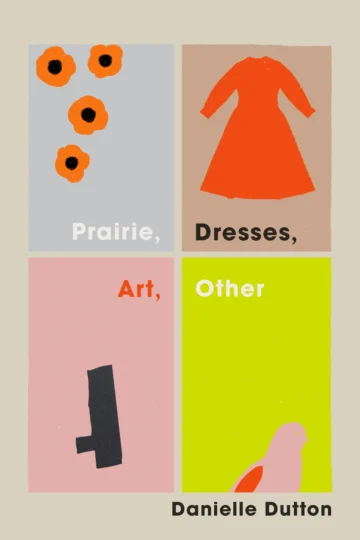
Danielle Dutton’s Prairie, Dresses, Art, Other is a collection of surreal stories full of haunted landscapes, literary experiments, and essays on the relationship between art and fiction. In this conversation, Mialise Carney and Danielle Dutton discuss the prairie as a site of dislocation, the process of collecting literary dresses, and how writing could be played like instruments.
Mialise Carney: In the first section, “Prairie,” you capture the uniquely 2020s feeling of constantly being on edge—the moment before something unthinkable happens—as the characters move through an unstable landscape, time, climate, family, and self. How did you go about writing the prairie as a setting for this pervasive modern tension?
Danielle Dutton: I didn’t go into writing the stories of the Prairie section overtly thinking of the prairie as some sort of synecdoche for America, but I can see how it might have turned out that way. Especially since the American prairie is a habitat that we’ve practically destroyed—and certainly destruction and dislocation and alienation were all ideas I was working with as I wrote those stories, many of which engage with the current political and cultural climate, one that clearly instills a lot of dread and disorientation in a lot of people.
But the whole thing honestly started with my interest in the prairie as a landscape. I’ve lived in the Midwest now for over twenty years—slowly sliding south, from Chicago to Champaign-Urbana to St. Louis—and I fell in love with the prairie somewhere along the way. Because most of the Midwest was once covered in prairie, the bits of it that remain—often in reserves or parks—are called remnants, prairie remnants, and that immediately struck me as provocative and poetic, and depressing. So, loss and sadness were always there in my thinking about the prairie, but so were beauty and wonder and love. I love the prairie, aesthetically, in a way that kind of surprised me, having grown up around much more dramatic landscapes.
The prairie is a background, vibes, in a couple of those stories, but in a few it’s more integral, shaping things or throwing them off balance. In “Installation,” the third story in the book, I was trying to write a story that would be like a field recording of a specific prairie, which is a weird thing to do and probably why that story wound up being the weirdest of the bunch.
MC: “Sixty-Six Dresses I Have Read” is constructed entirely of descriptions of dresses throughout literature and is such a surprising and captivating part of this collection. What was the process of arranging this piece like, and what interests you about literary descriptions of dresses?
DD: Oh, I’m glad you liked it. That piece was a lot of fun to work on, but it really was a lot of work. First, of course, I had to find all the dresses. I had not been collecting literary dresses for years—sometimes people assume I had. In fact, I dreamed the title “Sixty-Six Dresses I Have Read” and then woke up and went about writing it.
There were particular dresses I immediately knew I wanted to use, like the dresses in Jamaica Kincaid’s “Biography of a Dress” and Katherine Mansfield’s “Bliss,” and Elizabeth Bennet’s mud-spattered dress from Pride and Prejudice was always going to be in there. But then I had to start gathering the others, which I did both by noticing dresses in things I was reading and going back to certain books to see if there were dresses I could use. And then I had to start organizing them. What dress should go first? Second? Third? Even though the whole piece looks like a numbered list, I wanted there to be progression and movement, and certainly I wanted it to have rhythm (which had to do with language but also tone and color and style), and I wanted it to feel like it had a real ending. How do you do that with a list? Anyway, those were the sorts of things I was thinking about. And then, of course, I would put in certain dresses and decide that they didn’t work, so I had to take them out, replace them, reorganize, and on and on. I have a whole file (closet?) on my computer of dresses that didn’t make the cut.
The title came to me in a dream, as I said, but I’d been attuned to literary dresses ever since writing my second novel, Margaret the First, about the seventeenth-century writer and polymath Margaret Cavendish, Duchess of Newcastle. Margaret was famous during her own lifetime for the outlandish things she wore, and I had a lot of fun, while writing that book, making up dresses worthy of her and describing them elaborately.
MC: In your essay on the relationship between fiction and visual art, “A Picture Held Us Captive,” you write about a woman who was put on trial in 2007 after she was compelled to kiss a famous painting. This reminded me of an art historian I knew who was frustrated by how museums put ancient musical instruments behind glass because he said they were made to be touched and played. How do you see this desire to engage physically with art translating to writing and stories? Is there a way you hope your writing is “played”?
DD: I do like the idea of my writing being played. That’s a terrific question. Let’s see . . . well, there is a one-act play in the book, though I don’t think it’s possible to stage it, but I would love to see someone try! Would that be a kind of playing? And one of the prairie stories, “Installation,” which I mentioned before, has all these italicized words in it that I think of as whispered and with hand motions. There’s no reason for anyone to know that, but that’s how I think of them, and it would be fun to see someone perform that. Maybe I should do it myself. I haven’t yet whispered those words when I’ve read the story publicly, but maybe I should try.
This past week, in a class I’m teaching, I had my students looking at stories that do unusual things with text on the page, from Mark Danielewski’s House of Leaves to artists’ books to Cris Mazza’s “Is It Sexual Harassment Yet?” to Sarah Minor’s “Nest” and John Keene’s “Cold” in which there are all these small inserted boxes of text that intrude upon the main text. We talked about how Keene’s story, in particular, seems like a strange musical score. And really all of these works, though they are fiction, feel like they would ideally be performed—probably even by more than one person, and maybe involving bizarre soundscapes or avant-garde puppets or whatever—rather than simply read aloud.
But to return to the first part of your question: I’m not sure I am all that bothered about engaging physically with art. The works of art I tend to engage with in my writing are either things I’m looking at from some distance—like the Laura Letinsky photographs I used in my first novel, SPRAWL—or else they are things I’m moving my body around—like some of the sculptural installations that helped inspire “Installation.” The idea of actually touching a piece of art . . . well, it’s complicated, right? That’s what I was investigating when I told the story of Rindy Sam kissing the Cy Twombly painting.
MC: In the final story of this collection, “Pool of Tears,” you quote Mikhail Bakhtin’s theories of the novel as a genre born of the new world in the 1940s, and pose the question, “I suppose this means we’d need a newer new genre now?” Do you see this collection as a response to this need for a newer new genre?
DD: I’m drawn to art that is formally or stylistically responsive to changes in history and culture—I’m thinking of the Modernists, for example, Woolf, Eliot, Picasso. But I’m more interested in asking the question—what do we need now?—than in answering it.
MC: As a longtime reader and fangirl of Dorothy, your independent feminist publishing project, it was such a delight and easter egg to read your engagement with Dorothy authors like Amina Cain, Renee Gladman, Nathalie Léger, Cristina Rivera Garza, among others throughout this collection. How does your work as an editor influence your own writing and writing process?
DD: Thank you for being a Dorothy reader/fangirl! Yeah, those writers all appear in my own writing because—Dorothy or no Dorothy—I’m a reader of their work, a fangirl myself. When I’m choosing work for Dorothy, I only choose writing I absolutely love and admire, so it makes sense that my authors (speaking as an editor) would also become my favorite writers (speaking as a reader).
There’s something intimate about the writer-editor relationship. This doesn’t mean I become personally close to every writer I edit, but I become immersed in their project and language as I try to get inside it in order to help refine it however much it might need (sometimes a lot, sometimes very little), and getting inside of it like that means that I ultimately wind up feeling committed to and connected with it. For me, writing, editing, and reading are kind of like a big mash up, all one project. They’re ways I engage with language and creativity, and I feel incredibly honored and lucky to have so many ways to do that.