Shame
40 Minutes Read Time
My older sisters warned me about Ellen Osborne, the high-school substitute teacher with a big mouth. I can see her framed in the classroom’s doorjamb, her eyes dark and sharp like a hawk’s. Despite being a Quaker, Ms. Osborne wasn’t big on the virtue of silence. She preferred to shout the latest news down the hallway during class changes, when the corridor got so crowded that students actually moshed. “Beth Rogers!” she’d yell, spotting me in the commotion. “Your granddaddy’s cows got out this morning!”
When you’re a teenager, there is nothing more embarrassing than broadcasts about your grandparents’ livestock. I preferred not to think about the cows under any circumstances: the cows could have landed on Mars, and I still wouldn’t have wanted to know. But the Osbornes’ property line was close to my grandparents’, meaning that Ms. Osborne thought she was an expert on happenings at the farm. Convinced I hadn’t heard her in the hallway, she once went so far as to follow me into the music room, where I was unpacking my guitar for class. “Did you hear me, girl?” she asked breathlessly. “Those cows were all over the road this morning.”
In the back row, one kid snorted in response. Another looked up at me, perplexed, as if he’d summed me up incorrectly. Cows were nothing new in rural Guilford County, North Carolina. The Future Farmers of America club even sponsored a festival once a year, a sort of mini–state fair at school, tractors taking over the school parking lot, and livestock grazing on the grass. One of the big draws was a cow bingo fundraiser: people bet on squares of grass and waited to see if they’d be lucky enough to have theirs shat on.
But I was not a member of the FFA, not tough enough to be one of the true farm girls. Instead I was a nerd growing up in one of the rural subdivisions off US 421, driving an old Volvo to school with moody tracks from the Counting Crows’ August and Everything After blasting out the windows. I was going through my own personal Age of Enlightenment that year, one that included vegetarianism. After I renewed Upton Sinclair’s The Jungle from the library for the second time, I told my classmates I had given up meat “for political reasons.” To have grandparents who raised cows complicated the image of myself I was trying to cultivate.
When Ms. Osborne shouted these livestock jailbreak announcements down the hallway, I felt my ears turn hot as branding irons. It wasn’t just about the cows, though. The truth was that I’d been trying to steer clear of my grandparents for most of my life, always embarrassed by what their behaviors might say about me, what I might be made of.
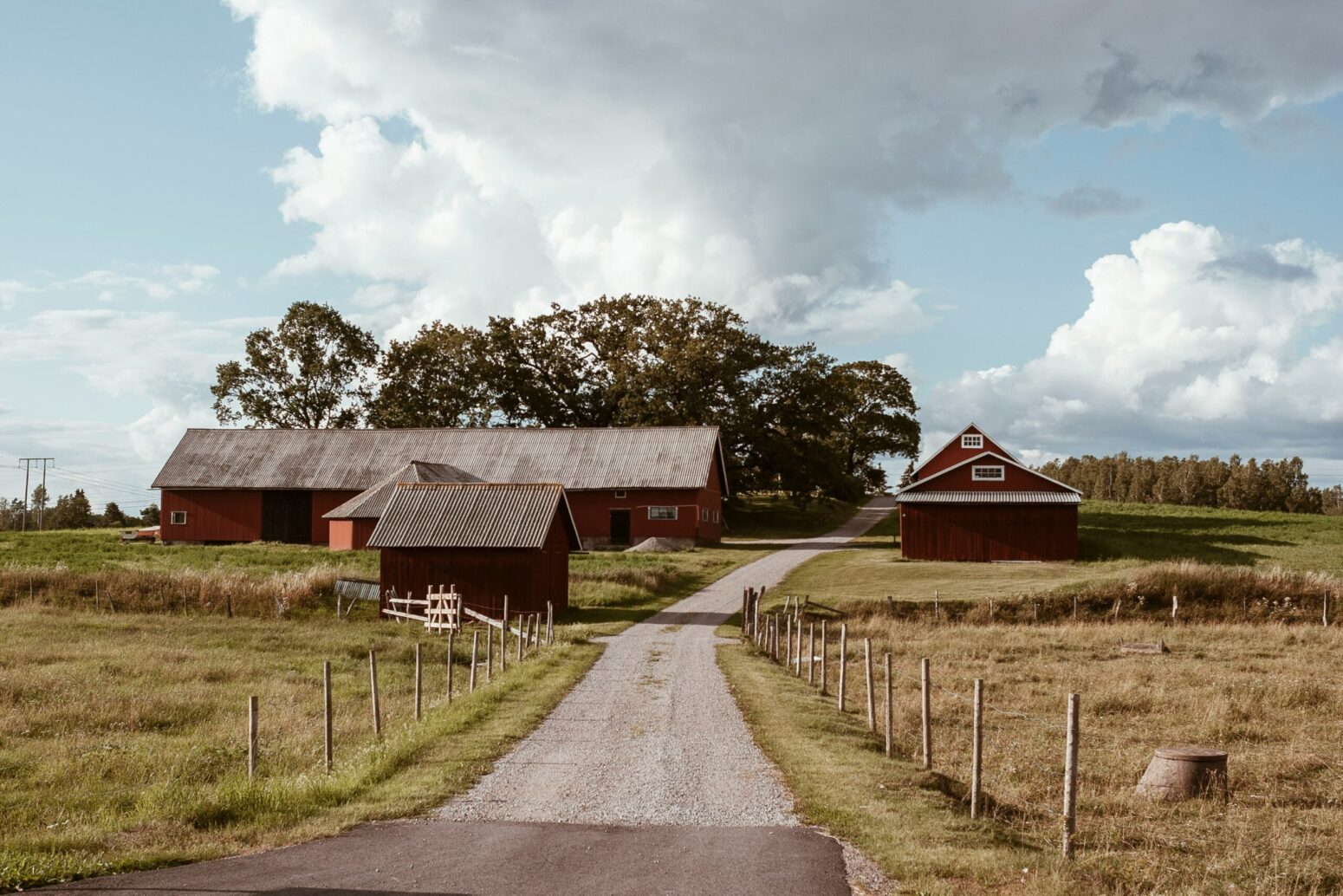
Carl and Rosa Lee Rogers’s farm was on the other side of US 421, just twelve minutes away from our house, but their world seemed even stranger and more gothic than the rest of our rural corner. I still feel the shapes of the farm scrolling through me, like a cyclorama cranked to the tune of an Appalachian ballad. The sun beat down on their hill-side pasture, the L-shaped farmhouse, barn, tractor shed. The roan-and-white cows drifted lazily toward the pond. A murder of crows shadowed the edge of the cornstalks. In the terrible dog pen, the black Lab clanged against the wires, forcefully nosing his big silver bowl full of kitchen scraps. My sisters and I pushed each other on the tire swing, its umbilical-looking rope always on the edge of rot.
My grandparents’ farmhouse was full of broken telephones and shorted-out vacuum cleaners they refused to throw away, as if these might be useful when the Rapture occurred. Carl and Rosa Lee were God-fearing Baptists who took the Bible literally. They weren’t poor so much as schooled in the mentality of the Great Depression, when their families had been poor. Both dressed like the cast of The Grapes of Wrath. My grandmother didn’t own a single pair of pants, hadn’t bought a new outfit in twenty years. The new blouses and skirt suits we gave her for Christmas sat in boxes, the tags on.
My grandparents’ frugality seemed pathological at times. Their general attitude was that anything of public utility or convenience was a sin. Because I’d seen The Bad Seed one too many times, my grandparents’ incinerator, a metal enclosure where they burned their trash, was an object of dark fascination. I once asked my parents why my grandparents didn’t get their trash taken away by the garbagemen, like everyone else in Guilford County. Was the farm too deep in the country, I wondered? “No,” my mother offered cynically, “it’s just that they’re too cheap to pay for it.”
My father, parking the car across from the barn, nodded in agreement, but his eyes shifted downward. Though he’d struck out on his own decades ago, separating his life from his parents, some small part of him was ashamed. It was difficult for me to believe that these depressed-looking American Gothic figures were, in fact, my father’s parents. My father was gentle, an analytical type who had gone to university in Raleigh to become an early-generation computer scientist. He’d retained his country accent, but he also began most of his major sentences with evidently, a word no one else used. He had my grandmother’s cornflower-blue eyes, but this was where their similarities seemed to end.
Our Sunday meals at the farm were compulsory and identical. My grandmother cooked fried chicken, biscuits, and vegetables from her garden. My grandfather, the gruff, half-deaf patriarch, was always the one to say the blessing. The conversation included what Bill Clinton was doing wrong, church, and numerous great-aunts and uncles that my sisters and I couldn’t keep straight, even with their litany of horrid health problems. Before dessert, my grandfather would announce one of his paranoid plans, which got even larger in scale as he got older. He wanted to have a secret road on his property in case he needed to escape; he wanted to build his own cemetery so that he didn’t “have to be buried next to Mexicans and Jews and Catholics.” Toward the end of the meal, he’d disappear from the table without explanation, falling asleep on the odd single bed wedged between the back porch and his desk. Jerry Falwell and a host of other right-wing Christians droned on the radio.
My mother, who had been raised in Raleigh before moving to Guilford County as a teenager, found fundamentalism especially distasteful. Our family had ended up at a more moderate Presbyterian church, a decision for which my grandparents had given my father considerable grief. “Do you want to know why your dad and I refused to take you and your sisters to the Southern Baptist church?” she asked me once when I was a teenager. “One reason is because women aren’t allowed to serve as elders or preach. They’re not allowed to do anything.” I never thought of either my parents as feminists, because gender roles remained fairly traditional in our household, but clearly they had spared their daughters from some strictures of Southern Baptist life.
Years later, my parents would find letters my grandmother sent to her sisters in which she described the gendered frustrations she rarely voiced aloud. She had written candidly about her depression, her unhappiness on the farm, even my grandfather’s occasional violence when something hadn’t gone his way. She spoke of her faith in God to fix her, to fix the suffering within her own marriage. Even so, she seemed to subscribe to the God that was the same brand of masculine, controlling patriarch as my grandfather. She quoted Bible verses warning about His wrath, the possibility of her future damnation. She also quoted the old marriage mandate from Ephesians: “Wives, submit yourselves unto your own husbands.”
In my lifetime, though, my grandmother was a hard person to know. She was a fastidious woman who rose at ungodly hours to tend to her vegetables. She wore a ratty pair of my grandfather’s pajama pants in the garden to keep the bugs off, her enormous hat shadowing her face. The word shame, as I later learned in college, comes from the Old English word hama, which was a kind of veil women wore to signal penance. Though Rosa Lee’s brim was meant to protect her from the strong North Carolina sun, I always got the sense that she was hiding, or else trying to protect herself from something bad I could feel but not fully grasp.
During Sunday dinners my father, desperate to make nonconfrontational conversation, would mention how well his kids were doing in school. When one of us made the honor roll or got an award, my grandmother’s stoic face would twist into a half smile, a quiet sort of pride. “That’s very good,” she’d say. “You keep that up.” Rosa Lee was in charge of her family’s finances—she was always better with numbers than my grandfather—and even though we didn’t have a close relationship, she made sure to set aside $5,000 for each of her five grandchildren, to be invested toward college. Reports about the college funds came in the mail, the blue arrow on the graph rising a little each year.
Rosa Lee had a silent ax to grind when it came to higher education. I learned that she had been the valedictorian of her high-school class in 1937. She graduated at the age of sixteen, winning a scholarship competition worth a year’s tuition at the local college. She went to study education, but her father refused to pay for the second year—either because he couldn’t or because she was a girl. My grandmother dropped out and went to secretarial school instead. When she met my grandfather, she was working as a secretary.
Rosa Lee never returned to college, but she did later register as a local substitute teacher to earn extra money. By the time I was eight years old, she had made her way to my elementary school, which spelled trouble for me. A very old woman roaming around school with your last name was a sure way to get yourself teased. Whenever I saw the ancient-looking ’70s station wagon in the parking lot, I was on high alert.
In the fourth grade, changing rooms for math one day, I walked through the door and froze at the sight of my grandmother, her knobby spine hunched over the desk where Mr. Plummer usually sat. She’d written Mrs. Rogers on the board, that same austere cursive I knew well from years of religiously themed birthday cards. When our eyes met, I immediately looked away.
“Whoa, wait . . . is that your grandma?” a boy asked me, slumping in the desk behind me. I nodded. “Man,” he said, laughing, “like, how old is she?”
Given that my father was the youngest in his family—born some twelve years after his sister—Rosa Lee was already in her early eighties. She was a gray-haired woman who would wear a polyester orange dress to school, the kind that wouldn’t be popular again until I was in college and students wore them to be ironic. Why couldn’t she be a normal grandma like everyone else’s, I wondered, the type that lived in a brick ranch and dyed her hair? Who showed up at sports meets and dance shows to cheer for her grandkids rather than showing up unannounced in math?
When Rosa Lee introduced herself to the class, her tiny voice sounded like she was coming from thousands of years in the past. She had us open our books to a chapter about how to convert one unit of measurement to another, and she asked me to read the textbook aloud. Snickers came from all over the classroom. This was taking the whole teacher’s-pet thing to another level. “Stand up,” she instructed me, as if it were 1950.
I couldn’t look at her. But I had been raised not to be rude. I wasn’t cool enough to be defiant or forceful enough to push back. She was still my grandmother. I remembered the college fund, the hopes she was placing in me. Cheeks burning, I obeyed and started to read.
My dad’s much-older sister was the only person on either side of my family to have a doctoral degree, which made my grandmother quietly proud and my grandfather suspicious. Once a year my aunt visited North Carolina from her cosmopolitan life in Los Angeles, the time change making her sleep in. She’d want to talk late into the night, entertaining us with her stories about serial killers. She was a forensic psychologist, not exactly the career her parents had imagined for her, I suspect. The usual talk at the farm’s Sunday dinners was replaced with her client stories: some guy who’d strangled all his ex-lovers by wrapping a telephone cord around their necks, for instance. Later I’d wonder if the creepy gothic sensibilities of the Rogers farm had gotten into her psyche, predisposing her to such a career.
My sisters were wary of my aunt because she was a bit much to handle, too crass and unfeminine, too tinged with the sort of darkness that didn’t lend itself to easy conversation with children. But I was drawn to her brand of strangeness, fascinated by the bizarre life she’d made for herself in California. She had a loud, raspy laugh and sometimes cursed like a sailor when my grandparents weren’t in earshot. On her visits, she usually stayed at the farm for part of the week before getting fed up and coming to our house, taking over our basement. “That goddamn right-wing radio twenty-four hours a day,” she’d complain. “I mean, I held out for as long as I could. I just can’t handle it any longer.”
I suspect that she visited only because she felt a particular responsibility toward my grandmother, who used her once-a-year visit as a kind of therapy session. While my grandfather was out in the barn, according to my aunt, my grandmother would complain about what an ass he was. “She can’t do this over the phone,” my aunt reported. “Dad listens in on all of her phone calls. He’s even got a phone installed out in the barn.”
I began to notice Carl eavesdropping on my calls with Rosa Lee too, his labored breath in the background. What was he was listening for? I wondered. I was never sure whether he was paranoid or just socially unaware. I started to feel like something about my grandfather was to be feared, something more ambiguous than his blatant racism and conspiracy theories. But in my late teens and twenties, when I heard the darker family stories, I still wasn’t fully prepared for them.
My mother finally shared with me a story my aunt had once told my parents: In her twenties, when she’d been home visiting, she was sleeping on the couch at the farm when my grandfather crept in and crawled on top of her. She’d pushed him away and left the farm in the middle of the night. “No one believed her back then, of course,” my mother said. “I mean, it was the ’60s.”
Stunned, I asked my father if Carl had ever hurt him when he was a child. “No,” my father told me. “But he was never affectionate with me either.” My dad paused, pensive. “I suspect things were worse for my sister because she was the oldest,” he said, “and also because she was a girl.” I started to understand why she had run off to the West Coast—and what my parents had potentially protected me from by never leaving me alone at Carl and Rosa Lee’s.
I was weighed down by my new knowledge. My aunt’s story confirmed my lifelong psychic sense that the farm was a creepy place to visit. Perhaps my grandparents weren’t to be completely trusted, weren’t as virtuous as they claimed to be. My visits became less frequent. By this time, I was a teenager wrapped up in my own life, my weekends full of social events, extracurriculars, homework. Occasionally I called my grandmother on the phone for an obligatory hello, but I was always conscious that my grandfather might be listening. When I did go to my grandparents’, I often drove myself so that I could leave as soon as possible. Talking mostly to my grandmother—my grandfather was now so deaf that he could barely hear me anyway—I sat as far away as possible from him at the dinner table, eating just the vegetable dishes while he gnawed his pieces of chicken to their bones.
By then Rosa Lee’s body was starting to wear down, her vertebrae protruding. She sometimes accepted my help cleaning up after the meal: I scraped the dinner plates, making a slop-scrap bowl for the dog out back before sliding the dishes into the sink of soapy water. I burned with resentment for the years she’d been doing these household labors without assistance.
Rumbling down the long gravel driveway toward NC 62 one evening, I brooded, feeling the heft of the farm at my back. I hate this place, I thought. There were no lights for miles; I edged down the driveway by muscle memory. Why would anyone end up here by choice? I wondered as I pulled out onto the road, the night as dark as a crow’s back.
The general culture of southeast Guilford County, even on my parents’ side of the highway, suffocated me. I was itching to leave North Carolina, convinced that the rest of the world must be more enlightened than our cow-dotted pocket. I got good grades, so maybe there would be exit paths, options for me. A musician, dancer, and all-around dork, I wanted Oberlin to be my school: a small haven of intellectuals on the cold blue lip of Lake Erie, a nine-hour drive from home.
My mother was suspicious. “But why do you want to go to school in such an extreme climate?” she kept asking me. “Do you know what the winter will be like?”
My father had other, practical objections. “This is one of those schools for wealthy people,” he insisted. I felt myself prickle with shame, wanting a thing I might not be entitled to despite my hard work in school all those years.
We were past the economic boom of the 1990s. The small investment my grandmother had given each of her grandchildren had taken a huge hit in the years just before I went to college. The money there would barely make a dent in private-college tuition. After we filled out the forms and got the financial-aid package, my family qualified for more relief from Oberlin than my parents had anticipated. But there was still a lot of money for which to account. I would take out loans, I told them; I would work all year and in the summers. I wore my parents down with my persistence.
At Oberlin I found the community I’d been seeking: weird intellectuals and queers and artists from all over the world, twentysomethings who made their own tofu in basements and played in punk bands and rode overnight buses to protests. What I hadn’t known was that I would feel an invisible partition of a different kind of privilege. Many of my peers had lawyers and doctors as parents, or even professors. Some had received private educations. They had traveled. And many had trusts set up by their grandparents, which meant college tuition wasn’t even something their parents had to sweat.
Compared to the other kids at Oberlin, I often felt like a hick. I’d never bought a train ticket or eaten food cooked in a wok. (“You’re not supposed to wash it,” an older student said to me scornfully, “because it rusts. Obviously.”) I didn’t understand the references people were making to Monty Python or Rosencrantz and Guildenstern Are Dead. There were fewer kids from the South at Oberlin than any other region in the US, and based on people’s reaction to my accent, it sometimes felt like I was the only one. After I said something in my history class freshman year, two chic-looking students approached me at the end of class, gazing at me sentimentally. “We were just wondering where you’re from,” one asked. “Is it Texas?”
At worst, my Southernness became a mark of bumpkin shame; at best, it was a quirky novelty for which I was teased. My first college girlfriend, a hippie Jew from suburban Philadelphia—a woman who had never driven deep enough into the country to use the high-beam lights in a car—was even turned on by it. “When you guys first met,” my friend Lydia told me, “she was so excited. She’s all like, ‘I just met this cute redhead. She wears a jean jacket, and when she talks, she sounds like this: Hayy, gurl!’”
With all of us eating bad vegetarian food and living in unrenovated dorms, it was sometimes possible to believe that we were all the same, that no one had an advantage. But my girlfriend’s grandparents were paying full cost for her to go to Oberlin. She took unpaid internships in the summer, spent our January terms doing international-language programs not included in our tuition. When I visited Philadelphia for the first time—walking the shady sidewalks of her family’s historic neighborhood, seeing her private high school behind its iron gate—it seemed to me that we had grown up in separate countries.
After what seemed like the millionth conversation with the financial-aid office—I was always in danger of having to leave Oberlin as the tuition went up each year—my mother admitted what my father had been too polite to tell me. Neither of my grandparents had wanted me to go to Oberlin, and they had given my father a terrible time about it. Hearing that wasn’t a surprise. After all, Oberlin was pricey, and its culture did contain several red flags for my grandparents: artists and weirdos, gay people and Jews.
But no: my grandparents didn’t know anything about the college. Apparently, my grandfather had a vendetta against the whole Lake Erie region. In the years when he and his orphaned siblings had been shuffled between relatives, my grandfather had lived in Elyria, Ohio, the town next to Oberlin.
“Carl said that it’s too cold up there and that there are too many Catholics who drink a lot,” my mother reported. “You know. Back in 1939.” I tried not to laugh.
“He also said that there were ‘a lot of uppity Black people,’” my mother continued, “who tried to tell him what to do.”
Having known my grandparents’ bigotry all my life, I should have been prepared for this. But his words made me sting with shame, and I almost wished my mother hadn’t told me. At Oberlin, many of my classmates were actively antiracist and came from families with similar politics. They had grandparents who had been activists or public defenders, started social-justice projects, fought segregation during the Civil Rights Movement. By contrast, the Rogers family’s legacy was typical American racism.
The longer my classmates and I were at college, the more our up-bringings were subsumed by the microculture of Oberlin itself. After a few years, you couldn’t tease me apart from any of the others: another queer college kid riding a secondhand bike to meet a bunch of activists, one pant leg cuffed at my knee to keep it from getting caught in the chain. Academically, I had no idea what half the people in my classes were talking about, but I could write well, so professors remembered me. When a paper came back with a B instead of my standard A-, with inked comments claiming “disorganization” or “muddled argument” or whatever other failure, I wondered if there was something inherently wrong with my brain, some lesser quality that was finally being sniffed out. Perhaps those feelings of inferiority—the ones my grandmother and father held onto, however subtly, throughout their lives—were not as many miles from me as I’d hoped.
I was often strapped for cash during college, despite working several campus jobs and also every summer. My senior year, I rented a small house on Hollywood Street with three friends, each of us forking over just $200 a month. It was a steal. Never mind that my housemate Rowan’s room was the size of a walk-in closet, and my room didn’t have a closet at all. The one-story house looked decidedly like a mobile home, especially when compared to our classmates’ rentals, those worn-down Victorians and Queen Anne styles with rambling porches. Their parents, I suspected, were covering their rent.
As an act of self-mockery or self-consciousness, Rowan and I decided to throw ourselves a “trailer-warming party,” inviting a huge swarm of friends and buying cheap beer. Rowan wore a man’s undershirt; I wore tiny jean shorts and too much makeup, teasing up my hair into an ’80s bouffant. One guest arrived with a fake pregnant belly, another naked except for an apron with “Italia” written across the front. “I’m Eurotrash,” she said. “Or at least the Italian side of my family is.” There was a lot of enthusiasm for themed parties in general, but one of my activist friends picked up on this one’s underlying prejudice. “Trailer-warming party?” she said. “I mean, it’s pretty classist, right?”
I was used to discussing privilege with my college classmates, but mostly in terms of gender and race. Money seemed to be a more taboo subject at Oberlin, perhaps because so many people had grown up with lots of it. The woman calling us classist was wealthy, white, and from the Northeast. She’d gone to private school her whole life and probably didn’t need a drop of financial aid. Still, she was right: I was mocking a culture I couldn’t call my own, making fun of people I’d grown up with.
Rowan—an androgynous queer Oklahoman who identified as coming from a “white-trash family”—spoke up. “Okay, maybe. But I’m totally allowed to make fun of my own people. I’m pretty sure I’m, like, the only person at this whole school from Oklahoma.” Rowan motioned at me. “And you, you totally get this too. Yeah?”
I paused before I responded. I had grown up in the South, sure. But I’d never lived in a trailer. My parents had never lived in trailers. My grandparents had one on the farm, but they rented it to people of lesser means. However, all four years at Oberlin, I had felt like a kind of Southern mascot and often wondered if I was the only person there from a South that was not Chapel Hill or the wealthy outskirts of Atlanta. In fact, it seemed like my only classmates familiar with rural life had had back-to-the-land hipster parents.
“Yes,” I finally said, agreeing with Rowan’s assessment, looking at our other friend. “My upbringing, you know, it was different than most people’s here.” Deep down, though, I had a clear sense that I couldn’t have it both ways: on the one hand, implying that I descended at least in part from so-called white trash; on the other, having been afforded opportunities that my father hadn’t had. All my life, each time I enter another space marked by privilege, I carry the shadow of my grandparents with me.
“Call your grandmother sometime,” my father would remind me, his voice crackling from the other side of the Appalachians. There was nothing about my life at Oberlin that I could share with Rosa Lee: not the liberal content of my courses, not my tofu-making and occasional attendance at Shabbat dinners, not the women I dated. But the main reason I never dialed the farm is that I could not deal with my grandfather listening in.
On visits back to North Carolina, the Rogers farm somehow felt more mythic to me than it ever had. I got jittery as I headed down the gravel drive, promising myself I’d stay long enough to be polite. My grandparents were now in their late eighties and not doing particularly well. My grandfather’s paranoid impulses—the decision to cut down all their trees for timber money, or a sudden obsession with Muslim terrorists coming to the farm—made him seem like a time bomb. My grandmother’s mind was intact, but her bones were breaking down. She refused any help. The farm was becoming too big to keep. Life in an assisted-living facility was inching closer.
During my senior year, I accepted a two-year teaching fellowship in rural China and was slated to leave for Beijing just a couple weeks after graduation. My grandparents approved for two ideological reasons, both of them unsurprising. First, they’d known missionaries that had gone to China. Second, my grandfather believed that communism was evil, and he behaved as if I were doing China a service by gracing them with my American presence.
“Terrific,” I said to my parents. “I’m sure that’s going to go over really well once I get there.”
But I went to the farm with my father, to say goodbye. At the end of the visit, my grandfather tugged my hand back toward the barn where he kept the tractors.
“Come see my hideout,” he mumbled. My father rolled his eyes.
His what? I drew my hand away, my grandfather’s touch too aggressive.
“Don’t take her back there, Carl,” my grandmother warned disapprovingly.
My grandfather was insistent. Eventually my father and I followed him back into the tractor shed. A door inside led into a smaller room. My father and grandfather had to duck as they crossed the low threshold. The room was just big enough for the three of us to stand in. One wall held a shelf full of old paint and stains, with a small desk and chair beside it. The other three walls were plastered, floor to ceiling, with pictures of Ronald Reagan on his Santa Barbara ranch, cowboy hat and plaid shirt, horse beside him. An over-the-top shrine to Reagan, who’d been president twenty years ago.
I looked at my grandfather and said nothing, wondered what the hell was going on in his brain. I wished I could blame his old age, but he had been like this for as long as I’d known him. My hideout, he’d called this inner room. What did my grandfather think he needed to hide from? What was the likelihood that terrorists would target his crappy farm in Pleasant Garden, North Carolina? Carl was grinning at me in an unreadable sort of way. I began to feel like the ceiling was closing in on me. I kept thinking about my aunt’s story, the one that no one had believed at the time. How could I share a name with this man? And who was he, acting like the salt of the earth, claiming to be a man of God?
I didn’t start to write about my grandparents in earnest until graduate school at Cornell, after my years in China. “Wow. Who are these people?” my professor asked rhetorically, her attention drawn to a series of poems I’d written about the sick bean-smell of my grandmother’s kitchen; my grandfather’s Reagan shrine and his diagrams of the Rapture; and their globe-domed Jesus, placed atop the piano, what my sisters once called “Jesus in the Jar.” With more distance, I’d become even more interested in the gothic quality of both my grandparents and the farm. My classmates, unimpressed, leafed through copies of my work and said nothing. My face burned.
But that series of poems ended up in the middle of my first book, published four years later. Knowing my grandparents would never pick up a book of poetry, I didn’t worry too much about exposure. And the February morning I got the phone call about the book’s acceptance, I had a gut feeling: a year from then, when the book was finally in my hands, my grandfather would no longer be living.
The next February, as I was checking into a Boston hotel for the conference where my book would debut, my phone rang. “Carl is in the hospital, and he’s telling everyone he’s dying,” my mother told me. “It might be real this time.” Well into his nineties and having lived with congestive heart failure for the past twenty years, he had said this over and over again: This might be the end.
“We’ll see,” I said, unsure.
In the morning I woke to the radiator hissing, snow moving horizontally across my window. Boston was in full whiteout, which was expected to continue for the next couple of days. Half the people flying into the conference wouldn’t even make it. My mother called again. My grandfather had taken his last breath just a few hours earlier.
I sat alone on the bed, fazed. Then I got on the phone with a Delta Airlines agent, soon realizing that there was no way I was getting to North Carolina that weekend, the Boston airport officially in a ground stop until further notice. When I asked about a ticket for a few days later, I was put on hold. I waited an hour before hanging up.
“I’m stuck here,” I told my mother. “There are no flights going out anytime soon.”
My sisters sent me text-message updates: Our aunt just got here from California. You’re not missing much. Dad seems relieved, honestly, that he’s finally gone. I went through my conference events feeling distracted and displaced. Going back and forth to my hotel, I walked down Commonwealth Avenue past the snowy brownstones, stunned and numb, the wind blowing directly into my face.
When I finally reached my father on the phone, he sounded haggard. I listened for emotion in his voice, trying to parse out whether he felt grief or bewilderment or simply unburdened. I couldn’t tell. He asked about my book. He was proud, I knew. But somewhere in me was a nagging feeling of failure, that the book was not as big a deal as we’d been making of it; that only a handful of people were going to read it anyway. At the conference, where writers were chatting at the bookfair and sipping cocktails in chic hotel bars, I felt again like the clueless kid at Oberlin, hearing people talk incessantly about things I didn’t know much about. Instead of posturing up here in Boston, pretending like a white-girl poet from the South was going to change the face of American literature, I should be at home with my dad, I knew.
I had fantasized that when my grandfather passed, Rosa Lee might change. That the burden of living with him might be thrown off, and I’d finally get to know her. “How are you feeling, Grandma?” I asked her on the phone. “Whatcha been up to?” She was almost as timid as when Carl had been listening in. Our conversations would struggle along for a few minutes before we hung up. It was too late, or so it felt.
When I got home to North Carolina once or twice a year, I rode with my father to visit her at Clapp’s Assisted Living, just a couple miles from the farm, a country brick ranch with a big sunroom on the back. By now, Rosa Lee had outlived not only her husband but all her siblings, and she spoke frequently of death. Though she’d push her walker down the hall to play bingo or make something out of beads, she spent a lot of the day lying fully clothed in her single bed, staring out of the window. At the front desk, nurses checked residents in and out for weekend activities off campus, but my grandmother refused to go anywhere except for the doctor’s office. She didn’t want to go to my parents’ house; she didn’t even want to see the farm again. The doctor put her on Zoloft, which might’ve been useful during the Carl years.
Rosa Lee no longer asked many questions about me—perhaps for the best. She didn’t even notice the simple gold ring on my finger that signaled I had promised myself to someone.
“I’m not out to my grandparents,” I had told my in-laws; this came as a shock to them. How I could keep this crucial information from my blood kin was unthinkable to the Ohio family I was marrying into. In the Oberlin years, when my relationships with women were new and not that serious to begin with, it had been easy to keep my “deviant” sexual identity, as they’d have seen it, from my grandparents. Now it began to feel like a lie through omission.
What Rosa Lee did know is that I taught at a university, which satisfied her. School had always been my grandmother’s domain; its order and purpose made sense to her. “That’s good,” she said of my work. “You are making sure they can write.” She seemed confused by my moving around—China; Ohio again; New Orleans; Washington, DC; Arkansas—and I didn’t have the heart to explain to her that I was taking fellowships and visiting professor contracts, trying to make a more permanent life but mostly just waiting for the contract to expire, the academic bottom to eventually fall out. Every couple of years, it seemed, it became harder to find the next job. Even with my fancy education and publications, I wasn’t quite living the life that either of us had imagined for me.
One Christmas, my sisters gone and busy with their small children, my parents and I joined my grandmother for lunch at Clapp’s: chicken, mushy green beans, sweet potatoes, macaroni with tons of salt. The meal was similar to what my grandmother used to cook, but it had none of her garden’s freshness and tasted like something mass-produced. After an hour or so, I excused myself to use the restroom down the hall. When I returned, I found my parents standing awkwardly a few feet down from my grandmother’s door. The custodian’s rolling cart was beside them.
“She didn’t make it to the bathroom this time,” my father said, his eyes down. “We’re giving her some privacy. The nurse is helping.” I saw my father making a mental note to bring Depends the next time he came over.
So this is what late life is, I thought cynically to myself: shitting yourself on Christmas. I felt a pang of empathy, and then a sense that I’d shirked my responsibility. How many of my father’s diapers had Rosa Lee changed? How many of his childhood accidents had she handled? One of us should be the one helping her. But I also knew how deep her shame was, how she likely trusted the nurses more than any of us. No wonder she was hesitant to leave the building.
When we later entered the room—my grandmother’s soiled clothes wrapped in blue plastic, the linoleum smelling of Lysol—she was lying down again, refusing to look at us.
“I’m sorry,” Rosa Lee kept saying, her apology directed at no one in particular.
It’s really okay, we all said back. We sat there and watched the cardinals come and go from the feeder at her window, their flicker and bravado. All of us were embarrassed , and none of us had done enough.
When I arrived in the old sanctuary of the Baptist church, it felt airier than I remembered: white pews and opalescent stained glass, the aisles so long I could barely make out the faces at the back of the visitation crowd. My wife, Sarah, stood beside me in the receiving line. My father looked weary, the grief hitting him harder than I had expected. But he had his social graces turned on. “This is my youngest daughter, Beth,” he told people he hadn’t seen in at least thirty years, “and my daughter-in-law, Sarah.” You could see the almost-comical confusion on some people’s faces as they tried to do the calculus: vaguely remembering that Dad had three daughters, not being able to account for Sarah’s presence. I had worried that Sarah, a secular Jew from Ohio, would be out of place. But the truth is that her qualities—practical, judicious, hardworking—were exactly the ones my grandmother valued. Now I was wracked with guilt, unable to decide whether or not I should have introduced her to ninety-six-year-old Rosa Lee.
The Baptist pastor said hello to Sarah and me with a cool smugness that I could read only as homophobia. Later when he took the pulpit, I tuned him out completely: his auctioneer-like preaching was typical of the Southern Baptist churches in North Carolina, all rhetoric and not a ton of substance. I never understood how people could listen to it and feel anything. It had been a long time since I’d been to any church, actually, and even longer since I’d been in a Baptist church. We’d never come here with my grandparents. The last time I was in this church, I was in middle school, unknowingly following a group of peers to a magic show that ended up including altar calls and a revival.
Mostly, though, I was amazed by how many people had come to the visitation and service. There were second and third cousins my parents’ age, people whose names I’d heard but whose faces I didn’t know, and people from both this church and another small one that my grandparents had helped found in the early ’90s with the couple who lived in a rental house on the edge of their property. Ms. Osborne, that cow-gossip high-school substitute, was unusually quiet, looking more or less the same as she had when I was sixteen. It seemed like she didn’t recognize me, and my grandparents’ cows had been sold off to another farmer some years back anyway. There were people I couldn’t easily connect to my grandmother at all. One sweet old man looked directly at me and said, “You favor Rosa Lee.” The caregivers from Clapp’s were there too. “She was the sweetest lady,” they kept saying. “You’re so lucky.” I was stunned, having experienced almost nothing but emotional reserve from Rosa Lee my whole life. I’ve missed something, I thought to myself. But looking at my father—the gentlest man in the room—I remembered that his good qualities came from somewhere.
A month or so before her body shut down, my grandmother had begun expressing regrets. “She told me that she hadn’t done anything important with her life,” my aunt told me. “And when I listed all her accomplishments, including the children she’d raised, she didn’t seem convinced.” As she told me this, I remembered all the things Rosa Lee had given up, the years she’d spent under Carl’s thumb. The privileges, the permissions I’d had that she never would. How smug I had been about these, as if I somehow deserved them more than she did. Still, I too was not living the life I had imagined: working a visiting-professor job in Arkansas, a time zone away from my wife and the rest of my family for a career that would likely dead-end in a year or two. How had I used the freedoms I’d been given?
As frustrated as she’d been with my father’s parents, my mother had sat beside Rosa Lee as she was dying, feeding her ice cream from a spoon until the day she wasn’t hungry any longer. “She got a little wonky at the end,” my mother said. “Lifting her arms like she was taking off to heaven. She just wanted to sing hymns. So we did.”
My aunt and father had chosen the traditional “I’ll Fly Away” as the final song for the funeral service.
When the shadows of this life have gone
I’ll fly away
Like a bird from these prison walls I’ll fly
My sister got choked up as we moved from verse to verse. The grief that we felt was not uncomplicated. I couldn’t claim to have been close to Rosa Lee, but now something came over me, something different than when Carl had passed. “I’ll fly away, O glory.”
“She used to sing this song when your dad was a baby,” my aunt whispered between verses, “and she’d hold him up in the air above her head, like he had just taken off.” I couldn’t picture my grandmother being that playful. Though I didn’t believe in heaven, I could imagine, at least metaphorically, Rosa Lee’s relief. I thought of her shame as a long shadow fixed to the soil. Above it, some new body winged its way up and up.
Months earlier, when I’d been passing through North Carolina, my father had taken me over to the farm to see the work he’d done preparing Carl and Rosa Lee’s farmhouse for its first renters. I heard the familiar gravelly sound under the tires, felt myself leaning back at the expected angle as we headed up the drive. The ironic-seeming sign that my grandfather had once hammered into the ground—ROGERS’ FRIENDLY FARM—still stood.
“Jesus, that thing is creepy,” I said to my father. “You’ve gotta get rid of it.” But there was also a new energy on the farm. Maybe it was the big oaks that had come down in front of my grandparents’ house, the strong sun. Maybe it was the former cow pasture, an unblemished grass canvas.
I barely recognized the house when I swung the screen door open. The musty furniture and old beige carpet had been torn away, wood floors now exposed. My father had finished the floorboards, painted the cabinets in the kitchen, pulled down the heavy drapery so that the rural green filled every window. The rooms were still modest and quiet, but there was a feeling of lightness that had never been in the house before. Some yoke thrown off. It hadn’t been some fancy renovation but a kind of hollowing to make space for something new, an unveiling.
I paused over my grandmother’s kitchen sink, my hands pressing its cool silver edge. I looked up and out the window. My eyes met the familiar slant of the barn. The darker pitch of the tractor shed leaned beside it, its old machinery sold off. In the window’s opposite quadrant: the exposed rows of North Carolina clay, the eastern edge of her garden. The sun seared the scene into focus: all of this had been her view.
Read more from Issue 19.1.