Nougatine
18 Minutes Read Time
I want to name a girl baby Nougatine. Because French. I don’t know what it means, maybe some sort of candy, which would be like calling a baby Caramel or Skittles or Bubble Gum, but those aren’t French. And I don’t have a baby to name anymore.
I give the name a test run by asking a woman sitting next to me at the bus stop about her baby. I point to the stroller and ask, “How is Nougatine today?”
She stands, walks the stroller a few feet away.
“The baby,” I say. “Is Nougatine well? Teething yet?”
She says, “Don’t talk to me.”
I find people aren’t as friendly as they used to be.
When I delivered my baby, I hadn’t yet thought of Nougatine as a name, and the social worker didn’t give me time to think, just handed me a pen, told me to sign the adoption papers, and said the baby’s family would name her what they wanted.
I said, “But I am her family.”
The social worker shook her head, said, “You’re only sixteen.”
“I don’t get to give her anything to take with her?”
She said I was doing the right thing, but I knew I wasn’t.
The first and only time I held my baby, I remember her head smelling of chocolate. I know most babies don’t smell that way, but the social worker stood there, too close, shaking a chocolate bar at me in exchange for the baby. I leaned down to press my nose to Nougatine’s wisps of hair, to the tiny pear-shaped birthmark at her hairline, to breathe in something I’d always be able to carry with me. In retrospect, the social worker stole that by shoving the chocolate bar at me. I eventually accepted the chocolate, but only after she wrangled the baby from my arms.
The social worker didn’t tell me my milk would come in, but of course it did. Painful and full, a leaking reminder of what I had done. No one told me it would dry up, but it did. And no one told me the loss of her would leave me empty.
I woke in the night feeling I’d lost something important, like my keys or purse. I told myself it was just a bad dream and after a moment was able to settle down—but then remembered it was true.
I walked through the park across from the hospital, counted children, searched out strollers, and wondered if she was there. By then, I knew her name. I yelled out, “Nougatine,” but there was no answer. The wind picked up, swirling dead leaves. I sat on a picnic table with my feet on the bench seat. Trees shook. Leaves broke loose. Sky fell through.
A woman came to me, put her hand on my shoulder. “Can I help? Did you lose your dog?”
I shook my head. “Did you ever notice that November skies are the most blue?” I searched for clouds but couldn’t find one. “November. You’d think it would be the summer months, but it’s the fall.”
“Should I call someone for you?”
I looked at this woman, probably somebody’s mother, lines of worry across her forehead. “No. There’s no one to call.”
The social worker had said I wouldn’t be able to support a baby, but I’ve had jobs.
I worked for a short time at a nursing home, wheeling oldies from one sun spot to another as the day progressed, to keep their brittle bones warm. I imagined them as a large collection of cats. I didn’t much care for the other duties, so they asked me to stop coming.
I worked one Christmas wrapping presents at a local department store, but I was rationed to three small tape squares per present, no matter how large the box, and a person can’t work under those conditions, so I sneaked tape when I thought no one was looking. They caught me on camera and told me not to come back.
I worked as a customer-service rep at Butterball, answering callers’ questions about cooking turkeys on Thanksgiving, but it wasn’t much about the cooking—more about the thawing, how long, what manner. I got to guessing what the question would be, and answered before I let them ask.
“Hello, thank you for calling Butterball. Thaw your turkey in the refrigerator, one day for every four pounds. That means four days for a sixteen-pound turkey. Three days for a twelve-pound turkey. And so forth.” And then I’d hang up. I had the best call-turnover ratio, but Butterball said that wasn’t the point and let me go before we got to the big day.
It took three years of jobs before I worked a week cleaning in the building where the social worker had her office. She wasn’t meticulous about locking files. I quit that job with two chocolate bars in my pocket—and a card with the name and address of Nougatine’s family.
I find my daughter in a nearby town, in a park across from sensible houses. I know it’s her because she looks like my baby pictures, and because I scouted the house the night before, looked in the window as the family ate dinner, the woman cutting Nougatine’s food into tiny bits.
The trees in the park are just starting to change colors, and though the sun is bright, the day is cool. Nougatine’s wearing a bulky sweater with sleeves rolled up because they’re too long, a skirt, tights, and little boots. I’m guessing she chose her own outfit, and I’m proud of her. She’s in the play pit, rocking back and forth, jockeying a red sea-serpent mounted on a giant spring. The woman from the dinner table tells her to hang on tight to the handles. I hate the woman and I’m grateful and I’m jealous. I’m watching what my life should have been.
The woman is also wearing an oversize sweater. But when she stands, it’s clear it’s covering a baby bump. I’ve heard that women who adopt find it easier to get pregnant. They stop worrying, I guess.
In the years I searched for Nougatine, I watched a lot of playground mothers. Some are overs, some are unders. Only a few get it right. The overs run back and forth from bench to child, zipping coats, removing sweaters, wiping faces, giving food, directing play, keeping children from playing so they won’t get hurt. The unders sit on the bench gossiping to other mothers, talking on the phone, texting, reading books. Mothering the right way is a matter of degree.
When I was a child, I watched a cat give birth under the front porch to six kittens, wet and helpless. The mother cat licked them dry, pulled them close to feed, kept them together and warm. None of my foster mothers did for me like that.
Nougatine throws herself forward and back, hooting like a sea-serpent cowboy. She used to move a lot inside me when I was pregnant—arms and legs poking out. Always when I wanted to sleep. I was surprised to find out I was pregnant, but as she grew inside my expanding belly, I knew she would love me and look at me the way I imagined a daughter should. It just didn’t work out as I planned. Most things don’t.
She’s giggling on the red monster when thunder rumbles, long and loud. Clouds darken, and fat drops fall from the sky. When I look back at Nougatine and the woman, they’re off and done, packing the stroller and gone before I take cover in an orange octopus crawl tube. I lie inside, listening to rain echo, no longer completely alone in the world.
A few months ago, I started as the fluff-and-fold girl at Mike’s Mitey Brite laundromat. Some wash their own, others drop off and pick up, which means I wash and fold for them. The tips are nice, and I add a bit of fabric softener for the best customers.
Sometimes I borrow a cute shirt or skirt until the customer mentions it’s missing, and then I miraculously find and return it. This maneuver usually buys me a week with the piece. I try to look nice.
I live in a small room over Mike’s and mostly work nights. I don’t mind. It’s quiet, just the sound of clothes tumbling against the dryer drums, and I watch old French cartoons to learn the language.
Life would be perfect if I lived in France. With cheese and croissants and wine and the beautiful sound of the language, like a song the wind carries. Even the animals speak French.
I sneak into a French class at the community center every now and then, stand in the back as a bunch of slow talkers recite phrases that will supposedly get them a cup of coffee or pointed in the right direction or to the bathroom. Doesn’t sound much like French to me. More like they’re dragging their words over a gravel road.
Sometimes the moon lingers in the midday sky, but that doesn’t make it the sun.
I return to the park the next day at the same time, hoping to find Nougatine and the woman. I find them at the sandbox, and I sit on a bench next to the woman.
She asks, “Which one is yours?”
I think of randomly pointing; any kid would do. Then I think of pointing to Nougatine because it’s the truth, but that seems risky, so I say, “I’m a playground designer. Part of my job is to watch how children play.”
She points to Nougatine squatting in the sandbox, busy piling up sand and pebbles with a pink plastic shovel and bucket. “That’s my Beth.”
Beth? What kind of a name is Beth? It’s flat. An unfinished thought. A dead balloon. But I nod and smile. The woman smells of oranges because she’s peeling an orange, dropping the peel into a paper bag between us. I pull out a small notebook and pen and pretend to take playground notes.
“Beth, don’t eat the sand.” Nougatine looks up at the woman and swipes at her tongue.
Beth. Again. Plain as a white dinner plate.
The woman sections the orange into a plastic cup, rolls the bag up, and stashes it in the stroller next to her. “What do you watch for?”
“What?”
“When you watch children play.”
“What they play on, how they interact with the equipment and other children.” I impress myself.
“That’s so interesting. I’ve sat at playgrounds a lot over the past few years, and I don’t think I could tell you anything about how children play.”
“See how she’s squatting in the sand, but the boy over on the other side is sitting.”
She nods.
“Most girls don’t sit in sand. It’s probably cold, or they have more balance control if they’re on their feet. I don’t know why, but I see it a lot.”
“I’ve never noticed.” She laughs. “I guess I’d be a bad eyewitness.”
I could grab Nougatine and run off. Certainly I could outrun this older woman, but I don’t, and I’m not sure why. Maybe I feel sorry for her, believing my lies.
“Beth, would you like some oranges?” Nougatine stands and looks over, biting her bottom lip while deciding, then penguin-runs to the woman. Nougatine wants to climb on the bench, but she’s not sure of me, so she stands near the stroller, at the end of the bench. The woman hands her a wipe and tells her to wash the sand off her hands, which she does a sloppy job of while keeping a constant eye on me. She sucks on orange sections, and I think she must remember me somehow. She’s so close. The woman whispers to her to offer me an orange section, but Nougatine shakes her head and turns around to face the sandbox. The woman says, “Are those oranges good?”
Nougatine nods.
“Can I have one?”
Nougatine hands her one, and she eats it. “That’s so good. Thank you for sharing.”
Nougatine smiles.
“I’ll bet this woman would like an orange too. You have such a big cup of them.”
Nougatine looks at me, at the woman, back at me, and reaches in for an orange section to give me. She’s so close, and I think again how easy it would be to carry her off, my leg muscles twitch, and then I’m standing.
“I really have to go, but it was nice meeting you both.” It feels like someone else is talking, but it’s me, and my voice sounds calm even though my heart is banging against my rib cage.
“Maybe we’ll see you again.”
“Maybe.” I drop the notebook and pen in my purse, but the pen misses and bounces over to the stroller. Nougatine picks it up, holding it out to me in her small chubby-knuckled hand, and I want to scoop her up and hold her close enough to smell chocolate.
After I signed the adoption papers, there was some sort of mix-up: the hospital sent me pink knitted baby booties and a Congratulations On Your New Bundle Of Joy note on a card with a stork. The social worker said, “Mistakes happen,” but I already knew that.
There’s one customer who comes into Mike’s wearing a bathrobe, just to buy cigarettes from the machine. Sometimes she needs change, so we talk a bit while I count out quarters.
I tell her I’m moving to France. She asks when, and I say, “Someday.” She nods, says that’s a good time to go. She asks what I’ll do until then. I say I don’t know. I tell her I’m afraid to decide something that I can’t undecide later, because regret is a difficult creature to live with. She says she understands.
I go to the park once a week with my notepad, but I sit on the other side, where the older children play. Sometimes I make it look like I’m writing notes, sometimes I sketch. Sometimes the woman and I wave to each other. I want her to trust what I’ve told her.
The mother cat taught her kittens to hunt. At first, she brought back injured prey so the kittens could smell death coming. Then she would bring back a small mouse for them to chase, and she’d keep it corralled. Only for the last step did she teach them to hide on the edge, unseen, not moving, just waiting for some poor creature to tremble before she pounced. Patience.
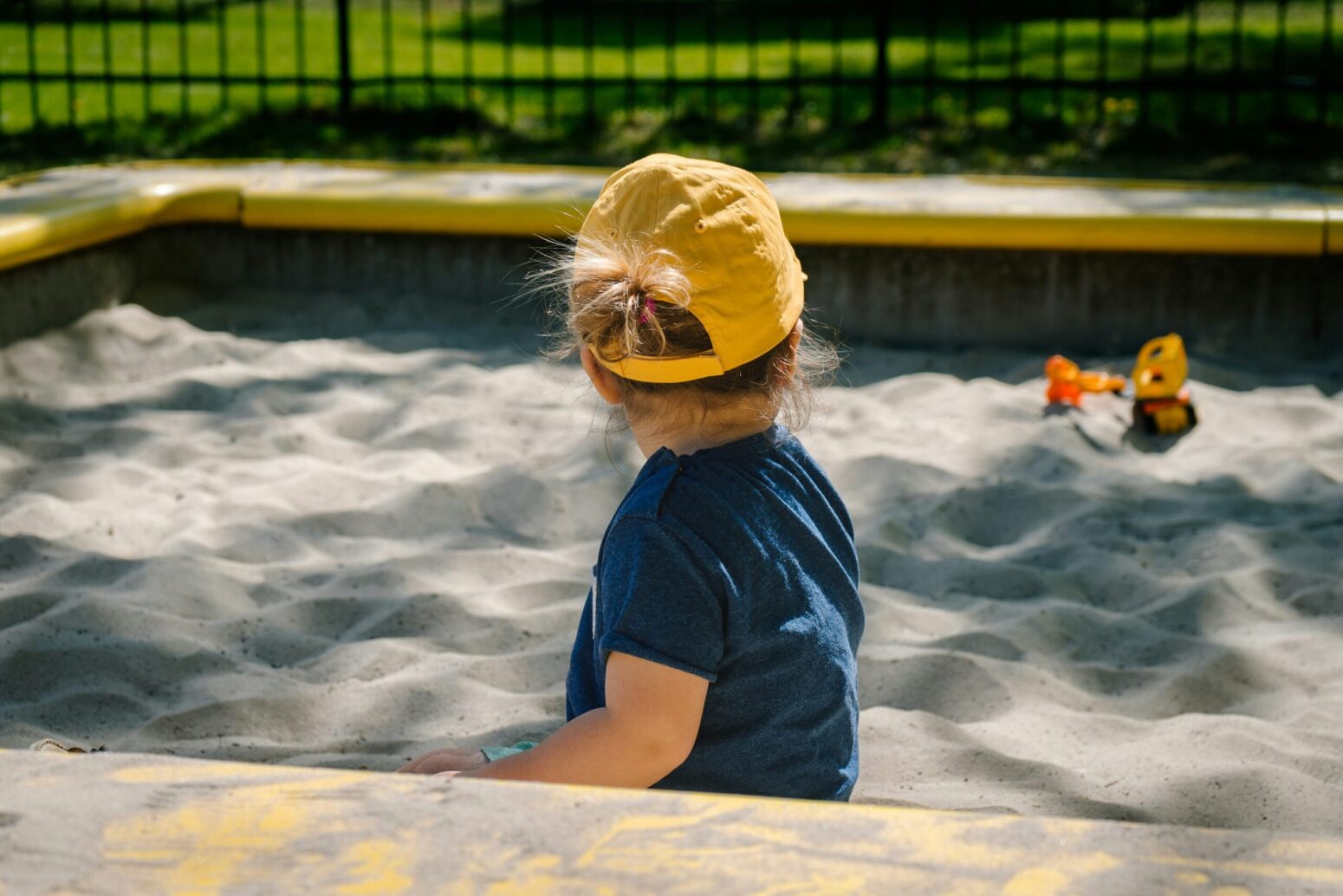
After a few weeks of park visits, I ask the woman if it would be okay to sit in the sandbox with Beth, watch how she’s playing and interacting with the playground. She nods, says she’s excited to hear of anything interesting I discover.
I try to walk steadily, the way drunk people do on the way to the bathroom so no one knows they’re drunk. Not too fast. Deliberate, like I do this all the time. I sit across from Nougatine and ask if I can help.
She hands me a plastic pink shovel. Her cheeks and chin red from the cool day. I want to touch her, but I scoop sand into her bucket instead. She says, “No, no,” covers her bucket with tiny hands and points at a spot in the sandbox where I am to pile the sand. I like how she’s sure of herself, bossing and directing the sandbox.
That’s when the woman says, “Can you watch her for a few minutes? I’ll be back in a jiffy.”
And I’m thinking how long is a few minutes, and who says jiffy, before I realize I’m alone with Nougatine, the two of us shoveling sand. It’s a normal day at the playground. Sun. Children. Mothers. Strollers. Laughing. Yelling. But it’s not normal. Nougatine and I are alone. To anyone watching, we look like an ordinary mother and daughter.
I watch her face for some faint sign she remembers me, even though I know she can’t. I hum part of a French song I used to sing to her while I was pregnant, but she doesn’t look up. She’s concentrating on keeping sand on the shovel. We play quietly for a while because I’m afraid to say anything that will break the moment.
An airplane scars the sky overhead, and Nougatine looks up, says, “Airplane.” I nod, and she continues moving sand from one pile to her bucket. I whisper, “Nougatine,” but she doesn’t look up. I say it louder. “Nougatine. Isn’t that a pretty name?”
She looks at me briefly, then pounds the shovel on a sand hill, flattening it. Her stroller sits obediently by the bench where the woman sat. I could pack her up and roll her out. Simple. Nothing I’ve ever done has been that simple. But then what?
Sun, low through the trees, flickers in my eyes. I close them, and light dances on my lids, bright and magical, and for the first time since I held her after she was born, I feel whole. I open my eyes to see Nougatine facing the sun with her eyes closed too. Like mother, like daughter. I close mine again.
The woman yells from the bench, “You two look like cats sunning yourselves.” Nougatine laughs, says, “Meow, meow,” and dumps the bucket of sand on her feet.
Time disappears, and the wind picks up as afternoon fades.
Nougatine’s hair is baby fine, wisps blowing with the slightest breeze.
That’s how I see there’s no pear-shaped birthmark at her hairline. I stare at the spot, waiting for another breeze that refuses to arrive. The mark must have faded. It has to be her. She lives in the house that matches the address.
When the breeze finally blows toward me, I want her scent to cover me. I want to smell chocolate, but I don’t. Just damp sand and dried leaves.
I look over to the bench where the woman is pulling a ziplock of Cheerios from the stroller bag. Nougatine protests that I’m not piling up sand as she directed, but I leave my shovel in the box and sit next to the woman as she stabs a straw into a juice box.
“Did you adopt Beth?” I say the name like I just tasted sour milk.
“What? Did she say something? She still gets words mixed up.”
“Sometimes kids play differently depending on various homelife issues they experience.” I don’t know where I pull this from.
“No. I carried her like this one.” She puts an arm on her baby bump.
“But you live . . . near here.”
“Yes, that’s why we come to this park. We moved here at the beginning of summer.”
The thing about autumn, the sun is harsh. It carves sharp shadows.
“The other family,” I say, “the one who moved out, do you know where they went?”
“Canada.”
That’s when it starts all over again. The same feelings of being alone, of having lost something important. My heart flutters, trying to escape, surely loud enough for her to hear it. “That’s a big place. Can you narrow it down?”
“I think Montreal, but I don’t know any more than that.”
The woman gets fidgety, says pregnancy makes her tired. She packs up Beth and heads for home, pushing the stroller along the path. I stay and watch wind chase leaves across the park.
I call out. “Hey, they speak French there, don’t they?” But the woman doesn’t turn around.
I watch other people’s children play until the sun is low in the sky and the air has a chill, then walk along the woods that separate the park from the road.
I remember the mother cat sitting at a vole hole for hours, occasionally sticking her paw inside, sometimes her whole arm, to reach her prey. Sometimes she got what she wanted, sometimes not, but she’d always be back at it in a day or two.
Read more from Issue 19.1.