On Inheriting Deafness
27 Minutes Read Time
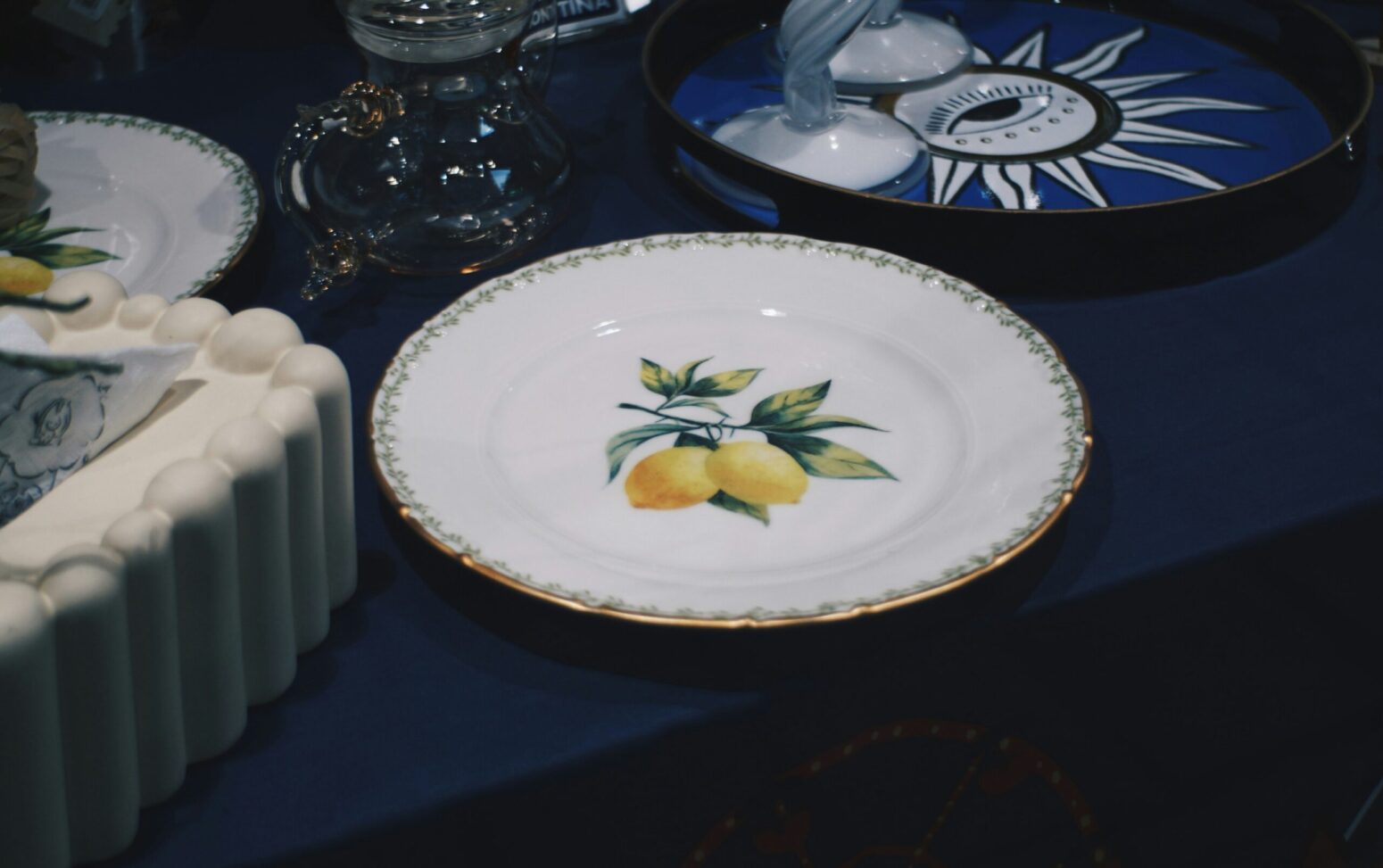
The first time she met her mother-in-law, my mom committed a faux pas that still makes her cringe. My grandmother, Anna, dropped a piece of Wedgwood—sky-blue stoneware, neoclassical designs—into Mom’s lap as they sat together in what working-class Philadelphians called the “pahlor.” Mom gushed her thanks, only to realize years later that the vase hadn’t been a gift. In my mother’s family, showing people your stuff is strange, even a little rude. On Dad’s side, where most of us are deaf or hard of hearing, it’s what gets parties started. Speech is evanescent, leaving behind nothing to examine, so quips, non sequiturs—basically, all forms of communal small talk—can be hard for us to grasp. Having something to pass around counters that transitory quality.
But did Anna maybe also like to dangle lures? She is an eager, soft-eyed observer of others’ hungers, just as she’s an expert trash picker and flea-market hunter. She’ll pluck a crusty ashtray out of a stranger’s recycling bin and scrub it up to reveal the crystal’s light-hugging facets, a famous maker’s mark emerging from the scum like forensic evidence. Similarly, she catches light—its needle-fine details—in others’ eyes. “Oh, do you like this?” she’ll say, a touch wryly. “When I die, it’s yours.” When I was a child and her death seemed far away, I was gratified by the promise that I would inherit a few of my grandmother’s many favorite things. Because she lavished so much attention and care on them—her carnival glass, her dog figurines, her collection of saccharine boxes complete with tiny tweezers—these objects took on a numinous glow. Of course, I didn’t want to be caught desiring them.
My grandmother is just as eager to detect signs of our rejection of her future generosity. She empathizes with the souls of belongings and practices the same brand of animism-lite that makes me sad when I spot a teddy bear poking out of a garbage bag. To present an item and see it met with indifference or distaste wounds her. She speaks passionately of giving these things “a home” or “falling in love” with them. Yet with her every gift or promised bequest comes an automatic escape clause, delivered with a blend of bright-eyed cunning and the fragility of a blown egg: You can always throw it out. When my grandmother asks me if I would like to inherit, for instance, her hand-carved springerle rolling pin or bedazzled toad-shaped pillbox, “no” is always the wrong answer. Still, she trails the bait, which must remind her of these treasures’ fate if she hadn’t rescued them from the curb.
Is this tendency perhaps connected to how deafness was passed down in my family? We have four generations—over one hundred years—of deaf history to look back on; had deafness been wealth, we’d be old money by now. Yet my relatives still talk about our shared disability in the language of a curse. A fever rasped away at an infant’s ears, which could previously detect the slim click of a pin dropped by her forever-mending immigrant mother. A blow to the head from a Depression-weary father left a corrosive ringing in its wake. I was once surprised to hear Anna refer to our type of progressive sensorineural deafness as the result of a genetic mutation. I admit I’d been caught up in the familial trend toward ignorance. I realize—and envy the fact—that some people are brought up with Deaf pride, but deafness was clearly not something my predecessors had wanted to give their children. Pride wasn’t even on the table. At the same time, they seemed to regard their deafness as the most powerful and distinctive thing they had. It was each person’s central drama, her tragedy, her mark of distinction visible underneath a layer of grime. Deafness was the ashtray that held the rainbow.
Once, glancing at my great-grandmother Apollonia’s silver-wedding anniversary portrait, I saw that her strand of pearls was more than it seemed. The picture hung, sepia-dim, in a corner of Apollonia’s living room. Hers was the kind of salt-and-pepper, thick-spectacled visage that glazed-over preteen eyes tend to whoosh past. But then I spotted Apollonia’s hearing-aid wire. In the early twentieth century, the flamboyant ear trumpets of the past gave way to espionage-inspired hearing instruments. You could style your bouffant around your battery pack, sport an insignia pin that sheltered a microphone, clutch a handbag that packed amplification along with your lipstick and comb. I imagine the resulting anxiety: businessmen tugging their sleeves over the wires running from their hearing-aid wristwatches, and women, on hot days, worrying that the garter belts holding their vacuum-tube battery cases might slip down around their ankles like a sudden birth.
This unease about revealing a hearing disability is hardly retro. The Americans with Disabilities Act passed a couple of weeks before my first birthday, meaning it’s only a little over thirty years old. It remains inadequate for the challenges of disabled life in America, and judging by the hiring practices of some of the companies I’ve worked for over the past decade, it’s obvious that I benefit economically from pretending to be able-bodied for as long as I can. Of course, the main reason I often neglect to disclose that I am going deaf is that I can’t get the words over my tongue. My knee-jerk shame feels like another inheritance, something that predates me, the dust that puffs off old bottles and pipe stems in an archaeological dig. When my kindergarten teacher first saw that my eyes followed her mouth around the classroom while she talked, I had no trouble believing the diagnosis she set into motion. But I felt bitter about what this revelation unearthed: I couldn’t control what others noticed about me.
Her observation led to regular audiology appointments at a state-funded institution that mostly housed disabled people whose families couldn’t care for them. The hallways were painted the chrome green of horror-movie asylums and echoed with shouts—not all of them miserable, I’m sure, but I wasn’t interested in distinctions. I flirted with making this place part of my mythology, fulfilling a family pattern in which deafness was discovered and then punished in banally evil ways. Everyone else had worse stories than mine: Apollonia’s teachers, Catholic nuns, had believed she was intellectually disabled and wouldn’t benefit from school, a prophesy they fulfilled themselves by exiling her to the back of the classroom. She wore the dunce hat, spent hours staring at the floor, dropped out young. Anna, too, lived with taunts of “deaf and dumb.” Her sister Marge was fired from a job after missing a verbal instruction. It had been hard for my forebears to imagine we’d be anything other than second-class citizens.
Was that why they didn’t seem half as jittery as me when it came to self-presentation? Apollonia’s pearls probably wouldn’t have fooled anybody, unless gazes were less scrutinizing in the decades before Photoshop and Instagram. Her hair wasn’t long enough to conceal the cord’s final leap to her ear. Could it be that by middle age she had shaken off any feeling of vulnerability related to those several inches of exposed wire? I’m told she was actually proud of the necklace, a rare gift from her husband. And I envy her ability to feel that way. Nothing designed to conceal something I’m ashamed of can bring me pride or pleasure; there’s only grim utility, a slightly resentful relationship with the object.
“I’m so sick of talking about stuff,” my mom often said when I was growing up. She worked at a mail-order collectibles company at the height of the limited-edition craze. Around us, people went into debt to amass Civil War chess sets, Princess Diana dolls, glass replicas of Titanic’s Heart of the Ocean. Part of Mom’s job was to alphabetize and file “stuffers,” advertising postcards slipped into, say, credit-card statements. You drew out your invoice, and out fluttered a hidden traveler, dangerous as the seeds of an invasive species carried in a bird’s bill. I remember my childhood friend K.’s mother showing up at our door, gripping a stuffer with panicked urgency—could Mom hook her up with the new Wizard of Oz bell jar? She wanted her daughter to have it.
Because her words puzzled me, they stuck with me for a long time: I want her to have it. I still can’t figure out why anyone would desperately want something like this—Dorothy, Toto, and company posed, static, under glass—for another person. K. wasn’t even a fan of the movie. Was it an illogical stab at establishing a college fund, the way the parents of another friend discussed their tropical retirement plans as they sealed their Beanie Babies in protective plastic? Was K.’s mom embarrassed to say that she herself wanted the palm-size scene of a motley crew on an odyssey to obtain the fundamental thing each character longed for? Was her daughter a chance to create the perfect childhood—complete with tiny red-glitter-frosted shoes—that she’d missed out on herself?
The point is, I couldn’t imagine wanting something for someone else that they didn’t request. I’ve never fantasized about passing on my DNA or possessions. That includes things I like—my long arms and handloomed throw rug in sunset colors—as well as things I’m more ambivalent about, such as deafness and the wooden crucifix my grandfather carved for me, red enamel dripping from each nail’s entry point. It’s not a matter of possessiveness, nor the belief that what I have to offer is so bad. Giving somebody something is making a claim about that person, and I don’t feel bold enough to do that. Every Christmas, my mom gets me a funny T-shirt; one year she branded me as “Silently Correcting Your Grammar.” I don’t think I’m that unpleasant to be around, and I feel the burn of English-major impostor syndrome whenever I wear the shirt. We’re all usually missing the bull’s-eye when giving gifts, but it’s me who’s unwilling to concede that not everything has to be so on the nose. Around the holidays, I’m the one who suggests we do away with presents, perhaps because I resent the effort, the perfection that I assume is necessary to find the precise thing that lies at the confluence of another person’s interests, values, personality traits, and mercurial food sensitivities. I fear I won’t be forgiven if I misunderstand or misread the recipient.
When I think about passing on deafness to another person, it’s not deafness I don’t want to give, but the adjacent shame and loneliness I’ve struggled with. I’m afraid of unconsciously saddling a child with my bad attitude—not to mention our imperfect world, which is a given. But I’m also afraid the kid would trounce me in the art of Deafness, become scornful of my faltering, middle-of-the-road approach. To be clear, I’ve never actually wanted kids. This makes it easier to imagine how I’d raise them, and ultimately, I get the relief of reducing these thoughts down to nothing, a clean, empty room.
Clean rooms—this was the topic of my parents’ most frequent arguments. Dad couldn’t bear to throw anything out, leaving our house scattered with items amassed for no clear reason. Mom thought Dad’s collections were irrelevant compared to people. Dad got angry that Mom trashed first, asked questions later. She was quick to deliver the judgments of “ugly” or “stupid.” Both talked on different scales. Dad: kitchen-drawer detritus, the spider webs on the birdbath, the penny on the sidewalk. Mom: how to build a middle-class, two-kid, two-car life. Their battles were a question of priority, rank, orders of magnitude. Who, or what, was most important? Dad constructed most of his stories fumblingly, with the inanimate, not humans, as the subject: “Engine bay was a real shithouse. Wires and vacuum lines mangled. Packed with sticks. Turns out to be a nest of squirrels, he tells me.”
“Who’s he?” Mom would demand, leaping on the life raft of the drifting pronoun.
“Jeff!”
“Start there,” Mom would urge. “Start with ‘My coworker Jeff . . .”
When I hear a story about a nest of squirrels attracted to the heat of an engine, I think about trying to forge a life within narrow constraints. Leaves to sleep on, hoarded acorns, deceptive safety, and ultimately, death and destruction. Then there’s Jeff’s discovery and dismay. But my father tells his story from the engine’s point of view: a breakdown resulting from the introduction of a problem, a blockage that clogs the smooth-churning pistons. I’m indignant: isn’t malfunctioning machinery beside the point? Shouldn’t his sympathy reside with the squirrels?
For years, my father didn’t even ask that the family budget accommodate new hearing aids; instead, he wore a grubby, taped-up device that scarcely did anything for him. In this one area, he exhibited learned helplessness; if my mom didn’t read his mind and set aside funds for what he needed, he just continued his cloaked hints. I’m the same. Sure, I grew up thinking everything was mine: name-brand snacks, the entitlements outlined in the United Nations Convention on the Rights of the Child, all the Pokémon cards. Dad would unleash his temper on me while Mom worked the night shift at the collectibles company, and the next morning, I’d always recollect my self-righteousness like a juicy dream and rat him out to her. But I flinch when asking strangers or even hearing family members for a repeat or necessary accommodation. My self-regard loses out to the soft-bellied part of myself that believes I’m subhuman. I don’t mean to sound self-pitying. This feeling strikes me as both common and correctable, like trash on the ground. It’s countered firmly by my assertive side: Pick that up!
But belief in my deficiency has been casually pooled, along with belief in my first-child specialness, into my palm like the twisted silver chain of my grandmother’s amethyst locket, which I’m told will be mine one day. It was given to her not by some Victorian ancestor but by my mom, who chose it with great care: her mother-in-law’s favorite color, a filigreed case that splits to reveal tiny pictures of my father and me.
The pink-ribboned toddler facing him down in the locket would grow into a sheepish traitor. I didn’t get along with Dad and even helped to police him, hushing him with an urgency that clicked a notch or two past typical adolescent embarrassment. Dad could be thoughtful, creative. No visual detail escaped his notice. He also tended toward passivity, defeatism, and coarseness. He’d belch in the mall or shout about shit and blood in a semi-crowded Applebee’s, not imagining or caring that others could hear him. For various reasons, he didn’t have a finger on the pulse of what was middle-class appropriate—at least, not the same pulse Mom and I probed worriedly. When I too sometimes talked loudly or failed to respond to remarks in public, Mom and I both winced. The two of us often thought in tandem and spoke in unison, and we both feared I might be found rude or unintelligent.
Shame is hardest to shake when it’s intertwined with love. Instead of a big wedding, my mom had wanted to elope, maybe fearing that somewhere between the vows and rice-throwing, Dad would pu-licly embarrass her. Still, bending to familial pressure, she visited a catering hall with an in-house wedding planner who spread his arms and said, “Tell me: What have you always dreamed of?” In the telling, Mom always gave the word “dreamed” a Julia Child–like spin. She wanted children and a home of her own. Neither chicken nor fish had ever featured in her dreams, not even symbolically. But she figured everybody liked lobster, and when Anna claimed her side of the family wouldn’t touch such rich food—baked ham, she believed, was the sensible choice—Mom split her order accordingly. On the big day, the lobster eaters dug in as the ham eaters’ indignation fizzed like Alka Seltzer. They were the poor relations, the deaf relations, and now they had a far more palpable reason to be aggrieved. They only had to point to their plates.
Mom presented her mistake as a wholly innocent one, but I wonder if she’d been a rebel on some level. Hating mind games, valuing straight talk, and quietly resenting having to plan a wedding she hadn’t even wanted, she’d decided to take my grandmother at face value.
If someone puts a piece of Wedgwood in my hands, I assume they are giving it to me, Mom says, forgetting to use the past tense: assumed. Of course, she swiftly became an unwilling expert on the manners and mores of Dad’s side of the family. That meant realizing that Anna’s claims about not wanting indulgences—buttery delicacies, department-store gifts—were part of an exercise in martyrdom. At times, my grandmother seemed to see herself as a shy guest in the world of others’ largess. I could piece together an empathetic story about why she might feel this way. Anna had relinquished many of her life’s dreams. She’d wanted a career as a dressmaker, but being self-supporting as a deaf woman was perilous in those days. She married a man who didn’t believe wives should work outside the home—and how could she have, with four children and a Navy sailor husband off at sea for up to two years at a time? Although she never gave up making beautiful clothes for herself, she preserved the tragedy of sacrificed talent: an underground atelier of dress forms with floral vines growing around them, secondhand chandeliers trembling and sparkling overhead. Simple food, she claimed, was all she needed. But what did she want? This could not be pried from her. My mom professes not to understand martyrdom and wonders why anyone would feel pride because of self-denial. I get it, though, because I’ve found that same succor in the absence of more straightforward ways to accept myself.
Despite our conflicts, as a kid I often ventured into Dad’s sanctuary, the basement. He’d make it clear that he wanted me to leave, yet I was drawn to his hoards of treasure, mounded up darker and dirtier than my grandmother’s in appearance but not in spirit: buckets of feral-smelling nuts and bolts, broken junk he planned to fix or Frankenstein, power tools with deadly teeth I’d caress fearlessly. From a rafter hung a ship’s bell he’d inherited from his father, who’d stripped it from a warship during a post–World War II salvaging mission. Dad voiced regrets about having truncated what might have become a family naval tradition because he wouldn’t have passed the requisite hearing test. He disliked the ocean and was prone to seasickness, but he still craved the authentication. To my mind, this gave him dimensionality; he stood adjacent to another version of himself, even as he took pride in his work as an automotive mechanic. Instead of pushing away the memories and artifacts that triggered his regret, my father managed to coexist with them.
Designed to cut through high winds at sea, the sound of the ship’s bell destabilized our house when Dad would get in a certain zany, manic mood and ring it. My brother, who hadn’t inherited deafness and feared the bell’s cilia-leveling tolls, used to clap his noise-canceling headphones over his ears and scream in pain I suspect was overplayed. This became one of many recurring family battles: “Dad’s ringing the fucking bell again!” But when I was a child, I loved it. The clanging felt like iron under my feet, waves in my mouth, bees stinging my ears but also leaving honey. I realize I’m always looking for objects that encompass my particularities yet dismantle them, choices that feel both tailor-made and counterintuitive.
For most of my life, I noticed almost nothing about how my father preferred to converse. Now I see that his preference was—is—to sit close to someone, with the details spread out in front of him like a newspaper: his coin collection, a shoebox of blood-drained Polaroids, or even just a stack of takeout menus. What he didn’t like was working hard to listen. Dad needed to speech-read and use hearing aids for verbal comprehension, but he didn’t always bother. When he struck up conversations without amplification or the willingness to focus on my mouth, we talked at cross-purposes. And often I’d get annoyed with him, snapping, “Never mind. Forget it.” I refused to see that the spirit, willingness, and turns-taking of an exchange were more important to my father than its contents. He’d ask questions, and I’d give answers that sat between us like a wrapped package he made no move to open. The gesture alone seemed to be enough for him. I didn’t think it was enough for me; I wanted conversations that meandered and made new, that burst open in clouds of confetti. Helen Keller described deafness as “the loss of the most vital stimulus—the sound of the voice that brings language, sets thoughts astir and keeps us in the intellectual company of man.” It’s worth pointing out that Keller found the language to craft this complaint.
But I believed her. In the social model of disability, it’s acoustically poor restaurants, “open” offices, laughably bad voice-recognition software, and incurable mumblers—not my body—that are responsible for disabling me. Progress to optimize the world for the deaf and hard of hearing is slowgoing, despite the speed of technological advancement. Why does the autogenerated captioning on YouTube regularly produce phrases like, “The puppies are grunting the banana hospital?” Why did my iPhone once autocorrect “deaf” to “dead?” Not to mention that HVAC systems remain loud. Chipotle workers can be impatient: Do. You. Want. A. Side. Of. Guac. With. That. Even the people who know me best assume I can hear in settings where I’m deaf, like dark rooms or the back seats of cars. In short, some concession is required on my part: in the realm of language, I can’t have it all.
In college, I became enamored of American Sign Language after seeing two deaf students chatting from opposite sides of a loud café in which I couldn’t make out anything my acquaintances were saying, beyond category-level recognition: anecdote, explication, the light hacky-sack toss of communal banter. My ideas struggle to join others’, which frustrates me. It has always been a fantasy of mine to be a sparkling conversationalist, able to jump topics with wit and grace. Which is inconvenient, because it’s difficult or impossible for me to live up to my punishing standards.
But I’m no more likely to take up American Sign Language as my primary mode of communication or assimilate into capital-D Deaf culture than I am to learn Greek or become a convincing Parisian. If you’re not born with a language, becoming fluent requires an orderly convergence of opportunity, desire, effort, and exigency. In our it’s-never-too-late society, it feels sacrilegious to suggest I can’t learn. But I doubt I’m exceptional enough to reinvent myself, and maybe my efforts are better invested in figuring out how I don’t have to.
While I was growing up, my grandmother Anna had plenty of opinions about me. She thought I was spoiled—fair enough—and was sure I’d look better with spiral-permed hair. Whenever I sang for her, she believed my off-key voice was sublime, the envy of angels. But she never aired her views on disability and me. Up until my birth, deafness in our family had been matrilineal; my dad broke the mold. Although his views on the “one correct way” to fry an egg or load the dishwasher sparked many minor rebellions in our household, he too remained silent about the many microdecisions that go into managing a disability. We stopped managing mine when I was in third grade, and I didn’t get hearing aids again until college. In between were years in which my deafness went untracked but flourished, a plant that’s resilient despite being ignored. I get the sense my father and grandmother watched with curiosity and vicarious eagerness, leaning forward to see what my mom would do. Would she raise me just as boldly as she’d walked out of Anna’s North Philadelphia row house, hoisting that Wedgwood vase like a stolen prize?
Not exactly. I was brought up to believe I had no choice but to support myself with a middle-class salary and that I would have to downplay and compensate for my disability. It takes a special kind of bravery to thrust forward what you fear will not be enough. In my first job after college, my armpits used to sweat whenever I answered the office phone. “Sorry, didn’t quite catch that,” I’d keep cheerfully repeating, hoping my upbeat tone would ward off customers’ annoyance. And for the most part, it worked; it’s not hard to scramble others’ signals, to convince them they can’t pin down what they think they know about you. “Passing” is a shared conspiracy.
I imagine it’s my mother’s more robust sense of entitlement that brought me closer to conventional success than any of my deaf family members experienced. I’m a freelance writer, so I shouldn’t claim that I have financial security, except with a sense of humor, but I’ve at least side-stepped hard physical labor or resentful dependence on an able-bodied spouse. I rely on my mom’s language of excision, which involves cutting details that seem self-pitying, impoverished, marginal. But I also share a lineage with those details I’d edit out—Dad’s underground city of scrap metal, Anna’s palace of flea-market finds. And here, my deaf relatives condescend to me a little. I don’t know brass from bronze or crystal from glass, there are certain chipped corners I’ve barely noticed and bruisy tones I can’t even perceive. I’ve sometimes wondered, Do they even know I have inherited deafness? Which sounds plaintive, ridiculous. Yes, of course they know. But they know like the wire sneaking up Apollonia’s neck, not like the ship’s bell.
Once, my grandmother asked me if I wear pearls when I “dress up for fancy parties in the city.” She clasped her arms across her chest and performed a closed-eyed sway. I was torn between hating to disappoint her with my life’s lack of glamour and feeling fairly sure that, since Anna remains shrewd in her advanced age and I am the poster child for introversion and sweatpants, she already had her answer. Was this her idea of a little dig: why, given my comparative advantages, wasn’t I thriving harder? Yet she is never consciously unkind. Maybe she was borrowing novelistic language to dress up, in an evening gown and vintage jewelry, a fairly simple grief. In imagining that my life would be even more dramatically different from hers than it already was, she’d taken it for granted that a mysterious transformation would occur, water-into-wine style. She’d had faith in a better future, here apparently represented by champagne and twinkle lights, but perhaps—if I can lay aside my resentment of her expectations to give her the benefit of the doubt—far more sweeping and idealistic than that.
Another time, my grandmother asked me, “What sayings of mine will you remember after I’m gone?” We were sitting down to Christmas brunch, a meal that’s usually pretty quiet except for the slamming of utensils against dishes. She attempted, haltingly, to clarify: “Maybe after I die, you’ll say, ‘As Gran used to put it . . .’ or ‘Gran always said . . . ’”
I had to admit, “I’m not sure.” I’ve never had the knack for reproducing dialogue or attributing sound bites to others. You expect your loved ones to know you—or at least, to acknowledge the pieces you are trying to arrange into an illusory whole, but of course, that’s not a condition of family: to know you the way you conceive of yourself. If it were, maybe I’d have an aphorism to pass back to my grandmother. It’s not that she prides herself on pithy sayings; I think she hopes I’ve caught what she herself has missed. She’s groping into the future for validation, I’m groping into the past, and neither of us can reach the other’s hands.
Maybe what I’ll hold onto is the memory of how much I liked to visit her when I was a kid. After my grandfather died, she moved to a twin split-level about a mile away from my family’s home, and I walked over frequently. Anna’s doorbell was wired to a table lamp that flashed gently, a casual herald. From her front stoop, I could see the lamp pulsing like heat lightning through her sheer curtains, her mirrors carrying the message to wherever she was in the house. Often, I’d just walk right in. “Coming!” she’d shout from her sewing room or kitchen as I strolled around the “pahlor” tweaking the tassels on her drawer pulls, stroking her porcelain animals.
I was inside of my inheritance.
Which was a feeling, not a place or collection. Though Anna has since moved to a condo with less space and strict rules about what residents can display in their windows, I still get a certain impression when I walk into her home: a sense of ease and reprieve from disconnect. Sure, these days I’m often slightly on the defensive because I know I will be called on to answer the same impossible question: Do you want this?
Recently, a vintage mohair dog with lightly scratched eyes: “I wish somebody would give him a home after I die.”
My aunt, who hadn’t visited or played this game in years, piped up, “I love him!”
“You love everything,” Anna countered, whisking the dog away.
But the split-level house accommodated and even harmonized the conflicting details that eluded us in conversation. Cat figurines, chipped candy dishes, pastoral landscapes, The Pop-Up Book of Sex: everything worked, somehow. Her wall-size print of Dante Gabriel Rossetti’s Veronica Veronese, the identity of which I learned after stumbling on the original in a museum, always gave me pause because of the extreme limpness of its Pre-Raphaelite subject—she can barely hold her head up. But actually, this is creativity in the making, Lady Veronica composing a melody on her violin while gleaning inspiration from the canary in the corner. Sharing a room with this print were several peacock feathers, a Victorian Barbie, a resin rabbit asleep in the palm of a leaf, and many other choices reflecting a maximalist’s tastes. I won’t even try to parse the thousands of decisions my grandmother made to craft her surroundings, her home, which seemed as alive and ever changing as her orchids and geraniums. I just know what it felt like to experience how the objects echoed and complicated each other, striving toward harmony but also toward surprise and purposeful dissonance. When she asks what I want to remember her by, I try to tell her this.
Read more from Issue 19.1.