
Overgrown Stairway: Richmond, Indiana
5 Minutes Read Time
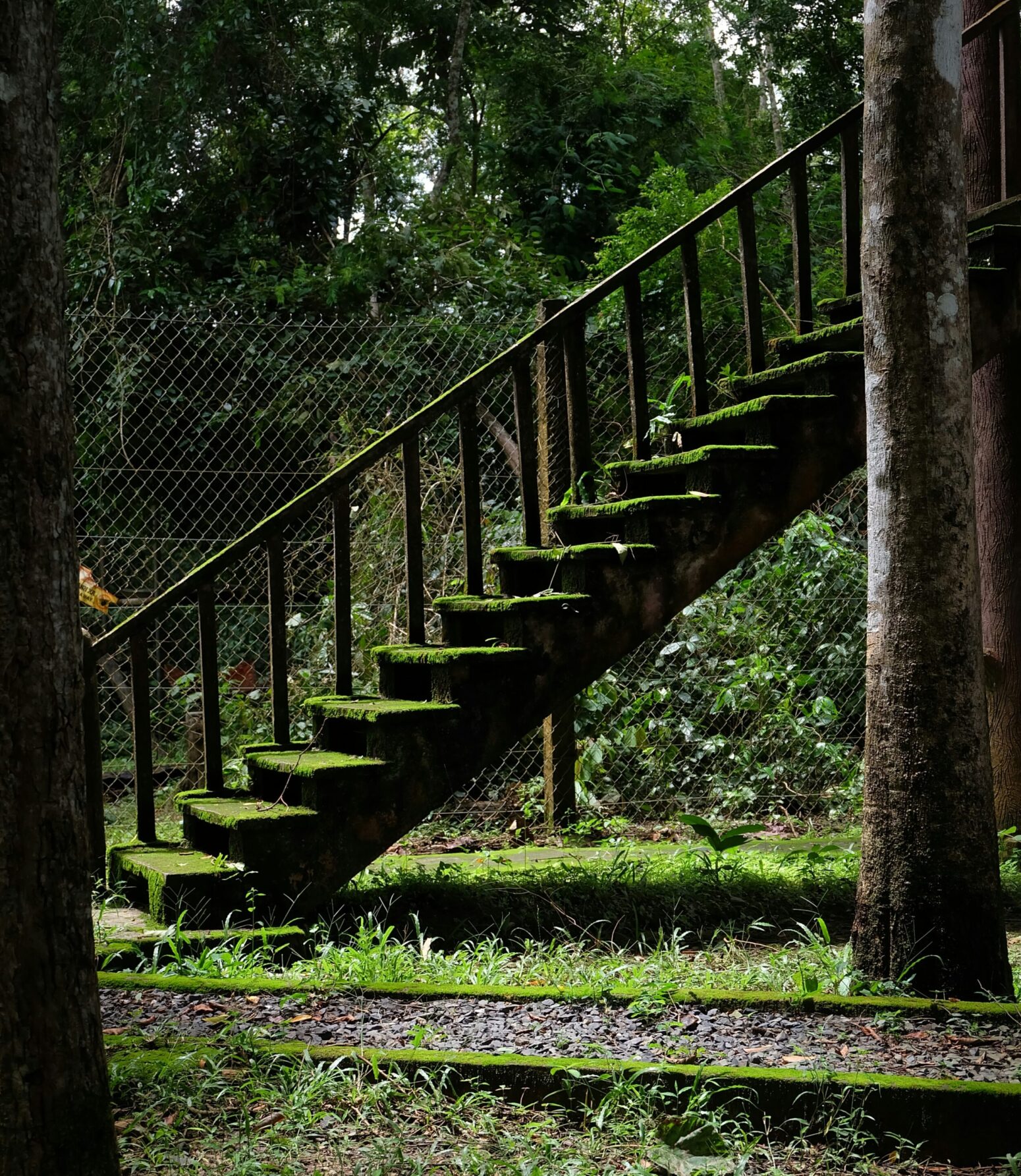
(Between South Second Street and the Whitewater Gorge)
I make my way along the old railbed where the train used to run on the eastern edge of the Whitewater Gorge. The train rolls through town on a different track now, but on quiet nights, or when the wind is blowing in the right direction, its whistle is still clear from my apartment. Before, the whistle would have been close enough to startle me awake. My windows would have rattled.
This is a crumbling postindustrial town, but it used to be bustling. They built cars and lawn mowers and pianos, wove cotton underwear. Roses bloomed in acres of glass greenhouses. Now I know this place by the scent of burning plastics one day, of dog food on another.
I stand on the railbed looking over the Gorge. In the first half of the twentieth century, workers would have used the old walkway that passes beneath me. They would have descended the stairway on their way to the piano factory or the recording studio. Nowadays, in summer, the railbed and stairway are overgrown with grass and weeds and leafy branches, and I don’t walk here. But it is fall today, the first really cold weekend of the season, and the leaves have fallen, clearing the view from the trestle to the river.
The upper opening of the walkway is mostly filled in by dirt and vegetation, though there’s still a space large enough for rainwater and animals to slip beneath it. I scoot down from the tracks on a concrete support structure. On the low side, the closed-up walkway is a sort of man-made cave scattered with garbage: soggy disposable diapers, empty cigarette packs, plastic bottles, candy wrappers. The walls are scribbled with graffiti. Green broken glass glints in the dirt. Someone might have camped out here for a time, or fucked, or smoked a bowl, or shot up. I make my way to the stairs, a tunnel through the leafless trees, down the slope to the Gorge, too steep for safety, with no handrail. At the bottom of the steps, the gravel is split where rainwater has eroded a groove on its way to the river. Someone has dumped a pile of old shingles and siding.
They stopped making pianos here in the 1950s, stopped pressing records in the ’40s. In the ’70s they tore down most of the six-story factory. Just last year the city tore up the rails on the trestle above me, leaving behind the overgrown pathway and a few creosote-coated ties. The people who used this route are mostly dead now.
These stairs are like a dying language. I have heard that one Plains tribe had a particular word for the ocular ridge around a bison’s eye, but after the animals’ numbers dwindled and the wide yellow fields stretched like a flat, unbroken sea, the word was forgotten. That could be apocryphal, but the point stands: If the thing a word names is gone, the word, too, disappears. I wonder if the converse holds true: Can we forget a word to erase the thing it names?
I imagine the workers on their way to the piano factory. Men in coveralls or pants with suspenders. Women in wool skirts. They pause in their conversations as a train drowns out their voices. They swing lunchboxes as they stroll beneath the rattling boxcars. One whistles on his way down the steps. Of course, some of the walkers don’t work in the factory at all but wait instead on the loading docks with shoeshine boxes or stacks of sandwiches, or they go by the piano company on their way upriver to catch a few fish. Some are kids cutting across the Gorge to school. Some are on their way to the studio to assist a trumpeter and singer named Louis Armstrong, who isn’t quite famous yet, or Jelly Roll Morton, or Duke Ellington, all of whom will record some of their earliest songs here, pausing when passing trains shake the needle that scratches the music into wax.
But anyone can hire the studio. They also record KKK singers performing songs from their rallies. Some of these strolling, whistling workers who kneel to tie a shoe or bend to pick a stone out of their sock—these ghosts that tip their hats to me—are walking home to eat the dinner their wife has made, and then will go out again under cover of darkness, to a Klan meeting, or a rally, or worse. They breathe the scent of the burning torches. They feel the boil of hatred when they raise their voices in chorus.
To you ghosts moving past me on these stairs: I will the ice to grow slick under your boots. The rails on which your trains rolled, we have torn them out. These old ties are rotten, the trestle in ruins. Water erodes your walkway. Moss consumes the stairs. The trees reclaim them. I write these words so I don’t forget that you walked here too, but I will not cut this pathway open again.
At the bottom of the stairs, a snap of branches. A rustling of leaves. I wonder if my ears know the difference between the sound of a startled deer and a person rolling over in a tent. I pause to listen, but hear only chittering birds, water running underground, tra∞c humming on National Road—all distant. I stand at the center point of a radius of silence.
note: Material from this essay was inspired by the “Fiery Cross” episode of History Detectives on PBS (season 10, episode 2), and the “Starr Piano Factory” page, part of the Morrisson-Reeves Library’s Lost Richmond series.
Read more from Issue 15.1.