Casting the Body
7 Minutes Read Time
The Cincinnati Review: Brandon Ahmad Haffner’s “The Route” appears in issue 23.1. Today, he shares a bit of family history to accompany his story.
My Grandpa Sufi was a sculptor. As a kid wandering through his dark house I’d grant a wide berth to the half-finished busts on the dining room table, rebar jutting from clay stumps like severed femurs, hunks of white plaster body parts littering the floor.
“Cookie,” he’d call me in his shaky voice. He’d rub my head, pull me against his skeletal frame. His clothes reeked of cigarettes, breath of booze. “Beta,” he’d say. In his accent it sounded like “beh-tay:” son, dear one. A Hindi word, I’d learn later, though he didn’t speak Hindi. I never heard him speak his native languages: Urdu, Punjabi.
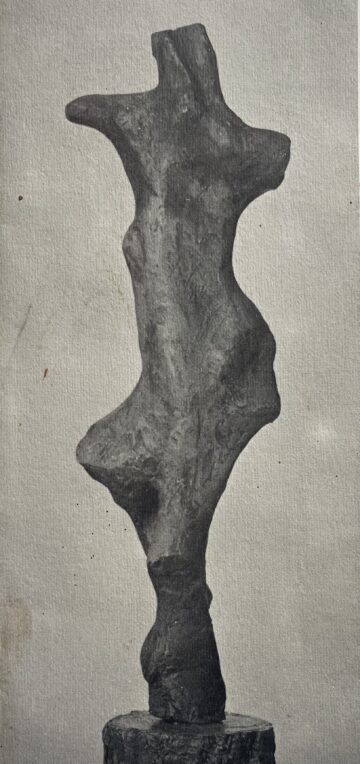
When he felt well enough to work, I’d stand in a corner and watch him. His watery brown eyes focused like lasers. Tufts of gray hair grew wild from his head like intelligent weeds. A cigarette hung so loose from his mouth it threatened to drop and start a house fire. When he was done he’d stand and grab his back and say, “Oy!”
My brothers and I started to say this, too. “Oy!” we’d say, climbing off the couch after watching a long movie. “Oy, beta!”
Sufi grew up in 1940s Lahore. His father was a well-known poet who worked as the Head of the Department of Persian Studies at Government College. They lived across the street from a mosque but never attended. Sufi’s father would drink whisky in the evenings, and as the story goes, sometimes he’d pick up the whisky bottle and shake it at the mosque in mock rage.
I picture Grandpa Sufi as a ten-year-old child, watching his father laugh at organized religion, those watery, intense eyes full of wonder.
In September of 1961, with an M.A. in Fine Art in hand and a grant from the American Friends of the Middle East, Sufi boarded a ship and came to the US. For a few days he stayed with a family in Chicago who fed him bacon for the first time, taught him to eat with a fork instead of his hands.
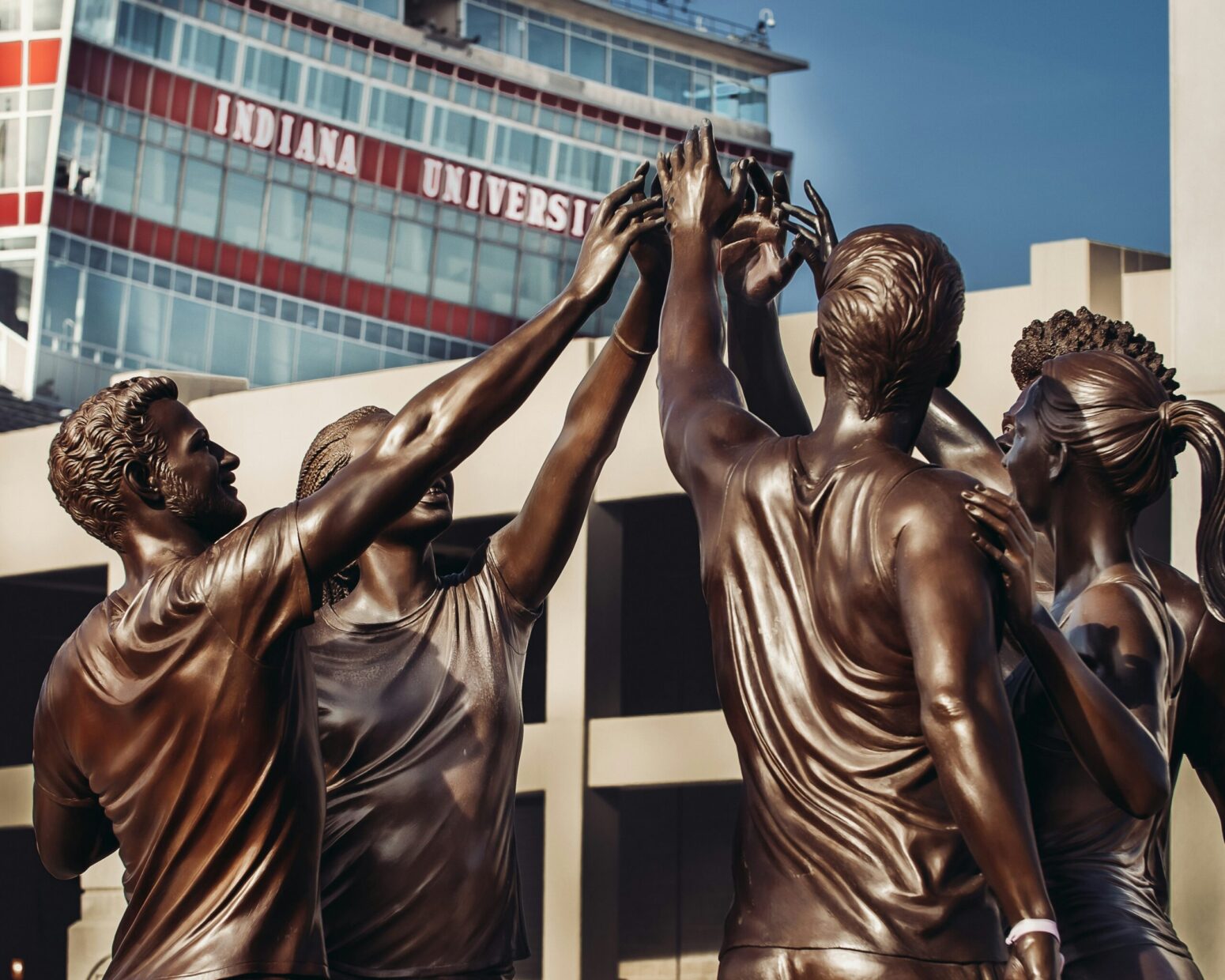
His post-graduate study was at Indiana University, the school I’d attend over forty years later. He loved the beautiful trees and limestone buildings on campus, much like I would. He was one of the artists who first installed Showalter Fountain. It was a fountain I passed often—and, once, on a date, in the middle of the night, stood ankle-deep in, staring at the night sky.
He met my grandmother, Rosemary, a pianist, in their dorm’s cafeteria line. I met my long-term partner in the Memorial Union at an arts magazine meeting. Sometimes I couldn’t help but feel I was following right behind him, that every patch of grass, every wooden bench, every scuffed-up bar counter had been experienced by Sufi, too. That he’d run his hands along them.
Sufi and Rosemary married and had kids while at IU. My partner and I moved in together a few months after we started dating.
As many couples in the arts and academia have to do, Sufi and Rosemary traveled from city to city pick up residency gigs, short-term teaching contracts, tutoring jobs. Anything that would pay them enough to live.
Then, about a decade they first met, while they were living in Wooster, Ohio, Rosemary was accepted into a PhD program in Tennessee. She left. He stayed behind.
By the time I was a teenager, Grandpa Sufi was often bedridden. He’d yell from his bedroom in pain, call for help, demand things. Water, pills. In his sleep he’d roll around and mumble strangely, as if some monster in his nightmares wouldn’t leave him alone.
We’d often find half-empty bottles of vodka or whisky tucked into strange places around the house. Next to the spray cleaner under the kitchen sink. Behind the toilet. Buried in dirty laundry in a bedroom closet. My mom and uncles tried pleading, interventions, but nothing worked.
He died on December 4, 2011, fifty years after he’d come to the US.
Family and friends gathered around his hospital bed to hold his hand for the last time. We stood packed in the hospital room for hours waiting for him to die.
When the moment came, his mouth widened like an alligator’s, a body begging for one last breath.
Twelve years after he died, my own life ruptured. My long-term partner and I had a wedding followed almost immediately by a long and painful break up. There was a lot of crying and confusion, and I started to drink recklessly. A few months after the breakup, after several consecutive nights of bar hopping in Lisbon, I had a health scare.
I stopped drinking for a long time after that. I often thought of Grandpa Sufi.
I’m often thinking of Grandpa Sufi even now, whose sketches and statuettes adorn the walls and windows of my new apartment.
The child-me who found Cutty Sark behind toilet bowls or stood by while he collapsed drunkenly into crowds of strangers would never have put it this way, but I looked up to him. He wasn’t alive to celebrate my acceptance to an MFA program nor to read my fiction. But as a child dreaming of becoming an artist myself, I was studying him. How would it be? What did a life dedicated to art look like?
I knew him, remember him, as an alcoholic, his mind gone before we could talk seriously about art. And so I admired him, and so he infuriated me. My mother often says I never met the man who was her father. That man, she insists, was a charismatic intellectual, beloved by his students. He’d discuss with you any manner of subjects—religion, politics, existentialism. He hosted late-into-the-night parties, the kind that attracted Fort Wayne’s artists and musicians and academics.
“But,” she told me, “I have no memory of him drinking back then.”
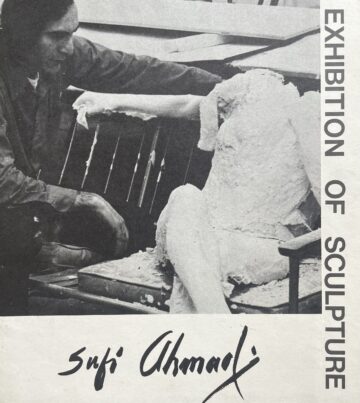
Recently I found an interview he gave in advance of an exhibition of his sculptures at the College of Wooster Art Center on January 7, 1973. The exhibition depicted plaster figures in cages. The interview reveals a man I never knew. Here is his response to the interviewer asking why he cast his models in plaster rather than work with clay:
By going straight to the body, I am trying to do away with what distracts me from presenting man as he is, not as he ought to be. When you are working in clay, you are trying for muscles and bones and the end product comes out revealing that. It shows you are very muscle-aware. When I cast the body, these things are automatic. They come. Structure is there. You can’t do away with it. This is the way the person was. This is the way he stands right in front of you. What I am saying is that I am trying to discover myself.
Later this same year is when his relationship with my grandmother would come to an end.
“He kept saying I was the love of his life,” my grandma told me.
The interviewer at one point notes that none of the figures in the cages are touching each other.
“They are totally cut off,” Sufi says.
The interviewer says, “Suffocation is possible because a vacuum exists between the figures.”
And Sufi says, “You can suffocate within your own self.”
