Vigil

43 Minutes Read Time

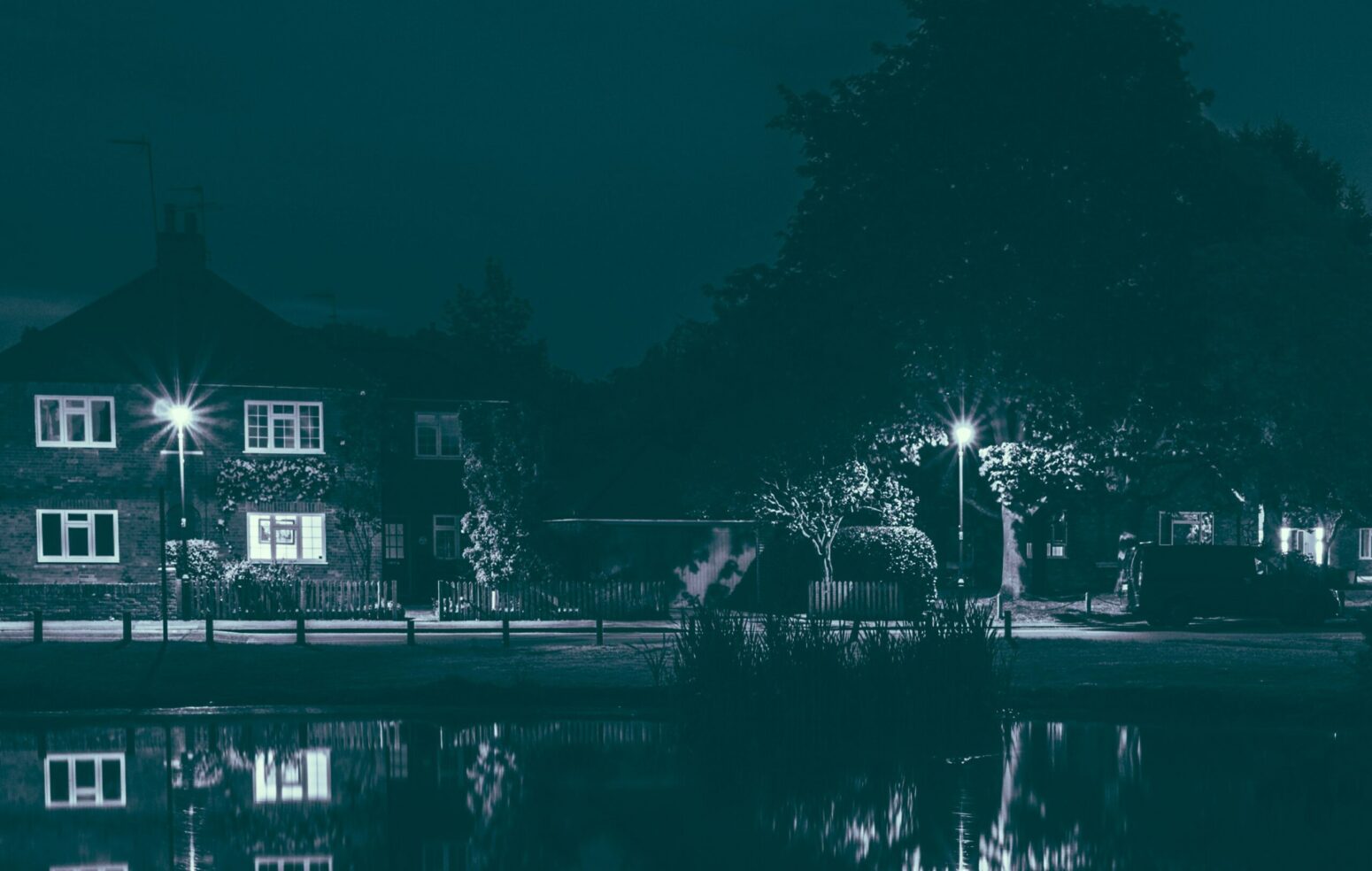
A view of a pool, house, and trees at night, all dark except two streetlights
Photo by Jamie Street on Unsplash

I remember feeling a restlessness in my twenties and moving quite often, not always to different cities or parts of the country, sometimes just to different apartments within the same city. Usually there was a reason for moving—grad school, a job opportunity, a relationship—but not always. Sometimes it was just the sense that I was not in the best place for me at that moment, that another place might be better. In those years, I could fit everything I owned into the trunk of my car, and when I moved, I’d simply buy new furniture, or else I’d make it (I actually got pretty good at building bookshelves), and I remember even now the excitement I used to feel the moment I arrived, the thrill of walking around my new neighborhood, making new friends, starting up new romantic relationships, embarking on new projects, but of course eventually that enthusiasm would fade, the novelty would wear off, and I’d find myself looking on to the next place, wondering what was coming next.

It was during this time—maybe around the age of twenty-five or twenty-six—that I found myself living in a small garage apartment on the south side of San Antonio with a woman named Daria Kosek, an artist and documentary filmmaker who had been, for a short time, a coworker of mine at the San Antonio Museum of Art, where we both worked as gallery attendants in the late afternoons and evenings.

Daria only stayed at that job for a few weeks, and I left shortly after her, but we kept in touch and remained friends, and later, when we both found ourselves unemployed and looking for a way to reduce expenses, decided to live together in this apartment that Daria’s older sister had found.

The apartment itself wasn’t anything special, just a standard two-bedroom with a spacious common room that sat atop a large three-car garage. It was owned by a German couple, who also owned the main house, but we saw them only rarely because they lived in Colorado for most of the year. This house was mostly an investment for them, I think, and my sense (though I never had proof ) was that our rent basically covered their mortgage payment each month, which allowed them to leave the house sitting idle, gradually appreciating in value while they remained in Colorado doing whatever it was they did in their regular lives.

At the start of each month we would mail our checks to them—or, rather, to a PO box in Boulder—and that was the extent of our contact. Whenever we had a problem or a concern, we’d call up this guy named Thomas (also German), who seemed to be a handyman, or maintenance guy, and whom they seemed to have on retainer.

It was a little strange living in a modest-size apartment behind a much larger house that was mostly vacant, but overall it was a nice arrangement. The house and garage sat on a half acre of land on a quiet street about a mile south of downtown, and the edges of the property were shielded by live oaks and a tall wrought-iron fence that was overgrown with plumbago and bougainvillea and these wild Texas sage bushes that looked like they hadn’t been trimmed in years. A gravel driveway led to the main house, which was in the Spanish Colonial style: white stucco walls, a red-tiled roof, terra-cotta tiles on the covered front porch. There was a small courtyard in the back, shaded by a canopy of trees and filled with hearty desert plants and succulents, and beside that an oval swimming pool and a cabana house that always remained locked. A pair of gardeners came by once a month to mow the lawn and do some light pruning, and Thomas came by weekly to check on the pool and clean any debris that had settled in it, but otherwise no one else ever came to the property, not even the occasional solicitor or UPS driver delivering a package.

Daria and I often joked that for two people without jobs we had a pretty cushy living situation. Of course it wasn’t entirely true that we didn’t have jobs. Daria was teaching some online and correspondence courses, mostly in the field of writing, I think, and I was doing some freelance video editing and taking on the occasional temp gig. We weren’t making a ton of money, but we were making enough to get by and sustain our current lifestyle, modest as it was, and I don’t think either of us was in a hurry to move on or look for something better. We both understood that this wasn’t tenable long-term, that at any moment we might get a letter or a phone call from the German couple telling us they’d sold it and asking us to leave. It was a month-to-month arrangement, which was partly why the rent was so low, I think. Built into the lease we signed was an acknowledgment that at any moment, on any given day, all this could be taken away. And maybe for this reason—the temporariness of our situation, the impermanence of our current life—we didn’t feel any particular urgency to leave it.

Often in the evenings, after we’d both finished working, we’d take a six-pack down to the pool, which was lit by a timer each night, and lie on the chaise lounge chairs under the stars listening to music that leaked out in a muffled way from one of our phones. Thomas had told us numerous times that we were not to use the pool area, but Thomas was never around at night—never around that much at all—so we didn’t worry about it. We’d often jump into the water in just shorts and T-shirts, float on our backs for a while with eyes closed, and then eventually get out and towel off, stretch out again on the lounges, our drenched clothes dripping silently onto the concrete deck as the summer heat gradually dried us.

Sometimes on those nights we’d talk about our future plans, vague as they were, or about the recent life decisions we regretted. Daria complained that there wasn’t enough time in her life for art, that she found herself constantly preoccupied with money: where it would be coming from next or where it had gone. She said her immediate goal was to find more stability in her life. My immediate plans were much less practical. I wanted to find a way to spend some time in Europe, I told her, maybe land a teaching job over there. Or maybe move back to California, where I’d lived the year before, though I didn’t know what I’d do for money there. Occasionally, as we lay there underneath the stars, Daria would want to speculate about the German couple or about Thomas, who she claimed gave her a creepy vibe, but other times she’d just talk about herself, usually in a self-deprecating way but sometimes in a more earnest or vulnerable manner, admitting she had regrets about the direction her life had taken, how she wished she’d majored in something more practical, like business, how the artistic life was filled with trapdoors and mirrored hallways, how it always led back to a confrontation with one’s self and that this was the one thing she hadn’t expected when she’d set out on this path, how often she’d have to confront herself, how there was no way to escape that.

I remember one night in mid-July, after we’d just come out of the pool, lying on a chaise lounge next to Daria as she talked about her life, her fears and regrets, her current uncertainties. Later, she told a story in a somewhat offhand way about something strange that had happened the night before. I’d been at a party at a friend’s house in Monte Vista, and she’d been home alone, finishing up her correspondence work, and had glanced out the window at one point, sort of randomly, and seen a light on in an upstairs window in the main house. At first she figured Thomas must have left it on, she said, but a few minutes later she saw it go off, and then a couple minutes after that she saw a light go on in another upstairs room, a light that stayed on for almost half an hour before finally being turned off for the rest of the night.

“Weird, right?”

I nodded. “Maybe Thomas?”

“Maybe,” she said. “But I doubt it. There were no cars in the driveway but ours.”

I nodded and stared up at the house, which was dark now. “Were you perhaps partaking of your little stash last night?”

She looked at me. “How do you know about my little stash?”

I smiled. “I can smell you smoking all the time.”

“Really?”

“Yes.” I laughed, glancing back at the house.

Daria folded her arms across her chest and was quiet for a long time after that, hugging herself, and then finally she looked back at me and sighed. “No,” she said, “it had nothing to do with that.”

Later that night, I sat in the darkness of my bedroom and stared out at the blue-lit pool as Daria rearranged the furniture in her room on the other side of the apartment. I could hear the vague sound of the Bauhaus album she always liked to listen to, the occasional clamor of something falling. In the first few weeks we’d lived there, I used to imagine Daria working in her room late at night, sketching or painting, maybe mapping out the structure of her next documentary project, but now I realized she’d simply been smoking weed in there the whole time, listening to music, probably scrolling through her phone. The ambition she projected in conversation was simply that: a facade, a projection, a cover for something else, something deeper that she was hiding.

There was a time when I’d had romantic feelings for Daria and believed that she might have romantic feelings for me, but all of that was in the past now and not something I thought about anymore. Besides, Daria had an on-again, off-again girlfriend named Sabine, who usually slept over two or three nights a week, unless they were fighting. Sabine lived on the south side as well, but much farther out than us. She had a one-story house on a small plot of land with a white stucco wall surrounding it. All this impressed me, as I didn’t know many people our age who owned property. Sabine also owned a portion of an independent art gallery she’d cofounded with a friend, and this endeavor along with several part-time jobs gave her enough to cover her mortgage each month and to take Daria on the occasional romantic getaway. They liked to eat at good restaurants and go to live shows, and they always brought back souvenirs from their trips, a poster from an experimental film they’d seen at a festival in Austin, a pair of dream catchers they’d bought from a roadside vendor near Marfa. They always seemed happiest when they were out of town, and this was something Daria commented on often. “If we were on a perpetual road trip,” she’d say, “I think we’d never have a single fight. It’s only when we’re back home for a few weeks that we start to get on each other’s nerves, that Sabine starts to ask for space.” They were on one of their little breaks at the moment, which was why Daria had seemed a little needier lately, wanting to get dinner together every night, rearranging her bedroom over and over, asking me to sit with her by the pool in the evenings. “I know what I want,” she’d said a few nights earlier, as we’d worked our way through a six-pack of Modelo, “and I know it’s not this.”

Over the next few days, I didn’t think much about that light in the window that Daria had seen. Whatever it was, it was easily explained—maybe Thomas going in to check on something for our landlords—or even something she had imagined, a by-product, perhaps, of all the weed she’d been smoking. But a couple nights later, as we were sitting by the pool, listening to music, it happened again, only this time in one of the downstairs windows, and this time I saw it too.

We were sitting there quietly, kind of in a daze, when Daria first noticed it. We couldn’t see anyone moving around in there, just the light. Daria looked at me and raised her eyebrows, as if to say See. Then she took a photo with her phone and texted it to Thomas, asking if we should be concerned.

A few minutes later Thomas texted back that we shouldn’t be. It was just the owner, our landlord, Mr. Mueller.

Daria held up the phone so I could see what Thomas had written, then widened her eyes.

Should we go? I mouthed.

“I don’t know,” she said. “Hold on.”

why is he here? she wrote back to Thomas. he’s never here.

A few minutes passed, and then Thomas wrote back, can’t say right now.

why not? Daria texted immediately.

just can’t

Daria showed me Thomas’s response, then raised her eyebrows in the same way she had before.

“Let’s go,” I said.

“Hold on,” she said, and started typing.

I stared at the window as if at any moment someone might look out, but instead the light simply remained on. I thought about the owner inside, Mr. Mueller, whom I’d never seen, never even spoken to on the phone. It was Thomas who’d done the vetting for the apartment, Thomas who’d handled the application and the contract, checked our references, offered us the place.

“We should go,” I said. “He might see us.”

Daria sent off whatever she’d written to Thomas and then stared at the window herself.

Can’t say?” she said. “What does that even mean? Can’t say what?” She stood and grabbed her beach towel and the empty cans we’d left between our chairs. “I don’t know,” she said. “Dude shows up without a car. Never leaves the house. Wanders around at all hours of the night turning lights on and off. I’m telling you something weird is going on over there. Something seriously strange.”

That night I lay in bed listening to Daria talk to Sabine. I couldn’t make out what she was saying exactly, but I could tell they were fighting. After a while, I heard Daria come out of her room and turn on the TV in the common room, a small retro set that used an antenna and only got three stations clearly. I could hear the sounds of gunshots and a car chase, and then after a few minutes I could hear Daria crying. I’d overheard her fighting with Sabine many times before, but I’d never heard her crying afterward, which made me think this might be serious. I waited about half an hour—I didn’t want to interrupt—and then walked out like I was just going for a glass of water in the kitchen, like I hadn’t heard a thing.

“Everything okay?” I said as I passed through the room.

She nodded. “Everything’s fine,” she said, turning back to me as I stood at the sink. “Want to order some food?”

“Food?”

“Yeah.”

“It’s like one in the morning.”

“I know, but I know a Mexican place nearby that delivers.”

“I don’t have any money,” I said.

“Me neither,” she said, “but it’s on me tonight, okay? Everything’s on me.” I knew she didn’t have funds for basic groceries, let alone late-night delivery, but I could tell she was in a bad place that night.

“Okay,” I said finally, turning off the faucet. “I could eat.”

She put in the order, and I sat beside her with my glass of water, and we watched the second half of Bullitt without talking. I could see the puffiness around her eyes as she sat perfectly still in the TV’s blue light. I could tell she was stoned—she’d probably been smoking since we got back from the pool— but I could also see that she was genuinely sad.

“Are you sure everything’s okay?” I asked again at a commercial.

“I don’t know,” she said. “I think Sabine and I might have broken up.”

“Really?”

She nodded.

“You guys break up all the time.”

“Yeah, but not like this. This one’s for real.” She said all this without looking at me, staring straight at the screen.

“I’m sorry,” I said.

She just nodded and kept her eyes on the movie, not moving a muscle.

By the time the food arrived an hour later—more than we could possibly eat—she was fast asleep in her chair. I just put the food in the fridge without waking her and went into my bedroom.

I’d been having trouble sleeping lately, and that night was no different. It was strange: I’d never had trouble sleeping before, but now suddenly I did. I’d find myself lying in bed for hours, struggling to find a comfortable position, every small sound annoying me, the temperature either too hot or too cold. Mostly I’d just lie there thinking about all the things I didn’t currently have: a steady job, a relationship, a long-term living situation, money. These were anxieties I managed to push to the back of my mind during my regular waking life, but they emerged late at night.

In the past three years I’d lived in seven cities and four states. I knew this wasn’t a sustainable way to exist and figured I’d eventually have to settle down. I just didn’t know when. One of the things I liked about Daria was that she never made me feel bad about my restlessness. She had her own problems, and it was like we had an unspoken agreement not to call each other out on our deficiencies, our mistakes, our flaws. In a way, we were enablers of a sort, inextricably linked by our mutual denial, our inability to face the hard realities of our lives. She’d reassure me, and I’d reassure her, and in a way it was kind of sweet; unhealthy as it might have been, it was something akin to love.

After a while, I walked to the closet on the other side of my room and pulled down two blankets, an extra for me and one for Daria. I knew she wouldn’t want to be woken, but I figured she might be cold, so I took it out there and laid it on top of her, then tucked it around her shoulders and whispered good night, though I knew she couldn’t hear me.

For the next few days Daria was gone a lot, either over at her sister’s or out with friends. A part of me suspected she was spending some of that time trying to get Sabine back, maybe showing up at her house with peace offerings, apologies, wine, but I never had any confirmation of that. Meanwhile, as Daria disappeared each night, I’d keep a regular vigil in my bedroom, staring across the yard at the main house, watching the windows as lights went on and off, the shadow of Mr. Mueller occasionally passing. I didn’t know what I was looking for or what any of it meant. Mostly I think I was just hoping for something strange to happen, so I’d have something to report when Daria returned. More and more, she was coming home depressed and discouraged, the breakup creating a new uncertainty and heaviness, and I wanted to provide her a little amusement, a little distraction from all that.

Unfortunately, nothing amusing ever did happen over there. Nothing even vaguely interesting. One night, though—and then for several nights in a row, as if he’d fallen into a routine—Mr. Mueller emerged to have a cigarette on the back deck, under the awning by the pool. I had never seen him in person and was surprised by how youthful he looked. I knew he was in his sixties, maybe early seventies, but he didn’t look that old at all, his hair thick and only slightly graying, his face clean-shaven and tanned. He wore light linen shirts and khakis, and he moved about the patio with an athletic confidence, his body slender and muscled, like someone who played a lot of tennis or golf. I worried that he might see me, but he never once looked over at the garage, as if he’d forgotten we lived there.

Later, when Daria got home, I’d try to describe him in a way that sounded mysterious—she still had never seen him—but when she’d press me, I’d always tell the truth, which was that he really just seemed a little sad.

“Maybe his wife’s sick,” she speculated one night. “Or maybe she died.”

“I think we’d know that,” I said.

“Or maybe he murdered her and is hiding out here incognito,” she said, then raised her eyebrows in fake terror. We were sitting in the common room, sharing a bowl of guac and tortilla chips.

“Oh, come on,” I said, leaning back on the couch, smiling. “I’m sure what- ever it is, it’s perfectly innocent. He doesn’t look like the murdering type.”

It was the fourth night in a row that Daria had gone out for hours without saying where she had been or what she’d been doing. I knew not to press her, but still it bothered me.

“Maybe tomorrow you could help hold vigil,” I said. “Keep me company up here.”

“Can’t,” she said. “I have a thing tomorrow night.”

“What thing?”

“None of your business,” she said and winked.

“A new love interest, perhaps?”

“I wish.” She laughed.

“An old love interest, then?”

She held up both hands as if to say, I don’t know, who’s to say?

“Ah,” I said, “the plot thickens.”

She turned then and headed toward her room, glancing over her shoulder as she did. “Just remember, it’s the ones who seem innocent.” She motioned toward the main house. “It’s the ones who seem innocent who are always guilty in the end.”

Then she winked and turned again and disappeared inside her room.

The next morning, as I lay in bed reading, I got a distressed-sounding call from Daria’s sister, Natasha. She’d never called me before; I wasn’t even sure how she got my number. She wanted to know if I had seen Daria recently, if she’d been home. I decided not to mention that Daria had told me she’d been at Natasha’s at least half the nights that week, figuring there was probably a good reason for her lying. Instead, I assured Natasha that she’d been home all week and was just very busy with her correspondence work and other things: Daria had been here just an hour before, in fact, but was currently out.

“She’s not returning my calls,” Natasha said, sighing, her voice slightly annoyed. “But I’m glad at least she’s alive.”

“Do you want me to pass on a message?”

“Yeah. Tell her to pick up the phone when I call. Okay? Or at least answer my texts.”

I assured her I would.

She was quiet for a time, and then finally she said, “She’s not off her meds, is she?”

“Her meds?”

“Yes.”

“I wouldn’t know about that,” I said, and I didn’t.

“But she seems all right, like normal?”

“She does.”

“Okay,” Natasha said, sounding calm but unconvinced. “Okay, okay. Just tell her I called.”

And then she hung up.

I lay there for a while after that, feeling disconcerted by the call and also a little curious. I’d never known Daria to take medication of any kind, nor had I ever heard her mention meds. It didn’t seem like the type of thing she’d withhold or keep hidden—there was no reason to, of course—but perhaps she’d wanted to keep it a secret. After a while, I went into our shared bathroom off the kitchen and looked through the drawers but found nothing stronger than Excedrin. I thought of going into her bedroom to search, but this would be a fundamental violation of our friendship, and very out of character for me, so instead I went back to my bedroom, got out my laptop, and took it to the common room, where I spent the rest of the morning searching for jobs, or at least approximating a person who was searching for jobs, glancing out the window from time to time to see if Mr. Mueller was there, though he never was.

Later that day, when Daria got home, I relayed the message from Natasha, and she nodded and rolled her eyes.

“I thought you said you’d been going over there,” I said. “A couple nights ago. And then the night before that.”

“Yeah.” She nodded. “Well, I didn’t. I’m not in a very good place with my sister right now.”

“Why not?”

She shrugged but didn’t answer.

“And why say you’re going over there when you weren’t?”

She looked at me, annoyed. “Boy, you got a lot of questions tonight,” she said.

Then she picked up her mail from the kitchen counter and disappeared into her room.

I must have been in the shower when she left that night because the apartment was empty by the time I came out to make myself dinner. I was trying to save money by eating lots of pasta and oatmeal—not the greatest diet, of course, but it filled me up and kept me solvent, and I remember needing to make the pasta without sauce that night, having run out earlier that week, and seasoning the bare noodles with salt, pepper, and a little olive oil. After eating, I made a cup of tea and took it to the window to keep vigil while I listened to the local college radio station playing a Charles Mingus retrospective. It was a nice night, the pool aglow, everything tranquil down in the courtyard and only one downstairs light on in the main house, in what I surmised to be the kitchen. It had been lonely in the evenings lately with Daria always being out, and I felt that loneliness that night as I stared out at the shadows on the pool deck from the agaves and the palms.

I was also, I realized, feeling worried about Daria, and not just because of the things Natasha had said, and not because she’d been lying about going over there or because she’d been generally so secretive lately. It was something else, something harder to pinpoint. I remember at one point, as I sat there that evening, looking down at the pool, recalling a story Daria once told me about dropping out of the University of Texas when she only had one semester to go. She needed to take just three more classes, she said, but she couldn’t bring herself to do it, and she didn’t know why. “I’m always doing stuff like that to myself,” she said as she tried to explain it. “It’s the same way with my film projects and my art. I always get really close and then for some reason lose interest. I feel like I’m destined to never finish anything, like this is the curse of my life.”

I was still thinking about this when I saw Mr. Mueller come out to the pool. But this time he wasn’t alone; there was a woman with him, a woman who looked a good bit younger, with blond hair, a slim, athletic physique, and pale skin. Both were wearing white linen and sandals, their hair wet, as if they’d just emerged from a shower. The woman sat down at one of the wrought-iron patio tables, and Mr. Mueller disappeared inside again, emerging a few minutes later with a bottle of white wine, two stemmed glasses, and a basket of what looked like focaccia bread.

I watched them sitting down there for almost an hour, laughing and talking, though of course I had no idea what about. Nor did I know who they were to each other, only that they seemed close and perhaps involved romantically. Once or twice Mr. Mueller reached over and touched the woman’s hand, squeezed it, though that was the extent of their contact, until they got up to go inside and I saw him place his hand on the base of the woman’s back. After that, he picked up the near-empty wine bottle and tucked it under his arm, leaving the glasses and the focaccia in the middle of the table as he turned and led the woman back to the house.

Once they were inside, I saw the lights go on upstairs and then a short time after that go off and stay off. I thought of texting Daria but decided not to and instead just sat there, listening to the college-station jazz and staring out at the pool, the blue-lit water and the palm trees above, swaying in the breeze.

“Still doing your Rear Window thing?” Daria said when she came in that night and caught me still sitting by the window. She seemed in a cheerful mood, and I watched her as she went into the kitchen and pulled a bottle of Lone Star out of the fridge.

“You know, something kind of weird happened tonight,” I said after she’d sat down on the couch across from me and kicked off her shoes.

“Oh yeah?”

“There was a woman over there.”

“At the house?”

“Yep, with Mr. Mueller. They were sitting by the pool drinking wine and talking for like an hour. Maybe longer. It was kind of bizarre.”

“Oh yeah? And this woman wasn’t Ms. Mueller?”

“I don’t think so,” I said.

“Hmmm.”

“But I’ve never seen Ms. Mueller, so it’s possible she was. I don’t know.”

Daria picked up her phone and started typing. A moment later she showed me a photo she’d pulled up from the internet, of Mr. and Ms. Mueller at some charity event in Colorado.

“Where did you find this?”

Daria shrugged. “I’ve been telling you, my friend, I have skills.” Then she held the phone closer. “So is this the woman you saw?” The woman in the photo was dark-haired and much shorter than the woman I’d seen with Mr. Mueller. She also looked considerably older.

“Definitely not,” I said finally.

Daria raised her eyebrows in that suggestive way she did. “Maybe we’ve found our explanation,” she said. Then she walked over to the couch and lay down, her eyes focused on the ceiling, her mouth frozen in a grin.

“Are you drunk?”

“I am not,” she said, smiling, then turning to me. “I have not partaken of any substances tonight.”

“Oh yeah? So, why do you look so happy?” She smiled then, mysteriously.

“What? You’re back together with Sabine or something.”

“I didn’t say that.”

“Yeah, but I can tell.”

She looked over at me again, still smiling, and started laughing.

“You two are unbelievable,” I said. “Seriously. You’re really something. What is this, like the fifth or sixth time you’ve broken up and gotten back together?”

“I don’t know,” she said. “I’ve honestly stopped counting. But you’re right. We definitely are something.”

She closed her eyes again and smiled, and I was happy to see her happy. She lay there peacefully for a while, just smiling, and eventually she slid over on her side, propped herself on an elbow, and looked over at me.

“You know,” she said, “I think I’m going to send a text to Thomas.”

“Why’s that?”

“I want to tell him what you saw.”

“You think that’s a good idea?”

“I don’t know,” she said, “but I want to see what he says.”

She reached for her phone in her bag and a moment later was sending off a text. We waited a while—maybe four or five minutes—for Thomas to reply, but when he didn’t, she just slid the phone back in her bag and reached for her Lone Star. “You know,” she said, after she’d taken a sip and put the bottle back on the table, “the next time you see him with that woman, you should take a picture.”

“Why?”

“Blackmail,” she said and winked.

Later, long after Daria had fallen asleep, I heard splashing outside, and when I got to my window, I saw Mr. Mueller by himself swimming short laps, his arms performing a perfect freestyle stroke, his legs a perfect flutter kick. I sat and watched him for a while, and in a way it was kind of beautiful, even relaxing. There was a full moon out that night, and everything around him—the sinewy live oaks, the white stucco walls, the water in the pool—was bathed in a soft, silvery light.

When he finished and got out, I watched him towel off, his body astonishingly fit for someone his age, muscled and tan, with little tufts of gray hair on his chest and arms.

He gazed around the property once or twice, as if surveying it, and then he looked over at our apartment above the garage, right at the window, in fact, which I realized just then was lit. I thought of ducking down but instead just stood there frozen as our eyes locked for a few seconds, and then he turned and went inside.

That would be the last time I saw Mr. Mueller. The next morning he was gone. I hadn’t seen him leave, and neither had Daria, and if he’d called a cab or ordered an Uber, we hadn’t heard that either. We found out he’d left from Thomas, who sent along a two-word text message that morning: He’s gone.

Later that day, the day Mr. Mueller left, Daria showed me her text to Thomas the night before, Thomas’s reply, and then the back-and-forth that followed. She looked distressed as she showed it to me.

We know about his mistress, she’d written.

I wouldn’t know anything about that, Thomas replied.

I think you do, Daria texted back.

You’ll be getting a letter soon, Thomas wrote back cryptically.

What does that mean?

You’ll see

Tell me what that means

It means what it means

Be more specific

It means they’re preparing to sell the house this summer

Why?

I think you can figure that out

And that was the last thing he wrote, even after she asked him to elaborate. “So what do you think that means?” I said.

“Probably that they’re getting divorced, right?” She shrugged. “I mean clearly their marriage isn’t great. Isn’t that what people do when they get divorced? Sell their properties, liquidate their assets, move on?”

“What do you think that means for us, though?”

“I don’t know,” she said. “But I don’t think whatever is in that letter is going to be good news.” She sat down on the couch and stretched out, closed her eyes.

“Are you going over to Sabine’s tonight?”

She shook her head.

“Why not?”

“I don’t know. I really don’t know what I did this time. I honestly don’t.” She opened her eyes briefly and looked at me, then closed them again, and

I knew not to ask anything else, knew to leave her there and go into my room.

That night I lay in bed, anxious and unable to sleep. I kept thinking about the prospect of having to move, of having to say goodbye to Daria and start over again. Usually the thought of moving excited me, but not this time. I was just getting settled there, comfortable, and though I wasn’t doing anything productive with my life at that moment, I was still strangely happy, content in our little backyard oasis, content just to be there with Daria.

On the other side of the apartment, I could hear Daria on the phone to Sabine, arguing again, or perhaps pleading. It was hard to make out what she was saying, only the rise and fall of her voice, the desperation of it. After a while I heard Daria come out and open some cabinets in the kitchen, and then a moment later I heard the door slamming, and when I looked out, I saw Daria walking across the driveway right below me, getting in her car, and driving off.

The letter arrived three days later.

I was in the kitchen, eating a bowl of cereal at the counter bar, while Daria read it to me from the couch. She’d been moping around the past few days, depressed about Sabine and whatever had happened there, reprimanding herself for getting her hopes up that night they’d hooked up, thinking it was more than a one-time thing. I knew Sabine meant more to her than just a love interest. She represented a life that Daria desperately wanted, a stable life with a stable relationship and a nice house with a yard and a garden and a dog and a regular way of living, a routine and things you could count on.

Now, though, she wasn’t moping; she was indignant, furious even, as she read the letter, a formal statement from Mr. and Ms. Mueller asking us to kindly vacate the premises by the end of the month and explaining that they would be returning our security deposits after Thomas had made a formal inspection of the apartment and the “grounds.” All this was expected, of course—we knew that they’d be wanting us to leave at some point—just not this soon. The end of the month was rapidly approaching.

“Fuck that,” Daria said, shaking her head after she’d read me the letter. “They want us to move out in five fucking days?”

“That’s really soon,” I agreed, incredulous myself.

“Yeah,” she said, “ridiculously soon.”

She started moving around the kitchen, picking things up and putting them down, opening cabinets and drawers and then shutting them.

“Well, I guess we kind of agreed to it,” I said after a moment, trying to reason it out, “when we signed the lease and all.”

“Yeah,” she said, “but still, what the fuck? Thomas couldn’t come over and tell us himself? He couldn’t have given us a little more notice? What a genuine asshole.”

“I bet they really are getting divorced,” I said. “I bet that’s why they’re selling it.”

“Who knows?” Daria said. “And who the fuck cares?”

She was upset in a way I hadn’t seen her upset in a while, maybe ever. She was angry, but I could tell it wasn’t about Thomas. She was angry at herself, perhaps for not planning better, for not having a safety net in place, and of course she was frightened too, we both were, frightened in a way that I don’t think either of us expected. We sat there for a while saying nothing, our stunned silence filling the room, and then finally Daria stood up and said, “I gotta go out.” And left.

That night, I called my parents in California and asked if I could come home, just till I got myself settled again. I spoke to my mom mostly, who said of course, they’d love to have me home for a while, and then more briefly to my father, who seemed less enthused but who didn’t press me on my future, like he usually did. I was grateful for that, and grateful to still have them as a safety net, though I was aware, even then, that their kindness and goodwill would eventually reach a limit, that they’d eventually insist that I pick a career, a city to live in, a place to settle down.

Later that night, I met Daria in our usual spot out by the pool. She’d calmed down a bit by then and had brought out, in a bucket full of ice, the last of the beer in the fridge. “We might as well finish it,” she’d said earlier in the kitchen, and now I could see she was already a few beers in.

I sat down on a chaise lounge next to hers, stretched out my legs, then folded my arms across my chest and lay there for a while like that, resting. It was a quiet night, warm, the sky above us filled with stars, everything around us very serene.

“Any idea where you’re going to go?” Daria asked after a short time, putting down her beer.

I told her.

She nodded. “Must be nice to have that,” she said. “A landing spot anytime you need one.”

“Yeah,” I said, “except I’m getting a little old for it now, you know?” I looked up at the house.

“Well, you’ll settle down one of these days,” she said, smiling. “I can tell it’s going to happen for you.”

“Really?”

“Yep.” She nodded. “But not me,” she said. “I think I’m going to be searching for a while longer still, maybe a good while longer.” She picked up her beer and took a long sip.

“What about you?” I said. “Are you going to head to your sister’s for a while?”

“Fuck that,” Daria said. “I’d rather sleep on the street.”

“What’s going on with you two anyway?”

“It’s a long story. Just a lot of history there, that’s all. Bullshit that’s not worth repeating.”

I nodded. “Do you need some money?”

She stared at me. “I’m not taking your money,” she said. “Besides, since when do you have money?”

“I have a little,” I said. “And I’m going to be making some more when I get out to California and start living rent-free out there and all, so it’s not a big deal. Anyway, I have a little saved up.” I reached into my pocket for my wallet and pulled out five twenties. “I know it’s not a lot,” I said, putting it in her hand.

She looked at it, and I could tell how badly she needed it, could tell by the way her eyes grew heavy, the way she rubbed at her left eye as if she were about to cry. She would never normally accept money from me, never dream of it, which was how I could tell just how bad things were for her right now.

“Just take it,” I said, and folded her fingers around it. “You can get me back down the road, okay? On the flip side. I know you’re good for it.”

She nodded and sat up, and then she stuffed the money in her back pocket and leaned over and hugged me tightly, hugged me in a way that told me how scared she was.

“Am I ever going to see you again?” she asked softly.

“Of course you will.”

“You promise?”

“I do,” I said, and then, because I sensed she didn’t believe me, I said it again, more softly. “I do,” I said. “I really do. We will definitely see each other again, okay?”

But I wonder now if she knew that we wouldn’t, if she could already anticipate the next few years of her life, if she knew that at a certain point she’d be going off the radar in a permanent way, vanishing without leaving any digital footprint at all. No social media accounts. No public address listings. No job or educational affiliations beyond the time I’d known her. In the years that followed, I would sometimes think of calling Natasha, whose number I still had on my cell phone, and asking for Daria’s email address or phone number, explaining that the number I had for her was out of service now, that the emails I sent were always bounced back. I would think about doing this but in the end never would. And then one night, a few years after I left San Antonio and shortly after my first son was born, a night when I was home alone, reading, a TV show on in the background, I received an email from Sabine informing me that Daria had gone missing in a serious way, that no one had seen or heard from her in over a year, and that they all feared the worst. Sabine said she thought I would want to know this, but that was all. She provided no other details, no explanation, not even when I wrote back a half-dozen times, asking her why, not even then did she ever explain it.

I remember going for a long walk that night by myself. I was living with my wife and son in a small apartment in Westwood, where my wife was in medical school at UCLA and I was now working as a teacher in a charter school, and I remember walking for over two hours that night, over by the military cemetery, then up into campus, and then back down into Westwood Village, passing groups of college students coming out of bars, feeling completely emptied out and hollow inside, devastated by the news but also strangely guilty, guilty for feeling relieved that whatever path Daria had taken was not the path I had taken myself. It seemed at the time that I could have taken any number of wrong turns, but Daria seemed to have known that I’d end up somewhere stable and safe, as I had, that I’d settle down, as my parents had hoped, that I wasn’t programmed to be itinerant forever. She knew this in the same way that she seemed to know that the path that she was headed down herself was likely darker, murkier, much harder than mine. “I’m not sure what lies ahead for me,” she’d said to me that night, sadly. “I’m really not sure at all.”

Sometimes I wonder what would have happened had Sabine and Daria gotten back together, had Sabine had a change of heart. Maybe they would have had the life Daria always talked about: running Sabine’s gallery together, building an artistic community around their mutual friends, settling down in a permanent way in Sabine’s house. But that’s not what happened, and I can only speculate now about all the ways Daria’s course might have been altered had the slightest thing been different; had she and Sabine reconciled, had the Muellers never divorced, had she and I stayed in touch more regularly, more consistently, after that.

Daria. She was one of the many people who passed through my life in my twenties, as I moved from city to city, state to state, job to job. But of course Daria was different from the others. She’s the one who haunts me, the one I still find myself thinking about now. And sometimes I’ll still remember the way she used to tease me, or the way we used to stay up late at night down by the pool at the Muellers’, talking about the most ridiculous things, making plans that would never happen. I often think about that last night with her, the way she just sat there drinking her beer, her thoughts a mystery behind her stoic expression.

We had four more days to pack, but she would be gone in the morning, leaving half her stuff behind and a brief note on the counter:

Sorry for leaving all this stuff, J. Too angry to stick around. Feel free to sell it or leave it. They can take it out of my half of the deposit, okay? And hey, keep your kind ways, friend. The world needs more people like you. Love, D.

I would feel shocked and saddened for the rest of that day and night, cheated out of an actual goodbye, and I’d feel that way for quite a while afterward, but as I sat with her that last evening out by the pool, not realizing it was the last time I’d ever see her, ever speak to her, in fact, that five years on she would officially disappear, not realizing any of that then, I felt strangely happy, at peace, just to be there, sitting beside her.

And I remember staring up at the main house that night, as we always did, staring as if I believed a light might eventually go on, even though Mr. Mueller was far from there now, and I remember Daria staring at it too and saying very little, deep in thought about something, and then at one point turning to me, as if she could sense my concerns, my fears about what was going to happen next, turning to me in a way that was uncharacteristic of her, and taking my hand, squeezing it, and then winking and saying, “It’s going to be okay, my friend.”

“What is?”

“All of it,” she said, smiling. “It’s all going to be okay.”

Read more from Issue 22.2.

Sun icon Moon icon Search icon Menu icon User profile icon User profile icon Bookmark icon Play icon Share icon Email icon Facebook icon Twitter icon Instagram icon Bluesky icon CR Logo Footer CR Logo Topnav Caret Right icon Caret Left icon Close icon

You don't have credit card details available. You will be redirected to update payment method page. Click OK to continue.