The Mannequin
26 Minutes Read Time
I
The position was tenure-track, the pay good. Great even, when you considered cost of living. The university would even provide a studio. Chava had never lived in the Bible Belt, the Deep South, but she was done with Boston, its frigid winters and people, this flu-like thing that she’d had for the past four months that couldn’t be the flu, her mother told her. Flus weren’t chronic, and they certainly didn’t survive her battery of remedies, that masoret from the shtetl. But what else could Chava call this headache, this deep-set chill that reached the marrow?
“Ennui,” her mother said, punctuating the statement with a sip of cold brew. Tourists and straggling students buzzed around them, their flower prints and jewel tones offending the hypoallergenic palette of the café. White subway tiles, pale wood, steel; the only color the sad green of tiny succulents trapped in glass globes in the windows. In her black linen dress and silver pendant, Chava’s mother—as New Englander as a Jewess could be—fit the setting perfectly. Chava had somehow spilled coffee down the front of her shirt.
“What?” Chava said, pulling napkins from the dispenser.
“It’s not a flu, it’s ennui.”
“What am I, a Victorian heiress?”
Stirring her coffee, her mother said, “I’m glad you’re moving, though I don’t like how far you’ll be.” She took out her phone. “What’s the address of the place you rented? I’ll send you rugelach.”
The emails began the day after Chava packed everything she couldn’t mail into her aging pickup and made the three-day schlep to Alabama. “Student Fatally Shot by Woman He Stopped to Help” read the headline of the first article her mother forwarded. The lede continued: “Adam Simjee was with his girlfriend in a national forest in Alabama when a woman flagged them down, claiming car trouble.”
“Don’t stop for anyone!!!” her mother wrote in the body of the email.
There were venomous snakes, tornadoes, guns. The conceal-and-carry law that just passed, oy. Her mother averaged an email a day for the first month. Alabama was a deadly place, according to her algorithm.
The last in the initial burst of long-distance worry arrived on a Sunday. Chava was in the backyard, looking out at the woods behind her rental, deciding if she wanted to go to the studio. The answer was no, she didn’t, she wanted to sip coffee on the back stoop she liked to pretend was a porch and to read a book, but Sunday was also the one day she was practically guaranteed not to run into students. While her studio was private, the kilns in the ceramics classrooms were shared with undergraduates and their dramas. Her phone dinged its notification: “Kidnapped Girl, 12, Chewed through Restraints to Escape Mom’s Boyfriend Who Killed Her Family.” Chava didn’t click the link. She didn’t need to: The house where all that happened was in the next county, a mere twenty minutes away. Public radio had reported that the girl had broken most of her braces chewing through the rope. For some reason, that detail unnerved Chava in a way that the other horrors of the crime did not.
“This isn’t helping,” she typed. “Please stop.” She paused, finger hovering over the send button. “Love you!!!!!!!!” she wrote and hit send.
II
“You’ll have to apply for a permit,” the landlord told Chava. “And reseed the lawn when you move out. But other than that—” He shrugged.
They stood in the backyard, in the spot Chava was proposing to put the shed she would use as her ceramics studio. Six of her pieces had cracked when a painting major opened the kiln before it had cooled. Chava’s response—yelling “Do you think this is a laundromat?”—had been deemed “unbefitting a professor.” While the dean and the head of the art department agreed that ideally students in other majors would use the ceramics studio only if they were trained and qualified to work independently, didn’t Chava think it was more important to encourage them to experiment in different media?
“Not if they don’t know how to operate the equipment,” Chava replied.
The administrators’ lips pulled into thin lines. It had taken every ounce of restraint Chava had to keep from slipping into the adolescent posture of defiance honed over years of summonses to the principal’s office.
“You need a permit for a shed?” she asked her landlord.
“Any structure bigger than a doghouse.” He took off his frayed baseball cap and raked his fingernails through his gray hair. The bumper sticker on the back of his truck said “I’m not swerving, just watching the creek”; his T-shirt said “Not today Satan” in flowing, unpunctuated cursive. Chava wondered if he was among the 25 percent of Alabamians who kept a loaded firearm in their trucks.
He looked past her at the sixteen acres of woods that began at the back of the yard, five attached to the property, the rest a state forest. “You see the mannequin in the woods?”
“There’s a mannequin in the woods?”
“Previous tenants put it up, to ward off trespassers is my guess. Scared the bejesus out of me last time I was back there. I meant to take it out before you moved in, but.” His smile twisted. Chava shaded her eyes and studied the wall of pines as he continued. “I don’t want it to sneak up on you when you’re out there.”
She asked where exactly it was, and squinted, following the arrow of his finger, but saw only trees. She shivered despite the heat.
“Makes the skin crawl, doesn’t it?” he said. “There’s a reason the church doesn’t abide idols.”
“How big is it?”
“Man-size. I can take it down for you next time I come around.” He looked her in the eye and Chava read a challenge there.
She stiffened. “I can take care of it.”
“You sure?”
“Yeah, I got it,” she said, making herself tall.
III
Out of some vague superstition, Chava waited until after Halloween to look for the mannequin. The sky was azure, the weather finally the crisp cool that autumn should be. The headaches and chills that had followed her from Boston had finally, unceremoniously, departed. The woods weren’t even that bad, the pine forest free of the kudzu that transformed landscapes into gatherings of monstrous, hulking giants that seemed to only pretend to be harmless vegetation. Chava forged ahead in the direction the landlord had indicated, the lighthouse beam of her gaze panning the trees.
When the house was just an ornament in the tattered scrim of fall foliage, she gave up. The landlord must have taken the mannequin out the same day he saw it, and forgot. Or he just wanted to scare her.
Fuck him. And his truck, and his guns, and his questions about the husband she didn’t have, about why she was moving to Alabama all by her little self. Spotting a faint trail twisting through the pines, she marched ahead. She found a two-point antler, moss greening one side of the bone. Sitting on her heels, she turned it over in her hands, wondering how young bucks shed their racks. Did they come loose like teeth and one day just fall off? Or was there force involved? She imagined a deer hooking his antlers around the trunk of a tree and twisting, popping them off with the effervescence of a beer bottle. Holding the antler, she stood and saw a man watching her through the trees.
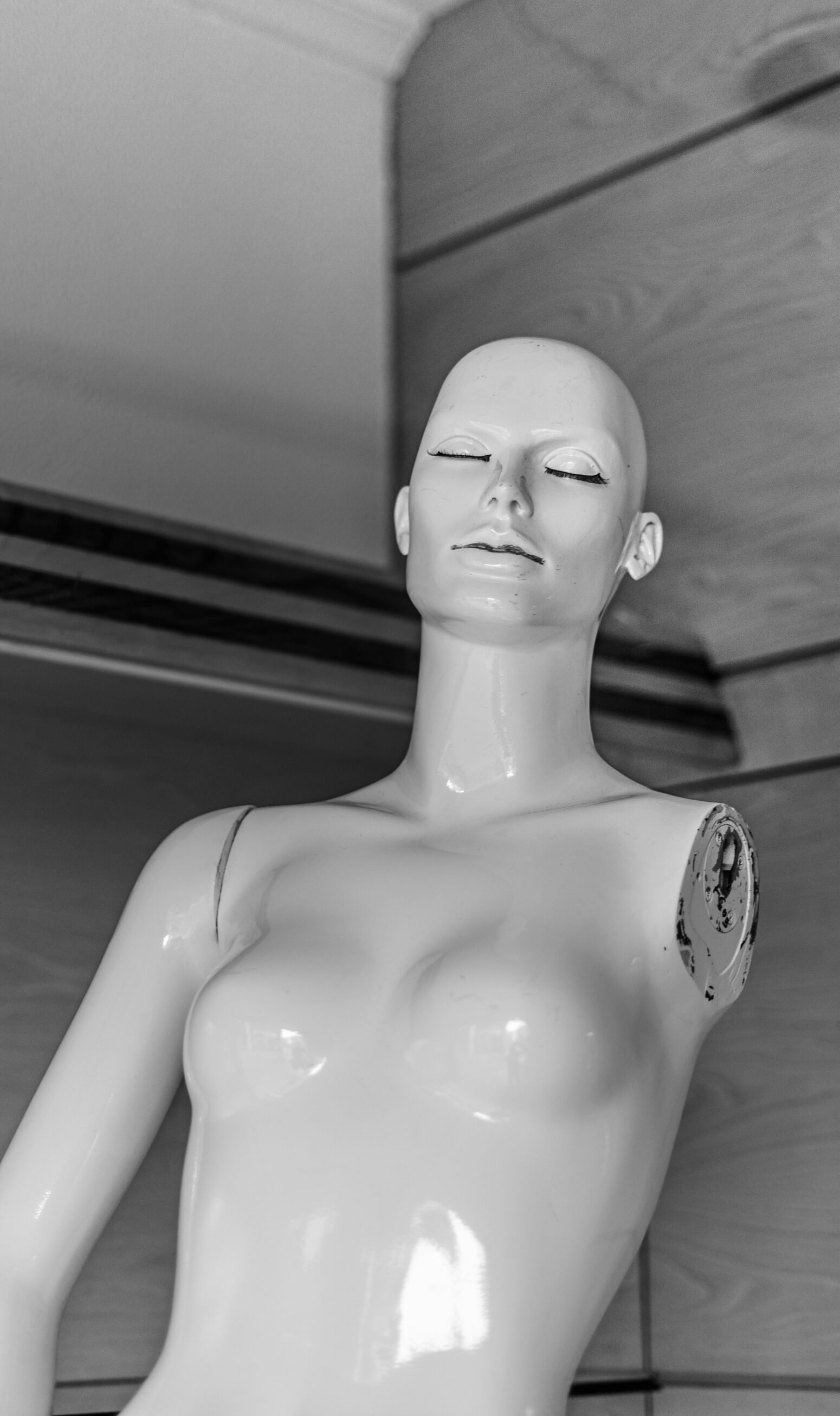
She grabbed her breasts—a dumb reflex, as if in a moment of mortal danger, her breasts were the thing she should be most concerned about saving. When her brain stem caught up with her cerebral cortex, she let go. From where she stood, the mannequin’s tan torso looked like a Carhartt-clad Jason stepping from behind a tree at Camp Crystal Lake. Only when she got closer did she see it was a woman’s torso, signified by breasts like grapefruit halves. Armless, legless past mid-thigh, a hook rising from its headless neck, it hung at human-height from a tree. A Venus with a question mark for a head, her body sieved with bullet holes. Chava counted the wounds: thirty-two, though the one directly between the breasts, right where the sternum would be, was much larger. The shooter had aimed for the heart.
At least the mannequin wasn’t Black.
At least there were no bullet holes in the plastic V of its crotch or where its nipples would be.
At least it didn’t have a face.
“You must be tired,” Chava murmured as she unhooked the mannequin from the branch and lowered it to the ground.
Clouds curled over the sun. When she withdrew her hand from the cold plastic, an oily, viscous substance gleamed on her skin. In the shadow left by the retreating sun, her fingers glowed electric blue.
IV
That night Chava dreamed she was inside the pulse of an early-aughts rave. She wove her way through the forest of dancers and their twirling glow sticks. Along the wall stood three Orthodox men, black coats and tallits. They held pocket-size Tanakhs in one hand, fingering their beards, their peyos with their other, and they shuckled to the beat. She turned back to the crowd and spotted the mannequin standing among the dancers, its torso awash in sparkles and glow paint. Chava raised her hand to wave and noticed the shining blue stain still marking her fingers. The invisible DJ patched a new song into the beat of the last, and a cantor’s voice intoned through the speakers: Baruch atah, Adonai Eloheinu, Melech ha’olam, asher bid’varo—/Blessed art thou o Lord our G-d, sovereign of the universe, whose word creates—. Dancers pressed against her, the sour milk of their sweat stifling. She birthed her way through the bodies, her hands finning a canal, till finally she reached the mannequin. Chava peered at the smeared paint on its plastic chest, then brushed her fingers over it. When she drew her hand away, the three Hebrew letters painted there were clear: <symbol> אמת<symbol>. Emet. Truth. The cantor sang: Baruch atah, Adonai Eloheinu, Melech ha’olam, asher bid’varo. Chava looked down at her hand and found an <symbol>ע<symbol>, ayin, printed on her palm. Over the heartbeat pumping through the speakers, the cantor finally finished the prayer: Baruch atah, Adonai Eloheinu, Melech ha’olam, asher bid’varo ma’ariv aravim/Blessed art thou o Lord our G-d, sovereign of the universe, whose word creates the darkness.
The beat broke.
V
She pulled her boots on by the back door and went out into the early morning fog. The municipal trash can was around the side of the house, far from any of the windows that opened. Before reason could seed doubt, she lifted the lid and took out the mannequin, setting it against the house. Chava squatted on the damp grass before it, at what would almost be eye level, if the hook were a head.
“Okay then,” she said. “I’m here.” She rubbed her cold nose and cleared her throat. Gray leprose lichen rashed the mannequin’s upper body, sloping down the left shoulder and over its chest. Below the impossibly pert breasts, a filigree of dirt. Chava rubbed her palms over the knees of her sweatpants. “What am I supposed to do with you,” she said, the words more statement than question. Over the mannequin’s shoulder she spotted the hose.
She rinsed the plastic body off, pressing her thumb into the stream to pressure-wash the lichen away, and dried it with a bath towel. Counting the bullet holes, she found thirty-three this time; she must have miscounted the day before. She touched a hole near the mannequin’s right shoulder, at first grazing her finger over its vacuum, then pressing into it. Her finger tingled, an electric current like licking a battery. She drew back, examining her hand for a mark. When she found none, she touched the cold plastic of the would-be skin—no current. She pressed the pad of her finger against another hole and again felt a weak tingle. She leaned over, pressed her lips to the hole at the heart till she couldn’t bear the vibration, then parted her lips and reached out her tongue. She was right: like licking a D battery. She turned the torso over, looking for wires, but as far as she could tell, the body was inert.
Chava drew back from the mannequin. Emet, the word she’d dreamed was painted on the mannequin’s chest, was the same word used to animate a golem. According to tradition, the word was painted onto the clay figure’s forehead so reason would guide the body.
The hook, a question mark, glinted teasingly in the weak sun.
Chava shrugged. From the house she got a bucket and trowel and dug up some of the red, mica-specked earth from the yard, that famous Alabama red clay. It was rich, needing little water. She worked it in her hands, feeling it slip between her fingers as it coated the palms of her hands and leached sweat and salt from her skin.
She took a pinch of clay, rolled it between her palms, and pressed it into one of the smaller holes, smoothing the excess in rays over the skin. It looked like a star. She plugged the rest of the holes, mending the wound in the center of the chest last, then laid the mannequin to dry in the sun.
The body was beautiful, sunlight catching the mica in each star. Chava swirled her finger around the slip at the bottom of the bucket, a calm cascading over her. There was a blank space above the mannequin’s right breast, the only part that hadn’t been constellated. Her finger tingled. She bent over and in that blank spot painted the aleph, the mem, the tet. From the woods came a bird call, sonorous and urgent. What truth she was creating?
VI
She called her Venus. Chava tied a whisper of a silk scarf around the mannequin’s neck and sat her on a chair in the kitchen, now a temporary workspace. Where the breakfast table had been stood a metal work bench Chava had borrowed from her useless studio at the university. Tools crowded the counters, and by the door stood buckets of red earth.
Seized by a current of creative energy, she had decided to experiment with the natural clay, firing in a pit kiln she would keep in the yard until the permit for her shed was approved. Chava dumped the earth from the bucket onto the bench and began picking out debris. It was easy work, the clay unusually pure. She worked her hands through it, reaching fingers into mica veins and fine sunset bands of orange mineral that sang from the deep red. She squeezed and, when she unfolded her fingers, found her lifeline printed into the cast of her fist.
As she worked, she concentrated on the feel of the clay, propping open a door in her mind so the material could come inside and show her what it wanted to be. No bowls, it said. No vases, no cups. It did not want to be a vessel, that was clear, but what it did want to embody was not.
Chava washed her hands and opened the music app on her phone. It was a Tori Amos, Sleater-Kinney, Ani DiFranco kind of day. The sun, low in the window, cast Venus’s shadow across the table, and the elongated curve of the hook fell onto the clay. Chava laid her hands on the shadow, feeling the pulse of her heart in her palms.
Hands, she realized. She would sculpt hands. Life-size, lifelike, fingers curled around an invisible key. Through the electrical current of her phone, Ani sang about Icarus.
When she had stopped for the day, she listened to a voice message from her mother. “Rabba Sarah made some calls and said the nearest Reform temple is in Montgomery. The internet says it’s about an hour from you, a bit of a schlep, but if it’s only once a week, and maybe you can do some shopping while you’re there, you don’t have a Target or anything where you are, do you, maybe get yourself some bagels too. I mean, the bagels, you can take them or leave them, but you really need to find yourself community out there. Did you hear? Somebody spray-painted ZOG on the wall of a school in Providence. And that’s Providence. Didn’t the KKK start in Alabama?”
There was an email too: an article from the previous year reporting a series of sexual assaults at Skye Bar, the big club in town, just off campus. Sources claimed gamma-hydroxybutyric acid, aka liquid X, aka fantasy, a date-rape drug, was sold at the club. “Everybody knew,” one anonymous source said.
Chava glanced at Venus. In the sharp cuts of moonlight the window laid across her body, the mannequin looked cold. Chava shrugged off her cardigan and draped the plum-colored wool over Venus’s shoulders. Only the aleph peeked from behind its curtain.
VII
Each night Chava dreamed of Venus. She would spot the mannequin in a crowd, turn a corner and find her sitting on a park bench or waiting in line at a café. Chava had the distinct impression Venus was leading her somewhere, trying to show her something. The mannequin took her down streets she didn’t recognize and into the homes of strangers to watch their lives unfold in mundanity. In a kitchen, by the pantry, they looked on as a couple bickered over whether to season the lentils with cumin; in another house they crowded the doorway of the bathroom and watched a little girl, no older than ten, kneel before the mirror as she cut off her braid.
Unlike in Chava’s normal dreams, the people didn’t seem to notice that she and Venus were there, nor did Chava appear able to exert any influence. She started knocking things over, testing the rules. They were little things at first: a remote control pushed off the edge of a coffee table, a glass of wine fallen to the floor. When those interventions elicited no meaningful response (“Butterfingers!” the man muttered, staring at the broken glass), Chava swept her arm across a dining room table laid out for a birthday, trying to pierce their world. But while the people gasped and lamented, they never once got spooked. From what Chava could tell, their world seemed to be one where nature was mean and unpredictable and not a reflection of any god or ghost. They cleaned things up and started again.
There was one place Venus often brought Chava. It was a tight box of a house, clapboard siding, rusted roof, a front porch just big enough for a rocking chair. Unlike at their other haunts, Venus never took Chava inside. Instead, they stood across the street and waited for the man to appear. He was a white man in his mid-thirties, work boots and jeans, a Ronald Reagan haircut—indistinguishable from most men his age Chava had seen in Alabama, except that just looking at him made her feel ill. She didn’t understand it; the things he did—cutting the grass, rolling his trash can to the curb, hauling lumber off the back of his truck—were as quotidian as the others, yet something about him made Chava feel that twenty feet of pavement wasn’t enough of a divide.
Once, Venus brought her to watch while he worked in the garage. They stood there listening to the scream of the table saw for what felt like hours. One arm raised, hand holding the lever, the other guiding the two-by-fours, the man fed plane after plane of pine into the machine’s gnashing teeth, sawdust flying all around.
VIII
She made the right hand first, then the left, curled into a cup. While those dried, she began sculpting an open mouth. Lips pulled back, tongue recessed as if set to strike. She modeled for herself in the mirror and discovered that the shape a mouth made when screaming was the same one it made just before biting. For the teeth, she used the memory of a mouth whose face she could not recall. The bottom teeth were crowded, and Chava fitted a mica filling over a back molar. The left eyetooth was chipped, and both upper canines overlapped their incisor neighbors. She remembered these details vividly, could even smell the tang of onion and red wine on the mouth’s breath, but the memory was unbodied, tethered to neither time nor place.
She began paying undue attention to people’s mouths: her colleagues at the university, her neighbors, her students. None of them had the particular features of the mouth she was sculpting, though the looking often made her miss what people were saying. This happened on a Friday during clean-up, when she asked her students about their weekend plans. A sophomore said she was going to Skye Bar, and Chava almost missed the implication.
“Wait, Skye Bar?” Chava said a moment later. “Isn’t that where girls get roofied?”
The girl who had spoken looked down and away, and her friends busied their hands with paper towels. The pause stretched into silence. Slowly the girl turned and reached for the cleaning spray, then walked away.
In her kitchen studio Chava watched her own jaw flex as she chewed. The rugelach had arrived, sealed in a Tupperware her mother wanted back when Chava went home for Chanukah. In the mirror she watched her jaw clench and ease. Bordering the mirror’s frame, a zoo of animals growled from the cages of their photographs: a grizzly bear, a chihuahua, a tigress, a baboon. Chava bared her teeth at the glass. She had been a biter in preschool, always in self-defense. She still bared her teeth when she got angry, something her mother and then each of her exes had pointed out. An ugly way to react, her mother once said. Looking at herself in the mirror now, she didn’t think it made her look ugly. It made her look mad as hell and likely to do something about it.
She bared her teeth for Venus. “You get it,” she said to the mannequin. Of course she did.
IX
Chava and Venus stood across the street, like always, the man’s house dark and still. It was twilight in that world, that time of day Magritte had captured so well, when the sky still holds light, but night has fallen on the ground below. Just as bats began to dip in and out of the streetlights, the man’s truck pulled into the drive. “Work is for people who don’t know how to fish” read the bumper sticker. The engine idled while the thumping bass of a fast-paced metal song bled into the evening air, soupy in its distortion.
The song ended and the brake lights cut off. The door opened, and the man walked around the back of the truck, still bobbing his head to the rhythm. Chava crossed her arms, wishing she could walk away, do something more interesting while she slept. The one time she had tried to choose her own adventure, she made it three paces before she blinked and found herself once again beside Venus, watching the house. Chava didn’t understand what Venus wanted her to see, or know, or witness. “I don’t get it,” she told the mannequin. “Were you in love with this guy or something?”
The man froze. Chava straightened, eyes wide, every atom of her body focused. He turned his head, listening. Could he have heard her? But no one in this world ever perceived her, no matter what she did. She held her breath, blood drumming in her ears.
After a moment, the man continued down the drive. Chava exhaled. Her hands trembled. She felt ill, sicker than usual. This time, she thought she might really throw up. Afraid even to whisper, she tried to mentally beam her plea to Venus as she reached out and held the edge of the mannequin’s sleeve.
The man went over to his battered red mailbox, the number 441 painted in white. This was the closest they had ever been, with only two narrow lanes of pavement between them. She willed him to hurry up, to get his mail and go inside the house. Once he did, Venus would surely take her elsewhere.
He leaned over and reached inside the mailbox, then stopped. The streetlight’s buzz became a whine, then a saw. He turned his head and stared directly at Chava. Her hands flew to her breasts, her fucking breasts, as his pupils bored through her.
She awoke to her own screams, a gunshot ringing in her ears.
X
As Chava maneuvered Venus into a sundress the next morning, she noticed a fresh bullet hole just above the letter mem. She touched her finger to the wound. The electrical current was so strong her hand jerked away, bashing her elbow into the mirror. The glass spiderwebbed. A line of blood followed the fractures, winding, a creek. Chava held her throbbing elbow and stared at the pieces of her face.
After her elbow was bandaged, she threw the cardigan over Venus’s shoulders and carried her to the car, strapping her into the front passenger seat. She set her mother’s Tupperware on the floor and inside it placed the pair of hands and the open, growling mouth.
At the first light, as she approached the university, she turned left where she usually turned right. The double yellow line dividing the road became a single row of dashes, then disappeared as the Morse code of houses and trailers faded. The road ended at a stop sign, and a pair of small white shields informed her she was at the intersection of two county roads designated not with names but numbers. Chava turned left onto number 16. The air inside the car thrummed.
She passed the invisible border between her county and the next, marked only by a change in the road signs, and tried to remember where the girl with the braces had been kidnapped. The vibration inside the capsule of the car intensified. It sounded like someone humming, very low, a tune Chava didn’t recognize. She looked over at Venus, snug in her seat. One hand on the steering wheel, she reached over and yanked the cardigan off the mannequin’s shoulders, and with another pull snapped the fake pearl buttons at the front of the sundress, exposing Venus’s breasts, the massive starburst between them, and the emet. The humming grew louder, a chorus now, in harmony.
Chava turned back to the road just in time to see a massive pickup barreling toward her. She swerved. Her tires lost the edge of the road for seconds that felt like minutes. The front tire glanced off something—a stump, a boulder—before she pulled back onto the pavement. Heart pounding, she drove on. Just as relief settled in, she heard the thudding bass of a flat tire. The humming inside the car stopped.
Chava got out. It was deep country quiet, the air thick with sounds of nonhuman life. She took out the lug wrench and the spare and walked around to the flat. As she sank into a squat, she noticed a smudge of red up the road. She straightened, took a step forward. It was a mailbox, the number 441 printed on its side.
She yanked open Venus’s door. “What are you doing?” she yelled at the golem. “What do you want from me?”
Venus’s question mark remained a question mark, remained a hook.
Chava’s eyes fell to the ceramic hands and growling mouth, spoiled-meat red in the Tupperware. She grabbed one of the hands and shook it at Venus. “What is it? What do you want me to do?”
Behind her, leaves crunched. Chava spun around, lifting the wrench.
Through the woods came a white girl, no more than ten. Messy ponytail, Elsa and Olaf T-shirt, grass stains at the knees of her jeans. The girl high-stepped over prickers and onto the road, squinting at Chava. “Your truck break down, ma’am?” The girl wound a length of red yarn around one hand, pulling it tight. The tips of her fingers blanched.
Chava lowered the wrench. “You live around here?”
The girl unhooked her finger from the yarn. “My uncle can help you.” She turned to point to the house with the red mailbox, and Chava saw her hair wasn’t pulled back but cut short. Hacked off, really. Like she had done it herself and no one cared to fix it.
Chava glanced at Venus through the passenger window, then turned to the girl. “What’s your name?”
The girl shaded her eyes with her bound hand and peered at Chava. “Ariana.”
“Is your mom home, Ariana?”
Ariana blinked. “No, ma’am.”
“What about your aunt?”
“My uncle Tony’s a bach’lor.”
Chava studied the girl’s face, the galaxy of freckles across her cheeks. She thought she saw stars falling there, then realized they were the white sickles of scars.
Chava set the ceramic sculpture in the bed of the truck and held out her free hand. “Lead the way, Ariana.”
The girl pressed her palm against Chava’s, the damp yarn sending a chill down the New Englander’s spine. Chava adjusted her grip on the lug wrench and let herself be led down the road, the steel swinging by her side, measuring their steps.
Read more from Issue 22.1.