
Surviving the Dream
8 Minutes Read Time

I Was Their American Dream: A Graphic Memoir. Malaka Gharib. Clarkson Potter, 2019. 160 pp. $16.99 (paper).
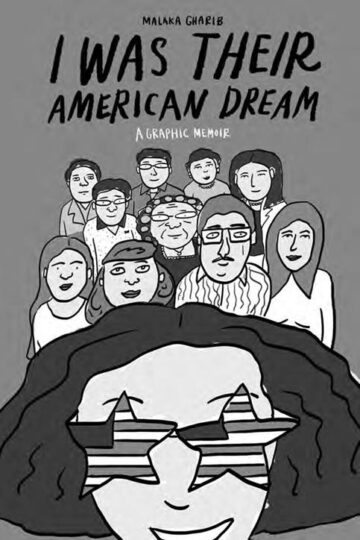
An exuberant black-haired girl greets the reader on the cover of Malaka Gharib’s I Was Their American Dream. Her eyes are made of large starry American flags. Behind her, family members are inked in vibrant shades of red, white, and blue. We are introduced to Malaka’s grandmother, bespectacled and wearing hair rollers; her Filipino mother and Egyptian father; her uncles, aunts, and cousins. The American Dream myth is collective and intergenerational, as Gharib asserts with the cover.
In the book, Gharib depicts her huge Filipino family eating Chinese food placed on a lazy Susan with multiple members of her family speaking at once (“I’m taking the pork chops to go”; “I haven’t even gotten a piece yet!”). Malaka is shown calmly eating, eyes closed amid the joyful frenzy of her immigrant family. There’s a similar photograph of my family stashed in one of my mother’s albums: so many cousins, aunts, and uncles, they spill out of the frame. It’s strange to see a family photograph so much like my own, to identify with the world depicted in a book, as a brown woman in the US with roots in the Bay Area and in the Philippines.
Such identification is possible in part because of Gharib’s genre, autobiographical comics. Many scholars locate the genre’s origins in the underground comix of the 1960s and 1970s, a movement associated mostly with cis white men: Harvey Pekar, Art Spiegelman, and Robert Crumb. However, Francesca Lyn argues that there were auto and semi- autobiographical comics before that movement, including “several significant examples” produced by women of color. Among these pioneers are Jackie Ormes, an African American who published semiautobiographical comic strips in the late 1930s, and Miné Okubo, whose 1946 Citizen 13660 detailed life in Japanese American internment camps. Though Gharib’s drawing technique involves simple and dynamic lines, the comic’s content is complex. She details the joys and
confusions of growing up both Egyptian and Filipino, both Muslim and Catholic, in a large family in Cerritos, a mostly Asian immigrant enclave in Southern California. Gharib also employs variations of red, white, and blue throughout, as a visual meditation on how immigrants and their children understand and embody Americanness (or how Americanness embodies us), as well as on the ubiquity of mainstream US culture. I live in Anaheim, not even twenty miles from Cerritos. On a recent drive to visit a friend, I suddenly noticed the number of American flags along my route (fifteen). Had they always been there? It reminded me of the huge American flag my uncle and aunt bought and displayed right after September 11, 2001. “So no one questions us,” my uncle had said. Gharib’s color choices reflect these kinds of negotiations with citizenship and belonging that immigrants must make.
Most autobiographical texts ground the struggles and triumphs in the perspective of the author. Gharib, however, prioritizes the collective experience of the American Dream by starting with the origin stories of her parents’ migrations to the US: her father, who loves American movies like The Godfather and is anxious to leave Cairo, and her mother, hesitant to ditch a privileged middle-class life in Manila despite the declaration of martial law amid political unrest in the Philippines. The first chapter opens with a car ride to school, as Malaka’s mother matter-of-factly states, “You have to be better than us,” while young Malaka in the backseat clutches her seat belt. This recurring interaction between immigrant mother and American-born daughter emphasizes the expectation to perform and to excel beyond measure, a negotiation that reverberates throughout the book.
The book then goes back in time with a splash-page layout (images that cover two facing pages) of Malaka’s parents, newly arrived to the United States and overwhelmed at a standard fluorescent-lit mall, the hallmark of American capitalism. The signs scream, “Shop ’til you drop!” “Don’t think . . . just buy!” and “Pizza as big as your head!” Food plays a crucial role in the comic. These cultural signifiers operate on multiple layers: yes, they tap into the immediacy of “home” that a familiar food can bring, but they also complicate notions of Americanness, whiteness, and belonging. At the center of the book is a panel with Malaka smiling widely next to a can of Spam and saying: “Love you, Spammy!” A repeated image throughout the comic, Spam serves as a lasting vestige of the US military presence throughout Southeast Asia, Hawaii, and Guam, and the nearly fifty-year US occupation of the Philippines.
That Spam panel appears when Malaka visits her father in Egypt. He expresses his pride in his “half American” daughter by dressing her in shirts with the US flag and emphasizing her geographical proximity to Disneyland. In one panel, Malaka says that she doesn’t “feel like a ‘real American,’” and Gharib illustrates her younger self with a disgruntled look and multiple speech bubbles emanating from her body: “I had a round, brown face,” “I loved Spam,” “I was in Egypt . . .?”, “I had a weird name,” and “I spoke English with a Tagalog accent.” Next is a picture of a grinning Malaka with a can of Spam; the caption reads, “Basically, I felt like a giant, Spam-eating FOB!* (*someone who is fresh off the boat).”
Food is often seen as a “classic” Asian American literary trope, but it goes deeper than that. In an interview with the Asian American Writers’ Workshop, novelist Elaine Castillo mentions a Filipino noodle dish: “Pancit is a party food, it’s a daily food, but it’s also often a food that you eat on your birthday for long life. What does it mean to choose a life? To eat food that says, Yes, I choose to be here. Between survival and not survival, I’m choosing pancit.”
Malaka experiences something similar in college. Her uncle Tito Maro insists, “We’re sending you to a white school so you can learn from them. Eat like them. Dress like them. Act like them. Because when you get into the real world, that’s how you have to be.” As Malaka attempts to adapt and understand her own identity as a bicultural Egyptian- Filipino woman at a predominantly white university, she relies on food to reconnect with her sense of home. And yes, to survive. In one scene, Malaka cracks open a can of Ligo sardines, which her family packed for her months ago, and eats them with microwaved white rice, much to the disgust of her white roommates. What appears as a simple meal is an act of survival.
With roots in DIY zine culture, Gharib includes forms that participate both in the narrative and in the book’s critique of culture. She designs recipes, games, and activities on pages meant for readers to tear, write on, and interact with. These include a facsimile of Gharib’s zine, excerpts from her high-school diary, and instructions on how to make a minizine; a checklist of “codes of conduct” for etiquette in Filipino, Egyptian, and American cultures; and paper dolls of a college-age Malaka with outfits for different social settings, from frat parties to business-school classes. As the comic progresses, these “games” distill larger issues of race and racism that arise in Malaka’s experiences at school and at work. For example, readers can play “Microaggressions Bingo,” which includes comments like “Why are Muslims terrorists?” and “Your English is great!” (Reader, I “won” Bingo twice.)
Rudine Sims Bishop has written about the importance of literary “mirrors,” books where readers can see themselves and their experiences. Gharib’s comic may act as a mirror for many children of immigrants. But even more so, she pledges to be herself. She models how to survive in challenging circumstances with these self-declarations: “My pledge to be the Real Me: Make people pronounce my name correctly”; “Don’t hide my slight Tagalog accent”; and “Stop pretending I like eating sandwiches for lunch.” Then she writes: “Whatever, dude. Imma just do me.” Though Gharib’s tone is casual, this isn’t meant to be flippant. Gharib deals with racism and microaggressions on a daily basis, and her self-declarations speak to the everyday ways she resists. Gharib’s choice to illustrate her experiences as a young brown woman navigating and ultimately surviving whiteness and predominantly white institutions is damn powerful.
Read more from Issue 16.2.
