Chorus
16 Minutes Read Time
Intimacy gives us a different way of seeing, when visual acuity is not enough.
            —Robin Wall Kimmerer
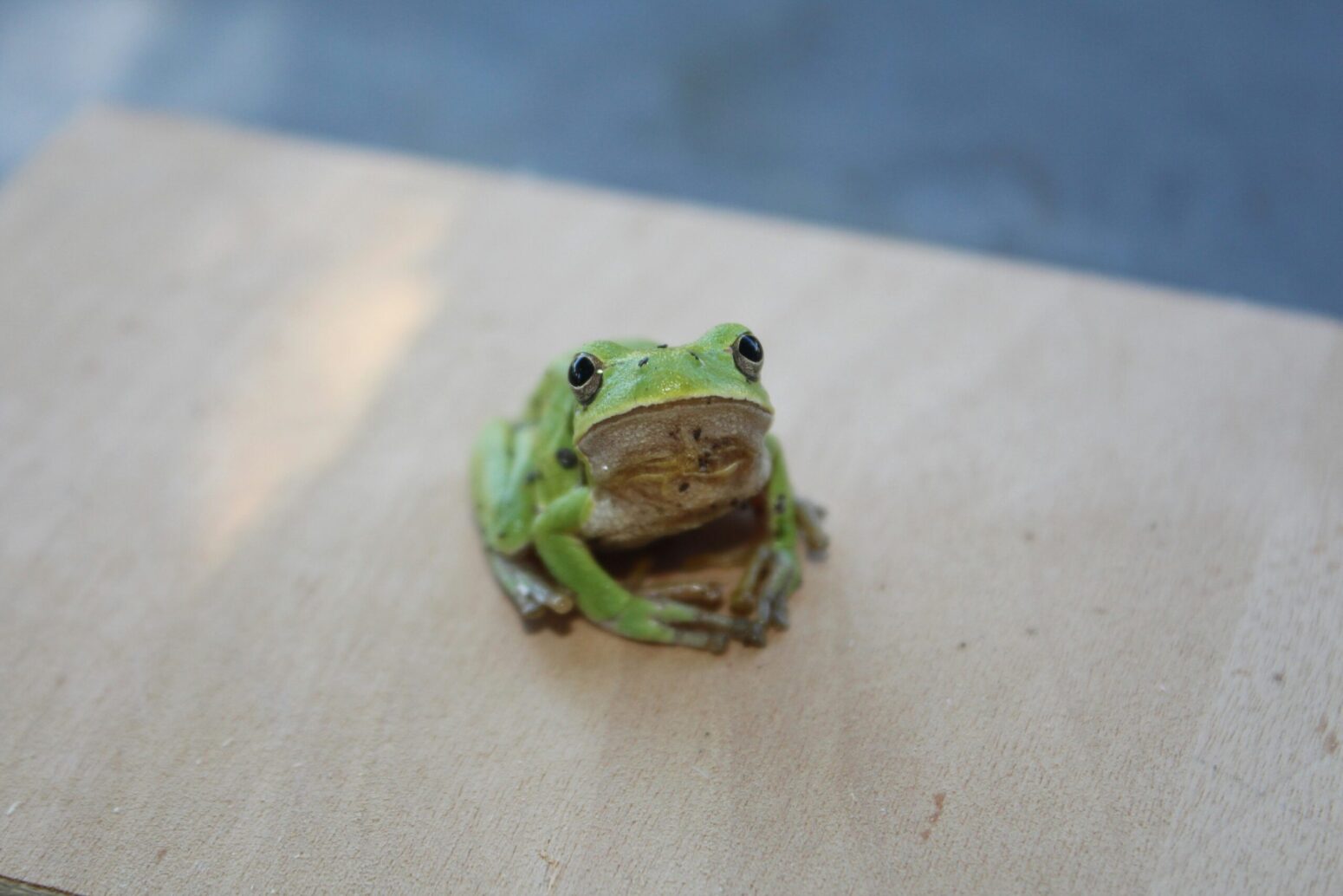
Every year around this time, a small frog shows up in my mother’s garden. A Pacific tree frog, also known as a “chorus frog,” with a bright-green body iridescent against sprigs of wild lilac or browned petals of spent gardenias. This year, on August 29, he has settled on my mother’s beige gardening glove and waits there, motionless.
He always shows up the week of my father’s death. He first appeared two years ago, on the day of my father’s funeral, sitting quietly on a miniature rose bush. He popped up a year ago, the week of my father’s unveiling—a ceremony to bless the headstone and the anniversary of a year of mourning. This year, he’s shown up two days before my father’s death anniversary and waits for my mother to notice.
These tree frogs, or peepers as they’re known in common parlance, live in or near a pond a hundred or so yards away from her apartment—part of the Cancer Center that lies on the other side of the green space from my mother’s senior-living complex. Their chorus starts up just as winter dissolves, so loud it can drive a person crazy if you’re not inclined to surrender to this reliable sign of spring. You hardly ever see them; they’re known only by their song, which gradually lessens in volume toward midsummer, then disappears as summer ends.
For years, my parents collected frog figurines. I think it’s one of those collections that start by accident: you buy one animal, and then people start giving them to you, and then you notice them wherever you go. Have you ever searched for mushrooms in a forest, or a particular seashell on the shore? Wild blueberries? You see one, and then more seem to appear right in front of you, like magic. We find what we’ve trained ourselves to seek.
Robin Wall Kimmerer calls this a “search image.” We overlook what is right in front of us until we learn how to see. “The neural pathways have to be trained by experience to process what is being seen,” she writes in Gathering Moss. “The synapses fire and the stars come out. The unseen is suddenly plain.”
Here is a selective inventory: A pair of frogs who sit upright, their frog legs crossed and dangling over the rail. A pair of frogs lying supine, heads propped on their hands. A frog reading a book, a frog singing a song, a frog swinging a golf club.
All these frogs are happy. They sport wide grins, and though cast in stone, they seem to revel in the Gumby-like nature of their slick bodies. They used to dot the bookshelves around my parents’ Sun Lakes home or perch in the rocks near the front door. Now, they decorate the fence that surrounds my mother’s small plot of land in front of her cramped one-bedroom apartment. “No one ever touches them,” my mother says, “not even children.”
She tends her small container garden carefully, coaxing blooms out of twigs. Others give her plants to nurse back to life. She buys the fifty- cent end-of-season castoffs at the grocery store and nurtures them to vibrant health. She’s often out there when I drive up or walk over with my dogs.
I like seeing her before she sees me. I like watching her pay attention to this yard, which we fenced off after my father died so her poodle can come and go. She bends at the waist, plucking up nascent weeds or thin blades of grass. She deadheads shriveled blooms continuously so that the plant will continue to flower well past its expiration date. In order to keep a garden going into fall, you must get rid of what no longer belongs, what no longer gives back.
Frogs are classified as amphibians, meaning they can live on both land and water. Like an evolutionary process in time-lapse, they develop from fertilized egg to tadpole to frog, a metamorphosis determined by the nature of their habitat. In a rapid sequence, they transform from a creature made up primarily of a long, coiled gut—a feeding machine— to a mortal being that has lungs and legs, eyes and heart. They can occupy two spaces at once, live in two different worlds.
My mother calls me over the moment I arrive at her apartment, brings me by the hand to her potting shelf, where the small frog sits passively, seemingly content, on her gardening glove. The frog gleams like lacquered enamel. For a moment, he appears to be a figurine of frog, painted with intricate detail, down to the black mask that bisects his pupils on either side—kohl eyeliner gone rogue. The dark green of his back shades into yellow underneath. His webbed toes splay on the glove’s fingers, but he’s not holding on as much as barely touching. His stillness, so whole, implies motion that could come at any moment. His silence vibrates the air.
My mother and I instinctively put our hands over our mouths and lock eyes, both of us brimming with tears. The frog seems to look at us sideways, blinks once. Both of us want this frog to be more than frog. To be something else. We want him to stay, but know that this sighting is so precious because, any second now, he will vanish.
“All it requires of us is attentiveness,” Kimmerer writes. “Look in a certain way and a whole new world can be revealed.”
Frogs are often a symbol of fertility, appearing in hordes after a flood. That chorus you hear in a spring pond? It’s male frogs “advertising” their presence in the habitat. They are looking for a mate but also letting other males know what’s what. The female is quiet; she is the listener. She’s paying close attention, to distinguish one species from another.
Some male frogs can transmit their song so loudly it can be heard a mile away.
I don’t know if this particular tree frog is a “he.” There’s no way for us to tell, without flipping him over and searching his abdomen, and even then we wouldn’t know. It takes a biologist’s trained eye to see such facts, to be sure of them.
But we’ll call this frog a “he” because we want him to be a “he.” My mom and I want his maleness in our presence. We want his haunches to be male haunches; his chest, a male chest. The frogs on her fence bear silent witness while we go through this wanting together.
I’m with three other women at Whatcom Hospice House as we circle the bedside of a dying woman. We’re volunteers with the Bellingham Threshold Singers, and she wants us to sing hymns. So we sing “In the Garden” and “Amazing Grace.” We can see her body sink by millimeters back into the bed, the smallest muscle fibers releasing their tension. Her eyes, already glazed, seem to cloud a bit more, seeing inward rather than outward.
“Can I tell you a story?” she asks, and of course we all nod and murmur Yes, yes of course.
“The night I got here, I saw a big clock on the wall. Bigger than that clock,” nodding at the standard-issue one on the wall of her room. “It was three minutes to midnight.” We lean in closer to hear her small voice. “Tick. Tick. Tick,” she says, and all of us slow our breathing to match hers.
“And I saw my husband there. And my daughter.” The four of us murmur Oh.
“What is my mission?” she asks, her eyes looking, but not looking, at us. “And then they disappeared.”
We are her chorus, her witness. We surround her bed and listen, while she describes seeing what no one else could possibly see. The search image has become clear, so all around her now are signs from the dead. We sing one more song. And God said / I am made whole / by your life. We sing it softly, and she closes her eyes.
Sarah Manguso, in her book The Two Kinds of Decay, tells us: “This is suffering’s lesson: pay attention. The important part might come in a form you do not recognize. You might not know how to love it. But to pay attention is to love everything.”
Once I worked in the Italian part of Switzerland for a summer, and my boss and I often took weekend excursions to explore the surrounding area. She and her husband like oddball museums—the cabinets-of- wonders off the beaten path. So, one day, we found ourselves in the French province, in Estavayer-le-Lac, at a museum dedicated to frogs. We know we’re in the right place as we drive into the small village; frog balloons hang from lampposts, dangle from telephone wires. No words—just icons of frogs, their legs stretched in the posture of leaping. We find the museum on a side street and enter through a display of antique railway lamps, the air dim and musty. Then, two steps down into an open hall, we glimpse the display cases filled with taxidermied frogs arranged in various tableaux.
These frogs were collected by a Napoleonic army guard, François Perrier, who loved these amphibians and began collecting them on his daily walks. He took them home—and this is where love turns gruesome—gutted them, and filled them with sand, so that he assembled a horde of beanbag frogs, which he proceeded to arrange in everyday scenes reminiscent of village life in the nineteenth century.
There are schoolboy frogs seated at rows of desks, listening to a teacher at a lectern; frogs seated around a large dining table, downing grog and slurping up spaghetti; frogs being sentenced in a courtroom; a frog riding a harnessed squirrel.
We wander slowly through the displays, by turns amused and horrified. By dint of the way they are posed, the frogs appear to be having a grand old time, lifting their mugs, heads thrown back in laughter. Their webbed toes hold playing cards at a game table, and their mouths gape open as if speaking or about to speak. The bodies are surprisingly well preserved, considering they’ve been arranged this way since the 1850s. It’s easy to spend a lot of time looking at a single cabinet, picking out the miniature accessories that Perrier crafted himself: tiny school desks, complete with inkwells; a scattering of dominoes; diminutive mugs and bottles of wine. In one diorama, the frogs appear to be in a barbershop, and they hold combs and scissors. In another, six frogs shoot pool, holding their cue sticks, waiting for their turn. If you look long enough, you can almost forget you’re looking at frogs and see the tiny people these frogs mimic. Some life force still shapes their bodies, though they’re long since covered in dust.
Perrier said he wanted to depict typical life scenes in the village. He wanted to preserve history, and he enlisted his frog friends as fitting symbols for the life he knew so well. I like to imagine him at his work, bent over shards of wood or pieces of bone. I hope that most of the frogs he used were already dead, belly-up in a roadside ditch or on the shores of a muddy pond. I hope he loved them. He must have—to pay this much attention to every limb, every toe, every small tendon.
When is the right time to bring up the fairy-tale frog? He’s been there all along: the man hidden in a frog’s body, waiting to be recognized through the omniscient influence of love. It’s up to a woman—just the right woman, endowed with compassion—to see beyond the slimed skin and to a prince’s beating heart.
But I have it wrong. The story of the Frog Prince has many variations, in many languages and cultures. And yes, the central element requires that the frog be turned into a prince, released from a spell that may have been cast by a witch or a spiteful fairy. The biological transformation of tadpole into frog may be the reason these animals are so often invoked in transformational tales; the core of these, no matter the outcome, is transmutation from one body to another, the unchanging self intact.
Also at the core is the princess: elegant, privileged, selfish, self-centered. In all the traditional variations of the story, she lives with her father, the king, and she is in love not with a frog but with a golden ball. The princess loses her ball in a pond and begins to weep inconsolably. Enter the frog, who never makes a claim to be a man in a frog’s body. He simply offers to dive into the water and bring back the ball, in exchange for a simple favor: bring him back to the palace and be his friend.
The princess agrees, with fingers crossed, and when the frog makes good on his promise, the princess runs away without him. But the frog is persistent. He shows up at her door. He rats on her to her father, who insists the daughter think of someone besides herself for a change. She sulks like a child but reluctantly agrees. So the frog eats from her dinner plate and sleeps on her pillow. She says cruel things to him, turns her back.
In some variations of the story, she actually throws him against a wall, so thorough is her disgust. And it is this gesture that turns the frog into a prince. Love isn’t necessary at all, just human contact. The frog turns back into the prince simply by being allowed once again inside the human realm. She doesn’t need to kiss him. She doesn’t need to love him.
The princess doesn’t recognize anything in the frog’s eyes. She does not pay attention to the frog, because she assumes the frog is worthless. She is not the heroine in this story. She is a disappointment to her father. She is a disappointment to herself.
When my father had his last heart attack, medical interventions kept his body going a few months past its expiration date. He now required help even with turning over in bed, so he needed to stay in a nursing home. We had many different conversations with doctors, nurses, social workers, a rabbi. Often, we arranged ourselves in a semicircle, with my mother near his head, holding his hand. If I’d been able to step outside myself and gaze at this tableau from afar, I imagine it would have resembled the adorations in Renaissance paintings: the cherished one at the center, every onlooker leaning in, paying close attention.
The Threshold Singers came at my request, but he didn’t want any of our core repertoire: songs that comfort the dying, urge the body and soul to go gentle into the night. No, none of that. My father asked if they knew “The First Time Ever I Saw Your Face,” calling it our song, nodding toward my mother. This was new information for me; I didn’t even know they had “a song.” The singers gamely gave it a try, singing of the heart trembling like “a captive bird” and how the lovers’ joy will “last till the end of time.”
Both my mother and father closed their eyes. My mother began to cry; my father slumped cockeyed on the bed and didn’t have the strength to straighten himself out; we’d need to call in an aide soon to scoot him upright. But for now—for the moment—the music surged in a wave around the bed, cradled him there, secure, as if he could never fall too far from our grasp.
We often forget about “Iron Henry” in the frog prince story. Henry, the prince’s faithful servant, devastated when his master was cursed. According to the Brothers Grimm: “Faithful Heinrich had been so saddened by his master’s transformation into a frog that he had had to place three iron bands around his heart to keep it from bursting in grief and sorrow.” When the spell is broken, the bands break apart, allow his heart to swell and love again.
Terry Tempest Williams, in her book Desert Quartet, remembers hearing frogs in the desert:
Before leaving, I drink from a nearby spring and hold a mouthful—I
hear frogs, a chorus of frogs, their voices rising like bubbles from what

seems to be the green room. Muddled at first, they become clear. I run
back to the edge of the pool and listen—throwing back my head, I burst
into laughter, spraying myself with water.
It is rain.
It is frogs.
It is hearts breaking against the bodies of those we love.
I’m not sure what my mom and I really believe. We know only that we’re transfixed by this small creature who seems to have wandered too far away from the water that sustains him. He’s disconnected from the group—the chorus of frogs—and has arrived in my mother’s garden for a solo performance. It’s a silent aria, suspended in time, and we tread carefully, not wanting to scare him away.
In the Jewish religion, little credence is given to the concept of reincarnation or the afterlife. And it’s not that my mom and I believe, literally, that my father is this little frog, that his spirit has folded itself inside the flesh of frog. But, like so many people, we wouldn’t mind seeing this as a sign of his presence among us.
My mom and I become as still as that frog. If I bend my knee and get down at eye level with the creature, I can see the sac beneath its chin expanding in rapid micromovements, as if in preface to full-throated mating call. But he remains silent. His side eye meets mine for a second, and then he hops onto the wild lilac, disappears among the green.
Read more from Issue 16.2.