Minister Creek
18 Minutes Read Time
One August Thursday morning, shortly after my sister, Amanda, turned twenty, I steered our blue Volkswagen into the foothills of the Allegheny National Forest. The clouds hung low, the air milky: a beautiful day in northwest Pennsylvania. I’d planned an excursion into the wilderness, just the two of us, to be followed by cheeseburgers at an old-school drive-in on the way home; I’d done some light googling and found the #1-rated day hike in the Allegheny, just three short hours from Cleveland. Minister Creek, it was called. I didn’t tell anyone where we were going. It was only rated moderate, according to my research. I meant the day to be a gift.
Outside the car in the gravel lot, Mand stretched while I double-checked our map; we were at the correct trailhead, though ours was the only car in sight. I popped the trunk, and we perched on the lip and exchanged our flip-flops for hiking boots. We could have opted for sneakers: the Minister Creek trail is only six and a half miles long, spanning one thousand feet in elevation. When we were in fifth and ninth grade, Mand and I used to walk the two miles to school together in half an hour, an iPod Nano in my pocket and each of us claiming an earbud, craning our necks toward each other and synchronizing our steps to Arcade Fire or The Who. Now, I felt a little silly driving three hours one way for what couldn’t be more than a three-hour stroll, so I’d packed PB&J’s and a couple of apples for us to munch before we reached the Minister Creek Scenic Overlook five or six miles in. Mand is a photographer, and from the pictures I’d found online, the scenic overlook promised color, perspective, a treetop carpet. We had zip in our step when we set off.
Mand and I are four years apart. We think this is one of the main reasons we are so close: we never shared the same age group for an activity. We were never tethered together, in other words, so we got to choose each other, the way friends do. The shared earbuds and our frustration at having to adjust to each other’s pace prompted, really, some of our only moments of curtness toward each other. And still we set off each morning yoked like that.
On the way home, whichever one of us was in middle school would untuck her uniform polo from her khakis while the other searched for a stick. When we procured one of optimal size, somewhere between twig and branch, we’d play Name That Tune, taking turns tapping out the beat of a song on the sidewalk. We found that if we stared really hard at each other beforehand, we could usually guess correctly by the end of the first measure. It’s less sameness and more synchrony. We often, out of nowhere, sigh at the same time. We are a holy terror at Pictionary. During the years we lived apart, the thing I savored most about reuniting was walking quietly together, after we’d caught up and I’d re-memorized the shape of her shadow next to mine, when every muscle taut from just the ordinary exertion of being in the world would relax, and I could bask in the relief of being so deeply known that I didn’t have to say anything.
As well as a trail, Minister Creek is a campground, the Allegheny’s smallest. Six campsites run along the west bank of the eponymous creek, each with a fire pit at its center ringed by trodden earth. The sign on the way in asks families to pay a twelve-dollar fee per night and establishes a first-come, first-served policy. There were no families, nor any of the typical detritus of families, at the campground. We reveled in our solitude, the surroundings so still we could hear the leaves grazing the backs of their neighbors.
We passed a man and woman, clad in matching overalls, at the end of the campsites. Mand saw them first, and I followed her gaze to where they stood at a nondescript shed, the man balanced on a ladder, both of them returning our stare. They appeared to be in the middle of painting the shed a garish and official-looking shade of chartreuse. They had stopped their work to look at us, and the paint dripped from their brushes. I waved, Mand offered a quiet hi, and they nodded once in unison before turning back to their task.
The campground abutted a clearing, and our path wended through it and into the forest. A pair of oaks at the border could have been someone’s portico, and we laughed as we ushered each other through, as though arriving at the same time to a party. Leaves caked the dirt: fall had begun while I wasn’t paying attention. And then the ground turned downward and we burst through the trees into an ocean of ferns. I had trouble placing whether it’d gotten louder or quieter. Trees are known to muffle sound. But the ferns made a noise too, a cousin of corn’s whisper, so I kept turning around to see if there was a squirrel or a fox or something else following us. There was not.
The ferns were their own spectacle. They were the size of my forearm, they were the size of my thumb. Interrupted only by the stripes of peeling oak trunks, the green stretched on for what seemed like miles, like hours. The sun poked through above us in merely lighter emerald. The ground below was visible only when you brushed aside the ferns at your hips. Mand spun in a slow circle, her mouth a big mock O, her tie-dyed T-shirt an aberrant splash of purple, her ponytail buoyant. I took pictures of her spinning. She took pictures of me marveling. The atmosphere was distinctly Jurassic. I felt somehow both great and small. I consulted our photos to get a better sense of my own size, but in that green, it was impossible to tell.
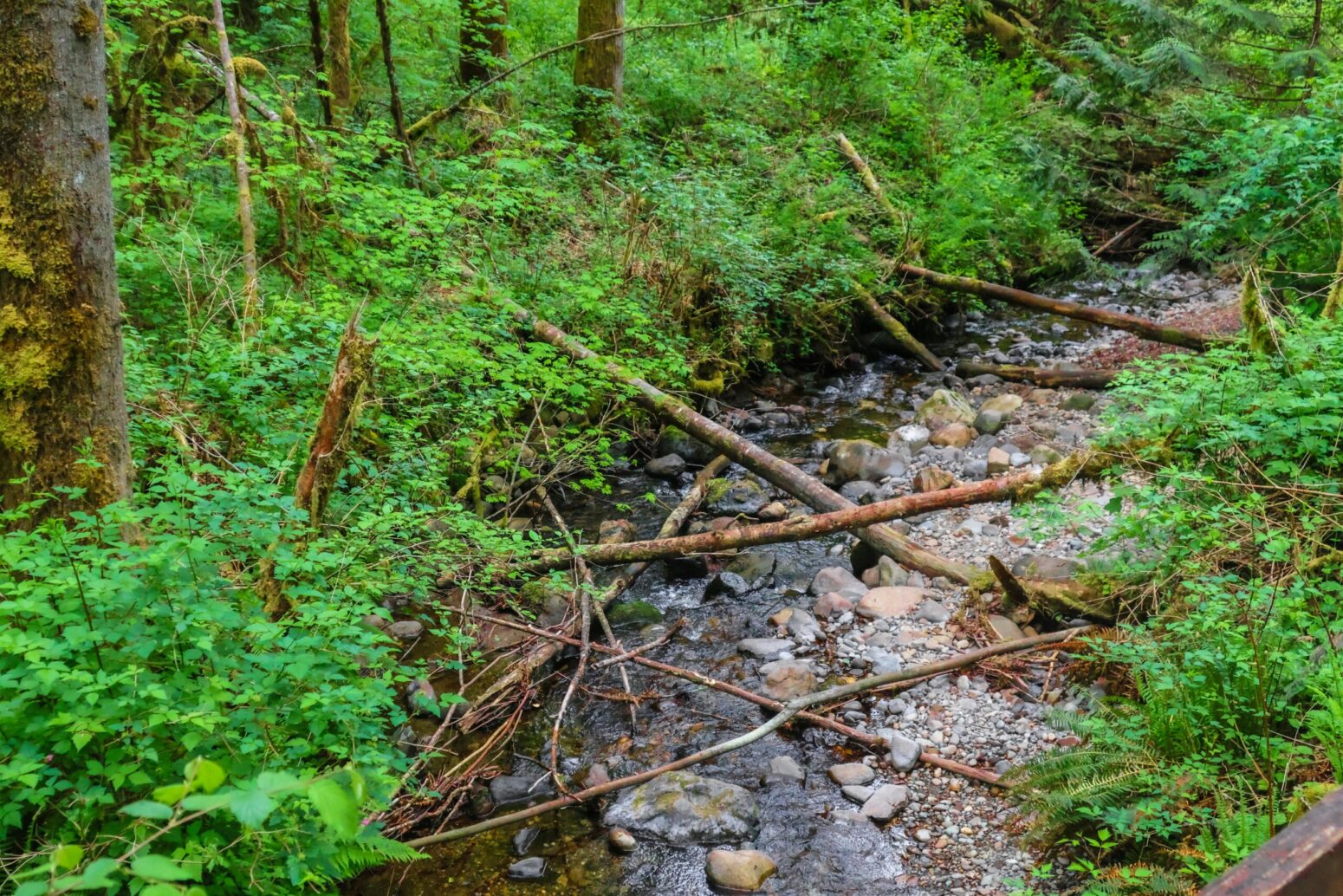
We pressed on, delighted. The trail being named what it is, the creek shouldn’t have surprised us, but still it did somehow, its trickle ringing out far away until suddenly we were right on top of it. It was shallower than I expected, unassuming, though rolling fast. We crossed it without incident or fanfare. I was anticipating a log or something more rustic, but we took a bridge. Of course there was a bridge—they were expecting visitors here, I had to remember.
Minister Creek is located in the very northwest tip of the Northern Unglaciated Allegheny Plateau, the ecological subregion that was spared the geological injustice of being plowed over by the Laurentide Ice Sheet between twenty thousand and ninety-five thousand years ago. The Laurentide Ice Sheet gouged out the Great Lakes and flattened the Upper Midwest. Compared to the topographically starved walks of Northeast Ohio, Minister Creek is rugged enough to lend itself to a day hike, but close enough to the ghost of the Laurentide that its ridges never quite sharpened and its valleys never veered into ravines. New Englanders would call it pretty flat. AllTrails, the user-maintained Wikipedia of hiking and biking trails, calls it moderate. Incidentally, the Forest Service calls it difficult, and no fewer than three times, the web page gently warns that the trail “offers challenges to a wide range of skill levels,” which probably would have affected our plans at least a little bit had I bothered to do anything more than give Minister Creek a quick google ahead of time.
Faded yellow blazes on the oaks guided us northward and upward. To our left was the creek, though we were quickly too high to see it through the trees that bloomed below us. To our right, a bulwark of oak trunks stood at attention. We followed the trampled ground close to the bluff’s edge, casting about for the blazes every few minutes.
Occasionally the brush to our left—because there was now brush to our left, barricading us from the edge—would clear for a moment, and we’d pass a smooth rock jutting out: the perfect spot for a small animal to perch for a nice lunch. I envisioned a squirrel with a tiny PB&J sandwich, a tiny drawstring bag on its back, overlooking the enormous valley, defenseless, oblivious to its place in the scale and order of things. With all these opportune rocks around, I felt as though we ought to be hungry. Mand found us an excellent ledge, and we sat with our ankles dangling over the trees, munching on our sandwiches.
Either a branch snapped, or I thought a branch snapped. Mand said she didn’t hear anything.
“I wonder,” she said instead, “how many people are also out here in this park today.”
We were quiet. I had completely forgotten that there could be others, could be somebody. Could be nobody. A realization burrowed in, that I didn’t know which I’d rather see. I gazed out at the valley and felt my stomach swim and still. I felt I could hear every leaf that fell.
I peeked at Mand squinting past her glasses, and when she turned to meet my eyes, I looked down at my lap and stood up and brushed the crumbs off my shorts.
“Let’s go!” I chirped, adding a hollow exclamation point, like you might if you were trying to prevent a dog from sensing your own fear or dismay. A futile thing to do, but if you love the dog, there you go, trying anyway.
Away from the ledge, leaves choked the sky. Woodpeckers pattered. Mand nearly stepped on a snake. But it was just a garter, and we let it pass before we continued up the slope toward a cluster of grassy mounds.
What looked like knolls were in fact enormous boulders, tiny islands three times our height and swathed in moss. Wrinkled oaks strained to wrap their roots around and underneath them, the tendrils thick as our bodies. The rocks were scattered, sprawling, a game of marbles God had abandoned. Mand and I each rushed toward a different boulder and threw ourselves into orbit around it, calling scouting reports through the trees about what patterns we noticed in the moss, how many spiderwebs we brushed. I found a good foothold and managed to scramble up one rock a few feet, craned my neck enough to see that there were ferns crowning the top, and had to hop down. We didn’t bother to take off our backpacks to mark our spot, and it took us a moment to find each other, echolocating between the stones.
The last surviving scrap of the Laurentide Ice Sheet is a glacier called the Barnes Ice Cap, which is the shape of a blunted arrowhead and the size of Delaware. It’s located 1,200 miles north of Quebec as the crow flies, or rather, as he refuses to, and who can blame him? The only birds that make their home there year-round are snowy owls, ptarmigans, and ravens. Even the arctic terns abandon ship in the winter.
It’s not like there’s much room anyway. The Barnes Ice Cap is 1,600 feet thick, about the size of One World Trade Center. In the last few decades it’s been losing three feet of itself each year. By the year 2300, it’ll be gone. Maybe by then it’ll be warm enough that the terns will stick around to watch.
Back when the Laurentide was the size of a continent, it plucked igneous rocks from the Canadian Shield, swept them along, and left them behind at its edges—the boulders we saw likely had originated in Quebec. “What’s this one like?” asked Mand, pointing at the rock to my right. “You climb it?”
I looked up at the stone, and it was a stranger. I circled it and considered. I put my palm on the moss, testing for familiarity. It felt as cool and soft as the moss on any other rock, or maybe as cool and soft as itself. To my left, another stone, or the same one, and beyond, more, impossibly old and impossibly new.
Had it crossed my mind to open myself up to omens, I might have suspected something was up when we got off I-80 and passed Blood Road. Or when we turned onto route 666, the only way to Minister Creek from the south, east, or west. But these aren’t signposts of actual danger. The real trouble is where Minister Creek’s path forks and connects to the North County Trail, heading very much not toward your parked car but rather toward Vermont, and the particular trouble for us was that I now realized I did not know where that happened. The path twists and curls up on itself enough that a simple compass won’t help you sync up with it, and the path had disappeared some time ago.
The trees bent erratically. I needed a drink of water. When had I last heard the creek? I needed to look at our map. I rooted around in my backpack. I felt Mand’s gaze. I looked at our map. Our map depicted, at the fork, a pile of boulders. We were in the middle of a titanic pile of boulders. Was there a cairn somewhere? Were we in the middle of a warning, or had we not arrived there yet?
I had told nobody where we were going—or even that we were going. Our spare water was back in the car. We were beyond cell service, had no radio, no first-aid kit. I saw, out of the corner of my eye, Mand begin to spin.
“Don’t do that,” I barked, surprising myself with my own harshness. I tried to soften my voice, stared at the map so I wouldn’t have to look at her. “It’s dangerous.”
My correction had the opposite effect, planting a seed instead of smoothing over, and Mand cocked her head. “Dangerous how?”
Disquiet breathed hot at the edges of my resolve. Silence stretched around us, and my mental map unfurled with it. I squinted. All I saw was ferns and terror from here to Burlington. Worst-case scenarios emerged as fast as I could imagine them: We might get hungry. We might get hurt. I thought of the couple painting the shed, the way they’d clocked us and said nothing, how they were the only people in the world who’d seen us that day, who’d have any knowledge of where we were. How, more likely, they weren’t thinking about us at all. How we might be getting further and further away from any promise of being found.
I forced myself to speak slower than my heartbeat, to channel nonchalance. “Do you happen to remember which way we came from? Before the rocks?”
Mand looked around. She had screwed her mouth up into her left cheek, her thinking face since forever. The lighter hair around her temples had come loose from her ponytail. When she turned to me, her face was the searching one she’d worn as a little kid in my bedroom doorway, fresh from a nightmare, asking by the glow of my night-light if she could crawl into my bed. She said, “I’m not actually sure,” and I remembered the soles of her feet, cold from padding across the wood floor, pressing into my calves. I couldn’t tell whether her devastation was merely from not knowing, or from having trusted me, the one who was supposed to know and did not.
My earliest memory of Mand is teaching her to smile, both of us crouching knees-to-ears and stuffed between the back of the couch and the wall of our apartment, the sofa’s denim slipcover not yet faded. I was grinning, and then she was, and then I was, and that was it—it turned out a person could be at once a fount of their own joy and an echo of yours, and it turned out you could find that person behind the couch or sharing your bathtub or just generally on your heels for as long as you’d have them.
Like most twentysomethings, I’d had practice building an identity through concealment, brightening parts of myself in some crowds or settings and dimming myself in others. I’d done this with parents, partners, strangers, acquaintances, friends. With Mand, though, whenever I’d wondered what to feel or how to be, she was already there, mirroring, magnifying. I was suddenly able to see why one might want to brick oneself off from the person one cares about most. I had no idea how to go about doing so. I felt horrified to even try.
Most siblings I know would be better in this moment. Most siblings I know have practice hiding behind the wall they’ve built between each other, or at least taking a short moment to lean against it out of sight—a smoke break from the other. When a joke at her expense has landed a little too sharply, my friend lobs barbs at her sister to buy time to get her bearings. Another friend is out to his sister but not to his brother. I once dated someone who, as a boy, escaped an abusive parent in the middle of the night with his younger sister; he shepherded her across a frozen field in the dead of a Wisconsin winter, but as an adult he wouldn’t tell her he had depression. These walls aren’t useless; they help you figure out how to walk alone.
Our mom’s youngest sister has had a brain tumor for decades. The tumor is benign but takes up valuable real estate. It flares up every so often, responds unaccountably well to experimental treatment, and recedes. Years after our hike, the tumor’s composition will change, and it will become less and less that our aunt has cancer, and more and more that the cancer has her, and when that happens, it will be like disregarding the weather forecast and getting caught in a downpour and having nowhere to shout your indignance but up. Our mother will be soaked through to her bones.
This may not be what happens to Mand and me. But something will happen—maybe even something beautiful—and we’ll resurface just a little further away from one another.
On the trail, we circled each other, trying to discern from which way we’d come. We decided to descend the hill, and a few minutes in, I listened hard to the wind and caught the liquid rush of the creek. Finally. Again. I swallowed my relief so it didn’t escape in my voice when I told Mand, but the triumph burst out anyway.
“It’s on our left! We’re facing the way we were when we started walking!”
“Should we keep going?” Mand asked, and I realized that I’d been wrong: she hadn’t wanted to go back, like I did. She’d been trying to tell which way was onward.
A gasp or a choke, a sound like ice calving, knocked free from my lungs. I cleaved in both senses: I split open, I reached for. I composed myself. I said, “I think we go back.”
We carefully turned and restarted our walk, boulders at our backs. We kept the creek on our right, and at some point the ground smoothened, the leaves under our shoes flattened, and we were back on the established path. We passed our sandwich rock and traipsed farther and farther down the hill, picking up speed, both of us pretending that it was gravity making us faster but hightailing it out of there at the clumsy speed of people who are trying not to seem like they are hightailing it out of somewhere. By the time we reached the ferns we were undeniably running, tearing through the primordial green, Mand’s back a violet swirl ahead, and my heart pounded, and I was no longer interested in pretending that what I was feeling was something small, and I overtook her without reservation and hurtled across the clearing, past the shed standing sentinel, through the campsite ghost town. I sprinted until I could see our car’s discordant blue, a blaze of our own making, marking the exact place and moment when we would be assuredly alongside each other, hurrying to strap ourselves in, Mand wide-eyed and telling me We can go with a raw insistence, and in that hoarseness I’d know that she was all the way there with me, and I would say—I would lie—to both of us: we won’t have to go down a path like this again for as long as we want.
Read more from Issue 19.2.