Last Chance
40 Minutes Read Time
I. Arriving
Where the building had burned last season had been replaced with gold, like kintsugi. Various parts of the mansion seemed glued together or as if an exterior had sloughed off and revealed a gleaming bone woven into an imperfect skeleton.
Fiona traveled there by limousine from an airstrip in the desert outside Reno. The car showed serious signs of neglect: Cardboard taped over the back window. A long, severe scrape down the left side. The driver, slightly intoxicated, had only open road to contend with. Fiona took advantage of her last hours with her phone, carsick in the back, her canvas bag at her feet, the desert sliding by unwitnessed.
Just yesterday, a scientist had predicted the last of another thing, a type of gazelle that lived in this area, and improbably, idiotically, she thought she might see it. She happened upon the sonogram in her feed when she should have been looking outward for this nearly extinct creature. The sonogram announced the soon-to-be-born baby of an old lover, Theo. Fiona paused momentarily, her pointer finger hovering over the discovery. Then, the shimmer of a likely real memory: her body turning toward Theo on the beach, the waves crashing behind her, a red dress wet at the hem, a strand of salty hair in her mouth, which was open from laughing at him.
Infertility seemed like a clear message from the burning universe, not something to thwart with intervention as many of Fiona’s friends and acquaintances had been doing with increased regularity in their late thirties and early forties. Science isn’t always a love story. Just because you can do a thing doesn’t mean you should. For example, the artificial intelligence that rested in a small square affixed to the driver’s shoulder, just under the skin. She noticed it throbbing there. How did he have money for such a thing? Perhaps this production had a bigger budget than she imagined.
Fiona would be the third oldest woman in the mansion, which everyone involved called “the house.” She’d live with nineteen other women for anywhere from three days to three months, depending on her luck and charm. All these women hovered above and below the age of forty. The symmetry of this number felt agreeable, if hard to wrap her head around. Online makeup tutorials promised that the older you got, the fewer products you needed to use—just cleanser, toner, eye cream, moisturizer, oil, sunscreen, foundation, concealer, and powder. This list baffled Fiona and was seven items more than she’d ever used.
The secret she’d not admitted to the producers in her audition interviews was that she’d gone through early menopause. Not premature mind you—early. It wasn’t yet decided what to do about her heart and her bones being depleted of estrogen for these extra years. Everyone had an opinion (hormones, herbs, nothing at all), and Fiona had spent six months assessing each sensation as a sign of something worse to come. So while she waited to see how much more quickly than other women she might shrivel and die, the mansion awaited.
It was as good an answer as any, coming here to this desert competition, a strange echo of what it used to be when it was first televised in a mansion in LA a century ago, starring women far younger who had hoped to marry a football player, a vineyard owner, a pilot.
She’d been on other reality shows in previous years: She’d sung, gone on jungle missions, guessed the amounts of money inside briefcases, pretended to be innocent when she was a villain, and so on. This was the logical next step, although truth be told, she’d also imagined herself retired.
Climate catastrophe, Fiona searched on her phone as the limousine plunked over the salted earth. The end of the world seemed closer out here, where so many dead things decorated the side of the road, though it had been happening for some time, just slowly.
Fiona remembered when Theo had told her that yes, of course, the sun would explode eventually. That was just math, not existentialism or poetry. He was an impatient and practical man. But, anyway, she wouldn’t be around to see it. In the meantime, lakes had dried and disappeared. The drunken limo driver said that the lakes out here had once been very deep, then swore aloud at a sad animal that had wandered into his path. The car veered toward the salt beds and then back onto the highway. She almost told him about the beach town she’d frequented as a child, how it had simply been sucked into the sea. For a while, it had been reported that the houses were being swept away one by one and destroyed over several hurricane seasons. But then even the reporting vanished, and it was just the sea again.
Fiona viewed her reflection in her camera phone, wondering how she’d appear on-screen. It had been a while, and she was nervous. Clips from her old shows still replayed online: her in a dress with bird feathers on the shoulders during her stint on the show with the briefcases full of money. She’d not quite learned to stop looking for herself in what she saw on her phone, as if something that someone else wrote about her might make the final pieces click into place. She wanted to find the thread that would explain her life. She’d won $40,000, and you’d be surprised how quickly that goes.
Some days, the weather matched her face. Like, overcast. Like, blue. She thought of the party in her early thirties when Ida had called out across the room, camera in hand: “You look so pretty tonight!” Ida’s drunken compliment and the photo she took, which Fiona never saw, had interrupted a conversation with Theo, who didn’t kiss her later, though she’d thought he might. This had been before the reality shows, when all that had been captured of her was her friends’ slurry photographs.
“You do look pretty,” he’d agreed. Looking good and getting kissed is not always a one-to-one ratio, as proven by that night. She had wanted him to kiss her, but the not-kissing had left a more lasting impression. Not-kissing comprised more experiences than kissing would have: sitting on a bed in a loft room and discussing the concept of love while everyone else was downstairs; walking outside in the rain for a cigarette, though neither of them smoked; them admitting that they’d miss each other’s company. Now, she couldn’t hope that he would catch glimpses of her on-screen and miss her, as he was not the type to watch these shows: the soap opera colors, the bronze and burgundy.
“Most people practiced dancing in front of a mirror growing up,” Theo had said to her when they’d been out dancing once, and she was surprised. She knew how to dance but had not practiced in that way. Maybe that was why producers always loved her so much. She forgot the cameras were there. She’d never really rehearsed for them, despite how many times she found herself in front of them. You couldn’t script that, you couldn’t bait anyone to be as good as she was for television: weeping into her hands, falling into the grass, screaming at whoever that she’d never forgive them, that she couldn’t believe they’d lied. And she couldn’t.
She’d signed up for Last Chance long ago, but the timing was appropriate. Theo’s daughter would grow up amid fire and extinction and virulent strains of brand-new diseases, and that’s if the girl was lucky. Theo’s wife was a year older than Fiona. Truthfully, Fiona had thought it wouldn’t happen for the couple, and now here she was, stuck wishing them the best in a comment, composed with great care, beneath the briny creature’s first portrait, and the scattered, inattentive heart emojis of everyone Theo had ever known.
Last Chance for what, the producers didn’t specify, but the title seemed heavy-handed enough for everyone to guess what. In her application, Fiona had written that sex without fear of pregnancy was the sexiest thing she’d experienced, this wilding like she’d grown fangs, and that the desires of men meant nothing to her anymore. She’d spent so long not understanding herself, and then it was as if she’d been handed a dark egg with a polished stone shell and been told, Go ahead and do whatever you want now. Anything might be born from you.
II. Confessionals
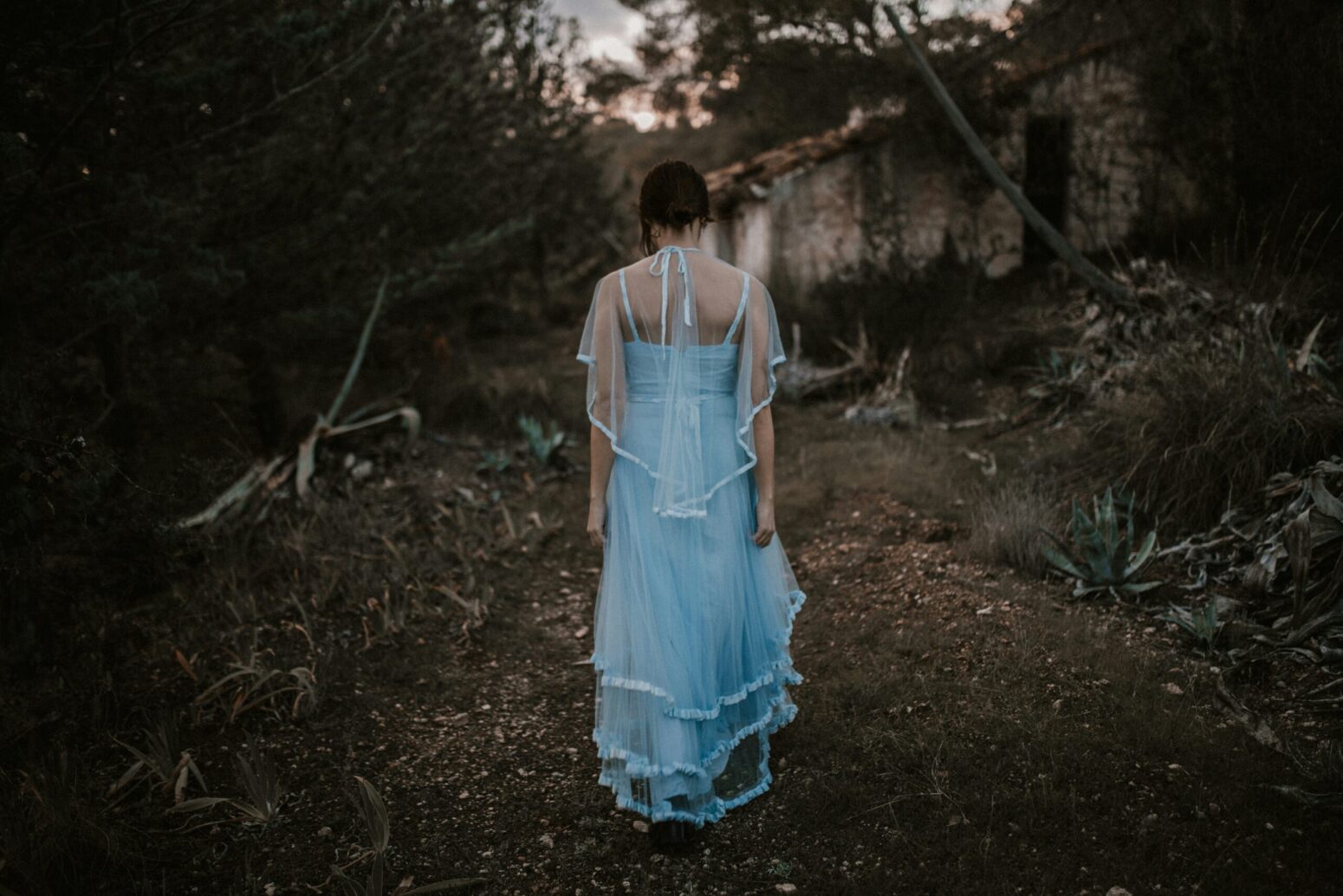
The house was one of the mansions abandoned during the droughts and wildfires. Fiona and the nineteen other women put on their blue dresses as they’d been instructed. They made their way down to the pool like mermaids washed ashore. Filming began unceremoniously in an onslaught.
The cameras were everywhere, with some handheld by humans and some attached to drones. Fiona hadn’t thought about how relentless it would be, all the surveillance. Later she would find cameras in corners and nestled in fake plants. She would pick one up and put it in her pocket.
She turned her body and straightened her spine. There were too many angles to be captured. She’d signed contracts. Her words could be taken in any context they chose. Her likeness used in any manner. She was used to this, had signed herself away in a similar fashion countless times. For some reason, this felt different.
None of the producers told her what to do, which seemed like a trap. She milled about. She sat on an old-fashioned turquoise couch. She pretended to study a painting of a crow with a snake in its mouth.
Last Chance—the show had once had a different name that she couldn’t remember—as a cultural artifact would certainly not age well, but Fiona vowed to live in the present. She had an excuse to leave the city and her phone and make some money and do something with herself. Absentmindedly, she stuck her hands in the pockets of her blue dress. Despite what everyone said, so far there was still a future. The paycheck she’d get from this would help with whatever that future entailed, though surely there were strings attached. Promotional appearances, contractual secrecy, a belief in a certain kind of romance.
Finally, one of the producers pulled her over for an interview.
“Do you want children?” the producer asked right off the bat.
The producer wore dark jeans, a hoodie, and red lipstick. She looked like someone Fiona would be friends with, but the producer couldn’t know that, with Fiona all decked out in blue and acting like she wanted this opportunity. She felt suddenly undercover, both pleased and disappointed in herself. She had some secrets to keep. She didn’t want this in the way the other women did. She was an anthropologist, a businesswoman.
“I had a child once. This tumor that spider-webbed into thirteen little tumors. It was born a fox. A house made of stone. A bright, clean skull.”
“You can’t say that on TV. You know that, right? You can’t say shit like that on TV.”
“Are we rolling?”
“We’re rolling.”
“Oh, I didn’t know. Ask me again.”
“Do you want children?”
“I haven’t given it much thought.”
“Can you answer as a complete sentence with the question included, please.” The producer seemed only mildly impatient. She’d made this request countless times before.
“I haven’t given children much thought . . . having them, I mean.”
“Your application said you named your daughter Maeve.”
“Well, she was an imaginary daughter, and also I came up with other names.”
“So you have thought about it.”
“I mean, sure, in my twenties.”
“You’re on a show called Last Chance.”
“I’ve been meaning to ask about that.”
“You’re thirty-nine.”
“No, forty-one.”
“The forties are different now than they used to be. Especially if you don’t have children.”
“I suppose they are.”
“Can you say that in a complete sentence, please.”
“Is the mansion on fire now?”
“No. That was last season. That won’t happen again.”
Last season, everyone had been evacuated. The footage had been remarkable.
The other nineteen women shuffled about in various posed scenes as Fiona finished up her interview. The women were resplendent in their blue dresses of varying lengths and styles, a throng of infertile bridesmaids. They hailed from all over the world. Some had attended college. Some had waited too long for true love. Some had changed their minds about what was most important. Some had never wanted what they’d been told they should want, and they believed convention was for those who couldn’t imagine their own life. Some had been shaped by forces they only partially understood. Some had escaped cults. Some, like Fiona, were careerists. This didn’t give them or Fiona the edge she’d expected. She found herself jumping at the sight of a producer in the corner of the room, as if she’d expected to be alone, as if this were a real love story.
Each woman had been told that she could plan her entrance to the evening’s party where they would all meet the Young Man for the first time, but not when that entrance would happen. Fiona had decided to wear an elaborate mask of green and purple with her face underneath painted the same. It seemed as though the party had already begun, and that their “entrances” had already happened. Fiona said this out loud.
“We change things spontaneously,” the producer agreed. “No entrances, just right to the party.”
Fiona wiped the paint from her face in dismay. “Did you read about the extinct gazelle?” she asked.
“Why do you mention it?”
“Last chance, right?”
“No, not like that. Not that kind of last chance.”
“Is there more than one kind?”
Fiona found it unsettling how much she missed her phone. The phones had been confiscated, lest the women read news about themselves or about the Young Man and alter their behavior in some strategic way. Fiona knew of at least one PhD student who was planning to study the house. There were conventions that the dissertation would no doubt critique. Gender roles, internalized misogyny, the ways in which one picked a life from a predetermined list of choices and then felt like a whole being who had decided things freely.
But this was upscale reality TV, the producers had promised. This was about how society treated women moving toward their middle age, how they weren’t seen. It had the potential to be truly groundbreaking.
“Who are you?” the producer asked. “Not a maiden, not a mother, not a crone, right?”
“A mammal with hair and teeth, a nearly extinct thing circling the dwindling desert water,” Fiona posited. The producer’s excitement did get to her a little bit.
“Go ahead and rejoin the party.”
Fiona wandered outside to the pool, where the air was cooler and the water was turquoise. She hovered her palm over the surface. Desert cams regularly captured animals gathering at one tiny puddle of water. The birds, the cats, but not the gazelles anymore. Fiona gnashed her teeth together, felt the air on her arms, the cacophony of her blood. She didn’t feel invisible at all.
As the night dragged on, their glasses were filled to the brim with their favorite wine and refilled with intense regularity.
“What do you do?” one of the women asked her.
Fiona felt woozy. “I teach workout classes,” she said. “You?” She didn’t mention her tenure as a reality star.
“I’m in marketing.”
And so on and so on.
Perhaps she’d not come up with any of her own desires, which was something she’d suspected in her younger years and was reaching a fever pitch now that it seemed too late to act on them with any hope of an actual outcome. Maybe that was her motivation to come here—to find out what it was she really wanted.
“Describe your dream man,” the producer requested later. It seemed very late, but there were no clocks, like the casinos in town. It had the intended effect of creating a grueling sort of eternity. Fiona had her second wind.
She paused. “Vague,” she said. “Amniotic. Visceral.”
“That doesn’t sound like a man.”
“Shorter than me but able to take charge.”
“Take charge of what?”
“Flying planes, disinfecting surfaces, recipes, maybe bread, political history, unclasping my bracelets. Math, I think. Prepping.”
“Can we go back to the height?”
“He can be taller than me. I guess I don’t have a strong preference.”
“You want to be able to leap up when he is around.”
“Those are your words. Not mine.”
“Tell me more.”
“I want to take him to all the thrift stores. I want him to look good in clothes. I don’t want him to get that strange belly that all men seem to get eventually.”
“No thrift stores. Your dates are chosen for you. You were told the rules, right?”
They had indeed given her the rules—no phone, blue dresses, a list of her fears ordered by seriousness.
“And your fears?” the producer asked. “Start with my fears are . . .”
Fiona had all the usual fears, including her brain’s starving estrogen receptors, which were wreaking havoc on her so-called personality and scattering her memory so she had to reach around for things to build meaning from.
“You didn’t list menopause. Everyone else here listed that.”
“I’m not afraid of that. Was I supposed to list that?”
“I just find it hard to believe.”
“Isn’t it suspicious? That we’re meant to fear . . . ?” She had more of a thought but not the words to form it. She didn’t want to give herself away. Truth was, she was already on the other side.
Instead, Fiona told the producer about an afternoon in college in the film building when she was taken off her feet by how badly her body was twisted up in pain from her period. The boys had come in to make their movies, and she’d been on the couch in the hall, its damp blue fabric against her winter skin. She was wearing her boyfriend’s heavy metal T-shirt, but she couldn’t recall now which band. The loss of that exact afternoon is not the exact reason that the boys went on to be famous documentarians and she went on to be a contestant on Last Chance, but that afternoon is what she thought of now when the producer asked about menopause. As she moved to the other side of menopause, she had been thinking more and more of her first period too, that time a bookend, a mirror, looking forward to this one. And her looking back now. At what exactly?
“You’re a bit young for actual menopause, though,” the producer said uncertainly.
“I only have one ovary, and it’s a bit temperamental.” Fiona didn’t want to lie entirely.
“So, if you aren’t afraid of that . . .”
“Was I paying attention to the wrong things all along? I think I was. I fear that.”
“Not existential fears. Like practical things. Maybe heights?” The producer’s patience seemed to be waning.
“Honestly, I think I’m in my prime. I’ve figured out skin care. I have the best clothes I’ve ever had. I don’t do stupid shit just because I think I should. I’m contained within myself. It’s amazing. I get that it’s almost too late, but it’s not actually too late, right?”
“You can’t say that on TV. You have to want something.”
“I’m not sure I do.”
“You must.” The producer was hopeful. She was a pretty woman, her hair parted in the middle, platform sneakers, a crop top. “It’s now or never.” Was she the same producer as before? Fiona searched the woman’s face and couldn’t be sure.
“Better late than never, perhaps?” Fiona asked.
“No, now or never.”
After the formal interviews were over, the women all sat at a picnic table by the pool and answered questions that were posed to them as a group. They answered as if they’d come up with this conversation themselves, and the questions were later edited out. What were their favorite bands of each decade? What was a deal-breaker for them? Gia, a recovering alcoholic, sipped seltzer and bitters and spoke at length about Emily Dickinson. The woman in marketing had to be seen by a medic on site, but no one knew why.
The pool lights provided a particular sensation that took Fiona to childhood and swimming pools and water wings on her ankles, and her parents’ friend with cancer making gin and tonics, and his girlfriend’s miscarriage, and Fiona too young to understand any of it. She’d imagined the baby stuck inside a tiny arterial tunnel, a little tangle, a knot, an explosion.
III. The Young Man
When the Young Man arrived, Fiona was startled by his age. No one had mentioned how young he was, but it seemed comical. Was this the conceit of the show, his absurd youthfulness?
“Twenty-five,” Gia whispered. She shimmied her shoulders in playful anticipation. Gia was Fiona’s competition for sure. “Of course they were calling him the Young Man.”
“Is it a joke?” Fiona asked. She found him instantly more pleasing than she’d imagined. She’d pictured a vacation, the money, a boring man she could trick into letting her stay around. Something shifted, though, when she saw him, and she felt competitive, anxious, alight.
The Young Man flung his body about with ease. At one point, he seemed dressed from head to toe in yellow. Another time, something soft draped around him like a feather boa. He wore a necklace of fake diamonds, and Fiona tapped at one diamond when he got close enough. He looked at her with kind brown eyes.
“What are you afraid of?” he asked.
“One of them already asked me that.”
“They told me to ask you again. Sorry, I wouldn’t normally start with that kind of question. I think they’re trying to plan the dates accordingly.” He seemed sheepish, amused.
“What would you do normally?” she asked.
“I’m worried if you don’t answer the question, they might send me to talk to someone else.”
“Let’s say I’m afraid you will never fall out of love with me. It’s tiring. Loving someone forever.”
He laughed. “Good one.” The cameras moved closer, sensing his amusement, the tilt of his body toward hers.
He restarted: “What are you most afraid of?”
“That I’ve forgotten everything.”
“We can’t make a date out of that.”
“Use your imagination.”
She remembered the epidural wire, the gown that revealed only her spine, the sticky socks so she wouldn’t fall, the tube in her nose, the magic that coaxed her blood to flow again. The Young Man would not understand any of that, not yet anyway. Maybe someday.
“You can tell me,” he said, like they were longtime lovers. He’d been told things about her. He knew her name. He knew that six years ago she’d almost died. The doctor popped one staple out of her belly at a time, saying Now, now, now by way of warning. But every moment was the staple coming out of the skin. It grew less surprising. It was happening even now, now, now.
She turned her back and unzipped the blue dress so he could see her spine. It looked like any other set of vertebrae.
“What am I looking at?” he asked.
She bunched the dress down around her waist and turned so that he could see the pale hook of a scar on her right side.
“I’m glad you’re okay.”
His sweater was violet. He was taller than her, but she could overlook it. She rearranged her dress. “And your greatest fear?” she said.
“All this.” He had a new expression now that the cameras had panned elsewhere, to some distant argument, drama stirring between the women.
“How did you get yourself involved in this?”
“I wish I knew everything about you.”
“That’s no fun,” she said.
“Tell me one thing.”
One thing! The night at the pond, the night in the snow, the rooms she’d stood inside, the sentences she’d said, the classes where she’d learned things, all the love, the various lies, the drives in cars. She’d walked up and down so many stairs with a drink in her hand, she’d found a coat in a box in the hallway, one morning her grandmother had died. She’d flown in a plane to see a man. Something she’d done had made him cry, but now she couldn’t remember what. It struck her that she was the only one who’d been around for all her life, all its weird little detours and secret pockets. No one knew her except herself.
“This is one thing. Last week, before I left, I found a bird’s nest on the sidewalk. It had fallen out of a tree, but there weren’t any eggs in it. I moved it to the base of the tree. There was a woman in a wheelchair in the center of the road. She was screaming, but she wouldn’t let me help her.”
“There was a bird’s nest? But how?”
“I know. I thought there weren’t any birds left. And the woman, she wouldn’t let me help her—”
“Theodore, come with me,” the producer interrupted.
“Your name is Theodore?”
“Theo.”
“I knew a Theo once . . .”
At 3 a.m., filming stopped. With their blue dresses discarded, some women swam, and others slept. Fiona washed her face and missed her phone and wondered what the celebrities were doing right now, like, right this second, the president too. She thought often of his daughters. She dreamed of a musician who was quite handsome. He’d been in a boy band before he outgrew it and went solo. This new Theo at the house reminded her of him a bit, the pastel hue of his clothes, his gentle and nonplussed demeanor, the undeniable smolder.
She woke up in her assigned room and couldn’t sleep. She wandered for a while, concocting an excuse in case anyone stopped her. She ran her finger along the gold that seemed to hold the house together. She walked from hall to hall and lost her way. Eventually, she moved outside. Something dark floated across the sky, right at the same height as the crescent moon. One thing she could say for menopause was that she’d never felt the world so much—literally, felt as if she were dirt and feathers and acorns herself. No self, some books said. Wild twin, others claimed. She was everything—multitudes of herself and no one at all.
IV. The Dates
Day two. Shooting began in earnest, everyone ushered to breakfast and more interviews and half-scripted conversations on various couches and daybeds and pool chairs. Phones were gone and rules were rules. Fiona felt sleep-deprived and strangely alone, despite being surrounded by people. The night before, the house had seemed both endless and claustrophobic. Now, in daylight, Fiona grew curious about the surrounding desert and what she had seen moving across the sky. Other mansions dotted the far-off hills, with what appeared to be nothing in between. She imagined all the contestants on a desert cam, watched not by the producers but something else, by an animal’s eye, a thing that would survive them all.
As the day and night went on, Fiona picked up bits of gossip from producers and the other women. On Gia’s date, the first, Theo learned how old they all were. Over wineglasses filled with sparkling water at the vineyard, Gia had told him about the night she blacked out and woke up in the shower in her party dress. It was so long ago. It was twenty years ago. Theo must have done the math but kept his composure, she said. He commended her courage and vulnerability. He handed her the Queen of Wands, a single tarot card, the sign indicating he’d like her to stay. When Gia had that bad night in college and decided to never drink again, he’d been in elementary school. In the end, it would be only four finalists, each given one of the queens of the tarot as their invitation to stay until the final round: Wands, Cups, Swords, and Pentacles (fire, water, air, and earth).
No one could say what would happen in the end. Perhaps no one believed they’d make it that far, not even the producers. After all, each year a cataclysm prevented the final episodes. It had become part of the fun, guessing what it might be.
“That’s a nice touch,” Fiona commented, her finger dropping to pinch the edge of the tarot card that Gia held up for everyone to see.
“Tell us everything,” the women gushed.
Day three. On Julia’s date, she said, Theo wore a suit inspired by a decade in which he wasn’t born. They walked down a road empty of cars and appreciated a city that once was. At the end of the road, they were surprised by a concert that had been organized just for them. During their tentative slow dance in the field, they were also surprised by a helicopter crash that wasn’t part of the day’s planned activities. There were no casualties. Julia was apparently afraid of dying in a smoking helicopter on a hillside, but this accident was simply a coincidence. Theo took her hand and assured her he didn’t know the crash was going to happen. She believed him, but it was too late for them now; they’d seen proof of an uncaring universe and their lack of agency within it. Love can’t come after something like that.
Day four, five, six. While all the other dates happened, Fiona wandered the house: three floors, balconies, a generous backyard. There wasn’t anywhere to go, not really, even if it seemed like there was. The gold repairs added to the mood. Despite knowing better, she couldn’t shake the idea that one wrong turn or mistake on her part would cause a collapse of some kind. She walked softly. When alone in empty corridors, she danced, opened her mouth to feel her jaw move, growled a little. The grip of routine had loosened. She felt almost happy. She forgot about the Young Man, and she forgot about the other, older Theo, and his baby, and maybe all the past.
She emerged with nothing that had shaped her, arriving mostly on time for her confessionals, shot at different scenic points across the mansion. One day, at the pool. Another, on the veranda.
“How do you feel today?”
“I feel okay. I guess at first I felt like kicking and screaming, but now it seems nice. I’m getting used to it. I have time to read.”
“Are you reading?”
“No. But I have time to.”
“Do you read in your regular life?”
“My regular life?”
“Do you want your partner to be someone who reads?”
“Yes. I mean, everyone reads, right?”
“No no no.” The producer checked something off.
“Do you read?” Fiona asked.
“I do.”
And just like that, they were down to seventeen women. Julia gone, Mabel gone, Anastasia gone.
Fiona’s date would be the last of the “First-Date Eliminations.” That could be a good thing or a bad thing, one producer said conspiratorially and asked Fiona how she felt about that. She reported that she felt okay. The producer wanted to know what she liked the most about Theo. Fiona wanted to answer that it was his conspiratorial nature, his belief in the apocalypse, his name, some ineffable pull that was clear as day, and yes, it was his youth, partly. His curls, how he said her name, how he looked when backlit by the pool, just this clump of darkness, and her eyes burning, squinting to make anything out.
“That violet sweater, the one he wore on the first night,” she answered at last.
“Anyone can wear a sweater.”
“That’s true. But how do you explain chemistry?”
“I don’t know,” the producer said and that seemed funny. Wasn’t this whole show about chemistry?
“Well, we have it,” Fiona said. “It’s like getting stuck in quicksand and struck by lightning simultaneously.”
“A slight exaggeration?”
“Maybe.”
Day nine, day ten, day twelve. Fiona fully became an insomniac. There were reasons. Filming happened at odd hours. The sheets seemed scratchy. Her dreams were odd, like TV shows, like amusement parks. In one dream, she lived in a minimalist green house and listed all her bad traits to someone who was both Theos at once and also a stranger. She couldn’t shake the knowledge that other people had spent their lives being artists, fighting in wars, saving up to buy houses. Disrupted sleep could be caused by waning estrogen, she’d read, back when she had access to her phone. Many times, when she woke in the middle of the night, she felt like an animal was walking on her body, its paws pressing into her abdomen, her chest, its breath a soft pressure on her face, its sharp, little nails scratching into her hair.
V. The Walks
It was 5 a.m., and someone or something was screaming. The screams were ecstatic in a way, as if meant to be overheard, but the context for them wasn’t clear. Fiona thought to investigate and walked to the window to look out. Could that be actual animals out in the desert? There were so few left. Just as suddenly, everything quieted.
Her body, awakened and sensate, was somehow covered in spider bites. A cat scratch. A surgery scar. A small burn from the heater, nothing really. Inside, the heavy creak of aging. Still, she knew she was beautiful. She took a bottle of pale pink seawater and sprayed it on the skin of her arms, her face. A small red bump emerged on her forehead, like an allergic reaction. She pressed on its warmth and decided that it must have been an animal outside, because she was one too.
She looked out her window again. One of the producers had knotted a hammock between two palm trees to sleep; she watched his body for its breath, and there it was, ever so faint. He was alive. Beyond the hammocked man was a garden of sorts that erupted in little patches that led toward desert. She pulled on her blue robe and blue flip-flops and went outside. She stood very close to the sleeping producer and plucked a nearby sprig of something and put it in her mouth and chewed on it. He shifted, and she stood over him, imagined biting him, wrapping her hands around his unsuspecting throat. What animal did this? they would say over his lifeless body, because all the animals were gone. It would be the scandal of the season.
He woke for a moment.
“Fiona?” He was groggy but intrigued.
She pulled at the hammock; it rocked, a bit more violently than she’d intended. “Nooo,” she cooed.
On the thirteenth night that she couldn’t sleep, she walked even farther out beyond the producer in his hammock. A good way away from the mansion, she grew just a tiny bit scared. Here was a fear she could describe, the kind of fear that is baseless and psychic premonition both. She’d have to mention that later in a confession—just basic animal fear. Wanting, for no particular reason, to stay alive.
She heard paws on the soft ground. She knew something was coming, from the sound, but even so she was startled when an actual cat walked toward her, a larger species than the kind people had once kept as pets. It stirred affection in her nonetheless.
It was a curious and bewildering thing, its owl face and thin gray body. It meant her no harm. Its instinct was for love, as was hers. Tenderness and warmth. She moved toward it with her hand open. She had no questions. She just knew it was the last of a thing, like she might be the last woman. The cat licked her open palm, made one small mark on the top of her hand with its teeth, and retreated.
She worried she’d imagined it, but in the morning light, the scratch rested in a soft cursive F against her skin. How was that possible? If the world knew her name, she felt responsible toward it in return. She didn’t think that the cat needed her to save it.
“You haven’t had your date yet. Have you had a chance to talk to Theo in a more casual setting?”
“No.”
“Do you want to?”
“If I do, can I?”
“Yes.”
“Are there animals here?”
“In the house?”
“In the desert.”
“Well, sure . . . probably a few. But not many, I would imagine.”
“Like what?” Fiona asked, picturing the cat, its serious green eyes.
“I don’t know.” The producer looked down at her tablet as if the answer were there. She seemed about to ask another question, but Fiona interrupted.
“I’ll wait—to talk to him again, I mean.” Fiona didn’t know where this came from, but she felt like waiting. Whatever impatience had fueled her forward all her life, it was gone now.
“What happened?” the producer asked. Fiona’s arm was bleeding. She wiped her wrist roughly against her blue dress and said it was nothing. Now, now, now.
The next night, the large cat was nowhere to be seen. She walked out much farther than she had before, but nothing stirred. Despondent, she felt sure she’d been sleepwalking, dreaming, making shit up. She was bored, perhaps, even though she didn’t feel bored. There was nothing here.
She did see the turtle from her drive there, its shell broken. This was more the type of destruction she’d anticipated. Though it smelled badly of decomposition, she sank to her knees beside it. How had such a thing ever come to be? She touched the shattered shell, the buzz of its disintegration. She lay down in the dirt to be closer to it. Later, she ripped up flowers from the garden and made her way back to place them over the dead animal.
On the sixteenth night, she encountered a rabbit, its ears straight up. When was the last time she’d seen a rabbit? It was bigger than she recalled from childhood. On the seventeenth, a skunk, the strangely pleasant smell of him as he moved toward her. On the eighteenth night, a raccoon. She didn’t think there was anyone to tell, anyone who would care, that she’d seen the last turtle, the last cat, the last rabbit, the last skunk, the last raccoon. But at least she’d been right, been awake. This reassurance, not hope exactly, woke her each night and mapped her movements forward into the desert—farther and farther each time. She felt that instead of dying and disappearing, everything was being born, taking shape, getting ready.
The next day was her date. It meant her days here might be coming to a close. Her nights too. Soon enough, these surviving animals might live in a world without humans, these bejeweled aging women and their one young suitor. How foolish for any of them to believe that they were more beautiful or more important than the mysterious starling, than the Pagan reed warbler, the Laysan honeycreeper.
Gia insisted she borrow one of her dresses for the date. Fiona’s was covered in dirt, blood, shell, fur, salt, thorn, after all.
“I was going for a look,” Fiona said, but agreed to let Gia braid her hair, flick gold onto her tired eyelids.
VI. The Last of a Kind
On her date, when it finally came, Fiona didn’t know where to begin.
The two of them sat in a boat in a man-made lake; apparently she’d told the producers something about a fear of drowning, but now that she was here, she wasn’t so sure. Theo looked thin and handsome and wore another anachronistic suit. It had taken a lot to get them into this seemingly spontaneous scenario, and now she had so much she wanted to tell him that didn’t seem right to say aloud, that certainly wouldn’t make for good TV.
“You told them something about boats?” he asked. He wanted to know.
“It’s not that I’m afraid,” she said.
“A fear of drowning?” he asked, trying to be helpful. His knees bobbed near hers, and she reached her fingertips out to touch his.
“I think what I’ve learned as I’ve gotten older is that what I want is so much bigger than any ambition I might have had before. It isn’t even a want.”
“That sounds like a contradiction.”
“Can I tell you something?”
“Yes, of course.”
She was aware of the cameras, of the two producers floating in the boat beside them, sketching out a conflict on their tablets.
There would be only a brief moment between them before they were interrupted, taken to land for their interviews and the sexier part of their date and prompted questions like, “Can you see a future with him/her?” She’d been told to prepare a sad story to tell him, which would draw him closer. She had plenty to choose from, of course.
Later, he would have to decide if he wanted her to stay or not. And she wanted to stay, in part so she could keep walking farther and farther from the mansion at night. There was something else to discover, something to save. It would take her time to figure it out.
The landscape was alive in ways she hadn’t understood just days ago, and she wanted to move within this surprising current and to understand the wordless and the nonhuman. She imagined convincing him to leave with her, to make their way into the unforgiving desert. They’d have help from unseen and unknown forces, they’d survive. They’d turn for a moment and look back toward the mansion; it would be the tiniest golden planet, and it would matter to them only in that it was the formal conceit that had brought them together and sent them forth. For a moment, in the boat with him, it seemed possible.
“At night, I’ve been walking outside. I didn’t expect to find so much living. So much is gone, but not all of it. I can’t unsee it now. I feel responsible in some way.”
“Me too,” he said. And for a moment, Fiona thought maybe he was the one for her, maybe he understood what was at stake and what had already been lost.
“What did you see?” she asked.
“A cat, a turtle, a rabbit, a skunk, a raccoon,” he answered.
She stopped, startled at his accuracy. Had he been fed this information by a producer intent on ensuring a bond between them? But the producers didn’t seem to be paying attention.
“What are the names of all the animals you’ve ever seen?” he asked.
She listed them for quite some time, all that she could remember. Even the small gray cat she’d had as a child, its kitten who dragged its legs behind it. The black bear with its baby near the house where she’d grown up in the mountains. The copperhead that almost killed her. The three foxes, the two coyotes, the whale, the cormorant. The Young Man listened to the whole list. It took hours, it took all the time allotted to her, including the sexy nighttime portion of their date. The producers weren’t even filming anymore; this was not the content they wanted. The scene had to end soon. She was done for. They’d never let him keep her now.
“Me,” she added at the end of her list in nearly a whisper. And for good measure: “You, my love.”
“I understand what you’re trying to say,” he said. He took her hand and looked toward the producers who were beckoning from the other boat. Fiona’s heart sank. Nothing flew over their heads, nothing stirred on land.
“Find me later,” he whispered, his voice a notch below recordable. And then, louder, “Can I give you this?” It was the Queen of Pentacles, adorned in her garden throne, covered in green and everything alive. “Will you stay?” he asked.
“Theo, Theo,” the producers called, waving their hands in distress, hoping to stop him.
“I will,” she said.
Something flashed in the water below them, a living animal body. The boat rocked, and Fiona held the edges, letting the startle of fear move through her, unafraid to drown.
Read more from Issue 23.2.