Kanorado
20 Minutes Read Time
Our drummer wants to know how our spirits are. He’s the only one who thinks we’ll make it. Our drummer sees light, swears the storm’s over. Our drummer, the embodiment of the world’s worst cover of Sublime’s “What I Got,” pleads with us: “This is nothing—dudes, this is nothing!” The van’s gray upholstering droops down to the top of my head as I stare out the windshield’s only unfogged spot. Monstrous shapes swirl in the snow. All is dark. And still our drummer smiles. His tense neck bears the word Namaste in henna. He’s either insane or in prophetic touch with the future. Our drummer acts like Denver’s just around the corner, like we’re not in a blizzard, like we’re not stuck on a shoulder in Kansas, like we don’t have school tomorrow, like we didn’t just hit whatever the hell we definitely just hit. He’s confident that this mess of snow will slow, that the van will move again. It’s been maybe ten minutes since the wreck. Our disconnected trailer sits somewhere behind us, masked in a shroud of white. But our drummer is not persuaded. In fact, he’s hyper, giddy, and wants to hear somebody rap. If only we stuck a few slick rhymes in our psych-folk tunes, he believes, we’d be famous as shit.
“Listen, my dudes,” he says, “I got a beat.”
Our guitarist, Benji, sighs from the way-back seat, suggests we go out and get the trailer instead. I shake my head—the storm’s too much for us now. Plus, I’m more concerned about my victim, the shadowy thing I hit with the van, but since I only play bass, I keep my mouth shut. Even though I shared that Facebook article about how researchers found bass to be the most scientifically essential element of live music, I don’t have much sway. Nobody clicked it.
Our drummer chants, “Rhyme with me! Rhyme with me!” He wants us in on his beat.
It wasn’t my idea to play this show, or to stay on I-70 as the exitramp semaphores blinked and the semis started veering off. Last night, ignoring the storm reports, I had the idea that this trip would finally turn us into friends, but today after our keyboardist, Colin, demanded we leave him at the Taco Bell back in Topeka, I knew this whole thing was a mistake.
“My phone might still connect to 911,” I say.
“Maybe they can find out what we hit?”
“This is not an emergency!” says our drummer from the passenger seat. “My guys, listen, we’re opening for Soul Circle tonight. Calling 911 means we’re not. 911 means surrender.”
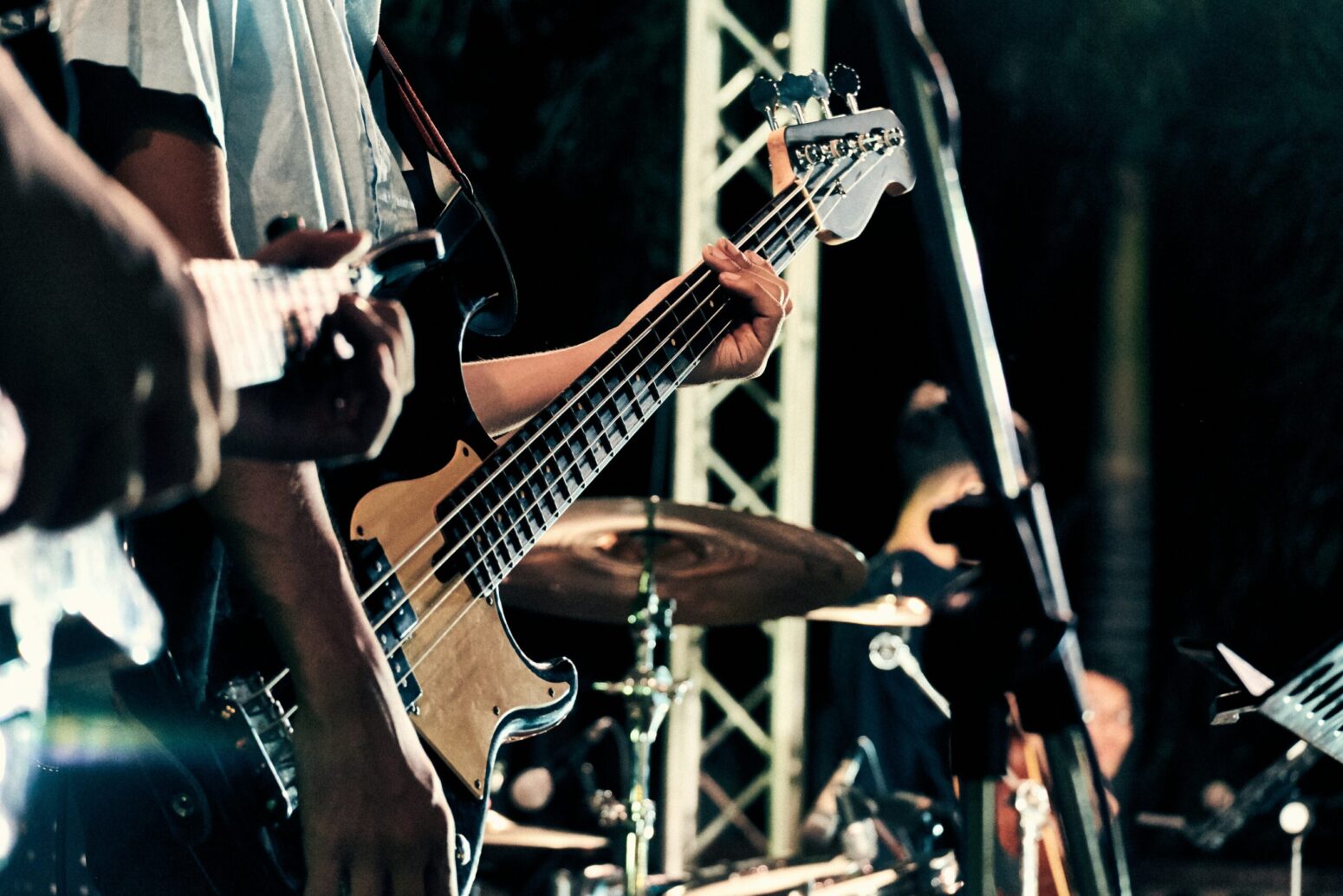
Our drummer punches the ceiling for a bass, honks the horn for a snare, and spits hi-hats with the quick click of his tongue. I can’t feel two of my fingers. His hand invades my personal space as he slams and slams the center of the steering wheel. I look back into the vehicle, past the empty middle row where, hours ago, Colin sat. Benji lies stretched out across the bench seat, every Windstar floor mat draped across his body. His face is serious, blue. Our drummer’s deep V-neck tee yells our band name: PILGRIMS.
“Brothers,” he calls. “Let’s love this time together! One and two and till the plows come . . .”
We’ve been ignoring him since the wreck, but Benji can’t hold it anymore and laughs. He sits up. Takes a deep breath. He goes in: “Okay . . . Uh . . . Check-check. Yo, it’s the fourth of December, heading to Denver, but NirVana broke down . . . and . . . I can’t get on Tinder?” Our drummer howls. Our drummer named the van NirVana. “More!” he shouts. This is exactly the shit he’s always talking about—cosmic energy. I hope this energy takes shape as a fight. Our drummer’s head swivels around, long hair looking rubbed-with-a-balloon. His spirituality fits him like an obvious, loud wig. I’d like to rip it off him and bury it in a snowbank.
High school might have been easier if I’d invented, like our drummer had, my own persona to hide behind. Instead, I remained quietly bitter and hoped to somehow be noticed. I wouldn’t have believed you if you’d told me then, at seventeen, that what I yearned for was transcendence. In fact, I would’ve rolled my eyes and spat, imagined killing you in the volta of a sonnet, the one form we’d learned about in class.
I’d not yet admitted aloud my suspicion that I was more poet than bassist. Sitting silently in class, I’d draw book covers with tough-as-fuck titles in Gothic cursive—No Poems for These People: Verses by Liam Craive. I hadn’t written a single line but thought that when I did, I didn’t want any of these people—our drummer, Benji, even Colin—to be anywhere in my work. I thought “Daddy” by Sylvia Plath only gave her enemy the satisfaction.
I had read exactly five poems.
But before I ever got the courage to make my poet-self public, everyone around me flipped into a mystic, their whole lives some sort of whispered spell. Colin, whose parents were ex-LA actors turned Midwest theater professors, said the best musicians did Transcendental Meditation. All the stars—Kid Rock, Prince, even the punks—were daily meditators. They mouthed a mantra and sat cross-legged on their yachts. Colin started an early-morning meditation club called One and the Same, where he and a dozen kids sat atop tables in the cafeteria, mumbling passwords to the soul, smelling their clasped prayer-hands.
What made Colin refreshing was that he never talked about himself. He seemed genuinely easy and kind, someone who didn’t need to win. On the other hand, after our drummer started attending One and the Same, all he could talk about was The Mantra.
“I have everything I need right here,” our drummer would say, smug, pointing to his temple. But The Mantra itself (I used to wonder: Was it a riddle? Slogan? One lone noise?) had to remain this big secret. Another meditation trick was to sit there and think about a riddle, called a koan, something like If you meet the Buddha on the road, kill him. I knew dozens because our drummer never shut up about them. He was so full of shit. He was from Kansas City, Kansas. I daydreamed of the cafeteria flooding, the water rising and rising behind the locked-tight doors, me watching from the security camera to see whether or not these hippies in fact had everything they needed. Could The Mantra help them breathe underwater? Could it make them levitate? After what I’d seen earlier that day in the Taco Bell parking lot in Topeka, I was beginning to wonder if Colin really could.
Our drummer keeps the beat quick. The snow’s thick on each window. I see only his insane smile when I close my eyes. I have nowhere to look except inside the vehicle. Benji’s rap stumbles on: “Freezing cold as a lake, lost with my mates . . . wait.” He coughs. “Uhh . . . Kanorado is a weird little space between states. I ain’t tryin’ to hate, but . . . we’re gonna be late—”
The song stops midmeasure.
“Don’t be so negative,” our drummer says. “Can’t you see the sky opening out there?”
From what we can see past our breath on the windshield, the sky is low and closed—a tombstone knocked over. What I can’t believe most is the noise of the snow. Loud and hard as a windless rain, it falls in stiff little pellets, sounds like tiny knuckles cracking against the roof of the van. If our drummer can hear it over the drone of false positivity in his empty head, I’d be shocked.
“Seriously,” Benji says, sitting up. “We’re hours from Denver, and this storm . . .”
Finally, an argument. Something our drummer can lose. Benji’s high must be wearing off. He doesn’t use meditation like the other two. He uses weed. It’s only slightly less annoying.
“Um,” our drummer says. “I think we’re much closer than that, brother. You can practically see the sign for Kanorado!”
We all peer out the white windows together. No, you can’t. “Either way, the gas light is on,” Benji says. “And our trailer is . . . off.”
“And our keyboardist is . . . gone,” I say. “Your phones are dead, and my phone’s shit.”
Our drummer grips his armrests. The veins in his big arms pop. He gathers that long hair into a ponytail, flips it into a bun—something he does before prayer.
I add: “And we don’t even know exactly what—”
“You’re fucking turning on me too?” he says. “What? Exactly what don’t we know?”
“We don’t know”—his face is so close to mine that I feel heat— “what it is I hit.”
“What we hit,” our drummer says. His hair’s fallen down again.
“We’re in this together, Liam. Colin too. That’s my point. All the people at the show, lining up outside the door? All of humanity is in this. If we die, guys, we all die.” I glance at Benji in the rearview mirror. He’s putting something into his mouth. He chews, does not return eye contact.
I’m alone. “I can’t believe this,” our drummer says. “We’re playing on an honest-to-god stage. This is our chance.”
Benji sits up in the back. “Our bassist has a point,” he says. “The fuck did we even hit?”
I shrug. Our drummer closes his eyes and rubs them.
“Oh my god,” Benji says. “Did we hit Colin?” He falls back against his seat in laughter.
“Jesus,” says our drummer, trying to open his door. The winter air sucks inside. The tiny, pale hairs of my upper lip stiffen. “If it’ll put you two at peace, let’s go find out.”
Our drummer had decorated the school-band room with fliers asking for “a chill as hell bass player with his own actual amp.” I showed up at Colin’s the following week and immediately hated the music, the long-ass ambient intros, the way the drummer, midsong, would toss his sticks in the air and always catch them, smiling like an animal.
But what else was there to do? Our school was small and quiet, and a band seemed like an okay way of proving you weren’t invisible.
We belonged to different groups. The marching band was mine, maybe. Our drummer took honors classes, ran track, was every teacher’s pet. Benji played the role of stoner well, hanging out in the art room. He wore one dreadlock, his dad’s dirty button-downs, and a bolo tie he’d made by hand from hemp. What I’m saying is, these were not the people I wanted to die with. I didn’t even want to die at all, because I had no confidence that when I did there’d be a paradise.
I understand, now that I am the start of a man, that it is all paradise—every step, every turn, fall, fling, even the suffering. I didn’t know so much that day, sitting in the freezing van in Kansas with my life about to begin. I only knew that I had done something wrong. The crash, yes, but also: it was my fault Colin left us. If this was it—if death awaited us outside the van—I wanted to admit it to someone, to something, to anything but these two.
Pushing the doors open is not easy. We all struggle. Unruly wind comes hard in every direction. Our drummer leads with his flip-flopped feet, kicking the storm as he slides out into it. Half-crushed cans of Monster follow him. Outside NirVana, the cold is dry. This snow’s not the kind you pack into balls or sled on, but the kind for prairie drift, the kind that snakes low and ghostly across the lanes. The landscape smears each way with it, the work of a wasteful painter. Benji sticks his hand out the door, but he can’t push his body through the wall of wind, so I grab his wrist, lean back. We both spill out into the snow-packed berm.
An hour before, when the snow was just starting and the road was speckled with traffic, we were moving along at a decent clip, with a real shot at making it on time. We were still in the race. We were going to play on a real stage, albeit without Colin. It was almost fun. To pass time, we pranked people back home using Benji’s phone through the stereo. I steered NirVana. Our drummer scrolled fast through the contacts, landing on people at random.
“Um, hello?”
Usually someone from our high school answered, although the first time, it was my mom and we hung up fast. The last to pick up was this cheerleader named Hope.
“We want you to know we’re going to die in Kansas,” Benji joked. “I can’t feel my face.”
“Oh my god,” said Hope through NirVana’s one working speaker. “Are you serious?”
“The last question, Hope—the last question I have is,” our drummer yelled, breaking out his favorite Zen koan. “What was your face before your parents were born?”
“What are you talking about? Are you guys okay?”
“Thank you for supporting the band, for believing in us. Hang fliers for our funeral!”
Benji hung up and slid down to the floor, laughing. The game was cruel but nonetheless fun—that momentary identity we got from evoking fear, that power. I was enjoying the distraction from thinking about Colin, who by that point was two hours behind us, probably still waiting for his thespian parents to rescue him from the Taco Bell. Our drummer was dialing Vice Principal Morales when the phone died and a big shape came through the screen of snow.
I didn’t know anything.
One second I was tracking our path, trying to keep us somewhat in the right-hand lane by comparing the weak glow of the van’s headlights to the wisps of tall grass poking through the snowbank, and then we were on top of something. And that something tumbled beneath us, got lodged in the space between the van and the trailer, and no one could see, but it jostled loose the hitch, and the trailer spun off into a cloud behind us. We slid onto the shoulder.
I stopped laughing first. Then Benji. Our drummer never stopped. His laughs always felt manufactured, always came in three stages—a yelled “Ah!,” a dog’s yodel, and a labored, nasal denouement. You have to hear it to know what the end of the world sounds like.
“This is beyond stupid,” our drummer calls into the storm.
“It’s all an illusion?” I say, though I hear him clearly.
“It’s ruined?” says Benji. “Can you guys see the trailer?”
We decide to take care of that part first. The hitch on the van seems intact, so we lumber forward onto the highway until Benji has his hands on the tongue jack. Without words, we work together to pull the heavy trailer by hand. I keep falling, knees soft against the snow. When we’ve got the ball lined up with the coupler, our drummer cranks the handle of the jack—his neck bulges as he tightens, the henna tattoo chipping from his neck like cheap paint. I look off into the snow. My mind blinks out. Sight hardly exists. All of my senses power down. Regret’s the only thing I feel.
Colin didn’t want to eat. He stayed outside while Benji and our drummer scarfed Crunchwrap Supremes. I left them midmeal to go practice my bass lines, which, honestly, I hardly knew.
When I opened the trailer door, I saw Colin sitting cross-legged on the drum rug, facing a half-empty Nalgene bottle on the floor tom. Full lotus, lips moving in a mumble, he didn’t even know I was there. I didn’t matter. Nothing mattered. He had everything. That’s how this stuff works. It was just us. Just me, really. Colin, somewhere else entirely. In silence I watched.
That’s when I noticed what the water was doing, how it shook. Little waves radiating. I tried to wake him up, palmed his head, mussed his fauxhawk.
“What are you saying?” I whispered. The water rippled as if a T. rex were not far off, trembled just like Colin’s lips.
I said, “Colin,” but Colin was a rock. For a second I thought he was dead, so I pushed him over and straddled his chest, looked down at his fish-mouth, tried to track the shapes to make words. I freaked out. The water shook harder, waves lapping against the sides of the bottle. Like a lifeguard, I pressed my braided hands into his sternum. When his eyes opened, I must have looked like a murderer or worse. He screamed. I clasped a hand over his mouth.
“Give me The Mantra,” I whispered, gripping his face hard. “Tell me what the fuck it is.”
His eyes watered as he let me have it.
Our drummer mouths The Mantra now, as we walk into the storm in search of what we hit. I can read his lips. The word is Pilgrim. And I should have figured, because the week after he joined Colin’s meditation club, our drummer burst into band practice, stood on his stool, and suggested we change our name from Ajar to Pilgrims. Colin blushed. Benji voted no. I shrugged and scratched my bottom bass string, which I’d never changed because it never broke. My bandmates wanted a yay or a nay. The word pilgrim felt old, dirty, and I wouldn’t say it. I lifted my finger to my nostril—it smelled like a bad penny.
(I no longer believe in luck.)
The walk takes longer than expected. At times the wind blows at our backs—it feels like gliding downhill in neutral. But then the gusts shift and knock us into each other. The worst is, of course, head on, which happens the most.
“Did we miss it?” asks Benji. At least, I think that’s what he says. His voice becomes lost as soon as it leaves his mouth. That’s why I’m trying to be silent on this journey. But I’m not calm. Don’t get me wrong. I keep looking behind us, for the van. And of course, there comes a moment when the vehicle is gone, erased, finally too far away. I try to remain confident that there’s only one direction it could be in. As for what we hit, I don’t even know what to look for.
“We should be sound-checking right now,” says our drummer, patting his pockets. “I swear to Christ, if I lost my damn drum key . . .” Here it is, the old him coming out—the positive mask sags away and all that’s left is bitching. This is the kind of person he was before Colin.
He’s not fooling me. I know it’s the kind of person our drummer always will be.
“We’re not gonna make it to the fucking show!” I say. The wind pummels our bodies. I try walking backward, but the snow still flies at my eyes, and now our drummer and I are facing one another. “And you’re no goddamn pilgrim!” I say. “You’ve been nowhere that a million people haven’t already been before.”
“What?”
“Fuck the fucking show!” I say.
“Fuck this fucking snow?” our drummer asks, a hand cupped around his flushed ear.
“Is that truck gonna slow?” Benji asks. We’re three wide. I’m on the outside, in maybe the middle of the left lane. I haven’t noticed the semi. Two whiter circles appear within the snow-screen before us. They grow bright, wide, wash our bodies in light. A horn blows. I dive sideways toward the shoulder, tackling the whole band, or what’s left of us, and we fall down into the ditch.
We don’t know where we are until we each focus on a red circle in the snow. It’s quiet enough to hear breathing. Winds are well over our heads here. The storm is tapering off into rain. Beneath the drift there lies a long body and this spot that blooms, a rose through the snow. Our drummer says nothing. Benji isn’t laughing. There are no points to be won. We form a circle around the thing. I begin to dig with my hands. The goal of this excavation is simply to know. The band joins me. We clear away what’s covering the creature. I work until I feel fur—the color of diamond, brighter than snow. The other two jump back, fall to their asses. Beneath my hands, the animal’s body beats out a rhythm, syllables, a mantra, not Pilgrim, nothing English.
I see the word. I try it out with my mouth. I confess.
I can’t tell you what it is. And it’s not because I don’t want to. I can only try to bring you close. Closer, almost touching. This whole moment. I am back in that ditch where, for all God knows, my drummer and Benji still sit. The highway falls away into blown snow, and beneath it lies this giant, ancient creature. Soft ears back like a worried pet. Snow melts at its wrinkled nose. Fangs bulge behind quaking lips. I whisper the word.
The yellow eyes open.
I cry, I cried like a hundred-year-old man. What I’m saying is that we were not, we are not, separate from it. This was always happening. This animal, the accident, The Mantra, a koan—which I have learned is not a riddle, some game to be won or lost, or stolen. Rather, it is a key to a warm room where logic dies gracefully. This has always happened. Soon there was a dude from fire and rescue in his neon-yellow jumpsuit, carrying us freezing back to the road. We were seventeen. Babies. He held us like babies. Me and our drummer at the same time. He put us in a rescue truck. Then he and Benji came back with the animal in their arms. The great dying body spread across the back bench seat, and we three squeezed into the front, and the vehicle lurched, and the heat poured onto our bloodless feet, and the animal rode silently behind us, and my knee kept bouncing against the gearshift, and if we ever woke up, we woke up home.
I hadn’t cared about the life of the band until I realized I had ended it. When we saw him in school, Colin was cordial but aloof, wary, no eye contact. Anytime I could catch him alone, he would wince, and I’d begin, and he’d stop me to say my apology was accepted. Who knows what more I wanted. A hug? Colin had given me enough. Soon he moved, and our drummer never called another practice. He’d smile easily at me in the hall like nothing ever happened. In the chaos of commencement ending, he found me smoking behind the band room in my blood-red gown. He clapped a hand on my back and asked, “Where you headed, pilgrim?”
I think he truly wanted to know.
Read more from Issue 16.2.