Dolls
12 Minutes Read Time
When I was a child, everything was perfect all the time.
I was long planned for and executed with great care: my mother dressed me in tailored suits, flounced petticoats, buttons shaped like clocks, sheepskin coats, electric-blue felt, coordinated layers of hot pink and purple, drop waists, sequins, Peter Pan collars with scalloped edges, oversize men’s shirts and ties, ruffles all the way down, flannel knee patches, turned-up cuffs in contrasting fabric.
I’m reading Nightwood by Djuna Barnes with Charlie, my professor. In the first chapter we are both captivated by the circus performer Frau Mann.
Charlie is interested in how she disrupts the gender binary (or maybe he thinks I am): he says, Note her muscularity, note that her name is essentially Mrs. Man.
I’m not. I’m bored with gender disruption.
What I’m interested in is the absence of a division between nature and artifice.
Barnes writes that Frau Mann’s skin seems to be the same pattern as her costume, red and yellow lozenges, or that her costume appears to be her skin, so that “one felt [the pattern] ran through her as the design runs through hard holiday candies.”
Further, her body seems to be made of polished oak, at the calf and at the groin, where “the span of the tightly stitched crotch was so much her own flesh that she was as unsexed as a doll.”
“Unsexed as a doll” is a false equivalence.
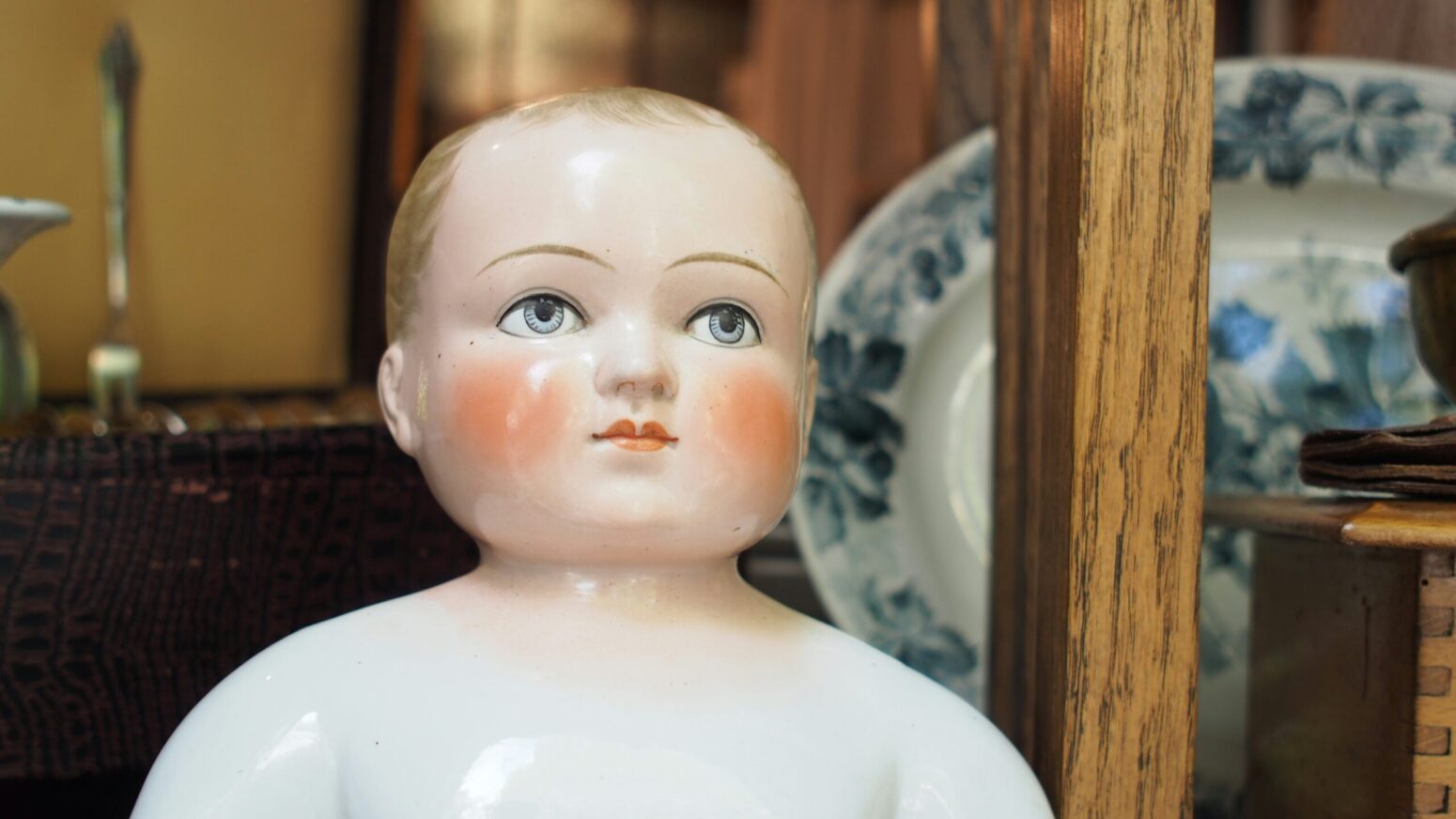
I would like to touch the face of a porcelain doll, cold and smooth as a bone-china teacup.
I would like to hold a precise female face: symmetrical, delicate. At once completely human and vacant, expressionless.
I would like to touch a face that’s sturdy enough to drink out of but only a millimeter thin, nothing on the other side.
That would be a satisfying face.
My soft cloth doll in racist caricature—woolen hair, round eyes—disappeared one day.
Months later I found it in the garage and retrieved it. My mother saw me, froze.
You can’t play with that, she said.
I said, Why?
She said, You just can’t. Put it back.
My face is not dissimilar to the face of a porcelain doll.
Maybe that’s why I can imagine I don’t have a face—why I can feel close enough to not having one that I can entertain this dream.
There’s a passage in Nightwood where the trapeze artist Frau Mann says to the impostor Felix, “We will have dinner, we will have champagne.”
“The way she said ‘dinner’ and the way she said ‘champagne’ gave meat and liquid their exact difference, as if by having surmounted two mediums, earth and air, her talent, running forward, achieved all others.”
As if density is the best way of determining what is a thing, what is not a thing, what is a different thing.
When I was sick, I went for an interview at a porn site.
Their thing was “natural”—they said they would give me a $400 bonus for having untrimmed pubic hair.
My body could barely walk me the five minutes from my house to company headquarters.
I listened politely to their pitch: all-female crew, respect, the need to be more and more adventurous to keep making money.
They took a Polaroid of me, topless, in a windowless room, in front of a dark wood door.
I remember the flash. I remember how my body was then: translucent, white, stretched, my hair an overbleached shag.
I walked home and went back to bed.
In my first year of acting school I bought an inflatable sex doll to use as a prop in a solo performance.
The doll was meant, crudely enough, to represent me.
I went with my friends to the XXX at Acland and Carlisle, the intersection of the 1920s amusement park, the McDonald’s, the art-deco street of European cake shops, the park that led to the beach.
It was one of the first warm days of spring. I felt tentatively happy and clean as I went in to make my selection, as if I had just washed my hair and it were drying in the sun.
I chose the cheapest doll the store stocked—still $65, half my weekly budget—and carried it home on the tram, my arms strong around the cardboard box.
I don’t remember exactly what I did in the performance.
The main thing people talked about afterward, and the main thing I remember now, is the doll’s anus: when fully inflated, it protruded like a flower.
Barnes doesn’t use the then-popular term for the gays, invert, except (I want to think) sarcastically, making a joke of its oversimplification. Her characters are inverted, then inverted again, enough times over to make a mockery of the notion that anyone is not upside down, inside out.
Hedwig, the only “upright” character in the book (the only character who believes her own myth), is pitiable for it.
Robin is externally-woman-but-perhaps-man, via child, via dog, statue, plant, earth, sea.
Guido resembles a fruit.
Nora is a tree.
The doctor is externally-man-but-really-woman, via dog, with a penis like a ruined bird.
The inner substance of dolls is important.
A Barbie: hard plastic all the way through. My clowny: soft stuffing held in by stitched cotton that’s at once skin and costume.
My cat-head puppet has a torso of wood, with a butt, a belly, and small pectorals grafted onto it in polymer clay.
His arms, legs, and head are built with aluminum foil and wire, with clay molded on the outside, so in this sense he does have skin covering internal organs, like me.
Unlike mine, his eyes are not distinct; they are molded in clay, then painted on, the same as the rest of his face.
I say to Charlie, Nora’s the most opaque character.
He says, What about Robin?
I say, Robin’s meant to be opaque!
We both laugh.
I don’t really think Robin is opaque.
None of the theorists understand Robin: she’s described as the great mystery, the unknottable knot of the novel. But I understand her.
She is like all those other examples in the book—the doctor’s cow who “had gone somewhere very fast that we didn’t know of, and yet was still standing there”; Felix, “damned from the waist up,” half something, half something else, caught in between.
Robin is half human, half doll.
She wants to be owned by other people, to hold their projections and have their projections hold her.
She is so passive: “as if [she had] no volition for refusal,” she surrenders herself to Felix, Nora, Jenny.
They all love her, know her, care for her, like a doll.
This being held is one half of her.
The other half is the horror of being a vessel.
A comforting thing about reading Nightwood with Charlie is the misery our conversation must necessarily contain and not address. It is held in the room, suspended in relation to the literary devices we identify and classify.
When we reach the doctor’s confession, we become tentative.
The doctor tells Nora how, having tried everything else, he went into a church and opened his pants, tried to reckon with his penis, tried to force God to answer him.
He says that he cried out, “What is permanent of me, me or him?”
It’s the question in the book that contains the deepest pain.
Which part of my flesh is me?
Which part is real?
My first publishing job was in an office in a 1920s brick duplex in the old, beautiful part of Canberra.
From the Italian shoe shop around the corner I bought an expensive pair of soft purple brogues.
I wore them with my office gear, in my elegant office, undertaking my legitimate tasks.
I even went to meetings at Parliament House, dress and stockings and shoes and visitor pass, sitting straight up in a fancy armchair, pen poised in hand.
Charlie and I are talking about Robin’s opacity again.
I say aloud that I don’t find Robin opaque, I can relate to her.
We are talking about how Robin holds a core human longing without attaching it to any object, just existing suspended in it.
Barnes’s iteration of longing throughout the book is ugly and raw, the kind you need to look away from.
Barnes suggests that attaching longing to an object is futile, but that living within that need without attaching it to any object is in some way inhuman.
Charlie says he’s known people like Robin but he can’t understand them.
I say, I understand, I’ve been that person.
I feel like maybe I’m owning up to something awful, that maybe I should feel ashamed.
Charlie says kindly, Well, yes, I often say I feel like my characters are more alive than I am.
I don’t understand what he means. I think he’s trying to make me feel better.
I’m more sure now that there’s something I’m meant to be ashamed of, but I don’t know what it is.
I have nudes from the summer I was twenty-nine. In them, I’m thinner and more muscular than I have ever been, before or since.
It makes sense to me now that I’d choose to disseminate naked photos of myself then—I thought of myself as a correct specimen; I had made my body, hair, and face correct; I wore clothes that were correct.
It was my last summer of feminine performance, before I forswore it. In retrospect it seems like a pinnacle of hardness.
In the photos, my body looks like it’s made of a uniform substance that goes all the way through, my breasts round and dense.
In the photo of me in the bath, I look like I’m wearing lipstick, though I’m not.
The women in Nightwood are more carefully regarded than the men, their substance more closely considered.
Felix is given more articulable thought than physical description.
Likewise, the doctor.
It’s as if this cutting narrator, while still taking the men in, takes one courteous step back from them, whereas with the women she pulls open their mouths and looks down their throats.
I have an old picture of dolls dancing.
They are dancing, says the caption, in the snowy grotto.
My porcelain dolls had hats and gowns like these, but they were too demure to dance.
The women in Picnic at Hanging Rock had hats and gowns like these. They danced, then disappeared.
In the unpublished ending of Picnic at Hanging Rock the women are swallowed by the sky.
The published ending is better—when it’s impossible to know what has happened to the women, you feel it deliciously. It’s more like life.
There is no reason for these dolls to be dancing here in the snowy grotto other than that they are dolls and have no agency.
They are more pliant than the dolls I had, more smiling.
My porcelain dolls were stern and straight. I never played with them; I didn’t believe they were people.
These dolls are compelling because they are oblivious; they are not afraid when it is so clear that they should be.
I visit the Djuna Barnes archive. Mainly I notice her pitifulness.
She is trying to historify herself: in every folder there are carefully cut scraps of paper where she has typed or handwritten the praise famous people gave her.
T. S. Eliot’s quotes about her genius, his pride editing her work, are written out painstakingly and repeatedly. She seems terrified of what she would be if we forgot.
I used to have fights with my ex about my appearance.
I would say I didn’t want to have one.
She would seem deeply wounded by this and deeply concerned for me.
She would try to explain to me how dangerous this desire was, how it was akin to not wanting to exist.
I didn’t think she understood me, but maybe I didn’t understand myself.
What I meant is, I want to be without artifice.
Maybe this means, I want to be unconscious.
Charlie and I are discussing the purpose of Jenny.
I tell him about my disorientation reading the Jenny chapter, the pages of detailed, vicious description of her house and her body and her trinkets.
I’m exasperated. What is this for?
He shrugs. Well, a novel always needs an antagonist.
It’s the vitriol that confuses us both, the pure hatred the narrator seems to have for Jenny, in a way that allows no space for breath or empathy or identification.
Charlie chuckles. Well, it seems like Barnes might have been working through some anger at a particular person here.
I know that I’ve veered into the personal now, that I’m reading myself into the book again, but these pages incite me to see my own anger, unstintingly expressed, at how people are.
This is the part of my own obsession I so rarely let myself see; when I do, I immediately try to turn it into something productive and manageable.
But the anger never goes away.
This is so raw and blunt that I can never say it out loud: I am so angry at everyone for being how they are, for performing the way they do, for implicitly accepting this standard of artifice.
I am so angry at everyone I know.
Read more from Issue 17.2.