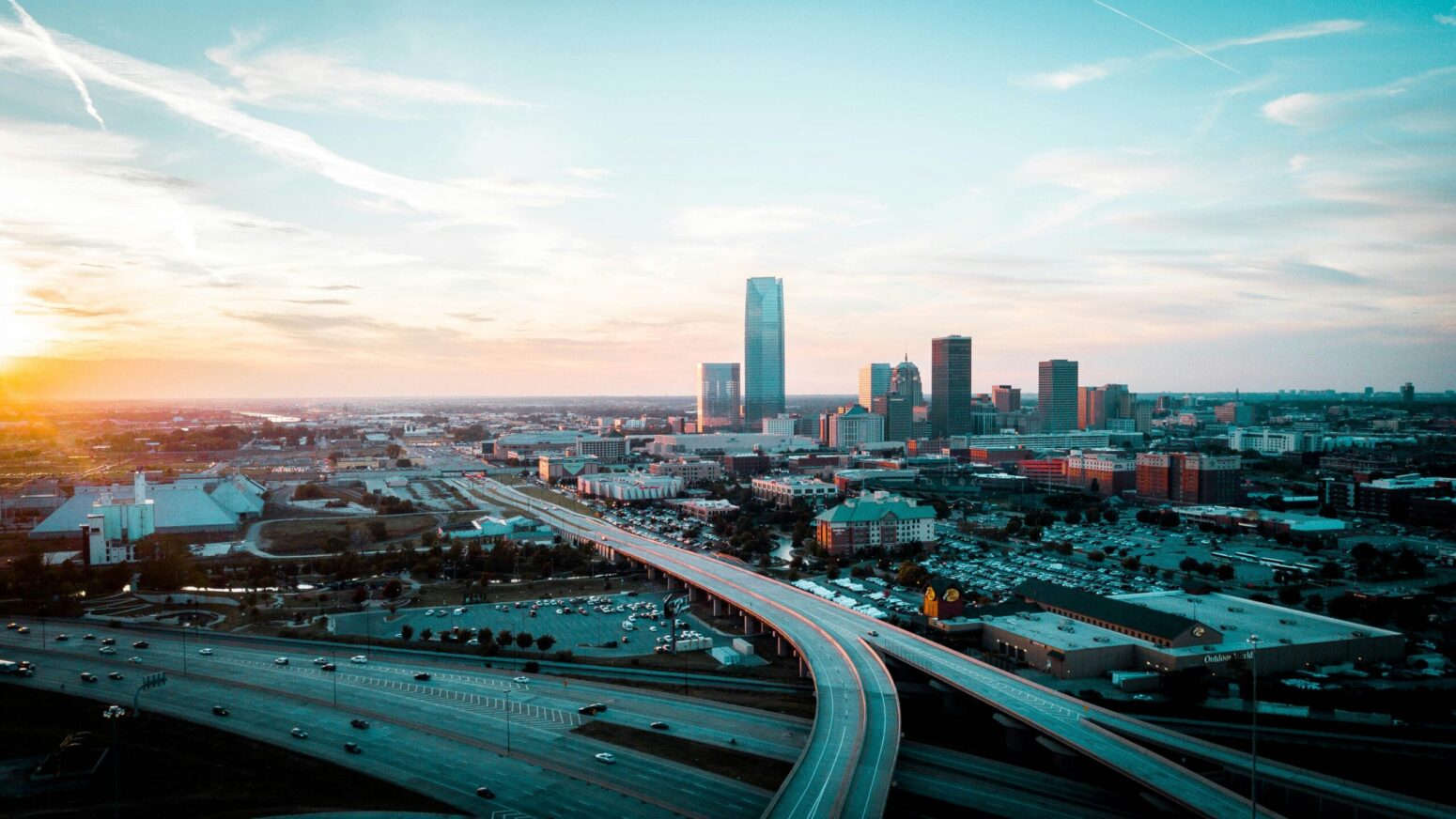
An Ordinary Evening in Oklahoma City
4 Minutes Read Time
In memoriam, Gary Rader (1946–2017)
I
The eye’s plain vision is not what it sees,
or what it understands, or even what
it ignores, but what it passes over,

like an angel among the mountains, an angel
above the entrance, retinal, peripheral, both
seen and unseen, dark things without a double,

without shadow. Landscape is another
kind of language, one we never learn to speak
but know the way we know our own skin,

our own tongue, the way it runs along our
teeth, an action for which there is no word,
only recognition, even though vocabulary

is a formula for knowing. Everything
is foreign without a word beneath it,
rooted and routed, downspringing

and upshooting, guttural, subliminal,
like a sentence planted both in sky and
earth, neither wholly written nor erased.
II
Suppose this life is nothing more than a
house on fire, who would pray for rain?
Rain on the church bells, on the trees, in

the yard, the children running up
the hills, the rivers and rivulets,
the blue and gray of the bluegray

day, as real and mutable as our
thoughts about them, this one and
that one, the match of the mind,

the fire of the idea not even
darkness can extinguish, not
cessation, the implacable

meditation, our scorched and
sonorous laments, the smokespool
of regret, like a log at our feet.

You know the syllables.
You have tasted the letters.
Sing the song as you swing the ax.
III
The point where the horizon ends and
begins is the same, but not our ideas
about them, or us, always ending,

always beginning, like this line,
and the next, this one too, as in a
shoreline or the cloud ponderous

above it, churning, turbulent as a
heart, the oar of desire alone on
the raft, the waves white as

castles of the dead, bone breached,
black ladled, their presence as real
as contemplation, real as the

realest real, beyond sight, beyond the
memory of sight, which is now beyond
wanting or even knowing of want,

where that last long light of emptiness,
that flicker, that flame, that solitary space,
that crack, that cleft, that fissure is filled.
IV
The end of one person is not necessarily
the beginning of another. When a thing
stops, something else may not begin.

Or it may, as the sun in its last self
may make of us a reflection of the stars
in their sacks of black. What shines in

your skin, first one? What lays its teeth
in your bones? The plainness of the plains
is savagery, the farmer says. So be it. So be

our blindness in the face of pure sight.
What do our bones know of the oven
that bears them back to the bodiless

body of the unushered air? What of
formulation and fixity? What of
flesh? Of the father and the son?

Of the sun? Of the stars and their shimmer
on the son in the raw reflection of reality?
What sees beyond shadow, beyond silence?
V
Our romance with the celestial is like
an X and a Y in a sentence composed
not of letters but of what letters used

to signify. Those two romanzas, the
said and the unsaid, ghosts of our regrets.
The heavens have always been haunted,

and yet we dress them like ourselves
in a play in which we are the gods
acting as humans acting as gods.

One cannot unfell the fallen tree,
one cannot un-understand this.
Not even the president, Mr. Blank,

strong mind in a strong land. The poem
is neither mind nor land, neither the
arrow nor the bow, neither the sun nor

the self. It is more like the barren limbs
of the trees after the leaves have loosened,
the silent summer gone, the ghosts glistening.
VI
Barrenness is not absence, but absence
is everywhere. My father is absent.
There is a hole somewhere in Oklahoma City

the size of something not quite right. If
Oklahoma City is part absence, what is
present? If the sun makes the silent sky scatter

like deer in the blue brush, what bringeth
the moon? Star ghosts whiten the night with
their disappearances as we will with ours.

My father’s bones have begun their heavy
work, learning their trade, perhaps from Stevens’.
The shared labor of the dead. The earth’s

bowl fills, empties, then fills again. Inside
the mind, the words we want wait to do their
own work. The philosopher waits, the president

waits, the poet waits. For our fathers? Our sons?
Our words? Our love? Our ghosts? The son waits,
while sun, the stars, the sea, the sky, the soil, opens.
Read more from Issue 20.1.