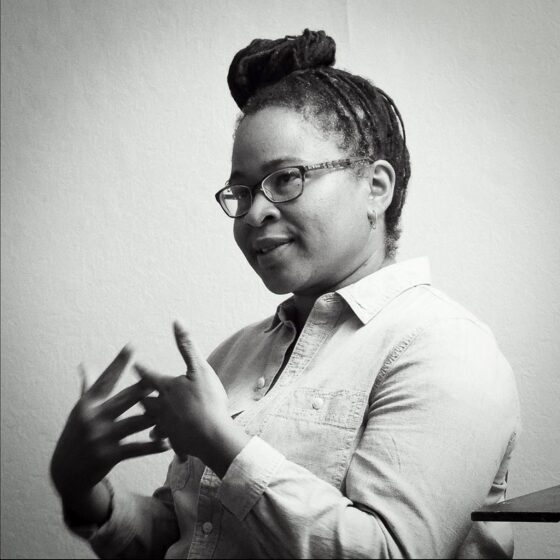
Interview with Renee Gladman
5 Minutes Read Time
Assistant Editor Leila Chatti: I was thrilled to pick the brain of prolific and inimitable poet and maker Renee Gladman, who will be reading at the University of Cincinnati on October 22, 2026. Before her reading, I had the opportunity to ask her a few questions about creativity, legibility, and joy.
LC: Something I encounter frequently with students of creative writing is an anxiety around being understood, being legible to others. So severe is this anxiety that they frequently burden their writing with over-explanation and simplification, and resist the inclusion of anything that might be specific, complex, or mysterious. What is your relationship to “legibility” and (how) has it changed over the course of your creative journey? Do you have any advice for writers who are struggling with perhaps too much consideration of the reader?
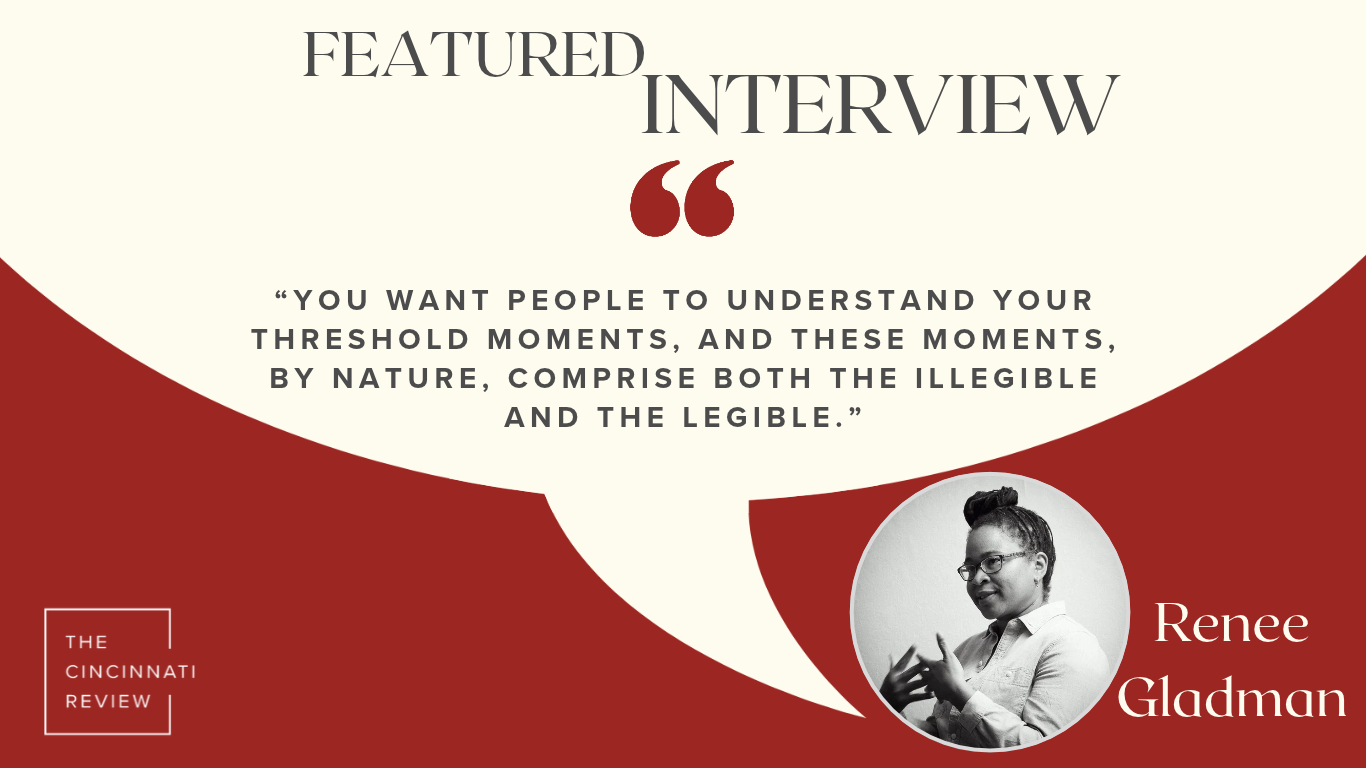
RG: Perhaps because I was born in the ’70s or because I was a philosophy student in college or because, in my adult life, I have been a person of color navigating predominately white spaces, perhaps because of my queerness or shortness—I could go on, and that’s the point, really—I have never felt legible. Never to others. Rarely to myself. Or, rather, I’ve never understood legibility as something static, a reading or rendition that doesn’t change. Conveying one’s living or thinking to others (which is fundamentally what writing does) is necessarily caught up in what has changed, what is remembered or misremembered, what is known or not known. You want people to understand your threshold moments, and these moments, by nature, comprise both the illegible and the legible. That’s just the everyday.
I have always found the question about the reader a tricky one. We think we know to whom we’re writing, but we really can’t account for who comes across our work and how they respond to it. If we’re fortunate, we’ll have an unruly number of readers, and they will each come with their own set of beliefs and expectations. So, my advice would be to focus on your own questions, on what you see when you look at the world or look at yourself in the world or look at others and try to pay as close attention as you can to what moves you and bewilders you. Then get that out—write that—as true to yourself as you can get.
LC: I have great admiration for creators who work in multiple mediums and genres. While I’ve always identified as a poet, there are many other art forms I work in—though I largely keep these private. I’ve recently begun confronting this impulse in myself and challenging what I believe I am “allowed,” based on my skill, training, expertise, etc., to put into the world. Is there a form of making that came about first for you, or that feels most natural or free? Do you experience any trepidation about venturing into forms, genres, or mediums that are new to you, and if so, how do you overcome it?
RG: I was first a poet, but my unit of expression was always the sentence and the paragraph. So, I never really wrote poetry, but I carried into prose that quality of compression, lyricism, fragmentation that characterizes poetry. I wrote novels that felt like poems because the novels were more interested in atmosphere or spaces for thinking than articulation of plot lines. Yet, I was interested in the line of the sentence and how it was possible to follow that line into drawing. I find intersections and crossings intensely generative and moving between forms and genres a necessity for thinking through being a person in the world.
I do experience trepidation, but rarely in relation to art. Sometimes, I worry that I’ve reached the end of writing, but then I write a book about not-writing and that seems to take care of the problem for a while. Otherwise, creative work—other than the intense conversations you must have with yourself about the “what” and “when” of writing—belongs to you. That’s your space to try whatever you want, to let your love of language or any other building material guide you.
LC: You are a prolific maker! How do you feed your creativity, and protect it? What does a creative life look like and mean for you?
RG: I feed my creativity by allowing myself to wonder without censorship or obligation. I have a constellated set of interests—architecture, lines, space, bodies, color, music, philosophies of experience, fictional math—and take great pleasure in moving between these points, regardless of whether I’m making drawings or narratives. Creativity will look differently for everyone and will shift as you age. For me, right now, it looks like this: space to work, time to work, devotion to practice, the accumulation of books, pencils, gouaches, woods, and waterways. And company. I am not the type of artist who needs to work alone.
LC: A short question to end: what are three things bringing you joy these days?
RG: I’m glad you asked this question because for many people joy is something you have to fight for these days. My top three sources of joy are my family, our daily walks in the Woods, and book club. Right now, we’re reading slender books only.