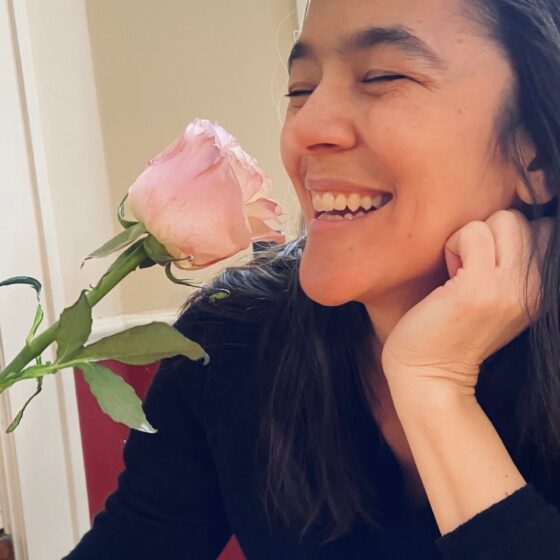
Interview with Joyelle McSweeney
6 Minutes Read Time
Associate Editor Andy Sia: Joyelle McSweeney joins us next week at the University of Cincinnati for the Visiting Writers Series. In anticipation of her visit, I had the pleasure of asking Joyelle some questions about her process and poetics.
Hi, Joyelle! Thank you for taking the time for this interview—I’m grateful for the opportunity to talk with you. Your book, Death Styles (Nightboat Books, 2024), came out of the loss of your daughter, Arachne, and explores the impossible bind of trauma: the contradiction, as you write, between grief, which pitches one backward, and survival, which asks one to move onward. To endure this contradiction and as a study of endurance, you wrote daily; Death Styles comprises poems which span between 2020 and 2021. I’m wondering if you might start by speaking about the trajectory of the book, especially now that it’s out in the world. Has your relationship with the book changed over time?
Although these poems each carry a date of composition, they don’t feel dated to me! As you note, this book was produced by a very specific writing ritual: I had to write daily, I had to accept any “style inspo” that stepped into view that day, no matter how absurd (a duck, for example), and I had to write until the topic was completely exhausted. I found as I revised the poems later, I would sometimes alter the poem’s opening move or quicken the pacing, but I would almost always preserve the ending, where the poem abruptly arrives on a strange shore or dubious planet, because I was always surprised or startled by those arrivals.
This is why I truly love to perform these poems: to inflate them with breath, to take to wild, startled flight, and to arrive out of breath at some unlikely, glamorous precinct. Afterworld or nightclub: each of those low arrivals gets me high. Sublime!
Writing Death Styles, you looked to writers such as Ingeborg Bachmann, Bernadette Mayer, Hannah Weiner, Mary Shelley, Alice Notley, Kim Hyesoon, Dolores Dorantes, and more. Immersing yourself in their works (and their styles?), you write in a moving précis in Annulet, has allowed you to “investigate the profound expansiveness hid within the supposed limitations of the daily, while calling into presence these sister-writers gives me the stamina to undertake the work.” Would you say more about these writers and works in your constellation, or some of them? What drew you to particular works and styles during this period? Were there (re)discoveries or surprises immersing yourself in these particular works and styles?
For me reading Dolores Dorantes’ Estilo/Style, translated by Jen Hofer, was an absolute revelation. Whereas in my own formal education I was almost always taught to separate style from substance, the aestheticized from the political, here was a poet claiming style as substance, style as political, style as the way we tell apocalyptic time, a de-exterminated way of smashing all the clocks, with a stressed and ecstatic syntax, with plurality, with Blakean imagery-as-energy and outrageous claims. This poem is like “Goblin Market” on Monster Energy drink and all in the name of reviving those we cannot live without.
All the other poets you mention are absolute heroes to me because of their daring, their commitment to their own inventiveness, to the joy of making that runs all through darkness, to their sense of taking up form or style to palpate the universe, to kick against the pricks, to make cosmic claims, to call down the gods, to take them to task, to build another culture, to extend a hand to sister, to do the work that has to be done.
Your oeuvre is wide-ranging, including poetry, translations, plays, performances, hybrid experimentations, and literary criticism. I want to touch on your criticism and, in particular, on The Necropastoral: Poetry, Media, Occults (University of Michigan Press, 2014), a mold-breaking work of ecopoetics, in which you theorize about the necropastoral, a political-aesthetic and ethical zone that hosts strange meetings that move us away from the pastoral as a pristine site toward the obscenities, horrors, degradations, and deaths of the Anthropocene. How has your understanding of, or interest in, the necropastoral continued to develop, evolve, or clarify since the publication of The Necropastoral, whether in tandem to recent works like Death Styles and Toxicon and Arachne, or more generally?
Mostly I feel lucky for the cosmic collision of influences that opened my eyes in the dark to the Necropastoral, a pluralized, co-mingled, bioluminescent, de-exterminated way of reading that takes posthumicity as its instructive political mode. I arrived at this model via my foundation in Latin, which gave me as sense for topology-as-narrative, trips to the underworld, and blaming the gods for your problems; and by starting a translation press in the middle of Hurricane Katrina, which hard launched both my understanding of the militarized, federalized, capitalized nature of so-called “natural disasters” while putting me in touch with routes to survival through the work of Raúl Zurita, Kim Hyesoon, Aase Berg, or Hiromi Itō; or living for twenty years in the Rust Belt, a place named for its supposed decline which instead waves the flag of decay-as-survival, as collaboration between ruin and atmosphere and human and non-human populations. Losing our little child made me even more grateful to find myself living in a place named for its distress which nonetheless remains vital, tough as the reeds that hold the dunes, here where rot is air. A text that holds its own death in its teeth. My kind of place.
Many of the audience members in your forthcoming talk and reading at the Elliston Room will be students. What advice do you have for writers, particularly young or emerging writers?
Put everything in. Don’t be afraid of your influences. Write it out and see where they’re leading you. I’m the Chair of the English Department at the University of Notre Dame and my three strongest influences right now are probably Euripides, Looney Tunes and Outkast. Each of these has something to teach me about imperial violence, ecstatic dismay and survival.