Interview with Christian Moody
7 Minutes Read Time
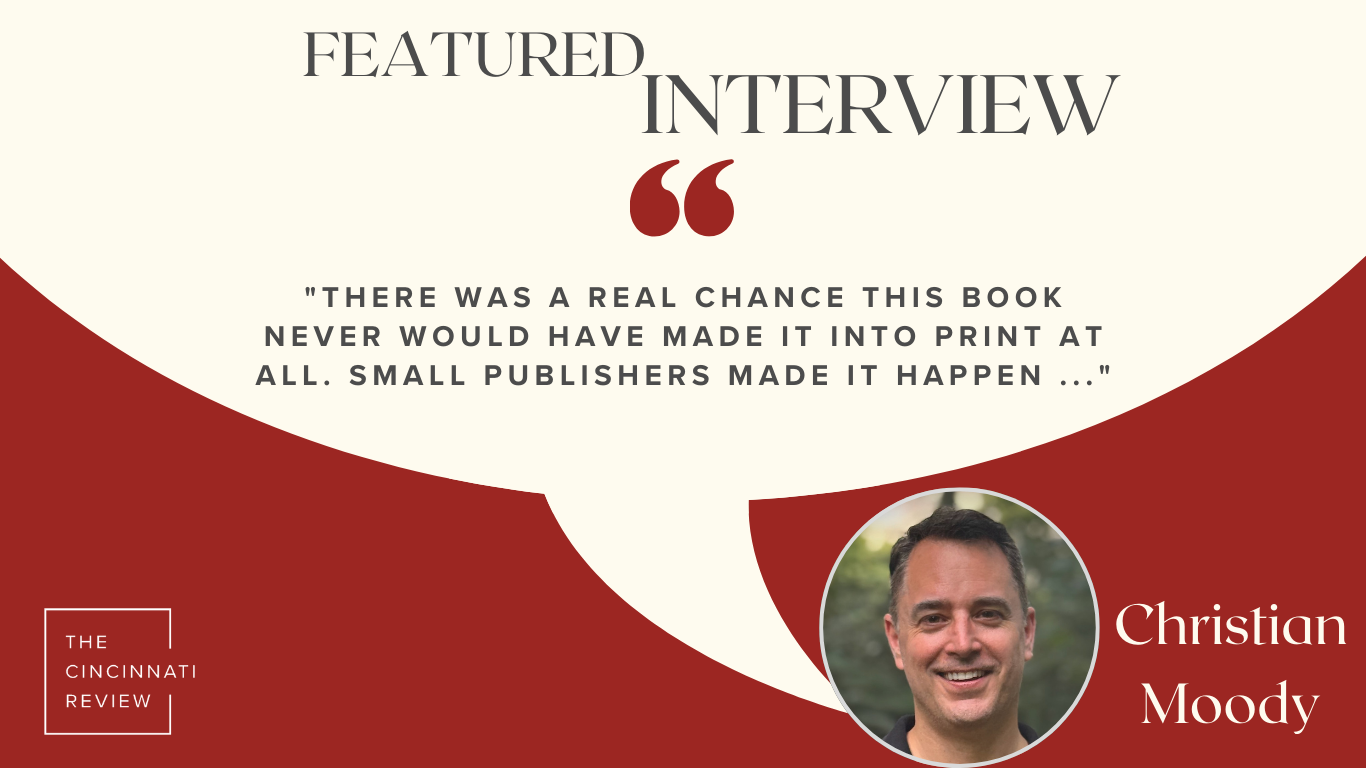
Managing Editor Lisa Ampleman: When I started at The Cincinnati Review in Fall 2010 as an editorial assistant, one of the three student editors on staff was Christian Moody. He helped me understand various aspects of the volunteer experience at the time, including how to log and return packets of read material and to enter copyedits from hard copy. He was also an impressive short-story writer who had been published by the magazine before he applied to the doctoral program at University of Cincinnati. That story later appeared the Best American Fantasy anthology and is now the “title track” of Lost in the Forest of Mechanical Birds (Dzanc Books, 2025), which is a finalist for the PEN/Robert W. Bingham Prize for Debut Short Story Collection. We’re thrilled to see that and the other things that have happened since he graduated from the program (and the CR). I asked him a few questions ahead of the awards being announced in March.
LA: We’re honored that the CR published the title story in the book (before you were affiliated with the university). Is your relationship to that story any different now than it was when we published it in 2007?
CM: Getting published in CR was a big moment for me and really bolstered my confidence at a time when I was struggling. It was a major factor in coming to Cincinnati for my PhD. I thought, Hey, if they like my work even a little bit, I’m going to go there and force them all to be my friends forever.
I see two major shifts in my work since that story appeared in 2007, one in subject matter and the other in technical approach.
In terms of subject matter, I was writing about the darker emotional moments of my own childhood. At my age now, with two kids, I spend most of my time thinking about my own children, fretting and worrying and annoying them in loving ways. Thanks to therapy, I feel at peace about my past and just want to be a good dad. So I tend to write from a parental perspective now.
Technically, my background at that time was mostly as a poet. I approached paragraphs as little prose poems. I knew how to do vivid description, but I hadn’t spent as much time thinking about narrative momentum or writing in scene as the primary unit rather than the paragraph. Over time, my approach to structure changed.
Where does a story/piece of fiction start for you? How did the novella come to be?
Historically, I start with a place or an image. Setting is really important to me. I’ve begun stories simply by imagining a strange woods of trees with eyes, or an egg factory, and then asking who the people are there and what they might be doing or wanting or feeling. From reading interviews, I know many writers hear a character’s voice first. That’s not me.
The novella took more than twenty years to reach its current shape. I was good at starting it and generating mystery, but until the most recent draft I didn’t feel any obligation to solve that mystery or make sense of it. Eventually I had to crack it back open and either provide answers or change expectations.
There were a couple pieces of source material for the novella. One of the assistant leaders in my Scout troop worked as an egg candler. He would hold a light up to eggs at a farm to see if there was anything strange inside. On hikes, he’d tell us about what he’d seen. That image stuck with me.
The second element was that as a poet in an MFA program, I really wanted to be a fiction writer, and I wanted to write stories with elements of sci-fi and fantasy. George Saunders taught in my program. I only studied with him briefly in any official sense, but I had plenty of chances to lurk in his general vicinity and sort of eyeball him across living rooms at gatherings, listening to what he said and seeing how he moved through the world. My instinct, based on that highly unscientific surveillance, was that he’s a pretty good guy.
The main character was originally named George, and the style was fairly Saunders-ish. Over time, George became Ray, his own person, and I had to modulate the style to fit my vision for the piece. But that influence was significant.
I know that the pieces in this book were written over quite a long period of time. How has it been to have the book out in the world—and shortlisted for the PEN/Robert W. Bingham Prize for Debut Short Story Collection?
The PEN shortlist and the Kirkus starred review were well beyond my expectations. I’m not naive about what it means to publish a short story collection. The most likely outcome is that a small group of other short story writers will read it. The only two Amazon reviews are from people I know. And that’s okay with me. A small group of engaged readers feels satisfying. My daughter and niece read it. A few writer friends have read it and taught it. To me, that’s success.
That said, the Kirkus star and the PEN shortlist did affect me emotionally. I was going through a rough patch when the shortlist was announced, and it brought tears to my eyes. I probably shouldn’t need that kind of acknowledgment, but sometimes it feels good to hear, “You worked hard and did a pretty good job.” It all felt meaningful.
There was a real chance this book never would have made it into print at all. Small publishers made it happen, and I’m grateful for presses like Dzanc Books and Acre Books for doing what they do.
Your day job is brand director. Any advice for writers who think the academic teaching track might not be for them?
CM: I taught college-level writing for a long time and got into e-commerce because I was worried about my students. Many were from rural farming communities. They were in college for upward mobility, but they wanted to study creative writing, not marketing. I wanted to understand how to help them get employed. In the summers I did freelance work for a brand that family members had started. Eventually the company asked me to be a copywriter, and from there I kept moving into roles that required more judgment, communication, and strategy.
Here’s what I’ve learned: English and creative writing majors can do very well in business if they can get a foot in the door. Critical thinking and precise communication are real advantages. Once you’re inside, people see you as capable and find a use for you. I’ve met a surprising number of English majors in high positions.
Getting in the door is the hard part. I had an advantage because of family, but it was also a fast-growing start-up. Early-stage companies sometimes hire whoever shows up because they don’t have time for a formal search. Reaching out directly to small companies and offering to write freelance copy is one approach. You may have to start low. I began by writing emails some people would call spam. But if you’re curious and willing to learn, people notice.
Marketing skills are learnable. You can study books used in business schools, read newsletters, listen to podcasts, watch videos. English majors are often very good at learning quickly by reading. Digital marketing changes fast, so timely sources matter too. Free certifications can help you feel more confident, even if they don’t guarantee a job.
The business world won’t care about your short stories or poems. You’ll talk about money and growth and KPIs. For me, separating what I love from my job and putting it in a “this is for my heart and soul” category was refreshing.
Writing has always been a refuge for me. In high school, I wrote my own things as an escape from my official homework. De-linking my creative practice from my official duties keeps it in that slightly illicit, “I’m not really supposed to be doing this” category, which, for my psychology, makes it all the more fun and meaningful.