Hardly Creatures: A Retrospective on Disabled Poetics with Rob Macaisa Colgate
8 Minutes Read Time
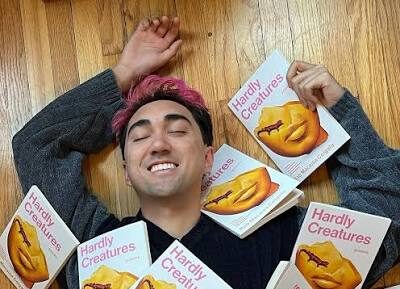
Rose Zinnia: Hi Rob! Thanks so much for taking the time to do an interview with me about your now one-year-old, award-winning, debut poetry collection, Hardly Creatures (Tin House, 2025)! HC architecturally reimagines the book-as-medium’s possibility and pushes the boundaries of it provocatively and generatively via access symbols, image descriptions, places to pause or rest while reading, reminders that the book can be put down, and blank page poems for art that was not able to be finished, among other things. I’ve been thinking about hybrid forms and trans-genre work that, like disabled and trans people, must invent the forms and relationalities to not only survive, but to sur-thrive, which is often collective and improvisational, messy, beautiful, difficult, and contradictory. I see this all at work in HC. Can I call HC a work of hybrid poetry (/positive)? What genres or relations do you hope the book has enacted or engendered? What future-genres of the book might there be?
Rob Macaisa Colgate: I think so often of poetry as a medium rather than the art itself, as the paint but not the painting, as an approach to language but not language itself. And I think queerness and disability operate similarly. Queerness is much more about the ecstasy of the alternative than the specifics of sexuality. And disability moves far beyond physical and mental debility, resting more firmly in the realm of how society limits our access because of this debility.
Another way I think about hybridity is how it occurs not just across genres, but across concerns. I published the verse drama My Love is Water with Ugly Duckling Presse last year (shoutout, love them), and my verse novel The Vice of Our Jaws is coming with Tin House next fall. While these projects are perhaps more conventionally hybrid (though is the hybrid ever conventional?) in that they integrate genres, I also think of Hardly Creatures as a hybrid between verse and an art gallery. The Vice of Our Jaws could most accurately be described as a hybrid of verse and a junk journal; it is really meant to be a found object, a queercrip artifact rather than a report on marginalization. And even right now, I am working on a new collection that is shaping up to be a hybrid of verse and a psychotic break. Poetry has the capacity to merge so contiguously with its concerns that the topic of the poem becomes essential to its form and structure.
Of course you could make the argument that these remain merely topics, not forms themselves. And I think you might win that argument in prose. But I believe poetry to be so elastic and porous that it can wrap around anything and start to subsume through the surface. So I don’t think it’s possible for me to write anything that isn’t hybrid; whatever the ends, the means will always be poetry, and the two will always coalesce.
RZ: I’ve been thinking about Édouard Glissant’s concept of the right to opacity as a form of liberatory practice in art and writing (and life), specifically as in not translating or “masking.” I see many instances in HC in which “legibility” (in terms of grammar, syntax, or subject) and “opacity” (in terms of a writing toward a perceived “normative” audience or not) are taken up as a theme and tension. For instance, in the poem “omfg” the speaker-poet says, “i don’t care about ‘rendering arresting images’ … i’m fucking / exhausted of convincing you that we are happy to be alive.” What do you think of the idea of the right to opacity as applied to disabled poetics and your work in particular? How were you thinking about this articulation of legibility versus opacity—which is of course a question of audience and capitalism—while writing this book and how has it changed over the course of the book’s life?
RMC: Thank you for introducing me to that phrase! The right to opacity is absolutely one that I maintain. For me, it’s an issue of disability justice. Schizophasia is my natural language; every time I speak cogent English, it is because I have medicated away a natural state in favor of participating in an inaccessible society. If I can’t return to a natural state on the page, then what is the point of writing poems? Writing poems should set you free, or at the very least should make you feel more like yourself. Otherwise I just wouldn’t do it.
At the same time, I think that having the right to opacity means knowing when to exercise it. When I was writing HC, I was aware that the book would be educational for many, and that even something as obvious to myself as the social model of disability might require a significant mental jump for unfamiliar readers. There is all sorts of discourse surrounding marginalized folks doing the work of educating others on their marginalization. I’ve seen recent arguments that the phrase “it is not my obligation to educate you” has done more harm than good across social justice movements. One thing I do believe is that poems themselves are under no obligation to explain themselves to every reader, to be written with didactic intention (though I also fear that it is impossible for a poem to fail to be educative, because poems are made of language, and language is the unit of information).
All this to say: I made the active decision in writing HC to take up this instructive work on my own terms. I wanted the book to be legible because I wanted folks to be able to understand what might be their first exposure to disability studies. And I took solace in knowing that not every project would have this concession. There is always going to be another book, another poem; I do not have to fit my entire ethos into a single project.
RZ: Finally—and thank you for your generous answers—one year and a month on from publishing HC, how has publishing this book changed you? What has changed about disabled poetry—in your own view and/or outwardly in the world that you have noticed—in the process of this book being out? What will you take with you to the next book and what will you look to create next?
RMC: God I’m tired. LOL. Of course I’m endlessly grateful for everything that this book has brought me: connections with astonishing writers, opportunities to teach brilliant students, booksellers who greet me by name. But honestly, I write because I like to write. It makes me feel like Rob. For me, writing a book and creating a public product with a press are completely separate activities, and being able to continue doing the former is why I am more than happy to do the latter. Tin House has been nothing but a dream to work with, and I am so lucky to stay with them for my next book. The past year has simply clarified to me that I am a poet before I am an author, and that prioritizing that balance is essential to my day-to-day joy and energy.
How has the book being out changed disabled poetry? I don’t know! I tend to be reclusive. Disabled poets, if the book changed something for you, let Rose know.
As for my next book: The Vice of Our Jaws was the most fun I’ve ever had writing. I started writing it the day after I finished Hardly Creatures. I was conscious while writing Hardly Creatures that it would be my debut, and a debut collection ought to hit certain notes. That certainly didn’t limit me or force me to write anything I didn’t want to write, but it did shape the experience. With The Vice of Our Jaws, I didn’t think for a second about publication, intelligibility, or reception. I think that total release allowed me to better build out the world of the book, which sprawls across forms and graphic designs and interpolates a lot of Filipino history. I feel so utterly privileged to have had the luxury of experiencing a deep connection to my craft throughout the entire process, whether at residencies or while on the train to my day job.
Now that I’ve had my fun, whatever happens on the public side is really none of my business. My editor at Tin House and I are making a lot of thrilling revisions; it is a privilege to have a professional relationship with enough mutual trust to entirely excavate and rebuild a personal art object. It’s a weird book! And it is nothing like Hardly Creatures. I’m so excited, and cannot believe it will already be here next fall. Until then, I’ll be working my day job, biking to the park, jumping in the lake, and going to the farmers’ market with my partner and housemates.