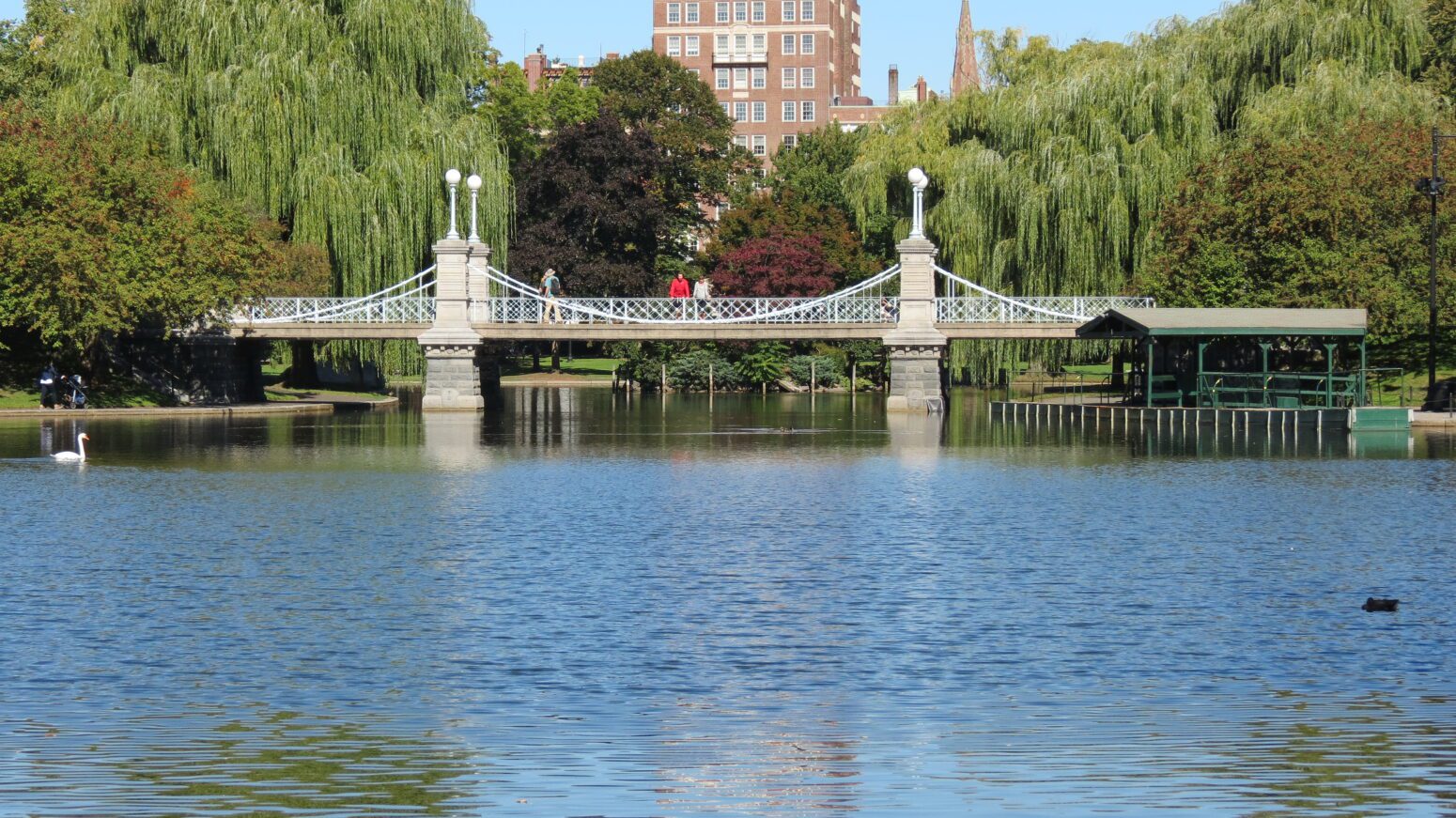
You and Me: Boston Public Garden Footbridge, 1962
20 Minutes Read Time
I
I saw only a glimpse of you that night. I woke, possibly frightened by a dream or the sound of unfamiliar footsteps on the other side of my bedroom door. I peered out. You, a six-foot-two dad who lifted weights and kept a stack of Muscle Builder magazines by the TV, were wearing what looked like a dress and high-heeled shoes. Unsure how to decipher what I saw, I quietly closed the door and waited until morning.
I saw Dad as a lady, I told Mom after you left for your job—it might’ve been the summer you worked for the company that sold family-size nuclear-fallout shelter kits. Why was he dressed like that? He’s not a lady.
It was a dream. Forget about it, she said, almost as an aside as she scrubbed the morning dishes in the sink. I was seven and not yet conditioned to believe other people’s version of reality over my own, so I headed next door to discuss the matter with my best friend, Elena. Mom called across the sloping lawn between our houses: Char, come back.
It was the summer of ’62, and I would start third grade in a few weeks. I was most likely wearing a sleeveless white blouse, plaid madras shorts, white ankle socks, and brown lace-up shoes, my summer uniform, as I trudged back up the hill, then the steep brick steps into our house.
I don’t recall Mom ever sitting at the kitchen table for long, not even to eat, but there she was, seated in one of the chairs, hands folded.
Maybe I sensed the gravity of what she was about to say and backed up, but she reached for me and pulled me so I stood directly in front of her. The slats on the venetian blinds over the kitchen window were tilted so rows of sunlight angled onto the linoleum around us.
I do not remember the exact sequence of what she said. The onslaught of her words—father-believes-woman-transvestite-people-kill-him-us-don’t-tell-never-never-tell-shame-abomination-sin-forget-murder-pervert-hereditary-genes-you-you-never-know-you-you-too—tumbled inside my head before vaporizing, leaving the most vivid memory of that moment as a tableau of us, her grip tightening as my fingers, then my hands turned numb.
You can’t trust anyone with secrets, she told me. And she believed that until the day she died.
I gradually shut down thoughts of you and instead fixated on TV dads, like the widowed father on My Three Sons, who wore a suit with a pencil-thin tie, or Pa from The Rifleman, who fired off twelve rapid shots before the opening credits of each episode. I tried to imagine what it would be like to have a dad like them, whom I could look up to and ask questions about confusing stuff.
I have few memories of you after that. In my teen years, I told friends who were hounded by disciplinarian dads that you meant nothing to me. You were a stranger. Inconsequential. A person whom I passed in the kitchen or hallway of our house as I came and went, spending more and more time away from you, our family.
In the summer of ’69, I was fourteen. Kids from the suburbs rode the subway or hitchhiked into Cambridge for the free concerts on the Common, groups like the J. Geils Band, the Allman Brothers Band, and the Beacon Street Union. I wandered among the young people, my latigo leather sandals that looked like Jesus-shoes tucked into my slouchy suede-fringed bag. I studied the hippie girls dancing, the way their willowy bodies swayed with the music, while long-haired, shirtless boys swarmed close by. I suppose my need to be desired by a boy in that way was no different from any other person my age, but it seemed impossible for me, something that age, a more slender body, or more self-confidence couldn’t fix. I had taken my mother’s words to mean that my father was a perv and therefore I was too.
The Cambridge Common was large enough that when standing in its center, I had no sense of cars or buses rumbling nearby. What had once been a communal pasture for the Puritans’ hogs, cattle, and sheep was now a mishmash of college students, hippies, and gawkers. Some formed their own drum circles on the grass. Others played Frisbee. Protest signs displayed messages: End the Vietnam War, Women Unite, Black Power, Free Love.
Dad, if you had been born not in 1925 but later, say 1969 or 1981, or even now, 2024, would you have been able to live your life differently?
II
When I moved to California in 1987, driving across the country with a six-year-old daughter in the booster seat beside me, I knew it was the right move. I wanted to get far away from the small New England towns with Puritanical roots where I’d grown up. I was a single mom, and many assumed I had once been married. I never corrected the assumption or told anyone that on my daughter’s birth certificate, it read: Father Unknown. I still felt at times like that seven-year-old child whose mother told her that no one would ever love her or want to have children with her if they knew about her dad. Not being married felt like further proof that what she’d told me that day was true.
After you died, Mom hoped burying you in a suit and tie would be the end. The VA provided a bronze grave marker that identified you as a private first class soldier who served in the US Army during World War II. She sold the house and followed me to California. It was not a good move for her. Or me. She had never lived farther than an hour’s drive from where she was born, and that included the four years she’d attended a small all-girls Catholic college. Yet here she was, three thousand miles from all that was familiar to her.
Nothing ever works out for us, she told me over and over again as she sat in the worn-out plaid La-Z-Boy recliner she’d had shipped from Massachusetts to her new home a few miles down the road from me. We’re doomed.
I did not want to believe that. I never wanted to believe that, but her words still whisper to me even years after her death.
I set out to know more about you—about Veronica, the name you called yourself. I began asking Mom questions. Not all at once. Not in one visit. But here and there, over the years, hoping she would reveal something: a concrete image, an event that would help me understand the dad that I felt like I’d lost as a child.
Who was this person you needed to be? Even now, six decades after I cracked open my bedroom door and saw you, I wonder if I imagined it all, but through the years, you left a trail of breadcrumbs: an oversize pair of green-flocked heels tossed casually in the back of your closet, an empty wig box tucked into the eaves of the attic, and jewel-colored clothing zipped inside a cloudy plastic garment bag.
If I had followed your trail, I might have found you—Veronica—while you were alive.
On a rainy afternoon, as Mom sat in the recliner, drinking the iced coffee that she drank year-round, ruminating on all things she regretted in life—getting married, having children, and now moving to California—I thought she might be open to talking about you, Dad.
I asked the questions she’d so deftly blocked when I was a child. Tell me anything about what it was like for Dad. How did he know he was a woman? What did she want in life?
Mom could be overly dramatic, and on this particular day, she squirmed, rubbed her forehead, then one eye.
I waited, sitting in the other recliner, the footrest raised, my ankles crossed.
She bunched the wool throw blanket around her belly and kneaded it.
It was a sparse square room, its contents illogically arranged. The recliners were stationed in opposite corners, not facing each other. One side table provided enough space for her iced coffee and the various TV and satellite remotes so she could watch Fox News or the Catholic channel. The senior-friendly phone with big buttons was usually on the floor.
Eventually, she spoke. These feelings he had were so intense, Char. He believed he was supposed to be a woman. He believed he was a woman. And yet . . . it couldn’t be.
I sat very quietly so as not to startle her.
She’d had no inkling about Veronica when she married you. She thought you were a rare perfect gentleman. I was so confused on our honeymoon, she said. He wouldn’t touch me. Look at me. I thought it was my body. I figured I disgusted him in some way.
I did not know how to comfort her. I never could.
I have Mom’s wedding book, which is open on my desk as I write this. It is filled with black-and-white photos. Happy images, with her parents, your parents, your brother, her sisters and brothers eating and drinking under a big white tent, but what Mom remembered most about that day was what happened later.
You’d rented a room at a lodge on Lake Sebago. Mom told me she was deliriously happy. As she slipped into the negligee she’d bought in anticipation of your first night together, you went outside to grab a six-pack of cold beer out of the car.
You did not come right back.
I am left with an image of Mom alone on her wedding night, coiling into herself as she lies on the bed, the edges of the wool blanket and sheets still tucked neatly under the mattress.
I can only imagine where you were, Dad:
You are sitting on the grassy bank by the lake, drinking a beer. The night is cool, and you raise the collar on your wind jacket against the breeze. A loon calls, reminding you that your bride, a twenty-one-year-old girl whom everyone calls Bird, is waiting inside the cabin for you to do what just-married people do. You love her; she is sweet, kind. Naive, you think. But you don’t love her in the way she expects. She will know something is wrong if you try.
How can you possibly explain how you feel to her?
So you sit, drink another beer, and then another, listening to the loon, wondering if you should swim out and let the lake swallow you.
Over the years I come to understand Mom’s pain. But never yours.
On December 1, 1952, a little over a year after you married Mom, the New York Daily News published a front-page story about an ex-GI who had undergone gender reassignment surgery in Denmark. When Christine returned to the United States in 1953, the media bombarded her with requests for photos and interviews. She was blond and blue-eyed with good cheekbones and therefore, by America’s standards, beautiful. Her clothing was impeccable, like a young Lauren Bacall in a 1950s black-and-white movie.
You bought a newspaper. I am this kind of a woman, you told Mom. This is who I need to be.
Mom didn’t believe in fairy tales. She was adamantly opposed to you going through with such a procedure. You were not small like George. You were over six feet tall and would attract attention. She had a child now whom she needed to protect. Mom thought she would have some control over what you might be inclined to do.
I saved your father’s life by staying with him, Mom told me. He could’ve been murdered in the streets. Killed! That’s what they do to people like that. And not nicely. Brutally. Chopping pieces of him off.
She stared at me. Her eyes unnervingly blue. And then they would’ve come for us, Char. His family. You!
I got up and went into the kitchen to make myself an iced coffee like she did: Dump two tablespoons of instant dry crystals into a pre-frosted sixteen-ounce Pyrex measuring cup, add tap water and ice cubes, then stir with a plastic straw. I sipped. Abrasive, gritty, just like Mom.
I bought the Vanity Fair July 2015 issue with its cover of Caitlyn Jenner in a cream-colored satin corset when it hit the grocery store rack. I showed it to Mom. Do you remember Bruce Jenner?
At first, she put a hand up to block her view. How could you bring that into my house?
In the recliner, my feet up, I flipped through the pages, glancing at the Dior ads, the Cartier rings, the Patrón Silver bottle, and stopped at the “He Says Goodbye, She Says Hello” article. Across a double-page photo spread, Caitlyn is wearing a fitted gold-sequin gown as she stares through the glass walls of her Malibu home out to the Pacific Ocean.
Mom watched me. You won’t find your father inside a magazine. I was the only one who knew him.
Then tell me about him.
She was in her eighties by then. Her weight had dropped drastically. Each day, the worn La-Z-Boy seemed to swallow up a little more of her, but her voice was strong. Her memories, at least those pre-1990, seemed vivid.
The need to be seen by people as Veronica was so strong. I can’t believe I let him talk me into going out with him like that.
I stayed very still in the recliner, knowing she was about to tell me something she had never told another soul. She didn’t speak again right away. The woodstove was blazing, and I could hear the ice melting in her glass as the cubes shifted.
It was so important—urgent. She closed her eyes, and under the lids, thin and gauzy with age, her eyes quivered. He wanted to go out in that woman’s clothing, and he wanted me to come.
Eventually, Mom’s story tumbled out—abrupt, fragmented, as if she were running, struggling for air. I went. Woburn. We drove to Woburn. Snowing. It was snowing. The plows were out. The streets so icy. I’m so cold.
She did not want to remember that night. Trauma, they say, affects memory. Pieces of an event go missing. Parts may get jumbled while in a stressed state. I prodded her for details.
This is what I surmise:
You run out of cigarettes, Dad, and ask Mom if she’ll drive to the store with you. Her first thought after a few beers is probably that a drive through the snowy night might be fun, like a sleigh ride. She says yes, not yet realizing you mean you’re leaving the house as Veronica. It isn’t until you’re both in the car that reality sets in, and she becomes very quiet.
As Veronica drives, snow is drifting every which way, and the plows have yet to clear Pond Street. Your windshield wipers can’t keep up. The glass is fogging, and you crack a window. You drive past old houses, the gabled roofs, chimneys, and turrets laden with snow, and from the street, they look like sleeping castles, you think.
Veronica needs to believe in fairy tales.
But Mom’s heart is pounding. Her breath is shallow. She wonders if the car’s exhaust pipe is blocked by snow, and soon she is sure she’s on the brink of death—poisoning by carbon monoxide.
You drive around the rotary and turn north on Main Street. The street lamps look like glowing orbs suspended in the snow-filled sky. The ten-year-old big-finned Buick Electra you bought used is wearing snow tires, and she glides into a parking spot as if on skis.
You park fifty feet from the corner market, on the other side of the street. Shopkeepers are already peering out from doorway windows, deciding if they should close up early. You look over at Mom. You’re feeling exhilarated. You brush the long auburn hair from the wig off your cheek.
She sits like a block of ashen stone. Eyes closed, her chin burrowing into the bib of her winter coat.
You ask if she’s all right.
She starts to shiver. Exaggerated, like a pampered child climbing out of a pool. You don’t believe she could be that cold. You’re quite hot. Your blouse, tight under the armpits, is prickly. The skirt pinches your waist. Your nylon stockings, which felt so luxurious when you rolled them on, don’t absorb the sweat inside your ankle boots, and the soles of your feet are damp.
I’ll be right back, you say.I’ll leave the car running with the heat on.
No, Mom screams.We’re going to die.
You leave the keys in the ignition in case she changes her mind about the heat. I’ll just be a minute. You pull up your coat collar. You’re not used to walking in narrow-toe, high-heeled boots, so you step gingerly onto the icy street. You hear the grind of a snowplow and look up. A monstrous truck rounds the rotary corner.
You try to make it across before it reaches you, but you hear the most bloodcurdling scream—FRANK, DON’T.
Mom is out of the car. You see her under one of those floating lit orbs, and she is screaming as she runs, slipping and sliding and falling on the sidewalk, but not toward you. She is flailing like a broken bird away from the car, and you are unsure what to do.
The grocer is standing on the stoop, watching. The plow has stopped, its headlights illuminating you.
You can see inside the cab as the plow’s windshield wipers sweep the glass. The driver’s rough face is framed inside a fur-trimmed hood. His eyes are wide, his mouth open, as he stares at you—a sturdy six-foot-two woman in the middle of downtown in a snowstorm. Possibly, he thinks you’re a mirage.
So you turn back to Mom, but her screams are growing fainter. You can’t see her, so you get in the car, turn the key in the ignition. You trail behind the plow until you find her, miraculously, way up the street, huddled against a snowbank, shivering.
She refuses to stand up. Finally, you yank her up by the arm, but she is limp like a dead animal, so you pick her up and carry her back to the car, ignoring a shopkeeper who steps out and asks if you need his help.
You turn up the heat and drive carefully back home, deciding then and there your life is impossible. Veronica will never exist outside the confines of her home. The clothing she wears, stealthily purchased at bargain-basement stores, will be seen only by Mom, who can’t conceal the shame she feels for marrying you, and now for being seen in public with you.
III
Dad, you always seemed to know where you were heading. You walked with long strides, arms swinging, your shoulders slightly hunched against the world as you pressed forward, us happy to follow.
When my sister, Kathy, and I were little and took swim lessons at the Boston YWCA on Saturdays, afterward the three of us might walk the four blocks along Stuart Street to the Greyhound Bus Terminal to eat. Bus stations weren’t so sketchy back then. Baked flounder with lemon sauce or ham with Boston baked beans could be on the menu. I always ordered macaroni and cheese. I liked to spin around and around on the red upholstered barstools at the counter and spy on people, like soldiers in uniform who were most likely heading off to Vietnam. I always watched the longhairs, a name you called hippies. I studied their ripped bell-bottoms, their bright beaded necklaces, and the feathers hanging from one girl’s ears. I thought I might want to be a hippie one day. But you told me to knock it off, Food’s getting cold. One day as I twirled back to face the counter, I took one last look at the woman sitting beside me, her cavernous black leather purse open as she counted out her change to pay the bill and, seeing me, snapped the magnetic closure shut.
Later, we might walk to Filene’s Basement along Washington Street, which passed through the Combat Zone that was packed with wondrous sites: Hookers in doorways. Drunks sleeping in piss on the sidewalk. Blinking marquees announcing XXX movies and peep shows. If Mom were there, she would warn me and Kathy not to look directly at anyone’s face. Supposedly, people in this red-light district were capable of slitting our throats for no other reason than that they felt like it.
But Mom was back home, and I was not afraid. I knew you were right there next to me, Dad, and if I lagged, you would reach back, grab my arm, and pull me along. It was still springtime for me, and as the heady smells of the street—the vendors, the sewage, the car exhaust—mixed with the moisture in the air from a recent rain shower, I felt cocooned inside a warm cloud of curiosity and smells. Filene’s Basement was buried two stories beneath the downtown Boston department store. Underground, I could feel the subway trains rumbling on the other side of the thick cement walls. While you checked the discount bins for bargains, I would look for something that if Mom were there, I wouldn’t be able to get.
On the day I’m thinking about, I found a fluffy faux-fur cap with pom-poms on its ties. I adored it. I pleaded, Please, please, and even though it was past winter, you threw it in your pile at the counter for the cashier to ring up.
At the top of the stairs, back on the street, Kathy was horrified I was wearing my hat. She said it looked like a dead possum, and she would not walk near me, which was fine.
On the way back to the car, we cut through the Boston Common. I ran across the vast lawns and waited under a cherry tree for the breeze to loosen its blossoms so they’d rain down on me. I stood near an old woman feeding an unruly flock of gray pigeons, and soon they were in flight. Kathy, three years older, was anxious to get home to her friends. She insisted we keep on moving.
At the lagoon I paused on the footbridge. The swan boats were running, a flock of flat-bottomed paddle boats with gigantic fiberglass birds perched on the sterns. Their white necks bowed as they passed under the stone bridge below us. Impulsively, I waved down to the people seated on the wooden benches and yelled, Hello, hello.
They looked up at us. Kathy groaned and told me to take the dead animal off my head. Everyone is laughing at you, she said and walked on.
You, Dad, smiled, the kind of half smile I now recognize as so like my own. You placed a hand on my shoulder, and we waved to the people in the swan boats and called out, Hello.
This is the image I now carry of you.
My Dad, known as both Frank and Veronica, standing with me on the Boston Public Garden Footbridge in the spring of 1962.
Read more from Issue 22.1.