When Your City Vanishes
23 Minutes Read Time
Because of China’s nature, there is a high possibility of conflict.
—Chen Po-Wei, Taiwanese lawmaker quoted in the New York Times, July 1, 2020
It used to be my day off, July 1. I would rise early, maybe hit the gym or meet my hiking partner for a walk through the New Territories at sunrise. Luxuriate in the empty trains of the Mass Transit Railway and buses that ran on time. By afternoon it was back to my rooftop room and solitude, before crowds thronged the harborside for the annual fireworks display.
Or did I? Who truly recalls normal life accurately during COVID-19 lockdown, when days at home seem eternal? In 2020, July 1 is political again—rousingly, noisily so, blasting through global airwaves as it did back in 1997, the year that day became a public holiday in Hong Kong, when my city returned to China. In case you’ve forgotten, my city was once the site of “a many-splendoured thing,” so titled for the novel by Han Suyin, a Eurasian medical doctor from Shanghai who fell in love with a married British correspondent and carried on a controversial public affair. Her lover died while covering the Korean War. She wrote it as fiction—thinly disguised autobiography—that placed my city on the world’s stage, especially when glamorized as a Hollywood movie. Despite its romantic story, the novel is a critical look at the historical, social, and cultural problems of my Chinese city, this political anomaly, this hybrid, cosmopolitan exclave that flirts with both East and West.
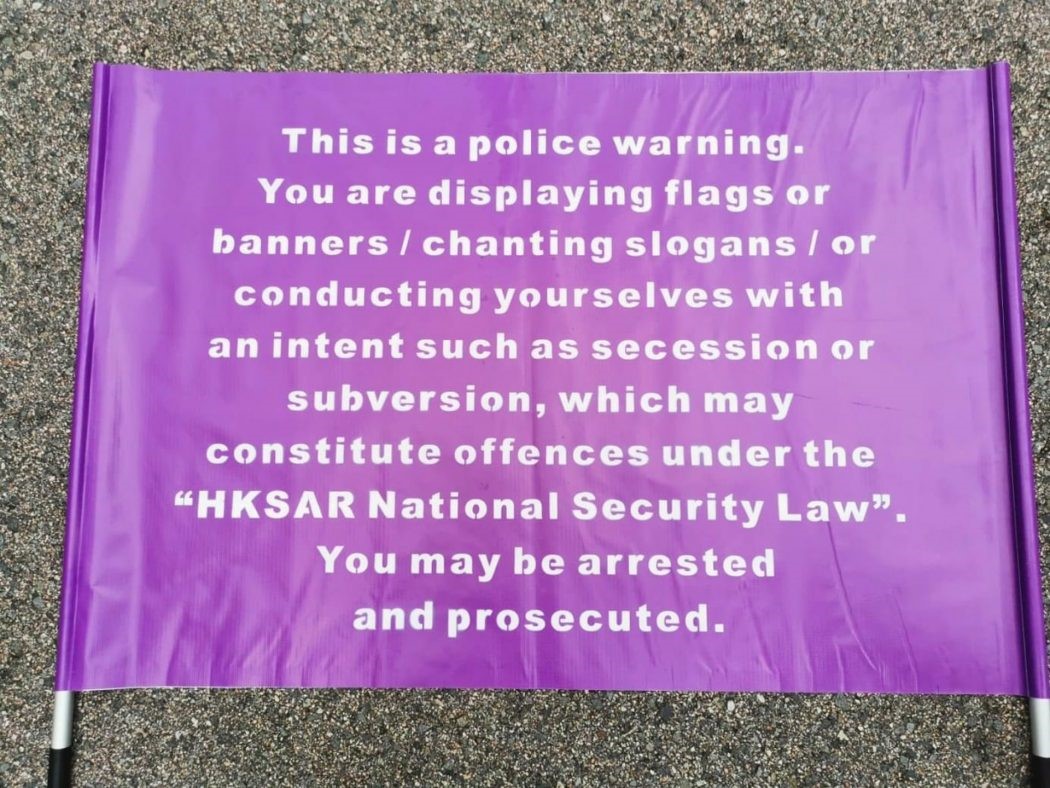
Now, “conducting yourselves with an intent,” as all the purple police banners read that morning in 2020, may lead to arrest and prosecution, an “intent” that’s slippery in meaning—secession or subversion—thanks to the Hong Kong Special Administrative Region’s (HKSAR) National Security Law that came into effect after midnight of July 1, 2020. Peaceful protests are now threatened, despite our Basic Law, just as the police now have (and continue to gain) increasingly greater powers to arrest people for questionably “illegal” activities. “One country, two systems,” the promise, among others, that Hong Kong’s rule of law will be separate from mainland China’s legal system, is a debt of borrowed postcolonial time to retain our hybrid and cosmopolitan way of life for fifty years, until June 30, 2047, to be exact. That morning, however, our lender extracts a rather large repayment, muddying the contracted time frame. Once again, I am watching my city vanish just a little more. Trust me, this is not fake news.
The flow of bounty that was Hong Kong is closing on my vanishing city, not unlike the outdoor spigot that had to be shut off in my northern New York home, the morning I awoke to a flooded basement, the year COVID raged.
1997 used to be the flash-forward year of my childhood and early adult life. Until the early ’80s, it remained that ninety-nine-year mark, the year the lease on a part of my city’s land mass was due to expire on June 30. How was it possible to rent a piece of a country? I wondered, when this anomalous arrangement of the Convention of 1898 first entered my consciousness, a Sino-British agreement to lease the New Territories and 235 outlying islands to Britain, expanding the colonized city’s territory. I think I was around nine or ten when the true meaning of Boundary Street became clear. My school was located on the north side of the street, which meant I daily crossed the border from the British colony of Hong Kong into the People’s Republic of China, geographically and politically a part of the leased New Territories. How was that possible, my yet-to-be-decolonized mind inquired. Dad’s answer was unequivocal: This is why you do not want to be a colonial “British,” although he never fully clarified why I wasn’t entirely “Chinese” either—since we were Indonesian citizens—even though I walked, talked, and certainly looked Chinese enough, despite my mixed blood. National affiliations are, however, difficult to ignore when I recall my passport. During the global COVID pandemic, my present document is getting a long reprieve, resting between its midnight-blue, made-in-America covers, unable to take me across borders that remain closed, forcing me to be only a virtual citizen in my city.
I never did become British, privileged as my family was to be Indonesian, although I retain my Hong Kong permanent residency. Back when I sported a dark-basil-cover passport, it felt odd rather than privileged, because I looked and sounded nothing like most Indonesians. There were quite a few of us foreign Asians perched in my British colony for many decades before 1997, mostly from Southeast and South Asia, as well as some from Taiwan and Vietnam. The Filipino wave happened later, in the late ’80s and early ’90s. Many of us were ethnically Chinese. Among those who were not, many, myself included, spoke Cantonese like natives, and several generations of these families called the city home. It was true for some British and other non-Asian nationals as well. Even though Cantonese people comprise the majority population, my Hong Kong is a city that has always looked out toward the world, this special administrative region that still is, and will be, for the currently foreseeable future, an exclave of China, one not entirely subject to Chinese national law.
At some point, it became possible to forget about 1997. Even when Wong Kar-wai released 2046, his excruciatingly beautiful and romantic 2004 feature film, it was all about love, obsession, and nostalgia for the way we used to be, as well as the way we perhaps wished we could continue to be. In the film, 2046 is the year of a speculative, dystopian future and also the number of a room that is unavailable for rent because a murder happened there, so the protagonist is offered room 2047 instead. Despite the film’s apolitical drama, it is impossible to ignore the political overtones, an allusion to when our decolonized-recolonized, one-country-two-systems arrangement is contracted to expire. How is it possible, the world wonders, for a country to embrace two systems within its boundaries? If you’re from Hong Kong, the answer has always been blindingly crystal clear. Once an anomaly, always an anomaly. My city is all about walking and quacking in sync with whatever power prevails.
Despite all that, July 1, 1997, remains difficult to forget. The optimists and pessimists erupted side by side on the eve of that day. Even though social media hadn’t yet begun spewing its freefall lava of words and images, the world’s media and intelligentsia pontificated loudly about the past, present, and future of my city during that year, the year China brought us “home.” My city was like a virus, infecting global chatter for a brief moment, banging pots and pans about our fate. Dire, so dire, many experts decreed, although many others, myself included, thought differently. Memory tricks you into thinking the past is like the present, doesn’t it?Yet what we think we know about life is a perpetual present tense in this deluge of knowledge, blurring conflict into a predictably repetitive cycle of I-scream-you-scream, like the song about ice cream, a sweet indulgence that, in the heat of the moment, melts and disappears.
In 1997, I walked through my city on the night of June 30, stopping into local parties, gliding past the Chinese ones, and witnessed Hong Kong’s democracy protesters take their stand one last time under British rule. The protesters were stalwart but few that night, not of great concern to the local police. No one demanded independence or threw petrol bombs. “Foreign interference” was not evident enough for Beijing to squawk. Besides, the police had all those important dignitaries to protect from the rain, as well as crowds to control at our newly extended giant tortoise shell, the Convention Centre, where the handover ceremony took place. It was at once wistful and celebratory, a good night to walk.
Now, I walk through those nights in memory, this city of mine that lends itself to long urban rambles, this city that was so safe and free of crime and disorder, this clean and orderly city where trains were graffiti-free, where universities were spaces for ideas, argument, and debate and no one worried too much about politics or the future, because the future was always willfully rosy. Am I just a deluded flaneur of remembrance, courting nostalgia, because I, too, refuse to accept the inevitable, hoping that the way we have become is the way we will always continue to be, a future as a global Chinese exclave with a separate but equal system and culture, in the twenty-first century and beyond?
Perhaps our future can only be dreamlike, a quality that characterizes Wong Kar-wai’s films. He is the filmmaker much associated with my city, one of the most well-known internationally. My father created a dreamlike home in my childhood, a penthouse on the seventeenth and eighteenth floors that overlooked the Hong Kong harbor, located at the tip of Kowloon Peninsula. From the veranda, it felt like I was gazing out at the world. It was an urban paradise, a home I believed would always be mine. That flat was sold years ago, and our family moved to a suburban hilltop flat north of Boundary Street, one that has never felt like home to me, even though it remained in our family for almost half a century. Its rooftop room did become my 120-square-foot home for more than a decade when I lived between Hong Kong and New York, helping to care for my elderly mother with Alzheimer’s until she died in 2017.
An early sign of a less-than-rosy future occurred when I was ten, the year Typhoon Dot blasted windy rainstorms. 1964 was a particularly active tropical cyclone season in the Pacific, with thirty-nine storms recorded across the region. Dot was neither the most powerful nor the worst catastrophe in my city. Thirty-six dead or missing, and eighty-five people injured, all of which was bad enough but paled by comparison to Wanda, two years prior, which left 434 dead and seventy-two thousand homeless and caused millions of dollars of damage.
But in my home Dot was catastrophic, because I awoke to an inland sea throughout both floors of our flat, on that Tuesday morning of October 13.
I was up first, as was often the case. My rubber flip-flops and schoolbag floated past my bed. The water was around a foot deep. I went downstairs to the living room. Outside, a typhoon raged, but the thing I desperately needed to know was whether or not I had to go to school. The people to ask were my maiden aunts, who lived below us on 12, facing east. From their window they could see the Royal Observatory, where typhoon signals were hoisted onto a giant hilltop crucifix: black metal triangles, T’s, and crosses denoting levels of severity from signals 1 to 10. I telephoned Aunties. Christine answered sleepily and listened to me blather on about a flood. Yes, it was Signal 10, she confirmed, and no, of course there was no school. But about the water she simply snapped, Well, mop it up, and rang off. Christine could be grumpy when dealing with kids. Only then did it dawn on me to wake my parents. Later, Mum asked why I hadn’t awakened everyone right away, but I was tongue-tied over that burning need to know about school, ashamed of my rigidly absurd view. She also complained about Christine’s selfish and irresponsible response, a what-adult-would-say-that-to-a-child complaint. But isn’t that the point of choosing not to be a parent, because you’re not ultimately responsible for other people’s children—even if you do care about them, the way Auntie Christine did love and care about our family—the way my own childlessness ensures the same?
The culprit? Wet leaves blocking the drains of our veranda, causing water to rise and seep indoors. Our penthouse flat faced south toward the open skies above the harbor, full frontal to the storm. Uprooted parquet floorboards—a foot long and approximately two inches wide—floated around like toy boats. Our family mopped all day until the typhoon dissipated and eventually vanished.
That same year, Mum finally told my sister and me, the two eldest children, that Dad was broke, his money all gone. Our family was no longer rich with the kind of wealth that afforded my penthouse dream home. Trickle-down economics was over, and from then on, I learned to curb my enthusiasm and dreams.
In late June of 2020, just days prior to the news shock from my city on July 1, I awoke to my Northern New York basement flood on a Saturday morning. Fortunately, this basement was still a concrete surface, since the contractor had mercifully not yet laid down finished tile flooring. The culprit? A likely leak in the pipes leading to the outdoor spigot that my husband and I had gleefully used the previous day with our new one-hundred-foot hose to water our newly planted garden. By July 1, we still didn’t know the real cause, although the water was mopped up and a new spigot installed at the back of the house, accessible from both inside and out. The plumber closed off the line to the existing spigot, which was inaccessible from inside unless we tore open the wall. So the actual cause of the flood remains a mystery of my new home, this dream home I built over five years, paid for entirely with cash from savings, investments, and earnings, while I juggled life between New York and Hong Kong. The culprit? That so-called contractor who built my new home had installed the spigot incorrectly. This engineer-project manager took my money, spent it on materials and labor, but had, at best, a half-baked idea of how to build a house, being in way over his head, good intentions be damned. Even the architect gave up on him. At some point, I cut my losses and hired another—competent—contractor to fix the last of his myriad stupid mistakes.
But who will fix the “mistake” that is my city?
Was it a mistake for us to have put such faith in our promised land? By 1997, Hong Kong was prosperous. The world flocked to our shores, pouring in money, talent, visions for tomorrow. We weren’t terribly worried when we first became “China” because clearly we were still Hong Kong. I remember a young local woman, one of my sales staff at that time in my job as circulation director for the Asian Wall Street Journal, her face brimming with pride and joy when she spoke of the upcoming return to our motherland. China was opening its doors to us and the world. Life was good, and we were as happy as the Clampetts in their new Beverly Hillbillies home, funded by the Texas tea that made them rich. It’s like that in TV land, where reality is merely played for laughs.
Despite certain “disappearances” that occurred during the early post-handover years, my city soldiered on. In 1997, bird flu culled 1.5 million chickens. 1998: the Asian economic crisis shrank GDP, and the property market deflated by half. 1999: the first plane crash at our new airport disappeared China Airlines Flight 642. 2003: SARS, or Severe Acute Respiratory Syndrome, an unfortunate acronym almost identical to that of our political identity, incapacitated the city; meanwhile, two iconic Hong Kong pop stars, Leslie Cheung and Anita Mui, died tragically young. 2006: the demolition of Star Ferry Pier to make space for a four-lane highway. 2008: Queen’s Pier, from where I used to board boats for various launch parties back in the ’70s, vanished, another victim of historical erasure. By the time our city was hit by the Asian swine flu pandemic in 2009, we knew enough to shut down schools, quarantine hot spots, and run temperature checks for inbound travelers.
In 2010, I returned to my city to live with my aging, Alzheimer’s-stricken mother and accepted a full-time faculty position at a local university. Prior to that, I had refused to be employed full-time by any company or organization—other than by my own writing—since I’d left my 18+ year business career in 1998. I shuttled between there and my other city, New York, splitting my life between both, earning just enough from part-time employment, freelancing, and trading stocks and futures to make a life. By then, peaceful protests were the norm in Hong Kong. There was always something to complain about—no government is perfect—and every June 4, we still gathered in memory of the victims of Tiananmen, since we were one of the few Chinese territories where commemoration was legal, although by 2021, even that’s changed. The subsequent years became a personal journey through memory, retracing steps to vanished or reimagined spaces around my city, walk- ing across reclamations where water used to flow. I rambled often through my urban life, one that felt free, safe, reasonably democratic.
1997 became a distant memory of what had been an inevitable historical and political reality.
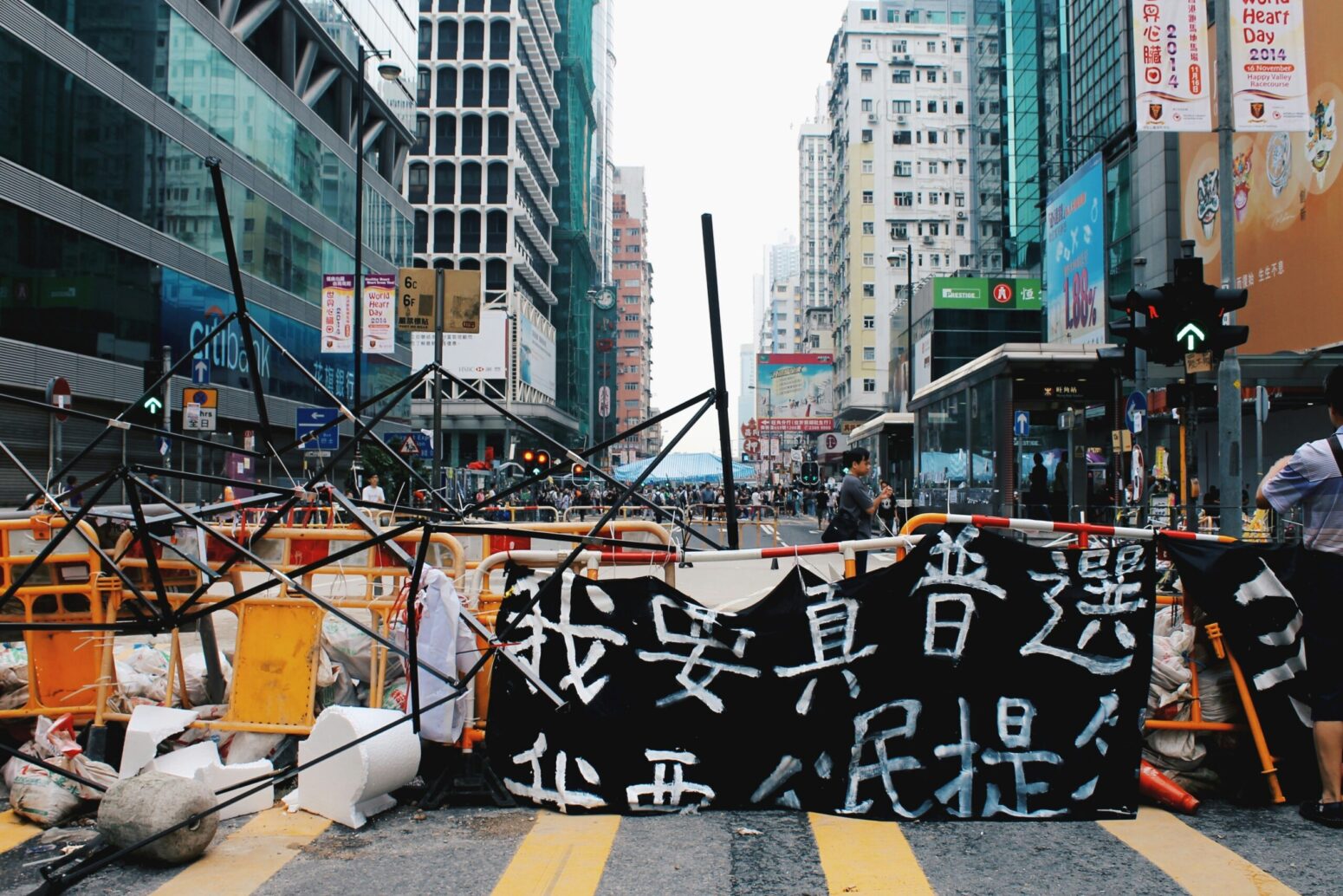
But a growing concern, similar to the trepidation I later harbored toward my fake contractor, kept nudging. On July 1, 2013, thousands marched peacefully, demanding universal suffrage. It was what we’d been promised for the election of our chief executive as part of our Basic Law, the hallmark legal document of one country, two systems. Early the next year, I employed that man—let’s name him Dungeness, given his crablike thick face leather (as Cantonese 厚 臉 皮 articulates such shamelessness)—to design-build my rural New York home on a wooded property I had long owned; he promised to deliver my dream home. His promises were poorly fulfilled as I watched my savings dwindle. The ultimate insult was delivery of a still-unfinished, barely inhabitable house over a year behind schedule, shattering the original dream. By 2014, the Umbrella Revolution shut Hong Kong down for almost three months. By 2019, violent protests shut down more than roads and districts, and the government’s rigidly absurd response signaled the beginning of the end of dreams.
Should we never have dared to dream?
What longing demanded I needed to design-build a dream home when I already owned and lived in a perfectly fine and mortgage-free raised ranch in my rural Northern New York enclave? No one needs more than one roof over their head. Yet over the course of my life, I have bought and sold several properties, in Hong Kong and New Zealand, and in the US in Massachusetts, Ohio, and New York, some of which were homes for a time, while others were or became rental properties. This has provided supplemental income to fund a literary life. I’ve also rented several homes at numerous mailing addresses— upstate New York on West Street in Lake George; Paris on the Rue Saint-Lazare; Greece, in Athens on Peta Street and on two islands; an Aspen, Colorado, room in the home of a coke-dealing postal worker; Hamilton Avenue in Cincinnati, Ohio; New York City at Windsor Terrace, Brooklyn, and Orient Avenue of Greenpoint-Williamsburg; Hong Kong in several districts—Tsimshatsui, Kowloon Tong, Shatin, Sai Kung, Causeway Bay, Mid-Levels, and the borderland between Central and Sheung Wan; Toh Street in Singapore, which few taxi drivers knew existed; East College Street, Iowa City, Iowa; North Twentieth Avenue in Phoenix, Arizona, from where I bicycled to the Valley Metro light- rail. This, in addition to living for weeks or months at a stretch in hotels and writers’ or artists’ residencies. Nor does this include travel accommodations for work or pleasure, or those long stays with my English “Uncle” Jack in his rose-garden cottage outside London, the year I was trying to become a real writer. Jack was a retired widower friend of Dad’s with whom he had done business during Jack’s many years in Indonesia and Hong Kong. He and his wife, Anne, were frequent guests at our home. He offered me a free place to crash for weeks at a time to write my first novel, in exchange for cooking him Chinese meals. He even read the drafts of my novel, becoming one of my first real readers, and telegrammed me in Greece to say that one of my stories had been accepted by the BBC’s short-story program. It was a marvelous exchange; his generosity allowed me to dream.
Like Jack, I’ve led a global life, born out of a childhood in my city where the world constantly haunted our shores. Was it so wrong to dream of a home for the happily-ever-after of life? In my early twenties, I wanted a dream home in the New Territories, which was then much more rural than today. I was renting a small two-story village house in Sai Kung with my first husband, a Scotsman who ran a kennel for dogs on our rooftop to supplement his dog-training business. We lived well in our one thousand square feet, across the road from the sea, where we and our own dogs—the mongrels, Charley and Bloo, and the Alsatians, Duke and Hera—would swim on hot summer afternoons. Both my parents grew up in villages by the sea in Central Java and spoke fondly of the freedom of such a life. That first dream home of mine did not materialize, although my family still owns the piece of village land in Taipo that my ex persuaded Mum to buy in her name, with promises of the garden she could grow there. He was persuaded by an Englishman who promised to get us a building permit, a difficult feat if you’re not descended from one of the original families, a quirky problem of village property law. Dream lands, like the desert land in Nevada some developer persuaded Dad to buy that is still a barren desert to this day. Our family holds title to the uninhabitable.
A few years later, I tried to build a dream home on the Greek island of Hydra, where no motor vehicles are allowed, during my year in Europe and England trying to become a real writer. My then-boyfriend was an English builder who had grown up in Greece, where he could work and live almost like a local, and we talked about the possibility. He also wrote wonderful letters, in his back-sloping, precise, and neat handwriting, when I disappeared to Paris and London in winter, making me want to rush back to Hydra in spring. But Greece was a difficult country for a foreigner, especially a woman, to obtain building permits, never mind oversee a male construction crew. Youth dreams until life forces an awakening, and for me it was a divorce from the first husband, a breakup with the boyfriend, and ultimately, simply knowing it was time to move on and make a literary life if I ever wanted to become that real writer.
But my city already had a life! Should it be forced to “move on” from a misspent youth to become some kind of earnest grown-up as a Chinese city? It was always irrevocably a part of China, we all knew that, even if we pretended for a while to be British. Did we asked to be snatched from the cradle—or was it the womb—of our motherland? Hadn’t we already grown up to become a financially responsible adult, contributing wealth and investment to the motherland, alongside our playground of luxury properties, designer brands, international five-star cuisine, a booming Chinese art market, and a springboard to the world for China’s newly rich? Isn’t there room enough for everyone?
Why disappear us? Why shatter our dreams?
My miscreant contractor is but a droplet in the ocean of dreams, despite shattering my self-confidence and well-being over a bad decision. My lawyer and other homebuilders shared stories of broken promises by contractors, which is apparently more common than not. Always over budget. Never showing up when they promise they will. Problems that should not happen in a brand-new construction. The poorly installed spigot is only one in a long list of far more egregious issues: Failing to disclose, for instance, that he had never design-built any house prior to mine, having persuaded me instead with the architect’s portfolio. Disappearances. As problems and delays mounted, Dungeness routinely disappeared. Phone calls, texts, emails ignored, until he dared to come out of his locker, still believing he was justified in taking on the project. So unlike Mr. Wu, my Hong Kong contractor of many years who always delivered competent, professional work, on time and on budget, until he contracted MERS—Middle East Respiratory Syndrome, first cousin to the SARS virus, from which COVID-19, or SARS-CoV-2, evolved—and could no longer work.
However, ex-contractors, like ex-lovers or husbands, are an acceptable disappearance. It isn’t the same for my city. As often as I have complained about my city—too noisy, too crowded, way too expensive unless you’re a tycoon property developer or own numerous properties or are safely ensconced as one of the highly overpaid civil servants, tenured academics, or business executives, all who, like the three monkeys, have learned to brook no evil of sight, sound, or speech, even while evil golden-handcuffs them—I do not want this vanishing. In Hong Kong, life goes on, and the teeming masses of a lesser privilege will either shut up or die in revolution, a revolution that will have difficulty raising militia to support it. Perhaps we should have taken a page from the Book of Mao: the Long March succeeded because it was painfully long, followed by years of deprivation, sacrifice, and want, fueled by a dream of building China’s “new Great Wall” with “our” flesh and blood, as China’s national anthem, “March of the Volunteers,” declares. How much more blood must my city spill before the river of red is mopped up and gone for good?
Or will our tiger economy become an increasingly toothless paper tiger, waving our Basic Law, our voices fainter and fainter as we vanish into the world’s memory, scrambled by dementia, delusions, or simple forgetfulness? Who will really care if my city vanishes and the world moves on? Once a political anomaly, forever after a mistake to be rectified, so that the humiliation of the unequal treaty that gave birth to my city be disappeared forever. China rises, continues to rise, distracting the masses with all they survey in this kingdom of power and plenty. Meanwhile, the global free fall of fake and real news flows. Will you be able to tell the difference?
Read more from Issue 18.2.