Variations on the Bodies Beneath Our Feet
14 Minutes Read Time
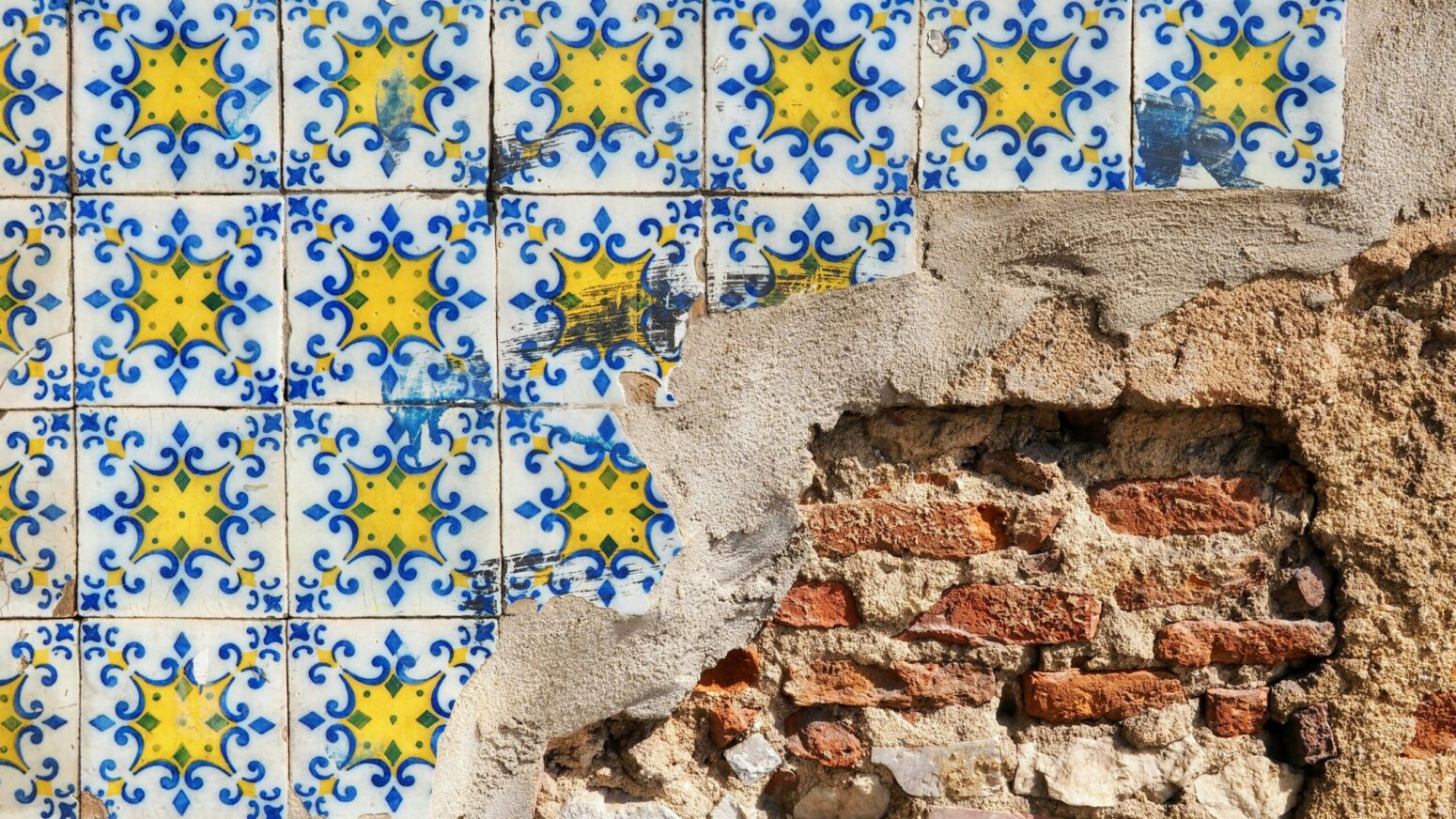
My friend Michael sends photos of his new flat in the old city. Twenty years on, Lisbon’s alleys are slick with renovation and rain, the stucco of the old squats livid in sunflower yellow. The stone floors are centuries old, but his place is dustless, with a real zebra-hide rug that he’s been dragging from flat to flat for ages, Graça to Santa Catarina to this knife-lipped stairwell in Alfama below the castle walls. The rug bellies the floor, monochrome and boneless. Whatever cycles of decay and ruin once pulled the stone masons and scaffolders into perpetual orbits of demolition and reconstruction are halted—as though the poles were stalled and then reversed, our former lives thrown to the earth, skinned beneath us. I barely remember my last raw, numb-knuckled days in Lisbon, before I abandoned the city for good. The work is done, for now, the rents paid. Every footing is repinned and blasted clean. I am equally unrecognizable.
I’m excavating toward a word for it, not the beforehand but aftermath’s unruptured inverse. Something less accusatory than causation, which suggests that we are anything but blameless in the unleveled city, or that we might willingly face all we have and have not remediated in these punishing, whiplashed years. Less biblically academic than prelapsarian, which invokes an angry deity I refuse to conjure, an Eden I’d have left without provocation. But thereafter is not easily reversed into therefore, and I was godless even before my father was murdered, his body scattered, fragmented beyond reassembly. The grind into endless war set in motion and the memorial architectures devised before we’d laid a single bone to rest.
Yet once, I was young and my life in Lisbon edged against imminent disaster like the hand that presses tile to mortar, stays the facade’s plated expanse against gravity. Years spent swaying in place as time bent like the palm trunks in the public gardens, until one late afternoon, the last light flooded a café in Carcavelos, and I watched the towers falling over and over on a tube TV wrenched and wired to a high corner above the counter. An ocean away, I believed nothing could unbox that disaster for me here. How to admit to the credulous relief of it—catastrophe trussed up above anyone’s reach, suspended. The proprietor needed a step stool to change the channel. I’d slipped through untouched. Never, I murmured over my empty cup, I will never go back.
I meant to stay forever, believed I would see Lisbon through many lives, into its next inevitable calamity but not my own. That night in September it takes hours for the calls to thread all the way to my rented desk on the third floor, where a picture window faces out over the sea toward Newark Airport. My father on the plane, they say, a crash in western Pennsylvania. Sirens, searchlights, and on the evening news one segment blurs into the next: I can’t untangle one burning field from another, the brush fires in the mountains of the Serra da Estrela from the smoking cleft in an Appalachian coal field. They say I’m needed back. I’ll have all night to load a single suitcase full of Portuguese books, bound for the first flight out of Europe when the skies reopen. I’ll wedge it in the trunk of Michael’s Fiat and ride to the airport before sunrise.
Call it antecedence, call it antecedência, the photo-negative articulation of aftermath, what ascends to the atrocity half-blindsided, leads us to climb the city’s stairwells as though they couldn’t possibly crumble. What might let unmuzzled search dogs roam the low streets that hook the docks, as sardines char over iron grates, what guided our Sunday drives toward the highlands of Colares for antiques and currant tortas. An antecedence through which we’d climb the tiered calçadas as though the alleys would never flood again, our fingers brushing against passing hands as though we were all unbreakable and there would never be a ruined city to rebuild, bodies to recover.
Lisbon wasn’t always antecedent, nor was I—though I was certain I was living in some grand therebefore, the last months before a rogue wave swept the city back into the sea. And though I knew nothing yet of disaster or dissolution, those years I lived in Lisbon I dreamed of earthquakes. Portugal’s last great earthquake was in 1755. The first of November, All Saints Day, and most everyone was at church. For ten thousand wicks lit in prayer, no call to God was answered; candles tipped, silk robes ignited with the hymnals and the wooden crucifixes, and beneath all seven walled elevations, the foothills burned. Along the coasts, wide nets of fishing villages and wooden dinghies were trawled by tsunami. The city ravaged, drowned, effaced, and refaced. By the time I arrived it had been nearly 243 years, and when disaster holds its tongue for centuries, you have to consider it might be your time.
Our most dreaded potential terrors lie waiting, dormant over time and distance. Even as the fault lines hold, and volcanoes seethe their listless unrest, every generation believes it will be the last witness to some final, converging violence. We may all maintain a selfish and particular fabulation of end times—flood or fire, a pet nightmare of our wild and common invention that we swaddle and feed, night after reverberating night. Before, the coming earthquake was mine. And so the morning my father boarded that last flight, I woke up five hours ahead of him on schedule, like I did every day, already washing and dressing for the worst, pantomiming my own deliberate concoction of catastrophe.
Antecedence, provisional capture of eventlessness, the long undisastered territory: Centuries without a major tremor, benign windswept months when no assault crazes the tiles, nothing alerts us to shelter under tables or rattles the city firmament. Just the flap and lull of the day ferries across the Tejo to the fishmongers at Cacilhas, the imperceivable tidal shifts that move nothing to surface, the foam lapping the shores of the river like the lolling tongues of stray dogs that pad behind me from the door to the Metro, then fall into step again upon my return.
How to distinguish the spiraling fantasy of disaster from the thing itself. In the rare dreams where I am not swept into the sea, I’m standing beside the castle walls, buoyed by late sunlight, the storm surge pooling around my ankles. The dead kings in their painted capes watch over me from their stone alcoves, and the yellow tram is bobbing, half-submerged, half-dangling from its funicular wires. The rest of the city drowned, but I’m safe, shelved above as the ebb tide carries the café awnings and the train tracks into the depths.
Safe, because disaster is archived by ruins and not premonition, by what we drag from the rubble in the aftermath, and no one can carve it into full relief while knee-deep in its ravages. As Lisbon burned, Voltaire, half a continent away in Geneva or Schwetzingen, was the first to catalog the earthquake’s spoils, its existential logic. If Lisbon could fall, any of our rickety foundations might fail as well. All of Europe was shook. Voltaire’s Candide begins amid the smoking wreckage, the slapstick heroes adrift in debris, witness to the scramble for resources, the makeshift executions in a city without a square. A satire written against faith, against optimism, against Gottfried Wilhelm Leibniz’s contention that there are many possible worlds, and that our own is necessarily the best of them.
One late and quakeless golden afternoon I’m walking with Michael in the Baixa, the low city. Our arms are hooked at the elbows like old Portuguese ladies’, and I can’t help but think that every other possible world pales against us. A crew of masons reorganize the chinks in the cobble, and Michael reminds me how after the city fell, there was nowhere to shroud the bodies, no place to bury them, no pyre that could hold a spark. The dead were swept into the shallow harbor with all the caved roofs that didn’t burn, with the scorched linens, the broken azulejos. The plaza was pressed and hammered into a solid underpinning, and here we are in the far shadow of the Enlightenment, stomping a graveyard gridded in black-and-white helixes. An antiques dealer, Michael doesn’t care about the bodies. Just think of the candlesticks, he pines, the silver tea sets from England, the porcelain vases that might have tipped and settled unharmed.
Amid Voltaire’s ruins, a brutal sailor is equally disinterested in the bodies. There’ll be something to pick up here, he growls, grabbing coins and rings before the ground is sealed. A small easement, how disaster might leave something, and not nothing. There are things to bury or recover, to abandon, something I might pick up and carry away. I’m bound to this materialism, to a world of liftable things, what catches in the sieve, what will not slip through my fingers, what might sustain me in the aftermath.
When Leibniz contended that we live in the best of all possible worlds, he didn’t mean that the requisite multitude of competing universes are divided up into moral binaries. Of course, he’d argue, there exists a discrete world that God has constructed to contain any given atrocity, just as there is another that has swerved loose of it, and maybe we lazily ascribe the essential difference to good or evil: a world in which Lisbon burned, a world in which it was saved. But Leibniz’s infinite realms are incompossible because no single world can contain the substantive immensity of all creation. The limitations are material and not logical. Thus, we must be faultless: No sphere can hold everything there is to pick up here; no buried city can hold every candlestick and every broken tile, the tumbled limestone pavers, the castle walls. All the bodies, all the remains.
I think for a moment that we’re landed here in this world, with our piles of bone chips and paper drafts, only because there are never enough archival shelves, nowhere to put the kiln-fired urns or the back-issue periodicals. We were not delivered here by some curse we brought down on ourselves. Leibniz could not have known that our own world has onion-skinned forty-seven distinct cities of Troy, how our one world encompasses many pasts, both mutually exclusive and coextensive.
No consolation to me; there’s a world in which my father is not on that plane, and it isn’t this one.
Here in this world, archaeologists scramble to preserve Lisbon’s ancient tunnels before the next seismic rumble erases their work. They chisel beneath coffee shops and cobblers’ benches. I’ve learned enough about antiquity and ruins to know there must be knuckles to tuck back into the dirt walls, elbows jutting as though there’s still a last path out. The scholars have to choose what they grab by the wrist to rebury and what they silently patch back into an enduring makeshift interment.
One spring after lunch, on a hill in Alfama, I’m unpacking books in a temporary flat, my single room rented from the recently bereaved grandson of its last resident. It’s over four hundred years old. Can you imagine it, Michael nudges me, this building was here before the earthquake, these floorboards shook and didn’t snap. Look how the stones settled, the repairs to the azulejos in the stairwell. I rifle through the grandmother’s unemptied dresser drawers, her cotton camisoles yellowed and creased but still clean off the clothesline. In careful elastics, a long braid, darkening toward the tip, and a silver necklace, blackened in a nest of shattered silk. My new American roommate, brutal sailor that she is, steals it for her own white neck.
Also spared: a handful of churches that still hulk upright, skeletal in their open plazas, their great hollowed vaults and apses arching like enormous rib cages. They shade the public water fountains, and the morning cafés set up tables in the striated cages of their shadows, light scoring the courtyard into animal hides. When I remember to fear the earthquakes, I stand beneath these bones. They might umbrella me from roof tiles and flower boxes dislodged by tremor. They held once, they might hold me again.
Who could sleep, knowing what teeth and nails are still furled beneath us, the bodies coiled knees to chest like the dead of Pompeii, or kneeling with clasped hands as though they saw the end coming and turned their back on it anyway? My nights in Lisbon shimmer with aftershock, the frill of fire, the rogue waves. The godless stretches into dawn as everything flammable is extinguished or exhausted. Mornings I wake certain today will be the day the tectonic plates are ready to grind each other’s edges again, and I ride the commuter train upriver, where no tsunami could reach to sweep me into the ocean or bury me beneath the ruins. High above the Tejo, in Vila Franca de Xira, and in Santarém, the dead are laid out in marble boxes on the hilltops, their gazes angled out toward the opposing shore, slippered feet pressed to glass windows.
When I think of the afterlife, all I want is my body left whole aboveground in just this world, unburied and intact. I imagine my children visiting me by that same train, their voices rattling unhurriedly through the panes as they block my view of the tides. Fled to the overlooks in late summer, I don’t yet know a thing about going to bed every night without the whole of my father’s body or waking up each morning cratered and aflame. The sprawl of the debris field over acres and decades. In those graveyards above the river, I’m sure I’ve seen disaster advancing, the hinged jaw of its widening delta, and even the flocked attending widows know I’m too pale in midday light. Flapping in black mourning garments, they wind through the grids of the mausoleums like bored wraiths, approach me without any hesitation: Menina, one says, pressing a thick coin into my palm, you need to eat.
How could I have known that I presided over an antecedence beyond my understanding? For all these ashen exiled years, I’ve been driving out past Newark Airport to the coal barrens where my father’s plane came down, where a bleached memorial white as limestone sidewalks has risen up from the crash site, warded by the National Park Service. The work is done, the ravage raked through, atrocity wrestled into institutional memory. When I try to picture the past lives of those open farmlands, a single red dragline left mining the field hooks the air like the stand of cranes that used to stagger the skyline across the Tejo, rigged to trawl the banks for an earthquake I’m still waiting on.
Doesn’t everyone wish to bury their dead unbroken? And not here in a graveyard off the Garden State Parkway, in a box the size of my hand, inside a casket the size of an entire body. Or there in Pennsylvania, evaporated in air, strewn beyond the acid lake, pitted under the fresh chestnut groves and the new sod, where architects have cobbled the flight path into a walkway that ferries busloads of tourists over the bodies beneath our feet. If I were to venture far enough into the woods behind the crash site, beyond the first stands of pine and hemlock, I know I’d still find bone shards, snarls of metal, what gnaws its way to surface, what wasn’t culled, what will not sink. What refuses any burial for a ruin I might have devised in dreams, or scavenged from the rubble, an artifact so durable I could carry it off in my hands.