The Fifth Arch
20 Minutes Read Time
It’s a pity almost nothing is known of Li Chun, master stonemason of the Sui Dynasty. While Trajan’s collapsed bridge rotted and the Persians invented chess, legend says Li Chun crafted the Anji Bridge by suspending twenty-five hundred tons of limestone over the Xiao River in a single night, creating what one poet has called a gray rainbow drinking from a stream. Legend also says Li Chun built the Anji out of pity for the drowned, for those Shui gui spirits cursed to wander the river restlessly, but whatever his motives, he died with his secrets of the arch. Maybe he had other secrets. Like whether glass is a slow-moving liquid or an amorphous solid. Or a map to Shambhala. Or how a world without arches would be not unlike the beaches of Shankarpur fifty million years ago, when the air smelled of cypress and azolla, and cows learned to sing, fleeing to the sea and becoming whales.
Natural arches are rare. China’s Xianren “Fairy” Bridge. Romania’s God’s Bridge. Durdle Door in England. The sandstone arches in southern Utah’s Devils Garden. The Azure Window off the coast of Malta began forming thousands of years ago as salty ocean waves smacked against the limestone cliffs. This centuries-long abrasion, coupled with wind and heat and gravity gnawing at the rock, eventually created the famed arch—but also collapsed it.
Let’s not pretend Li Chun could have told us anything about the fifth pharyngeal arch in mammalian embryology. He could have done no worse than the Dutch mathematician Nicolaas Hartsoeker, who in the seventeenth century proposed the preformationist view that a fully developed homunculus is squeezed inside the head of every sperm waiting to expand in the womb. Or, a century after that, Haeckel’s biogenetic law in which a single cell undergoes rapid metamorphosis into a fish, then amphibian, then reptile before becoming a mammal, a strange but beautifully empathetic theory that makes us not one animal but all of them.
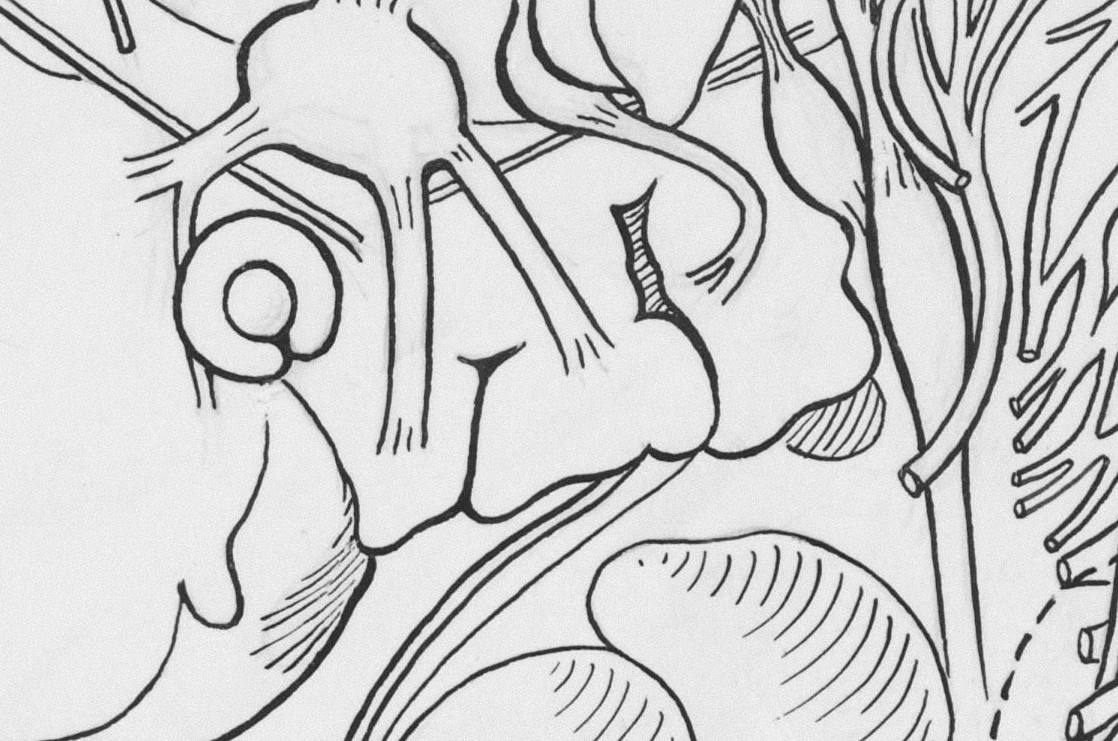
There are six pharyngeal arches in vertebrates. In fish, these become gills. In mammals, each arch differentiates into a network of nerves, blood vessels, muscle, cartilage. They do not develop all at once but differentiate slowly, staggering into existence as cranium, neck, head and tongue, even the ear, which in whales is unique, an acoustic funnel, gifting them a world of aquatic sounds we cannot hear.
All pharyngeal arches are transient things, waiting to become something else.
Except the fifth arch, which around the thirtieth day of gestation inexplicably disappears.
The first pharyngeal arch splits into the mandible and the trigeminal nerve, which is responsible for sensation in the face and chewing. Without it, we would be unable to consume.
It is unlikely that when Li Chun strolled across his bridge at night and looked up at the stars and saw the constellation Cetus, he thought of whales, as they do not figure in Chinese astrology. Dragons and tigers and tortoises, yes. But no whales. Picture Jonah adrift in his rowboat of empty nets, daydreaming yet another excuse for his wife, cursing, then staring at the sunset, then listening to the wind that seems to him like a faraway voice, and then that incomparable muse surfaces beside his boat—the whale. Marriage is so mercurial.
Being swallowed by a whale makes a good story. Who would have believed Jonah had he claimed he was kidnapped by, say, a manatee? Sea sirens, Johann Illiger named them, perhaps because sailors spotting them burned with intimacy after Columbus, that scholar of monsters, mistook them for mermaids, although he noted in his diary They are not half as beautiful as they are painted. A cow with fins and a dopey egg-shaped face that is almost human, the manatee floats through the ocean munching on kelp and algae. Sinking to the seabed to roll in the sand. Blissfully upside down in unihemispheric sleep. Drifting lazily to the surface in a game of Russian roulette with boat propellers, the Dudes of marine cosmology.
Pliny the Elder might have said something about manatees but instead died at Pompeii, asphyxiating as ash and pumice rained down. His body was rescued by friends and is not among those that were incinerated in seconds, posed in suspended animation, some crouching as if in contemplation, others suckling at a mother’s breast, and even more gritting teeth, twisted, dreaming, praying—reminiscent of those shadows burned onto walls and sidewalks at Hiroshima. To see Pompeii is to see the face of God, just as to see Hiroshima is to see God’s shadow.
How will God resurrect a shadow? Will he stitch it onto the flesh, like Peter Pan in a London nursery? Or if in the beginning was the Word and the Word was light and word makes flesh, then what word can piece together 4.5 billion years of dust? Certainly nothing in the language of hominids who chatter, grunt, screech, hiss. But wouldn’t it be nice if the word to piece together all the vanishing things was already with us, hiding in plain sight?
If I had to guess, such words are known among killer whales, who speak with clicks and whistles and pulsing moans. Killer whale, of course, is a misnomer. Orcinus orca, Linnaeus named them, a false whale belonging to the realms of the dead.
Haida natives of the Pacific Northwest call the orca Blackfish, a sacred creature. In their mythology it was Natsilane who created orcas by carving figurines from wood, and set them loose in the water to kill his treacherous brothers-in-law. In some circles of Haida belief, when a sailor drowns, the orcas take him down to their village and in a kind of reincarnation turn him into one of their own.
Nanasimget, the Haida folk hero, sees his wife kidnapped by orcas. In most versions she is the damsel in distress. Perhaps in some other tellings she is in love with an orca. In the most common version Nanasimget hides himself in the skin of an octopus and swims deep into the spirit world, where sea creatures shed their animal skins and live in houses and towns as humans. Through trickery, he saves his wife from marrying the orca and becoming one of the Tsagan xaaydagaay, the underwater people, but never asks his wife if she actually wants to come back.
The second pharyngeal arch becomes a network of muscles and nerves in the face, many of which are responsible for displaying the six primal emotions: sadness, happiness, fear, anger, surprise, and disgust.
In Sunday School I was often shown a diagram of an arched bridge with Jesus’s face in the center, the keystone, holding the arch in place. Without Jesus the universe collapses, the teacher reassured us with a smile. My childhood mind assumed Jesus was in every stone, and over time Jesus himself became a stone: cold, hardened, oblivious to my existence. Even now I hesitate to skip rocks along a river, afraid they might crack and bleed, afraid I might split the universe.
The keystone fixed at the apex of arches is a vain thing, basking in the glory of locking in place all the other stones, but in reality it suffers the least amount of stress. The pressure is in the ribs, the curved underbelly of the arch thrusting horizontally toward the abutments at either end.
The medieval mathematician Fibonacci spent his days dreaming about rabbits, not bridges. Suppose a pair of rabbits is placed in a field and breed at the end of one month, and subsequently produce another pair of rabbits every month, which also produce a pair of rabbits, none of which ever die and the breeding continues forever. How many rabbits will exist at the end of a year? From this riddle Fibonacci calculated a sequence where each number is the sum of the two preceding ones. 0, 1, 1, 2, 3, 5, 8, 13 . . . to infinity and beyond.
When squares with dimensions based on the Fibonacci sequence are assembled, the arc that can be traced by connecting the corners of neighboring squares forms a spiral. This spiral, which is really a string of tiny arches threaded together, is found throughout nature. Leaves of the aloe polyphylla. Pinecones. Cauliflower florets. Nautilus shells. Hurricanes. Even the Milky Way galaxy spirals in a nearly exact Fibonacci sequence. I cannot decide if such order in the teeming chaos of the cosmos is terrifying or comforting.
Sit down and draw a spiral. Eventually you run out of space and the lines overlap and intersect, the spiral collapsing on itself into an ink blot, swallowed up in the void of its own arches.
I find myself frequently shouting, ironically demanding my kids be quiet. If I close my eyes, the noise fades, but the silence reminds me I have so much to lose.
Not content with infinite spirals, Fibonacci also introduced the concept of zero to the West around 1200, replacing Roman numerals with Hindu-Arabic numbers and inadvertently revolutionizing Western mathematics. In Latin, zero is zephirum, from the Arabic sifir, which is a translation from Sanskrit sunya-m which means “empty place, desert, nothing.”
I remember sweating in a Utah chapel where a man preached that God would cast those with impure thoughts into outer darkness. Thirty years later I always feel one thought away from being zeroed.
When I tried to search the etymology of zero the Oxford English Dictionary said, “Error 404: the zero you are looking for cannot be found.”
Nestled beneath the sternum and wedged between the lungs like the pinkish-gray corpse of something caught in a spider’s web is the thymus. It emerges from the third pharyngeal arch and expands rapidly throughout childhood, filling with T cells to protect the body from infection. After puberty, it slowly shrinks into a useless glob of fat. This is known as involution.
In the pale-yellow sands outside of Cairo lies Wādī al-Hītān, the graveyard of whales. It is not uncommon in this ocean of sand for windswept dunes twice the size of the Taj Mahal and stretching monotonously for hundreds of miles to disappear into valleys within a few months. The Archaeoceti fossils at al-Hītān took thirty million years to shed their sand skins. Oh, the beauty of time, pressure, solitude! A sand-swept valley of bones in what was once an ocean. Whales not quite whales, bones twisted as if still struggling to decide whether to live on land or sea. Inside the oldest fossil, a Basilosaurus, is a smaller whale fossil. But whether this prehistoric whale is a mother or a cannibal remains uncertain.
After putting the kids to bed one night my wife says, “I never understood Medea until getting married.” I can feel her looking at me, like I’m the orca that fooled her into this underwater life.
Which is the more essential anatomy derived from the fourth pharyngeal arch? The vagus nerve, a wandering bundle of tendrils that act like fiber-optic cables, allowing the brain and heart and gut to communicate about breathing, blood flow, and memory-making? Or the aortic arch, shaped like a candy cane and supplying large quantities of blood to the neck and head, finally allowing our tetrapod ancestors to avoid respiratory and circulatory malfunction and to transition from water to land?
“Nothing will come from nothing. Speak again,” King Lear tells his daughter Cordelia. And the kingdom crumbles into silence. I pity Lear, because I too have three daughters.
Theophilus of Antioch, however, believed in creation ex nihilo. “Out of things that are not,” he wrote in his letter to the pagan Autolycus, “[God] makes what he pleases.” In cardiology, there is speculation that in some cases the fifth pharyngeal arch, instead of vanishing during the sixth week, malforms into a congenital heart defect causing significant trauma that may go unnoticed for a lifetime.
Something tells me cardiologists are the least equipped to speak of the deformities of the heart.
A blue-whale heart, largest among living species, weighs four hundred pounds. As hefty as an upright piano, it will beat 1.2 billion times in a life-span while pumping enough blood for the whale to swim 1.2 million nautical miles. Somehow, that feels less impressive than Chopin’s heart, which weighed ten ounces and beat roughly 1.2 billion times before he died but traveled with his sister a thousand miles from Paris to Warsaw preserved in a bottle of cognac.
The evolution of octopuses is a mystery. Nobody really knows how or why they suddenly appeared three hundred million years ago. Recently, a group of fringe scientists hypothesized that a meteor with alien biology crashed into the earth and infected a population of cephalopods, which spurred their evolution into octopuses. The octopus has nine brains, three hearts, but no embryonic arches.
I think three hearts is pretentious, like the medieval legend of the soldier who dies in the Crusades only to send his heart back to his lover who, grief stricken, eats it. It sounds disgusting, but my wife says it depends on the chef.
Wādī is Arabic for a desert riverbed canyon that floods during monsoons. In his final, semiautobiographical novel, the Palestinian poet Emile Habibi speaks of wandering along a wādī searching for his childhood friend Saraya, whom he imagines kidnapped by an ogre and locked in a tower rather than believe she disappeared into the sea of exiles after the war with Israel. “Come, my phantom, come out, O ghost of Saraya,” he calls to the sand, “laugh, laugh loudly to break the spell.” Embraced by silence he wonders, “Hasn’t this fairy tale come to an end?”
Nearly seven thousand miles away from Habibi’s wādī, cutting through the San Juan archipelago in the Salish Sea, is an imaginary border zigzagging north from the Strait of Juan de Fuca through Haro Strait toward Vancouver. Shortly before the Civil War, when the territorial sovereignty was still in dispute, when orcas flourished here as they had for thousands of years, a farmer on San Juan Island killed his neighbor’s pig in cold blood. George Pickett, who sealed the fate of the Confederacy when he charged the Union line at Gettysburg and who ended his life as an insurance agent, was dispatched to the island and escalated tensions when he refused to allow British troops to land in the harbor. There is a rumor that Pickett was hoping to provoke a war between America and Britain to distract the North, allowing the South to secede from the Union, but the fortunes of a pig could not save the Lost Cause.
Or perhaps Pickett was just a man at the fringe of experience, still grieving the loss of his Haida wife, Morning Mist, who had died in childbirth.
Along this imaginary boundary in the Puget Sound, this diplomatic no-man’s-land, swims female orca J35. Tahlequah, researchers call her. Several years ago she was spotted carrying her dead calf. Its body floated briefly on the waves, head tilted back as if sleeping, mouth agape; it almost sank, then was buoyed to the surface once more by a heartsick mother. Twenty-six miles north off the coast of Saturna Island. Twenty-four miles south through Rosario Strait. Under the full moon swimming into the flood tide, swimming nowhere. Fifty miles north to the mouth of the Fraser River. Sixty-two miles into the Salish Sea, beyond human surveillance. Seventeen days she carried it, the calf she had gestated a little less than seventeen months, over a thousand miles through the archipelago, charting a strange cartography as if reminding us there is so much grief, there is not enough grief.
From the sixth pharyngeal arch comes cuneiform cartilage in the throat, which sadly does not make one knowledgeable of ancient Mesopotamian writing on clay tablets like the Epic of Gilgamesh but supports the vocal cords. It gives us voice.
After Tahlequah the question becomes: if animals had religious affiliations, what would they be? Hindu goats. Catholic owls. Islamic golden retrievers. Buddhist orangutans. Evangelical wasps. Cats, of course, are agnostic. If I had to guess, the orca, who occasionally hunt great white sharks in packs like ecclesiastical wolves, opening them with surgical precision to suck out the liver as if it were toothpaste, would be Mormon. Full of inconsistencies, inanities, wonders, historical fraudulences and misrepresentations, yes, but a religion as rich with theology as foie gras is with fat.
Mormonism is a four-act play. In the beginning, God discovered the intelligence, the evolutionary ancestor of the soul. Living, raw thought, without beginning or end, adrift in the interstellar ocean. Being a compassionate fisherman, God took that intelligence and housed it in a spirit body. That spirit will live for eons throughout Act 2 in a pleasant primordial society before God decides he is actually a terrible landlord and evicts the spirits from heaven, caging them in flesh on this third-act earth where we can more perfectly agonize mesmerize apologize disguise poeticize bastardize harmonize incise and civilize before this human costume falls apart and our spirit is released into Act 4, the afterlife, whatever that is. There is no Act 5. Playwrights tell us that omission means there is no catastrophe, but also no epiphany, resolution, catharsis. We are four-act creatures, caught in a perpetual falling action.
Zoroastrians believe that before reaching the afterlife the soul must navigate the Chinvat Bridge. Some traditions say the Chinvat Bridge is flat, others inclined like a ladder. If I had to guess, it is curved like a rainbow.
Four days after death the soul meets Rashnu, one of three angels who with his scales of justice will judge. If the soul has performed good deeds, the bridge will widen to ease the passage to the Garo Demana, the House of Light and Song. If the deeds of the soul in life were wicked, the bridge will narrow to a razor-sharp edge the width of a single hair until the soul falls into the Druj Demana, the abyss, the House of Lies.
It is a tenuous thing, a curvature. Sometimes reality curves into imagination. Other times the imaginary flattens the curve of reality and grinds the world down to atoms.
Elephants also grieve, staging funerals for their dead. Mourning rituals have also been documented among sea lions, baboons, magpies. Wolves have a dialect of howls. A howl to warn, a howl to gather, a howl for breeding, a howl for hunger. Each tone and pitch is distinct. One low and flat. Another high and looping. When mourning, wolves howl one by one, and then together as a pack.
Years ago, we enrolled one of our daughters in an expressive arts school where she learned to paint and dance and sing the blues but never learned basic math. One day she was given the assignment to remember a deceased loved one. At a ceremony on the playground the next day, my daughter and her classmates dressed all in blue and released hundreds of blue balloons into the sky as a token of their grief. My daughter, mourning the loss of her great-grandfather, wept and wailed inconsolably, prompting one teacher to comment on the influence the great-grandfather must have been in her life. She never met him, my wife said.
Somehow, my daughter had intuited the need to engineer melancholy, a very human desire to feel connected to tragedies not our own, to convince ourselves our grief is special, a unique feature of our evolution.
And so we stare dumb struck at the television when an orca carries her dead calf for seventeen days, a mother miserable but alive in the wild, feeling in a way that is authentic and palpable, unlike our own faux grief with all its distant nearness.
In his despair over the death of his friend (and possible lover), the wild man Enkidu, Gilgamesh grieves over the corpse until it rots. He weeps. He howls. Dressing himself in the skin of a lion, he wanders the underworld seeking the secrets of immortality.
Sometimes I imagine that our capacity for grief is located in the fifth pharyngeal arch. Too fragile to evolve with us, we must shed it like a skin and spend our lives trying to recover it elsewhere, if we find it at all.
I’ve lost count of all the things I’m in love with that disappear. Strangely, I don’t want the things ghosted from me to return. They feel closer to me as absences.
Like my Mormon faith: quarantined, it incubates into an unexpected but welcome fever.
Like my children. Sometimes I want them to grow up faster, stop calling me Daddy, stop hugging me, stop nagging me to play lava floor, stop making so much goddamn noise and leave me to become an old fool cut to the brains, laughing at gilded butterflies near the cliffs of Dover, silently melancholic for the giggles these girls no longer share with me.
I am not a mother like Tahlequah, capable of such beautiful grief in the now. Just a father who imagines himself in the future grieving the past of his daughters. This is my self-inflicted outer darkness.
In Dante’s Inferno, Lucifer is imprisoned not in fiery pits but in a lake of ice.
This detail has always pained me, since my earliest memories are a love affair with snow and ice and cold, places far from the warm, sunny beaches of my California youth. I read books about Shackleton’s expedition to the South Pole and studied Mercator’s 1595 map of the Arctic, daydreaming how I would one day sail to the phantom island of Frisland. A copy of the map hangs in my office today.
Perhaps no man has known more about snow and ice than Wilson Alwyn Bentley. In 1885 he became the first to photograph a snowflake. In making visible the ephemeral, Bentley found no arches and no spirals, but hexagonal prisms. Over the next forty years he cataloged more than five thousand snowflakes in northern Vermont, hypothesizing that among these “dainty hieroglyphics” there are no two alike.
Wilson Alwyn Bentley was sixty-six when he died—does it matter if we say childless and unmarried?—his name and accomplishments almost universally unknown.
Discovering the photographs of Wilson Alwyn Bentley I marveled that I had found my soul mate, someone who shared my weird fascination with ice, with snow, but was devastated that he had lived the life I wanted to live, stolen my biography before I had a chance to live it.
The crushing sadness that I was born in the wrong time and the wrong place, betrayed by natural selection that works fast for some and slow for others, lingers with me.
A rainbow is not actually an arch. The horizon and landscape create an illusion. Elevated, from a bird’s-eye view inaccessible to most of us, all rainbows are circles.
Conventional theories of reality suggest Wilson Alwyn Bentley died of pneumonia after walking through a blizzard. Was he looking for snowflake variant 5,382? Or was he searching for the original snowflake, the so-called ur-crystal or Platonic snowflake that refuses to sublimate in these cartographies of grief?
What I would like to believe, although I know it is patently untrue, is that when Bentley walked into a blizzard on 23 December 1931 with his bellows camera tucked under his arm, he was never seen again, his anonymous life finally agreeing to its own hypothetical sublimation, which I suppose is the best any father can hope for.
Read more from Issue 18.2.