The Art of Falling
13 Minutes Read Time
Liveaboards
In my new island life, I am a woman on the beach, all wrapped against the wind. It is not sunny. I am no longer young. The skies are gray; perhaps it is misting or has misted or will mist. I am not old. The water is choppy, little whitecaps rolling in like glimpses of a wedding dress. I am in the middle of the journey, looking behind and looking ahead, but trying to stay upright in the present. There is no one else on the beach. The beach is not sandy but rocky, littered with seaweed, broken shells, driftwood. I must watch where I step, or I will twist my ankle and fall, but I can’t help lifting my eyes.
When I do, a man in a skiff not far out comes into view. I’m not sure what he is up to. He brings the boat to shore and climbs out. His rubber boots are knee-high, and his pants are stuffed into them. His beard is long and gray and falls onto his chest, and a baseball cap obscures the top of his face. How old he is exactly I can’t say, because he’s so weathered and ungroomed. He’s lost some teeth past the middle way of life.
We get to talking, sitting on a log, looking out into the rain-lit waves. Like a few others, he lives on a boat in the harbor—the liveaboards. I know another man, my friend Ted, among this group. They row themselves to shore in skiffs. On land they walk everywhere.
These men call to me, point me to another way of living. They have a philosophy of life. I’m not a liveaboard, but I too left behind a different way of being when I moved to this island. I cleaned up the past with an eye on dying.
Why am I not lonely, when so many are? Is there something wrong with me that I am not beset by a yearning for company? Perhaps I am beyond lonely, have accepted solitude as a condition of living. There are no women among the liveaboards. Something about that existence is unwelcome. It is arduous, rowing a skiff from the dock out to the boat, carrying laundry, groceries, back and forth, often in the dark and the rain. And alone.
Ted likes his boat at night, sleeping on the rocking water. He doesn’t want things he doesn’t have, and he’s not afraid of dying out there. He says that it’s his safe harbor.
Emergency Preparedness
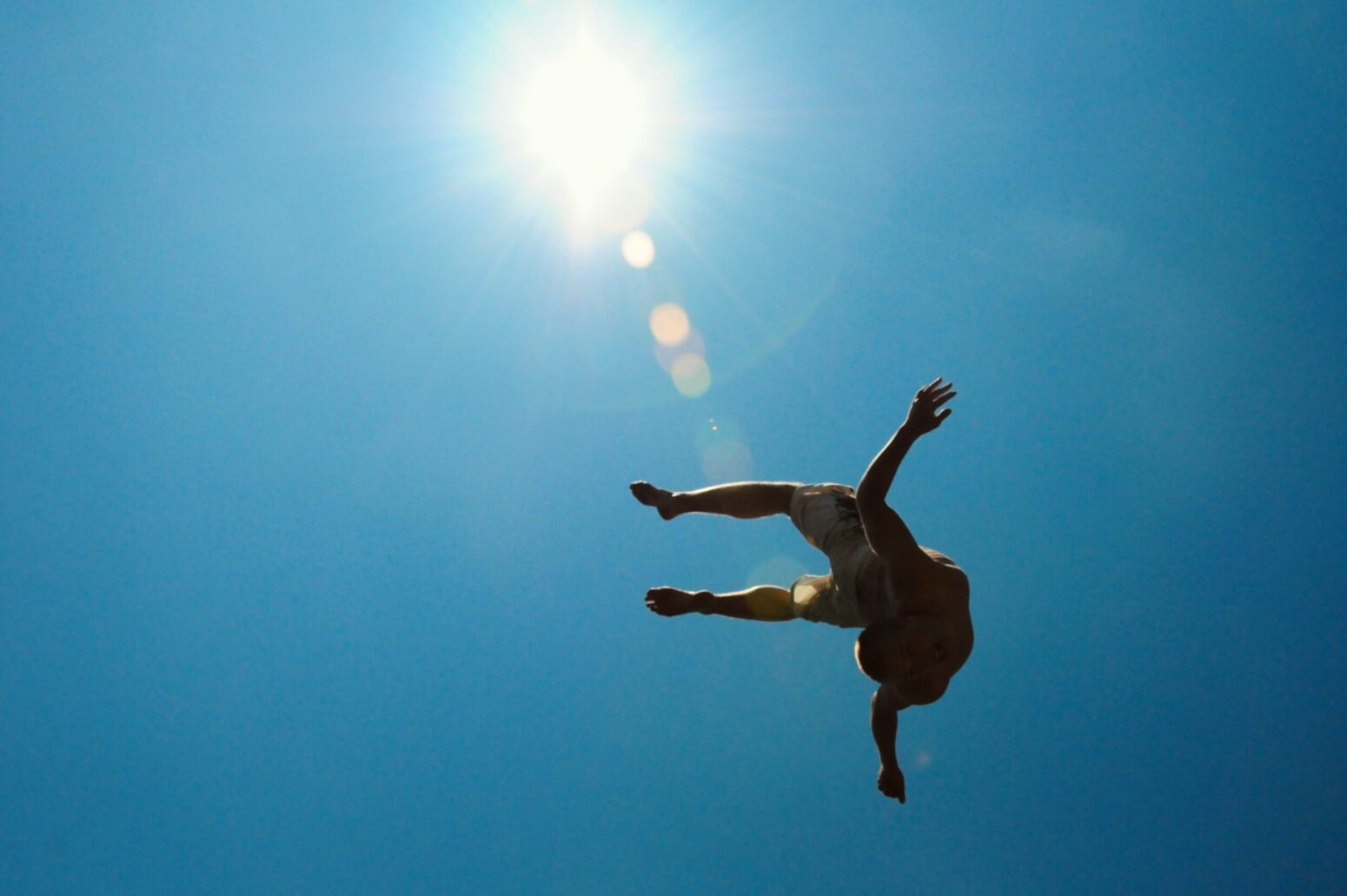
I read an article called “The Art of Falling Safely.” What? Can we teach ourselves to fall safely? That’s a contradiction. Falling comes without warning—there is no time to save myself as I grab the air.
I have a problem with balance. I practice a tree pose every day, and every day I shake and tremble and teeter forward. My doctor tells me my bones are thinning and could shatter, like a beautiful white sailboat athwart a huge wave, breaking apart, its shards floating away on the black seas, never to be put back together again. This would be a catastrophe, yet something in me lets go when I think of it. “Nobody’s heart is really good for much until it has been smashed to little bits,” said Elizabeth Bishop.
Figure #1
Walking up from the ferry in Seattle, I stop at a red light, puffing a bit during this steep stretch. A very tall man, whose wretched pants swamp his gaunt frame, is standing on the curb ahead of me, eyes fixed downward. He holds a brown bag in his right hand. He has paused at the edge of the curb, and I feel an unsteadiness in him. It would be so easy for him to step off or tumble forward into the rushing cross-traffic. But he stands in absolute stillness.
Then I see liquid run from his leg over his bare ankle. Is something in the bag leaking? No, the man is urinating. I’ve seen the street people urinate against a wall or in bushes. I’ve seen them unzip and piss off to the side of wherever. But this man has not unzipped his pants. He is standing in a group of people on a Monday afternoon waiting for the green walk sign in downtown Seattle and is unaware. He hasn’t decided to pee; he just pees.
Should I do something? I think. What is there to do? I should ignore it, I decide, and walk on when the light changes. A bottle of liquor is probably in the bag.
When I look back, I am up the next hill and he is far behind me, lurching from left to right; before long, I can’t see him at all.
Beats
These moments are my real writing now. Turning to the page is like speaking to an old friend who knows me better than I know myself, who asks that I give an account. No subterfuge is allowed, no artifice that is more decorative than essential. Just the engine of myself.
Figure #2
Sitting in front of my daughter’s apartment building in Capitol Hill, I’m watching over the assemblage of her furniture that we have carried down. Many people of a singular nature pass by. One woman is old and not in good shape, so her age is pronounced. She is short and bent, thin, nearly frail, and carrying a purse and a large bag, likely full of groceries. She carries it on her left arm and leans heavily to that side, her droopy clothes in indifferent shades of brown. She doesn’t stride but shuffles, crooked through the middle section, hunched over, nothing about her straight. Carrying the heavy bag does not help matters. She moves slowly on the sidewalk; it takes a long time for her to pull even with me. Shortly after passing me, she stops at a concrete barrier near the curb, puts her bag down, opens her purse, and pulls out a white handkerchief, which she lays carefully on the concrete. She sits down to rest.
Her face remains impassive and she makes no eye contact. We share no greeting, nor does she notice others in her difficult world. After a few minutes, she gets up, shakes out her handkerchief, folds it, and returns it to her purse. She picks up her burden and continues slowly toward the next corner.
I am not exclusive to myself. I am always on the verge of falling into other people or wanting them to fall into me. I want to catch them. I want to be caught.
Flinty
What do others see when they look at me? They see an outer form that is intact and smooth. They do not see the breakage inside, my capsizing bones, the little fractures along my spine. Mutiny from within.
In an acting class in college, we were directed to pair up, look closely at each other, and report our findings. Deeply searching my partner’s face, I saw nothing to remark on. Was there nothing to discover? I invented a description about her softness. Indeed, her features were very soft. She said, “You’re harder than I realized.” She didn’t use the word flinty, but she could have.
Figure #3
As I climb the stairs to the Zig Zag Café, it is raining lightly. A woman, inappropriately dressed for inclement weather, walks down the slick steps from the Market. She wears high-heeled wedge sandals and a tight pink bandage dress, clinging fabric that wraps the body like a wound, only there is no wound visible, just every nonmuscled spot, every sag and bulge and roundedness. The dress is squeezing the life out of her. Her cleavage is hellbent on emerging above the neckline. Her blonde hair is a huge messy upsweep, falling down in the rain.
Given all the difficulties her attire presents, I wonder if she’ll make it inside the bar. But she does, and a man who has claimed a table smiles at her arrival. She takes mincing steps toward him and they embrace.
G Minor
Of Mozart’s half-dozen string quintets, the G minor is the darkest. See also his G-minor symphony and the piano quartet in G minor: all dark and full of inner turmoil. These are his works for me. I feel no kinship with the major key. I owe all my education to the minor.
Waiting
It occurs to me that I am waiting. That when I dream-fall, I am waiting for my death. It’s not what I want. I don’t think I want to die; I’m not looking forward to the day. It is, however, the condition of my birth, what I was born into, this waiting for the lump in my throat, this homesickness to clear.
Catch and Release #1
Sleepless, hacking coughs that felt like I was splitting in two. Woke up and saw the bouquet of white roses drooping, the petals on the verge of falling. Got up to give them fresh water. Took them out, poured out the old water, and what should emerge but Quin’s cremated ashes, grit and chunks of dog bone. Six white roses in one hand, the vase in the other, the water running, and Quin’s remains draining down into the sewers. There seems to be no end to the pieces of him.
Endings
Things I can say with certainty:
I will never bleed in that way again. All my parents are dead.
No more horses—too many fractures in my back.
I will never feel that young sense of possibility, not knowing where it will lead. (What waits for me? Will there really be no new beginnings, no sense of anticipation?) Before was a period of aspiration, dreams. Most would never be realized, but I traveled with them, and they led me forward. Now many such dreams move to the other side of the ledger, crossed out.
Catch and Release #2
A fox fell through the frozen surface of the Danube and drowned. No one was there to see or help. Later a hunter came upon the drowned fox encased in a block of ice.
Cause of my death? A heart attack like my father, massive and fatal. Or a cerebral hemorrhage like my mother. Both fell: My father fell to the floor, and that’s where they found him; my mother fell against the wall and hit her head. Then she fell against the bed and broke it.
Aloft
It took me a little while to realize what was in the tree that stands alone in the field. The tree has seen better days, battered by winter storms and age and neglect. But kids like to gather there, and someone has hung a bird feeder from its branch. Once, two girls sat under its limbs playing cello and violin, the notes floating above the grasses. Tonight after the dinner hour, when the fields are lit with a soft light, I notice that a girl around high-school age has hung a hammock from two branches and is now suspended off the ground and swinging. She has long black hair that waves down her back, and she has brought several bags, as if she has run away from home. I keep my head arched in her direction, curious but respectful of her privacy. After all, she’s come here to be alone, hoisted in her throne.
Lone Survivor
A sixty-seven-year-old woman who jumped from the deck of a Bainbridge bound ferry was rescued by crew members Friday afternoon, according to a Washington State Ferries spokesman. At 2:15 p.m. Friday, passengers reported that a woman had jumped from the back deck of the Puyallup. . . . Crew members responded by throwing a life ring to the woman and launch ing a rescue boat Passengers jumping from ferries is not a common event, Mannion said.
I once threw my wedding ring off the back of that ferry. Before I could count to ten, I had slipped out of my ring and thrown it overboard, from whence it sifted down past underwater valleys and ridges, basins and sills, to a depth of at least six hundred feet. The little fleck of rose gold glittered through the night, dropped and disappeared. I felt regret, but not the kind that breaks me into bits.
On November 4, 1875, the sidewheeler Pacific……… rounded Cape Flattery en route to San Francisco In the darkness, the sailing ship Orpheus struck the Pacific, which sunk almost immediately, killing nearly 275 passengers and crew, except for two survivors. Are we each the lone survivor of our life but don’t know it?
Figure #4
I enter the street at First and Pine with the crowd, trying to stay under the awnings, the sidewalks slick and wet, people lying in doorways under blankets. Some of the faces are amazingly young; some have dogs by their side. I’m walking, my hood up, intent on watching my steps to avoid slipping. She comes toward me, picking me out of the crowd, and looks me in the face, catching my eyes and asking, “Just a dollar, please?” She’s plaintive, quiet voiced, not young. I hold her gaze for a minute. What’s the money to me—a dollar? What’s the money to her? I reach into my wallet, pull bills out and place them in her hands. I leave her standing on the sidewalk. I don’t look back. I make my way into the night. I’m soaked through, having failed to keep the rain from entering me.
“It’s only a relatively few moments that we get to keep and carry with us for the rest of our lives,” one of Stuart Dybek’s characters says in “Paper Lantern.”
Wipeout Dream
I’m standing on top of a banquet table. There is no beginning of the table and no end. It is loaded with vases of flowers, whose heads are so heavy they topple over onto the wood. I’m dressed in an outfit I’ve never worn, an outfit out of my time, something like a swim costume from the nineteenth century, with puffy pantaloons and a ballooning blouse. My hair is long, curls cascading down my back. All along both sides of the table, strangers are seated, and they’re elaborately clothed as well, as if we’re actors in a costume drama. I am walking down the tabletop like it’s a gangplank. The people are trying to trip me, to make me fall. They thrust their hands out, grabbing at my ankles. I do not fall—this is the miracle of it.
Wonder
Many nights, before drifting off to sleep, lying on my back, I feel as if I’m going to fall. I sense it in my chest. Maybe you’d call it a clenching or a cleaving. It’s a sense of foreboding, something waiting for me, a darkness, an ending perhaps. I was visited by bad dreams sometimes when I was pregnant with my daughter, dreams about her drowning, falling into a pool. This sensation is not a dream: When I am relaxed, exhaling, a premonition seizes me, as if, out of the corner of my eye, I’ve seen a car run a red light. It’s a glimpse into what happens after, the awareness that I will be dead. I turn onto my stomach to sleep it off, like Scheherazade telling one more story.
Read more from Issue 16.1.