Sunshine Skyway
22 Minutes Read Time
“The peephole is installed backward,” my one-night stand said as I sat up in bed. We were in his high-rise studio apartment. “I keep meaning to tape a piece of paper over it.”
I thought about what this meant. A tiny aperture gave passersby in the hallway a fish-eye view into the bedroom. It wasn’t exactly the attention I wanted. I glared at the door. “Who installed it?”
“Always been that way,” he called from the bathroom. When he emerged through the steam, his hair was combed, and he looked exactly as he had the night before, minus a gun. The gun had been his most appealing feature, though. Its simultaneous danger and safety had kept my mind far from more devastating facts.
He stirred cream and sugar into a mug of coffee and brought it to me. I took a sip, and he said, “What’s your background?”
I played dumb. “My background?”
“You’re very beautiful,” he said. “Where are you from?”
“Thank you,” I said. “I’m from here. Florida. Like you.”
He chuckled. “No.” He started to say more, but staticky voices came through his radio. He frowned. “I have to go,” he said. I didn’t like him, but I didn’t want him to go. He slung his belt holster over one shoulder and picked up keys from a junk tray on the entry table, which was in the bedroom. It was all one room. “Stay as long as you like,” he said. Deadpan, I blew him a kiss. His shiny badge caught an edge of sunlight as he turned to leave.
He pulled the door shut behind him. His keys rattled on the other side, and I watched the dead bolt turn. I wondered if he had ever used excessive force. Then I opened all the windows and smoked a cigarette, naked in the breeze. I was going to see my mother later that day and didn’t want her sniffing me and commenting on my nicotine habit. Obviously smoking is bad for you, but I needed something to do.
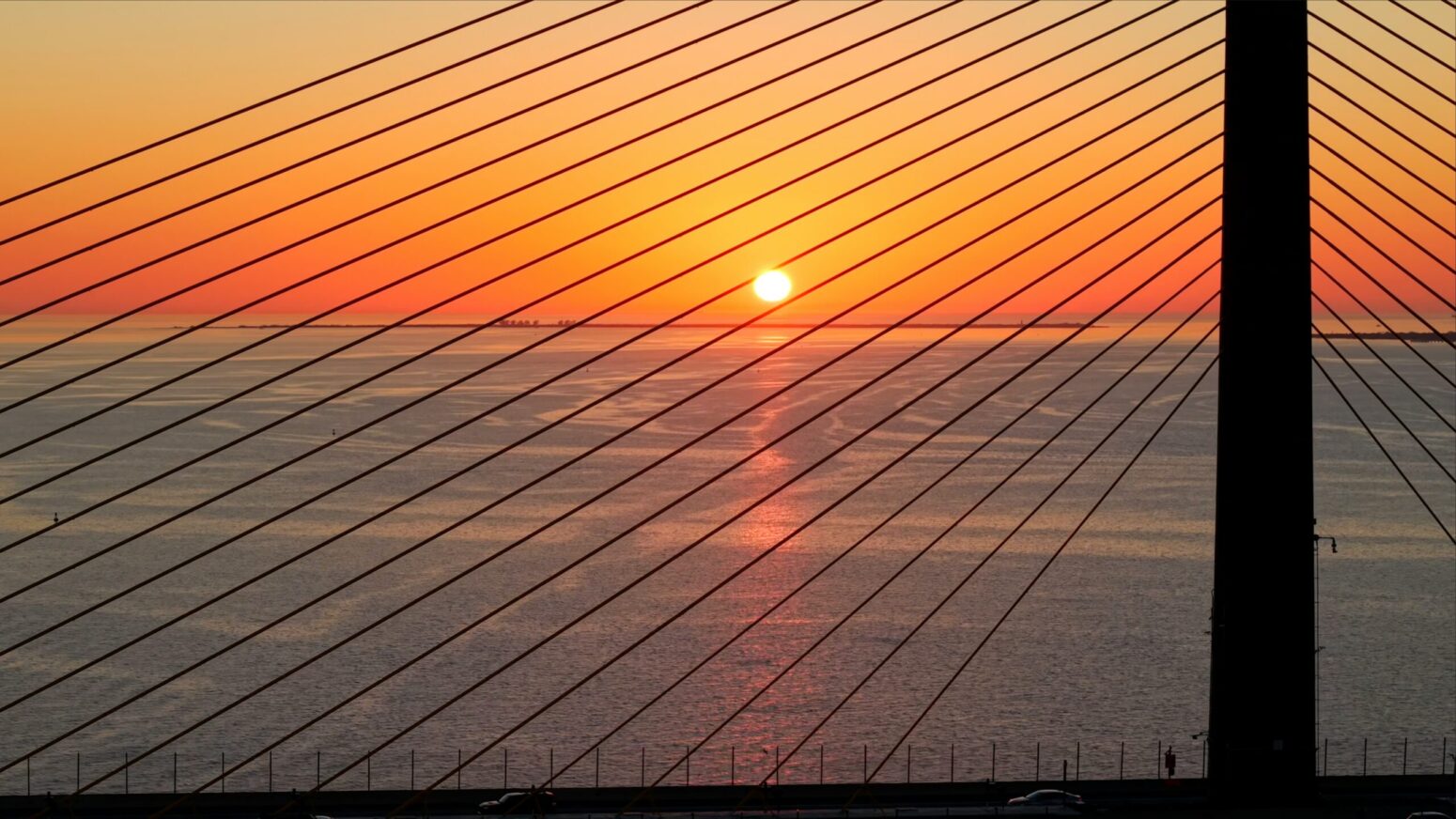
After I finished, I got dressed. My day would only get worse. But first, I headed over the Sunshine Skyway Bridge. The bridge and I were introduced to the world on the same day, April 20, 1987. April 20 was also Hitler’s birthday and the day Deepwater Horizon exploded in the Gulf of Mexico, but we get to pick where to find meaning in our lives, and I loved the Skyway Bridge. Its deck hung from cables attached to two towers along the median. Over either edge you could see unobstructed views of Tampa Bay, like an expanse of hammered cobalt, from hundreds of feet up. On foggy days, the bridge’s roadway looked like it crested in the clouds. I wanted to drive over it indefinitely. On the other side, I had funerals to attend.
The forecast called for thunderstorms, and strong winds made my little red car drift. Near the apex, construction slowed traffic to a stop. Brake lights dotted the path ahead. I was going to be late, though who would notice? As I contemplated a series of bright red cubes evenly spaced along the road’s shoulder, the magic of the bridge faded. A sign above each red cube said “Crisis Center.” Cars honked, and I rolled up my windows to keep out the noise. These Crisis Centers were free phone booths that connected callers to the suicide-prevention hotline. I had called the hotline once, out of curiosity. On the other end of the line, they hadn’t been good at their job.
People were always jumping off the Skyway Bridge. They crossed state lines to do it. Over the years, despite the Crisis Centers and around-the-clock patrols, Tampa Bay had become a hot spot. Now Tampa was installing a suicide prevention net. For sixty-five days, protesters had chanted things like “More Net, Less Death!” on the bridge’s mainland side, until the City Council approved the project and construction began. The net would be a mile and a half of steel obstacle. I couldn’t help but think that if a person wanted to kill themself, they would find a way. The barrier was only going to ruin the view. I loved the black path disappearing into a bright white abyss.
I’d spent the previous evening on the downtown pier, not far from the bridge. At first, I’d picked through the stores along the main strip, brushing my fingertips across trinkets, ceramic tableware, and the cellophane wrapping of fine chocolate. I admired a glazed earthenware jar with a blue-and-green maritime design. The price tag said $340. What if I picked up the jar—a perfect vessel to hold a loved one’s ashes—held it out in front of me, and let go? Its crash and the shards at my feet might help release the charge in my chest.
I wandered along the pier, where an overweight man performed cover songs with an acoustic guitar and headset microphone. Children ran around in wet bathing suits, their lips purple and chattering, and red-faced adults shouted at referees on the outdoor bar’s wall-mounted TV. The performer sounded like Frank Sinatra, and when he called out PG-rated jokes to the kids darting across his quasi-stage like banshees, he made them seem spirited. Delightful, even. He was almost the whole package. Talented, full of social grace. Too good for this gig, for sure. How unfortunate, I thought, that he hadn’t been born handsome.
I ordered a rum punch, and it sat untouched as the ice melted into a clear layer on the top. The performer started to sing Bob Marley’s “Three Little Birds.” I closed my eyes and sang backup to myself. I’d listened to this song my whole life. And now, the worst thing had happened. My grandfather’s funeral was the next day. I was alone in the world. My insides felt scooped out.
The sun set over the bay. It grew chilly. As I sat still, my sadness continued to bob to the surface. I struggled to push it down. The chair next to me scraped the cement ground, and I opened my eyes to see a police officer lowering himself into the seat. I wasn’t doing anything wrong.
“Pretty voice,” he said. I squinted at him.
“Mine or his?”
He laughed. “I just finished my shift.” I raised my eyebrows. The cop lifted his chin in the direction of the chubby performer. “That’s my kid brother.”
I looked at the policeman’s brother. He had moved on to a song I knew, but didn’t know. I looked at the police officer sitting there with awkward confidence. They could be brothers, I thought. The same bland face. The same dark, thinning hair. I liked the idea that it was true.
“Can I get you anything?” he asked. “Fries? Ice cream?”
I laughed. “Like I’m your daughter?”
He returned with french fries and a paper cup of vanilla soft serve.
“What made you want to be a cop?”
“My grandfather was a policeman.”
I didn’t care. He was leftover birthday cake after a long day. A tired decision, but I would forgive myself. As I left the pier with the performer’s brother, the police officer, I tried to give the impression not that we were walking together but that he was escorting me. I kept a half step in front of him and made my face miserable. I wondered what the tourists imagined I had done.
Arriving at the funeral, I parked on the street and entered the unfamiliar church through the front. Scenes in stained glass crowded three of four walls in the small empty room. It was dim and solemn, as if a priest had just traversed the aisle gently swinging a metal globe of smoldering aromatics. How different this place was from the world. How perfect. I made my way to the back of the nave where a slice of light shone through a shut door. I stepped carefully, not wanting the click of my shoes to disrupt the eerie peace of the room.
The metal door was heavy, and I leaned against the push bar with my hip to open it, leaving the sanctuary behind. On the other side, artificial light reflected off yellowing linoleum. I saw my mother immediately. She wore a bright red dress cinched at the waist with a woven metallic belt. Her head was thrown back in a cackle, and a handful of people flanked her as she excitedly spoke. I recognized some of them. Mostly nice people. Friends she’d had for decades. She often complained about them to me. According to her, they all talked too much, made poor decisions, and had messy homes. I didn’t understand why they were so enamored with her. I was missing something, or they were.
In her element, my mother didn’t notice my entrance, so I examined the room. Fluorescent bulbs hung from a mottled drop ceiling. Someone had set up plastic folding tables, and a snack table with tinfoil-wrapped trays waited in the corner. Alongside was a second, smaller table draped in white cloth. Twin urns sat atop it.
Both my grandparents had died the previous week, independent from each other. First Grandpa, then Grandma. They’d been divorced for thirty-five years, so their joint passing was either an enormous coincidence or a testament to the power of hatred. Some married couples died within weeks due to heartbreak. But I think my grandmother passed away violently in her sleep because without my grandfather she had no raison d’être. Hating him was her life force.
Sure, my grandfather was an alcoholic, but he was also a saint. For my grandmother’s part, I wish she’d had a glass of wine here and there. A giggly drowsiness would have served her well. It would have served all of us well.
My grandfather always listened to what I told him and remembered what I said. I once watched him administer CPR to a goose he’d pulled from under the ice of a frozen pond. Cradling the limp creature, he took its beak in his mouth. And he’s the reason I loved the Skyway Bridge. Though we never drove over it, he often took me fishing on the neighboring pier. He’d say, “You wanna take a ride?” and I didn’t have to ask where. We would stand with our poles and gaze out over the bay.
I knew the bridge’s history through him. He remembered when the original was constructed. And he was there in the squall of 1980 when a cargo ship crashed into it, collapsing the bridge and killing thirty-five people. In newspaper photos from that year, it is his cream-colored sedan that has skidded to the edge of the severed steel platform. The guilty freighter looms just beyond the bridge’s wreckage, and beyond it, the atmosphere is so hazy that it’s impossible to tell where the ocean ends and the sky begins.
Locals said Skyway was cursed, and my grandfather agreed. He never drove across the bridge after it was rebuilt. But my grandfather survived the crash, so the bridge had been good to me.
My grandfather had joined the army the year the Korean War ended, and he credited his military training with giving him the wherewithal he needed to navigate the buckling structure during the accident. He sometimes told a story about how he rescued a group of people from their cars that day. They held hands and crept along the halved bridge back to solid ground. If he’d been drinking, he told a different story. Sitting in his armchair next to a bottle of Carlo Rossi, he would recall that a Greyhound bus had been next to him that day on the suspended roadway until it wasn’t.
And now, this funeral. A door opened next to the refreshments table, and several more guests stepped into the church’s rec room with a gust of wind. I glimpsed the sky behind them as the heavy automatic door shut. A shelf of clouds blotted out the sun. Family friends I hadn’t seen since my teens blinked as they adjusted to the ugly room. When I saw them see me, I took a deep breath and made my way over. I tried to smile. They grinned at me. I couldn’t remember their names.
The woman’s tanned skin matched the color of her dyed-brown hair, and her husband’s blue eyes leaked. He dabbed at them with a tissue that he’d pulled from the front pocket of his pants. Their daughter, who was my mother’s age, had gained weight since I last saw her. Their daughter’s daughter was there too. Her curls were pressed straight, the edges frizzy in the damp Florida air. When we were kids, she’d seemed older than me, but now I realized we were around the same age. I had been in awe of her as a child. Like me, her father was Black and her mother was white. But unlike mine, her father had been a father to her.
“Look at you!” they said.
“Is that you?”
“What a lovely young woman you’ve grown up to be.”
“It’s so strange, isn’t it? A week apart.”
I thanked them for coming. I told them about my modeling career—just local stuff, I assured—and my apartment downtown. I said, “How cute!” as they showed me photos of their great-grandchildren. I nodded and smiled. I said, “That’s amazing.” What really amazed me was multiple generations showing up, together, to offer their condolences.
When I was a kid, my mother cooked dinner every night and sat me down for each meal like someone who’d read a book on how to have a family. She was a good cook. I had to give her that. She also offered advice. “Don’t have kids,” she said. “It’s my biggest regret in life.”
Even as an eleven-year-old, I knew that this would be psychologically damaging. “Mom, don’t say that,” I said.
She was only trying to help, she explained. She would look wistfully at an imagined past somewhere in the space behind my head. “Think of all the things I could have done if I didn’t have you.”
It’s not like she was a teen mom. She was a middle-class white woman from Boca Raton. She’d had opportunities. But she dropped out of college and got pregnant a few years later. She loved to tell the story about when she first told her mother she was pregnant. According to her, the first thing my grandmother asked was, “Is the father Black?” My grandmother already knew her daughter had a type. My mom got smug when she told the story. Defiant. I wondered sometimes if she had been trying to make a political statement, or piss off her parents, or something else.
I avoided bringing my friends around my mother, especially my Black friends. “What up!” she’d say, miming like she was scratching a record. I wouldn’t be able to swallow while I shepherded my company away from her.
“What was that?” they’d ask.
I’d roll my eyes. “She’s old. She’s an idiot.”
But she was ahead of the curve. It would be another twenty years before white women started announcing that they wanted mixed kids. The least she could have done was learn how to braid hair.
Once, I asked my mother what her father had said when she told him she was pregnant. My grandfather had been calm, she told me. Practical. “You’ll have to move home,” he said. And so she did. I was grateful for that. With him, things were never complicated.
I kept an eye on my mother while exchanging pleasantries with our friends, and when her audience started to break apart, I made my way to her. She was using the flat side of a knife as a mirror and dabbing an orange-red lipstick onto her bottom lip. “Hi, Mom,” I said. “You look nice.” She was a young mother, but today she looked old. The lines around her mouth had deepened, and her eyes sunk into their sockets. She was strong, though. I always imagined her bouncing like a boxer, arms held up and ready to strike. We embraced, and I felt the knobs of her vertebrae under my fingers. She was her mother’s daughter down to the bone. Spirited, sharp-tongued, uncharitable. I wondered if I was my mother’s daughter too. I let go.
“Hi, Sweetie,” she said. Her face turned pained. “I don’t know if I can stand this. The same conversation over and over. Why won’t anyone leave me alone?” She lowered her voice to a whisper: “I had a few drinks before.”
“I thought there were going to be two funerals. Separate,” I said. “Which urn is even which?” She had insisted on planning the event herself, and I hadn’t liked how she had described the arrangements to me a week earlier. Two back-to-back funerals at a church nobody went to. Now it was clear that this was a single event. “And I thought there would be actual services. Why are we in a church rec room?”
She groaned. “They did so many things together! They got married. They had me. They got divorced. What’s one more thing?”
“They hated each other.”
“Don’t be ridiculous,” she said. “It was cheaper. I needed to get it done. And it’s not for me. It’s for the guests.” She gestured at the modest number of attendees. “The urns are labeled on the bottom.”
“It’s for us too,” I said.
She sighed. “I know you know it isn’t.” She found my eyes. “I know you’re upset,” she said. “I’m upset too. They were my parents. But it’s just us now. So don’t give me a hard time.” The back door swung open with a bang, and new guests entered. My mother rolled her eyes. Soon she had their full attention.
I made my way over to the urn table. I felt like I knew which container held my grandfather’s remains. I was drawn to it. The other urn sat there inert, though my grandmother rarely just sat there in real life. My mom was always complaining about how her mother was mean to her, writing her in and out of her will until her dying day. It was true that my mother couldn’t do anything right: she would bring my grandmother a box of pastries, but they weren’t from the right bakery, or she would offer to walk her crusty-eyed bichon and then walk her for too long or forget to offer her water upon returning. I wondered where things had landed between them. I wondered where the dog was. My grandmother had been decent to me for the most part, but I saw how my mother turned into a child around her, hungry for approval, scorned again and again. My only prayer in life was that I wouldn’t turn out like either of them. I traced one of the urn’s lids with my fingers. It was plastic made to look ceramic.
It didn’t seem like there were going to be any speeches at the funeral, and there was nobody I wanted to talk to. I glanced around. Everyone seemed engaged. I took a styrofoam cup from the snack table, pried the lid off my grandfather’s urn, and filled the cup with his ash. I kept my eyes on my task. I didn’t want to see anybody seeing me. My stomach growled, so I grabbed a cookie from a tray and, holding the cookie between my teeth, pushed through the back door. Palm fronds flapped in the wind like flags on a pole. The cur-rent lifted some of the ashes in my cup, so I used the cookie as a lid. I walked around the front of the church to my car.
Back on Skyway, construction had stopped. Traffic was thin and fast, and I switched on my hazards to park on the shoulder between two orange construction drums. Why build a bridge just to ruin it? Hadn’t people been jumping to their deaths for millennia? What did a bridgemaker think was going to happen? But the net would make it harder to jump, and maybe that was something. Maybe for some people, harder meant a postponement. And maybe a postponement could last a lifetime.
Parked on the road’s shoulder, I left my keys in the ignition and the hazards on, and got out. Steel cables stretched into the clouds. Drivers blared their horns at me, and the tires of speeding cars whined over the concrete. I held the cookie over my cup of ashes and crept toward the bridge’s edge. Fat drops of rain hit my face. A gray blur obscured any views of the mainland. The wet wind, the vehicles that felt too close, the vastness of the ocean below: it all thrilled me. My first and last trip over the bridge with my grandfather. I was cold and wet and couldn’t hear the thoughts in my head. I held onto a rail with one arm and kept the ashes close to my body. The dampened cookie started to disintegrate, so I dropped it to the metal grate below.
Red lights flashed, and a police cruiser pulled up behind my little car. I didn’t have the time I wanted. I saw my grandfather’s loose yellow teeth. His hairy earlobes. I smelled his breath like spoiled milk. He had a calm nature. He’d been curious. The wind and the rain seemed to stop, and I exhaled slowly. I couldn’t tell where the water met the sky. Everything was soft. I flung the ashes over the rail, and they made a dusty streak before dissipating.
Then a man shouted “Ma’am! Ma’am!” and I was lifted off the ground from behind. I gasped. I grabbed the arms wrapped across my chest. We were too close to the edge. A voice in my ear said, “You’re okay, you’re okay.” I was being carried backward, away from the bridge’s rail. My backside pressed against a stiff form. The arms held me tight. They finally let go, and I turned.
It was my one-night stand. The cop from the night before. The same moony face. The same gold badge. He staggered back, squinting. He said my name.
“Jesus,” I said. “What are you doing here?” Behind him, my car sat on the narrow shoulder, blinking. The officer bent his head to speak into a radio but kept his eyes on me.
Rain smacked my face. I shivered. It was coming down hard now. White noise rushed around us, and the view over the water blurred. It seemed dangerous to be out there on the bridge, at a construction site, in the middle of a storm. I wanted to get back in my car and drive home. My apartment would be warm. I would eat ice cream. I would watch a movie.
“Are you having thoughts of harming yourself or others?” he shouted.
“What?”
“Are you having thoughts of harming yourself or others?”
I didn’t say anything.
“What are you doing?” His hand seemed to be in a ready position next to his gun. I wondered if it was his training or if he felt threatened.
“What are you doing?” I shouted back.
“I’m on bridge duty.” He eyed the bridge’s rail. “It’s a lot of resources to find the bodies. And it’s upsetting. For fishermen who see them jump.” He paused. “For their families.”
“I’m not jumping,” I said.
“What?” It was hard to hear anything.
“I’m not here to jump!” I yelled. We were too close to the edge. “I’m gonna go. This rain.” I ran around to my car, got in, and buckled my seat belt. I didn’t look back. I merged into traffic and turned off my hazard lights. I felt something like relief, like I had let a single clay jar fall to the ground in front of me.
My mother called while I was driving home and asked if I wanted to say anything at the funeral. She clearly didn’t realize I’d left the premises. “I’m in the car,” I said as rain pummeled my hood. “The weather is bad.” I hung up. The bright yellow cables tethered to the middle of the bridge fanned out above me like rays of sunshine, even in the downpour.
When I got home, I ordered takeout and took a long shower. As I pulled a sweatshirt over my head, the door buzzed, and a small man, dripping wet, handed me a paper bag with hot food inside a plastic bag.
In the weeks and months that followed, I thought often of my squall on the bridge, my quick farewell during that period of construction. I watched the scene from on high over and over. I added a supporting cast. I imagined a stooped figure out on the bay. I couldn’t see his bent knees through his suit of thick rubber, but I knew they held him steady as his boat rocked over the water. The bright yellow cables tethered to the middle of the bridge fanned out over the people in their cars like rays of sunshine, even in the downpour. Passersby saw a young woman leaning against the rail, and they slowed to make sure she was okay. She didn’t seem distraught or in danger, they observed. She looked serene. It was clear to all that she had her reasons for doing whatever it was that she was doing out there over the water. Same as me.
Read more from Issue 20.2.