Starting Over, or, When Will the Koi Arrive?
36 Minutes Read Time
What can starting over even mean?
“Check yard signs,” the realtor says to me and Daniel when we’re looking at houses in North Carolina. “Which signs are people sticking in their front yards? That says everything about the neighborhood.” Everything emphasized, everything pointing to subtext she doesn’t trust we’ll get because we’re northern and, this being the South, things go on here we can’t understand. (When, yes, I know subtext.) Hours careening around town in her massive silver Lexus hybrid, ensconced in its living room–like comfort, with her talking at me in the front seat and Daniel half-listening in the back. It’s a wildly intense housing market, and we already lost two houses to higher bidders, even starting at five thousand over asking. “Like there,” and she points a manicured finger at an In this house we believe in science etc. sign, shyly tucked up by a bungalow’s door, partially hidden by a shrub.
“We like those signs,” Daniel says, and I quarter-nod.
“We all do,” the realtor says. “And good, since the house we’re headed to’s a block over.”
With a damp, musty basement and fuchsia floral wallpaper in the dining room and hallway. More houses, so many houses, and finally we go “fuck it” because we have to move, we must move, and we win the bidding war for a house six blocks away from the “science” house but across a busy road, so not technically the family-friendly neighborhood the realtor targeted. Instead of bungalows, this neighborhood is lined with large established houses, solidly constructed with painted brick and stone quarried ages ago, each with multiple chimneys. It’s a neighborhood of pillars and smooth, graceful driveways arcing through long lawns, of triple garages and slate roofs. Estate gates and tall, prickly hedges. The yard signs here are more like Hope Brothers Window Washing and Joe Bell Plumber & Sons Since 1945, signs that vanish once the work is complete. No children’s toys littering front yards, no loose dogs. A lovely, eerie, almost apocalyptic emptiness perfect for the frosty chill infiltrating my interior.
“Such a smart move,” the realtor congratulates herself, “buying the smallest house in the best neighborhood.” She grew up nearby, “oh, about a hundred years ago,” and points out her childhood home, a Georgian mansion filling half the block. (Later, we check Zillow and gasp at the Zestimate and its twelve thousand square feet.)
By now, we’d have taken any house in any neighborhood in any state at any price. Our house in DC went as expected, in a weekend bidding war allowing us to determine the terms. Just a fast closing, setting us free before the fridge breaks or a tree topples onto the fence. Our terms: nothing more to deal with, please god.
And so that life back there really, finally is finished. Daniel, moving permanently to work-from-home. Me, moving to North Carolina, and also: me, moving nowhere.
When she asked, “Why y’all moving here from DC?” she believed Daniel as he spouted our prepared story: “Looking for a less stressful life.”
Five weeks later, movers unload fifteen thousand pounds of boxes and furniture. “How do two people own so much?” Daniel asks me. The previous owner left beer in the basement fridge, so I’m drinking a bottle at 9 a.m. and another thirty minutes later. My mind fuzzes, and I relinquish checking the master list as each numbered item comes off the truck. If we’re meant to own it, it’ll show up, I think. I’m sitting on the window seat, feeling guilty that I’m watching men work. Daniel’s in the backyard in a collapsible camp chair, in a Zoom meeting he calls important, perched at the outer perimeter of the wireless connection.
He’s mad, not because of the beer but because last night at the hotel I told him the house felt haunted, that any time I was in it, I sensed a ghost in pain. “You don’t believe that shit,” he said, and I said, “You can’t know what I do or don’t believe,” and he said, “Let’s hold it together until the movers are done.” We were at a Hilton Garden Inn off the highway in a room where the AC was only a weak rattle. “Just remember,” I said, “it’s your solution, moving.” He sighed and tossed the TV remote over onto my bed; we’d ended up with two queens, though I claimed I made a reservation for a king.
“Stop,” he said. I couldn’t bear either of us crying, so I found the predictable calm of the Food Network, but it was that manic Guy Fieri, not Bobby Flay or Chopped. Daniel said, “We’re doing our best, right?”
I felt the tiniest bit touched by his hope, so I flopped back on my bed and pointed to the man on TV, said, “Backwards sunglasses are affected.”
Now I focus on these bulky young Serbian men asking, “Which room?” and me saying, “Bedroom one” or “Kitchen.” They don’t mind me changing my mind and saying nicely, “Let’s try that bookcase against that other wall.”
“We need you to be happy, ma’am,” the boss says, which is such an idea. (If you knew me, I want to say…) The men come from Serbia every summer to haul around American crap—“crap” is my word, not theirs—then return home with wads of money and relax in cafés for five months. There’s still more beer in the basement fridge, so I pop another and give the rest to the movers, who hide the bottles under movers’ blankets so the truck’s interior surveillance camera won’t surveil alcohol. Daniel shows up at the end to dole out fifty-dollar-bill tips. That’s okay. The Serbian men are pleased. We’re laughing at things that aren’t funny. Daniel’s Zoom meeting went well, though there’s another important meeting in three hours, and he has to prepare.
I ask the movers if they believe in ghosts, thinking they’ve been in so many houses that their perspective is extra-relevant. Daniel rolls his eyes, and the boss says, “I can’t say no,” and one of the men says, “Read your history books. We’re the haunted country of haunted people,” and there’s awkward foot-shuffling and nervous laughs, and I’m about to ask another question when Daniel butts in: “We can’t thank you enough,” so it’s goodbye to the Serbian movers. But the guy with the bristly red hair, the one who seems least comfortable with English, pauses outside the door and sharply brushes off both shoulders three times, meaningfully. He knows something.
That night, surrounded by boxes, I feel the ghost watching me, assessing, evaluating, wondering, perhaps planning; inhaling and exhaling; a thick presence. The feeling is like catching the hoary print of the moon pale against a blue sky or that dusty scent rising off hot pavement in a summer sprinkle. It’s like looking into a dog’s eyes and seeing wisdom. Let Daniel not believe, but my best and only plan is to find reasons for my shattered heart to beat.
Two days later, the realtor pops in with a welcome-to-the-neighborhood gift card to Southern Home & Kitchen, “only the best kitchen store on earth,” she says, “just down the road. Y’all will love it.” She claps her hands with delight. “How y’all doing?” Boxes are everywhere, packing paper. I don’t know how recycling works here. Only a quarter of the boxes are open, if that.
I say, “Daniel’s out getting our new license plates,” though I know she never cares about things unrelated to houses.
She says, “You’re gonna see people here are real nice. You’ll have buckets of friends before too long.”
I say, “We lost most our friends where we used to live.”
Dead end.
She tilts her head and quickly says, “How y’all liking the house so far?”
I say, “I think it’s haunted,” and she laughs, then says, “Oh, you mean seriously.”
“Not in a bad way,” I say. “There’s a good way?”
I tilt my head in a mirror of hers. Her eyes are a crisp, no-nonsense blue and won’t meet mine. “I’m kidding,” I say.
“Y’all will be so happy here,” she says, “I promise.” Her smile copies the smile in the photo on her business cards. “Gotta run,” and off she goes. She told us from the beginning that she’d feel like a best friend but that ours is a professional relationship. “I say so to everyone,” she apologized, “to chase off confusion. No mixed signals.”
Later, bored with boxes, I drive to Southern Home & Kitchen in Daniel’s car. Mine feels… not mine; too new; something to fear. I leave the car unlocked at the store, where I select a great big black cast-iron skillet. Seems like something we could want for cornbread and fried chicken, though I’ve never cooked either. The lady who rings me up admires my choice, saying my children and their children will use this skillet, that she’s got one handed down from her great-great-grandmother, that if you take good care of it and rub vegetable oil—I interrupt: “I don’t have children.”
Dead end.
My skillet’s too big and heavy for a shopping bag, so I skulk out with it in my bare hands, but once I’m in the house, I imagine someone packing it into a cardboard box, a mover hauling it out of this house, onto a truck, and into another house, and on into infinity. “Exchange it for a tablecloth,” Daniel says when I tell him the skillet makes me sad. Instead, I shove it into the way back of a cupboard that’s too high up to be useful.
The Amazon delivery person is the only one to ring the doorbell, leaving things like new toilet seats because Daniel says who wants to sit where someone else’s ass sat for twelve years?
But it’s diiing-doong at 4 a.m. I shoot straight up in bed, and Daniel rolls over, dragging a pillow over his head. He’s mean when his sleep is interrupted, but I poke him: “Did you hear that?” and he groans, and I say, “The doorbell rang,” and he says, “No,” but it’s all grunt, muffled by a pillow, and I grab the pillow and toss it across the room and say, “Get! Up! Someone’s at the door. Maybe they need help,” and finally he props his rumpled self up onto one elbow.
I say, “You want me to go down there alone?” and I hang one foot off the bed, as if I’m about to get out. The floor will be cold. I still haven’t found my bathrobe, and I’m thinking the movers lost that box or maybe I left my robe behind the way this previous owner left that beer. Maybe the ghost took it. “There’s lots more left to unpack,” Daniel told me, “it’ll show up.” The agreement was that I’d unpack because he wants to focus on his big work project, because he’s BUSY and I’m NOT. “I didn’t hear anything,” he says.
I’m right: the bare floor’s definitely cold.
I tiptoe downstairs and open the front door. The air outside smells damp, and the sky’s blacker than where we used to live. I fill my lungs with darkness. “Anyone there?” I ask quietly. I step outside and examine the doorbell, but it’s not like ghosts leave fingerprints. The cement prickles my feet. Before going back in, I brush off my shoulders like the Serbian mover did, three times. Should something happen? Should I feel something?
When I get back upstairs, Daniel’s asleep, or fake-asleep. I slide way over on the edge of my side of the bed and listen to him breathe. We haven’t touched each other for how long?
Each night I hear a different loud noise. Doorbell. A sound like a car crash but no fiery wreck outside. Bells that aren’t from a church. A train whistle going too long. One night, across town, there’s a fire in a fertilizer factory that makes the local news. Tomorrow or someday, something will drop a long ways down, like a comet or a meteorite, something that barely misses crashing into our house, forcing us to exclaim, Wow, we’re so lucky, though I don’t feel lucky at all.
Daniel insists he hears nothing, that he’s sleeping like a baby. My lips press tight at that word, but he says, “It’s a cliché, what people say.”
I listen to a bird singing in the darkness outside. Under the covers I google on my phone: it’s a mockingbird, either a young male desperate for a mate, or an older male who lost its mate. Either way is lonely. It goes and goes and goes.
“How about a dog,” Daniel wonders, “or a cat? A guinea pig?” I shake my head, no, no, no, no lizard, no hamster, no turtle, no nothing, until he says, “We need something, and if you don’t watch out, it’s going to be a dog,” and I say, “How about starting with fish?” He grimaces, but I say, “Fish.” I mean a fishbowl with one cheap, ugly fish named Fishie, and he means an outdoor pond flickering with koi.
A guy comes out to explain how much it costs to put in a koi pond, convincing Daniel that we’ll be happier doing it “the right way” vs. a “two-bit kit offa the innanet.” He agrees there’s a significant price difference, so he repeats, “the right way.” As if he knows we are—rather one of us is—prone to error.
We’re outside. “You want some shade,” the man tells us, waving his arms around like he’s directing a light show, “but also four hours of sunlight. And away from your black walnut tree,” pointing to a stark tree that’s been dropping heavy, rough green balls onto the grass.
“Those are walnuts?” Daniel says. “We were wondering.”
“Tough sons of b’s,” the man says. “Won’t hardly crack lessen you run a car over. And don’t park underneath.” He laughs in a chummy way, suggesting we’re incapable of being so careless.
“Good point,” Daniel says. “Thanks.”
The man goes on: “So, yep, right here,” and he stamps one foot down. “This spot’s ideal, as if God himself made it for a water feature.”
“There’s no god,” I say. “Right?”
Dead end.
He addresses the rest of his pitch to Daniel, who finally says, “We’ll call you,” and they shake hands. As he’s walking away, the man says, “Lotta people don’t know, but ‘koi’ is a Japanese word for love.”
Once the man’s truck is gone, Daniel says, “I don’t know.”
I know what he doesn’t know, but I stay silent. Maybe it’s pleasant to think of god mapping out spaces for koi ponds and water features?
Daniel says, “Are we sure? Sure we want . . . ?” The sentence dangles.
“To spend the money,” I say, though he’s thinking, Sure you want something needing to be taken care of? Do I want something to take care of? I haven’t unpacked all the boxes. I think a house is haunted. “To spend money basically on fish.”
“There’s no punishment for affording a koi pond,” he says. “You don’t really want a dog,” I say.
“Let’s see how fish go,” he says. And then he has a meeting.
Daniel and I met at a surprise party his previous girlfriend threw for him, six years ago in November. He fake-loved the surprise, with an exaggerated, blustery OMG face, like if Munch’s The Scream were not an existential crisis. I lived downstairs from the girlfriend, invited only to ensure I wouldn’t call in about the noise and not expected to show up. I’d had a hunch I should go, and Daniel and I got immersed in a great conversation about Tarantino, specifically Pulp Fiction, and I teased him on his pompous pronunciation of the word film. Abruptly he asked, “Do you want kids?” and I shook my head, said “No.”
“Me neither,” he said. We locked eyes, both thinking, Good. That assured. (Then.) We were kids ourselves. “My girlfriend’s pushing me,” he said.
“I would never,” I said. Who, who would punish us for that?
We were in the kitchen, where the wine was, and finally he said, “I was planning to break up with her tonight. Swear I knew nothing about this party.”
I said, “Surprise,” and he rattled me with a tremendous kiss.
Those were the good days. Nothing was haunted; the footsteps above us as we read books together in bed on snowy nights, as we made love on my futon were only footsteps. No ghosts. No “unseen souls living in a bodily likeness,” which is how the internet defines ghosts, because, really, it’s not a simple question, is it: What is a ghost?
“You used to be happy,” he tells me. “We used to be happy. Weren’t we?” “Maybe,” I say. “Hard to remember. Hard to say.” Everything was such a long time ago, such a “before” when now is definitely an “after.”
No sex for months and months now. If his fingertips dare brush my bare skin, a scorching, dangerous burn rockets my body, and I push away as if he’s the devil—though, really, I am. Dead end, I think.
One night, there’s rain clattering on the roof of the house, and I hear the ghost tap-dancing. It’s the same mournful rhythm over and over, the way a rehearsal goes, trying to get something exactly right. As if someone displeased is demanding, Again and One more time.
The next morning I’m exhausted. Daniel makes coffee and asks if I want any, but I’m too embarrassed to admit how much I need it, so I wave him away. My hand shakes, getting that same ghostly rhythm, as I sip orange juice from a mug. “Is that bourbon?” Daniel asks, and I nod, and he says, “No, it isn’t,” and grabs the mug. “I knew it wasn’t,” he says, but I know he didn’t. He smiles. For half a second I feel like I used to. But that’s over because he’s got to answer his boss’s email time-stamped 4:49 a.m. Then there’s a meeting.
I tell Daniel, “I want a yard sign,” and he says, “Like ‘We believe in science’? Don’t you want to fit in? Don’t you want people to like us?”
“You want to fit in,” I say. “You want people to like you again.”
He shakes his head no, something he does lately, like words are effort. The only time I hear his voice is through a door, on Zoom, in meetings. He’s always meeting. “We both need to try,” he says. “If this is going to work.”
I say, “It’s just Beware of Dog, for safety. Because of the noises I keep hearing.”
Instead he buys an alarm system that comes with a small discreet red sign shaped like a shield, the same sign half our neighbors have.
The problem is: there’s another woman Daniel loves, who lives downtown in a building conveniently next to his office. The problem is: he rides the subway and flashes women during the evening commute. The problem is: he has a child I didn’t know about in private school, and he secretly attends her soccer games to watch her in goal. When I can’t sleep, I imagine the ways he might have failed me. None compares to the unimaginable way I failed him.
No. What turns out is that the problem is me. I’m to blame. I’m at fault.
It’s our wedding anniversary. New York strip, Caesar salad, baked potatoes, cabernet. Cheesecake in the fridge. Such a celebration! The dining room smells like meat grease. The store here doesn’t carry the good anchovies, and these taste like salty rot. The meal tastes like salty rot. I choke it down.
Daniel’s smile is plastic. “This can’t go on like this,” he says. “Us barely talking to each other.” He reaches for my hand across the table, but I grab for my wineglass.
“We’re talking right now,” I say. “I said I forgive you,” he says.
The glass is empty. I press my big sweaty thumb into the side of the empty wineglass, leaving behind a smudgy print: evidence of my guilt.
He says, “What does your therapist say?”
“I stopped calling in,” I say. This long, hard silence. I wasn’t planning to admit this to Daniel, but there it is. I should feel better after confessing the truth, but I feel worse. Daniel thinks things can be fixed. Daniel is trying. Daniel likes people who try. The world depends on people trying.
Daniel says, “Are you even trying anymore?”
“I guess not,” I say.
“We moved here for a fresh start,” he says. “We didn’t have to do all that if you aren’t going to try.”
I say, “If you’d done it, I would never have forgiven you. Even if I said I forgave you, I wouldn’t. If it had been you, I would’ve left. Immediately. Why do you stay?” My voice rises in anger. I clutch onto the bowl of the wineglass, press in, hoping for it to crumble in my hand, crushed into dangerous shards of glass. I push harder.
“Because I love you,” he says.
“For real,” I say. “Please don’t say the thing you’re supposed to say.” I get my wish as shattered glass stabs my fingerprints and palm. I want to withstand the pain but can’t. I howl. Daniel howls too.
I wait while Daniel sleeps, and at 5:33 a.m. I hear the quick clicking of typing on a keyboard. I hear a muffled chainsaw. I hear footsteps in which one foot treads harder than the other. I hear myself saying I don’t want children, Daniel saying, “Me neither.” I hear the throb of my own blood pumping through my ears. “Are you there?” I whisper. “Because I hear you.” Daniel shifts, pulls the blanket tighter. I envy him so much.
Daniel’s on Zoom, and the door’s closed, and I’m sitting on the floor in the hallway listening to his side of the conversation. “You would think so,” he says, and “Thursday would be fine,” and “You could say that.” Nothing adds up to anything. I imagine a brain filled with calm.
I used to have a job. How competent those days were before. Mistakes were misspelling a word in an email or creating a paper jam in the copy machine. They didn’t want to fire me, they said, but clearly they wanted me gone, so I signed paperwork in HR and got severance.
“You know we never needed your salary,” Daniel said. “And cost of living’s cheaper down here.”
I still haven’t unpacked everything. I ordered a new robe, cheap beige terry cloth. Blue was on back order.
Behind the door Daniel tells faces on a screen, “There’s more to come.”
Cold air snakes across the floor as I stare at how the wood grain in the floorboards doesn’t match up board by board. “Hardwood floors!” the realtor said, and “Hardwood floors!” the people on HGTV say as their remodel is revealed. No one’s ever excited about carpeting. A ghost can’t tap-dance on carpeting. Everything is quiet with carpeting.
Daniel’s meeting will never end, and when it does, he’ll have made sure there’s another scheduled. To do something, I find my phone and set an appointment for someone at a flooring store to come by and estimate how much it’ll cost to carpet the entire 2,800 square feet of this house.
“You’re moving because you need more space?” the other realtor, in DC, asked. “Are you having a baby?”
As if a baby is the only reason to need space. As if the purpose of space is to fill it with people. I hate that I think of that other realtor still. She knew who I am and what I did, and she asked the question anyway.
On another day, I wonder about how big the average house in Serbia is. Google informs me it’s a flat, not a house, and it’s presently 58 square meters, up from 55 square meters. Because 58 square meters is meaningless to me, I plug that information into Google and get back 624.327 square feet.
Embarrassing that those Serbian men moved fifteen thousand pounds of crap into 2,800 square feet. They could have stuffed this space with entire families, whole neighborhoods. I look up the average size of a house in America, which is 2,301 square feet. We’re five hundred over—roughly the size of a Serbian flat.
How many square feet does a ghost need?
“Don’t be afraid,” I whisper to the ghost, “I’m right here.” I wait for an icy hand to slip into mine, a frosty sigh tickling my ear, a fluttery hug. Wait, wait. I want to be friends.
I google “how to talk to a ghost?”
Not advised, is the consensus. Once you open yourself up to the spirit world, anything can happen. You know neither the power nor the mood of the being who might respond. Another site urges the dead to stay with the dead and the living with the living. A ghost cannot be your friend.
All I am is emptiness, surrounded by empty space. All I am is silence, waiting for sound.
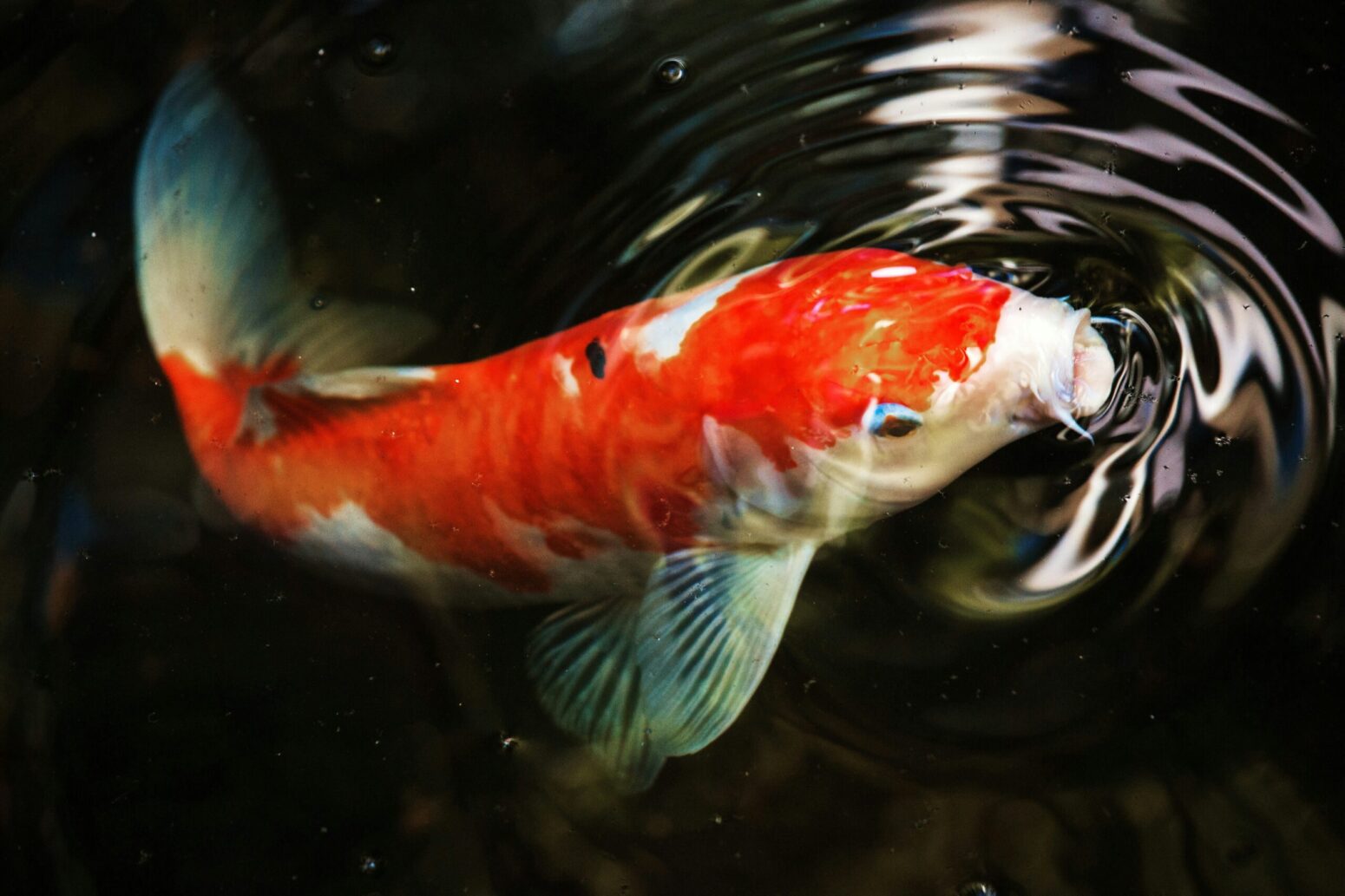
Someone cancels a contract, so our job gets bumped up, and they’re going to start work on the koi pond. It’s suggested that we wait until spring to buy the fish, but I scroll through pictures online at Next Day Koi, comparing pond packs—groups of five, ten, twenty-five, sixty fish; “an economical way to populate a pond”; “exact fish not pictured”—and admiring individual, exact-fish fish for purchase, their intricate scales and fluttery, wispy fins. They’re movie stars, these fancy fish, far too precious for someone like me to own. Yet all it takes is a credit card.
$600. Plus shipping.
“For one fish?” Daniel says when I tell him, when I tell him that many cost more.
I say, “It’s those butterfly fins. They’re very special. And the coloring.”
Silence webs around us. Is now the time to say something? This is all your idea, I think. I can’t, I think. I say, “Once one sold for almost two million dollars. There’s breeding and bloodlines to consider. How bright the fish is, its flash while it moves through water.”
“What about raccoons?” Daniel asks. “What if the $600 fish freezes?”
I lift one hand so I don’t have to hear more. I tell Daniel that the fish arrive UPS. That a koi named Hanako lived more than two hundred years. “It’s okay if you forget to feed them,” I say. “They’re fine for two weeks without food.”
“I wouldn’t forget to feed them,” he says. “Are you saying I would?”
His eyes won’t meet mine. Yes, he means exactly what I think he means. He’s not a cruel man, he’s only a tired, wary man. “Wasn’t this your idea?” I ask.
“Maybe,” he says. “I can’t remember now.”
Later, I think about how a breeder winnows three million baby fish into fifteen thousand in one year, then drops to one thousand; that nine years might pass before a fish is ready to show. Google does the math: 0.03 percent and 2,985,000 extras that first year. That’s how one koi becomes extraordinary.
I’m halfway through the boxes. The only breakage is a single Waterford martini glass from a set of two that Daniel’s uncle gave us as a wedding gift. Easy to replace, if we cared now about martinis or crystal or things. Waterford was on our registry, but how wrong to assume we’d care about that. Minds change.
We paid for all the insurance the moving company offered, but a single broken glass doesn’t clear our deductible. That cheap wineglass I broke (my fault) doesn’t matter; I bought it last year at the Crate & Barrel outlet. It was not extraordinary, and—turns out—neither is this $100 crystal martini glass.
One box isn’t unpacked. There are lots of still-taped boxes, but really all I think about is this one. When they carried it off the truck, the movers said things like, “Which room? There’s no label? Where does this go? Where do you want this box?” They stood there, holding the box, all four of them, though that can’t be true. It’s only one box, not very heavy at all for movers. Daniel packed it. Maybe I did. I know exactly everything inside it. So does he.
“Set it anywhere,” I said, so the movers set it at my feet, and I said, “Not there,” and then “Not there,” again, and “Not there either,” about six more times, and the Serbian who spoke the best English said, “Ma’am? You have to want this box to somewhere.”
There’s a tiny closet in a tiny bedroom that the realtor suggested could be (don’t say a nursery) transformed into a large closet with a fancy dressing table. This box ends up there. It takes all four men to set that box up there in that closet and all four men to shut that door tightly. Takes only me and Daniel to not open that door.
That room is the coldest in the house. Daniel talks about insulation. Talks about storm windows and caulk and gets the name of a guy from the realtor. The guy never calls back, and the next guy tells us four months to get new windows because of problems still with the supply chain.
This house is 2,800 square feet, and that box is 18 × 18 × 24—or 4.5 cubic feet. The realtor could have sold us 12,000 square feet and same thing. I’m lost trying to calculate square feet and cubic feet into a percentage. Doesn’t matter. This unopened box will travel to the next house, the next. This box will haunt us.
Daniel says, “We’re not being punished because we can afford a $600 fish. We’re not being punished because we have some money. We’re not being punished, period. It doesn’t work that way. Things are random. Things are bad luck. Things are accidents. Things just are. What happened is no one’s fault.”
I say: “I know.”
I think: No one. No one. No one! No! One! NO ONE!!
I think of how it’s easy to replace a broken glass, to tape a box securely.
I parrot Daniel: “What happened is no one’s fault.”
He gasps to hear the words in my voice, to hear me say the words. Good. I wrap my arms around my chest and forget to breathe. He likes to say that what happened is no one’s fault only because he’s confident that what happened is not his fault.
There’s no such thing as ghosts.
What happened is. What happened is.
What happened.
What happened is.
These words overflow my mind at night as I wait for the ghost. What will I hear tonight? The doorbell, rustling in the attic, the click of venetian blinds, the tinkle of piano keys. Tonight the computer printer in Daniel’s office starts printing suddenly.
What? Happened?
I get up and look in the printer tray. In harsh, squinty light I read an email Daniel printed about how to submit expenses starting on the fifteenth. I stare at it so long that the paper seems to glow.
What happened is my fault.
Koi can last a whole winter without being fed; never feed koi when their water temperature is below fifty-two degrees. “How convenient,” Daniel says.
“And sad,” I say.
A chilliness enters the room, and I tug on the sleeves of my shirt.
Daniel says, “Do you want salmon for dinner?”
“We can’t eat fish when we own fish,” I say, and he says, “The fish aren’t here yet.” He hates me.
If the UPSed fish arrive dead (DOA, the website puts it), there are avenues to take, refunds to receive, people to notify. There’s a plan, a path, a simple procedure to get a new fish on the way to you and your pond. What you lose, what’s nonrefundable—the only thing gone—is your shipping fee. And that exact-fish fish.
Order another exact-fish fish, another pond pack: so many dozens of pictures on the website, fish from $20 to $1,350; 2,985,000 extras. Fish are numbers. No one thinks twice. Just a fish. Just a glass. Just a baby.
Can a fish be a ghost? Is that salmon we ate for dinner haunting the unbuilt pond?
“He’s not here,” Daniel says. “He’s not here! He’s not a ghost in this house. He’s! Not!”
“There’s no such thing as ghosts,” I say.
Can a ghost slide into a taped box, stay silent as that box gets heaved onto a van, as that van pulls into a strange driveway in a different state; can a ghost be patient as a box is unloaded onto a hand truck, wheeled into a new house, hauled up the stairs by four Serbian men? Can a ghost drift through a taped-up box in a tiny closet and settle into the cracks between floorboards, cozy up in the kitchen cupboard that’s too high up to be useful, perch on a window seat? What can starting over mean when there’s always, always this ghost?
Daniel sits at the kitchen island, poised to return to the endless Zoom meeting he lives in. He takes a bite of granola bar and talks around rough chewing. “Stop saying he’s here,” he says. “Stop saying he’s a ghost.” He drops his head onto his folded arms. “If he’s here and he’s a ghost, I’m the one who should see him, not you.”
A moment later, he says, “It’s not fair.”
A moment later, he says, “You think I hate you, but I promise I don’t.”
A moment after that, he’s back on Zoom. No one works harder than Daniel.
He earns the money to buy koi to stock our new pond in our new house. If koi die, there’s money to buy more. Try again, with the koi, try again. Koi are infinite, and Daniel’s money feels infinite, and emptiness is definitely infinite. We stay together, broken—because neither of us can ever be fixed.
At night I imagine the ghost sitting cross-legged on the rocky edge of the half-built koi pond, asking, “When do the koi arrive?” A melancholy swish of words, the way a subtle wind sometimes feels surprisingly pensive.
“Sure you want a koi pond?” my mother asks on the phone. “Sure you—?”
Silence.
“The fish can go two weeks without food,” I tell her.
“I meant,” she says very carefully. “That I understand they live for a really long time.”
I say back, also very carefully, “I understand that. Too.”
Once, my mother told me I was lucky I didn’t go to prison. “Lucky,” I parroted, and now she speaks much more carefully.
I call the realtor. “We’re building a koi pond,” I say. “How does that affect our property values?”
She’s in her car. I hear background traffic. “Is this important right now?” she asks. “I’m with just sweetheart clients, the loveliest couple. Y’all would love each other. I’ll call back. But I’ll say right now, no fancy water feature’s like adding on a bedroom or bathroom. That’s the real ticket.”
She doesn’t return my call. Being in a rush works as an excuse for her, for this. Also, we’re not friends.
“Just in case?” I say—just in case . . . I kill them? What heavy words. They could break a window how I heave them back at him. “Just in case what?”
Pink rises in Daniel’s cheeks. “You know what I mean.”
“Say it,” I say. “Only order a pond pack of three cheap fish? Like goldfish, not even real koi? That’s what you want? Just in case I kill them?”
“Aren’t they delicate? Parasites. Oxygen. And the water—”
“Will be too hot? One hot day I’ll forget about our poor koi in their hot, hot pond?”
He speaks quietly, says the words twice before I hear them: “I meant water filtration is complicated.”
Is it? Did he? What matters here? “If you’re afraid, how do you think I feel?” I ask.
“Also afraid,” he says. “We’re both afraid. Both of us.”
We lock eyes. He’s standing, and I’m sitting at my computer, dazzled by an array of tissue-paper fins, grids of golden scales, bright splotches of orange and slashes of black and elegant dots that must have been placed by an artist’s brush.
“I have my marketing meeting,” he whispers. But he doesn’t move. I hear us breathing, almost in sync.
I click on a pond pack of five A-grade 4ʹ-5ʺ for $39.30 plus shipping and add them to my cart. Standard grade, and not these exact fish, but the samples are white, yellow, yellow-orange. Fingers crossed that one has black speckles, that another is deep orange. For balance, and because I want to—because I need something and I don’t know what something is and I’m weary of not having it—I click on a gorgeous silvery-white, platinum ogun with butterfly fins and a metallic sheen, and add this exact fish to my cart: $525. I want clicking on its picture to feel like forgiveness or like moving forward or finding closure, but it feels like an upper-middle-class American buying an overpriced fish. I order five pounds of growth-formula koi pellets (blend) for $24.95 and add a climate-shield insulated liner to my shipment for $10. My fish will travel in safety, damn it. If there was insurance, I’d buy it.
Daniel watches. It occurs to me that the silvery-white fish looks like a ghost. I feel Daniel thinking the same thing.
Quickly, I add two black T-shirts printed with four curled koi, sizes M and L: $22.99 each. Nothing more to buy, except fish.
Checkout. I type this new, still-strange address, and the credit-card number autofills. Seven to ten days for shipping, with the food and T-shirts arriving separately. One last click on “Complete your order” and these fish will become my responsibility. Instead, I slam back in my chair, fold my arms across my chest like a resentful teenager.
“You can’t punish me forever,” I say, knowing it’s not Daniel punishing me. He says, “Do you want to punish yourself forever?” He sounds sad, like he’s trying to convince himself of something. Or maybe that’s how I hear him now?
“Maybe,” I say. “Probably.”
Daniel kneels so he’s not looming. His hand hovers over my bare leg, and I sense the warmth of his skin.
I say, “I’ll never feel at home, anywhere, ever.”
Daniel says, “Wanting to be happy again is okay.”
“Is it?” I ask.
He rests his hand upon my thigh. The muscle tenses, but I don’t yank myself free this one time.
“If I could grow fins,” I say, “I absolutely would live inside this pond forever.”
He points to the thumbnail picture of the $525 fish. “The butterfly fins make it special, right?” he asks.
“They’re all special,” I say. “Each one. You know that. No matter how many there are. Every single fish.” My eyes burn with sudden tears that I blink out, letting them roll hot along my cheeks. “What if I need them all, all the fish? What if that’s not enough?” I ask. An irrational question. I can’t make sense anymore. No one needs fish. I imagine the realtor’s tinkly laugh, the Serbians’ lilting question, “Ma’am?”
He speaks calmly: “You have the credit-card number.” And he says, “We can call the guy and get a bigger pond.” And he says, “Listen to me. There has to be a way.” I remember this earnest voice, how I used to listen to it.
I say, “Everything looks like a ghost.”
“Even me?” he says. And he squeezes my leg with his hand, and I set my hand on top of his, squeeze back.
It’s not that there’s no starting over, but that there’s only starting over—and over and over. Guilt and grief want to wipe us out, wipe us clean. They’re powerful forces. Maybe hope and love are too. We’ll see.
But that’s a lesson, and I’m no longer living a life of simple lessons.
Daniel spends hours now sitting on a stone bench I placed at the edge of the koi pond. He sits, thinking, brooding, and pondering—alone, no Zoom—as the water feature that’s not an extra bedroom or bathroom comforts with soothing babble. I suspect he’s listening for the ghost.
The days shorten. I look forward to the darker months and that specific wintry closeness that settles in and quiets the senses. Living more deeply within. From the window seat, I like watching Daniel out there. I imagine he imagines himself alone. But I see a presence at his side, something patient, enduring, fluttery. I see flickers, like diffused light off golden fish scales. Maybe something like time, like love, like hope.
Maybe this is what starting over is, feeling emptiness, hearing silence—waiting for spring, when the fish will arrive.
Read more from Issue 21.1.