“Narrative Is an Underrated Epistemology”
8 Minutes Read Time

My Favorite Thing Is Monsters. Emil Ferris. Fantagraphics, 2017. 416 pp. $39.99 (paper).
The other day while I was running my usual route along the river, I saw something near the trail that hadn’t been there before. At the base of a large maple, where a knot had formed around a gash in the bark, someone had put a button-size door handle, a welcome mat of stones, fake flowers, and an address number. I was immediately transported; I wanted to linger in this alternate realm suggested by these miniature domestic details.
So many classic stories feature similar portals: the wardrobe that leads to Narnia, Platform 9 3/4, the Phantom Tollbooth, Alice’s rabbit hole, Dorothy’s house flung to Oz. Even the phrase “Once upon a time” acts as a gateway; with these words, you know you are entering a fairytale world of magic, spells, even danger. The book itself is a portal too: by holding it and reading, we are transported in space and time. It’s the same with a painting; framed and hung on an otherwise blank wall, it offers a glimpse into a different place than the one we stand in.
I first read the graphic novel My Favorite Thing Is Monsters in one utterly mesmerized sitting, awake and turning pages until 2:00 a.m. on a weeknight. In those few hours, I was transported: to 1968 Chicago, to 1930s Berlin. But not in a generic sense: Victorian London is not the same thing as Dickens’s Victorian London. I was transported to Emil Ferris’s Chicago and Berlin through her utterly distinct, intricately rendered, obsessively hatched drawings, and through the dizzying story of ten-year-old Karen, whose upstairs neighbor Anka has been shot dead. Ferris’s virtuosic drawings of the rough characters and grand architecture of Uptown in Chicago and Weimar Berlin are made with Bic pens, and each page has the blue lines, punched holes, and interior spirals of a cheap notebook. This is Karen’s visual journal, where she records and tells stories through image and text in her attempt to solve the mystery of her neighbor’s death. The book is full of portals: paintings and eyeballs and cemeteries and cassette tapes. And it is in these spaces where important knowledge about the “real world” is revealed and discovered.
In the opening pages, we see Karen in her room at night transforming into a monster threatened by a menacing M.O.B., which stands for people who are “Mean, Ordinary & Boring.” What makes them this way, Karen writes, is “that most of them believe only in what they can see, smell, taste, touch, hear or buy.” They’ve never seen monsters, so they don’t believe in them. However, Karen notes, “The dictionary says the word monster comes from the Latin word ‘monstrum’ which means ‘to show’ (like to demonstrate).” Monsters show us who we really are; they offer an alternate version that sheds light on our real selves.
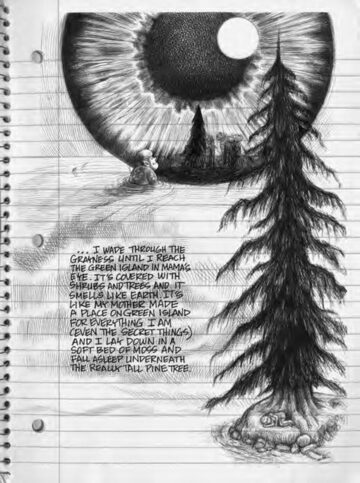
Karen flees her room and curls up next to her sleeping mom, whose eye acts as a portal: “In her left eye there is one patch of deep green . . . that I call Green Island.” Ferris’s drawings do their dazzling work of immersing the reader in Karen’s visual imagination: A sketch of Mama’s face with a tiny green spot in her eye is overlaid with a larger drawing of the eye, next to which a small version of Karen sits near the tear duct. The eye takes up most of the top of the next page, and we see Karen wading “through the grayness until I reach the green island in Mama’s eye.” In this moment, the Green Island equals safety, but later it will reflect the real world (the pine trees will lose their needles as Mama’s hair falls out from chemotherapy), and ultimately it will reveal the truth Karen has been hearing about her family’s past. Through the portal of Mama’s eye, she will actively imagine stories that help her understand what’s happening around her.
A while ago I attended a panel discussion in which Aleksandar Hemon said that “narrative is an underrated epistemology.” At first this seems merely a fancy way of saying that we learn through stories, which is true. Lisa Cron says that our brains are “wired for story”—that, as a matter of cognitive evolution, we tell stories to test possibilities before we have to experience them with real-life consequences. But
Courtesy of Fantagraphics Books
Hemon’s point takes this a step further by suggesting that stories are a methodology, a way of knowing. That through the active experience of creating and receiving storiescthrough reading and writing, drawing and looking, telling and listening to stories—we make discoveries.
Often we think of a story as an attractive vehicle for delivering a dull moral (e.g., Aesop’s fables), as a product to be rated on Amazon or Goodreads, or, in academic circles, as a specimen to be analyzed.
Ferris reminds us that stories—oral, written, illustrated—are dynamic, that they produce knowledge. Karen doodles and takes notes, telling us about her life at home with her dying mother and troubled but tender older brother Deeze, her experiences getting picked on (and worse) at school, and her visits to the Art Institute of Chicago. She even relates her neighbor Anka’s life story, from the brothels in Berlin to a concentration camp. Hearing stories, recording stories, reading stories (especially horror comics), and telling stories through words and image are Karen’s method of learning and knowing.
Significantly, in this graphic novel, paintings act as portals. Karen visits the Art Institute with Deeze, who gives Karen (and, thus, the reader) insightful interpretations of the works they see. Ferris reproduces both the paintings and visual portrayals of Karen’s experience of them. For example, in front of Eugène Isabey’s Shipwreck, Deeze and Karen are portrayed in shark-infested waters in the museum gallery, discussing whether the men depicted will get rescued. Or when they look closely at Georges Seurat’s A Sunday on La Grande Jatte, they are drawn in a series of dots as Karen realizes, “It’s all made out of . . . dots!”
All the paintings offer glimpses of other worlds, but only some act as portals. When they get to Saint George Killing the Dragon by Bernat Martorell, Deeze says, “Sometimes it’s like I’m in the painting. Do you know what I mean, Kare?” The next six pages are dedicated to a detailed copy, followed by enlarged details of key images. Karen understands that Deeze feels like he’s “in” the painting because he shares similarities with all three figures: the knight “is the part [ . . .] that is super protective” of Mama and Karen, the princess “is the part [ . . .] that likes to draw and paint and listen to music,” and the dragon is the part that gets into a “blind rage” sometimes. As Karen looks more closely, she thinks she hears a noise coming from inside the cave in the image. In the next panel she’s shown kneeling at the cave’s entrance as the characters come alive. Saint George says, “There’s . . . uh . . . nobody in the cave . . . ,” and the princess says, “Oh my dear! You must not go in there!” But Karen does. From inside, she can see an adult version of Deeze in the museum even as she sees eight-year-old Deeze in the cave, crying and saying, “I did something terrible!” When Karen enters the painting, she learns that there may be more to her brother’s past.
Later Karen returns to the museum for a clue. She has gathered more information about Anka’s death, but she feels like she’s missing something she can learn only from Jacob Jordaens’s The Temptation of the Magdalene. She “enters” and asks a hidden demon she’s noticed about the “something or someone standing in the darkness” behind Anka when she was killed. The demon says it was probably not a demon but a human, that demons “encourage humans to keep secrets from themselves.” Karen realizes the demon is referring to her inability to face the possibility that “Anka was murdered by Deeze . . . or even . . . or . . . even. . . .” The demon helps her finish: “Can’t even say . . . Mama . . . can you, honey?”
This may be foreshadowing, but if it’s a spoiler, I don’t know it. Monsters has always been planned as a two-volume series, so the book ends without the reader or Karen knowing who killed Anka or what Deeze’s secret is. The second book is due out in September 2020 (long after the press deadline for this issue).
My Favorite Thing Is Monsters makes clear that there is a deeply moral aspect to storytelling, and that stories are in competition with one another. Ferris inverts social hierarchies: her narrative celebrates the young, the poor, the female, the queer, the dark-skinned, and the vulnerable, and presents mainstream culture as “mean, ordinary, and boring.” She’s reflecting back to us important truths about the “real world” by showing it to us in a new way.
Similarly, those cute decorations I saw on my run made me imagine creatures living in that tree, the tree as a home. Only afterward did it occur to me that small creatures do in fact live in and on trees: insects, birds, squirrels. Someone turned a tree into art and made me resee its wonder.
Read more from Issue 16.2.
