In the Style of Miriam Ackerman
20 Minutes Read Time
I exit my rideshare and find the pamphlet from Aunt Mi’s funeral in my jacket pocket. That must be the last time I wore this suit, my only suit—three years ago. Funny: one last joke between us.
The Rowe Art Institute’s facade sports two dark banners announcing Miriam Ackerman’s (After)Prints: The Digital Second Life of an Outsider Photographer in stark white text, parallel to the fluted columns. The beaux-arts building is beautiful, lit up in the twilight, boasting the name of the robber baron whose home it used to be. So many bedrooms, now turned into galleries.
Arrived, I message <CarelessWishbone91>. Instantly I get three emojis back—all hands, which I’ve learned they prefer to words:
👏🙏👍
Maybe the emojis are less incriminating if we ever go to court.
Someone hands me a guide to Miriam’s exhibition. I tuck it, along with my warm phone, into my pocket. It kisses the pamphlet from her funeral.
As Miriam’s nephew and one of her only living relatives, I’ve been invited as a guest of honor. I was the one who found her negatives: after the funeral I stayed extra days to clean out the empty bungalow in Biloxi. Aunt Mi had lived there alone for years. I had moved out after college, and Mom was off to the nursing home. Aunt Mi should have just sold it and moved into a smaller house.
But instead she filled that house. I found negatives in the garage, the bookcases, the cabinets. She’d stored them in boxes, binders, grocery bags, and, in one case, a Dutch oven.
Waiters swarm like wasps. One catches me and offers, from a legitimate silver platter, small toast pieces. The toast is covered in a dollop of green, then cold cream, then a quivering scallop. I take one and throw it back like a shot. It is a curious mixture of crunchy and soft, salty and green. Aunt Mi would have scrunched her nose at it. But maybe she would have liked it, once she tried it, being a curious mixture herself.
Since her photos went viral, I’ve been asked over and over to describe her reclusive tendencies and eccentricities: for podcasts, for local news segments, for Garden & Gun, Aperture, and the Oxford American. They all expect me to act shocked that she had real talent. Did you know? Did you suspect?
Of course I did. I’m the little boy in the photos.
I was there when she lay on the cold linoleum floor of the Piggly Wiggly to snap a series of photos of me, age seven, from below as I considered a captive lobster. She’d wiggle one inch to the left, mussing her skirt, and snap rapid-fire again. She angled the camera by craning her neck. Other shoppers steered their carts around her and looked back over their shoulders from a politer distance. Still on the floor, still swiveling to get the frame right. All that to get one shot, one right image. I remember the clicking. I remember wishing she would hurry up. In the resulting photo, it looks like I am trapped in the tank with the spiny creature as my companion.
Aunt Mi lived in Biloxi for as long as I can remember. She had her own bedroom in our house, was my babysitter, but we didn’t call her that because she was my aunt. Unemployed was what my mother said. A leech, a mooch. Mi drove me around for hours, crossing the railroad tracks, taking back roads. Errands, she said, even if we just did circles: on I-10, then off again. She’d pull over if she saw something on the side of the road. I’d go on ahead and poke around and she’d take photos of me looking: at a road-killed deer, the haunch torn off; or at a tractor overcome by kudzu and jasmine.
I’m the boy in the photos, but no one seems to recognize me as I scoot into the gallery. Of course they don’t. I’m in my forties now and all these well-dressed professionals look like kids to me. I might be the oldest person here.
I stick to the edges. I pass clumps of people in short sequined dresses, dangly earrings, smart jackets. Somewhere in the crowd, no doubt receiving congratulatory handshakes, are the museum director and the exhibition curator. I wasn’t included on whatever Zoom call they used to set this all up.
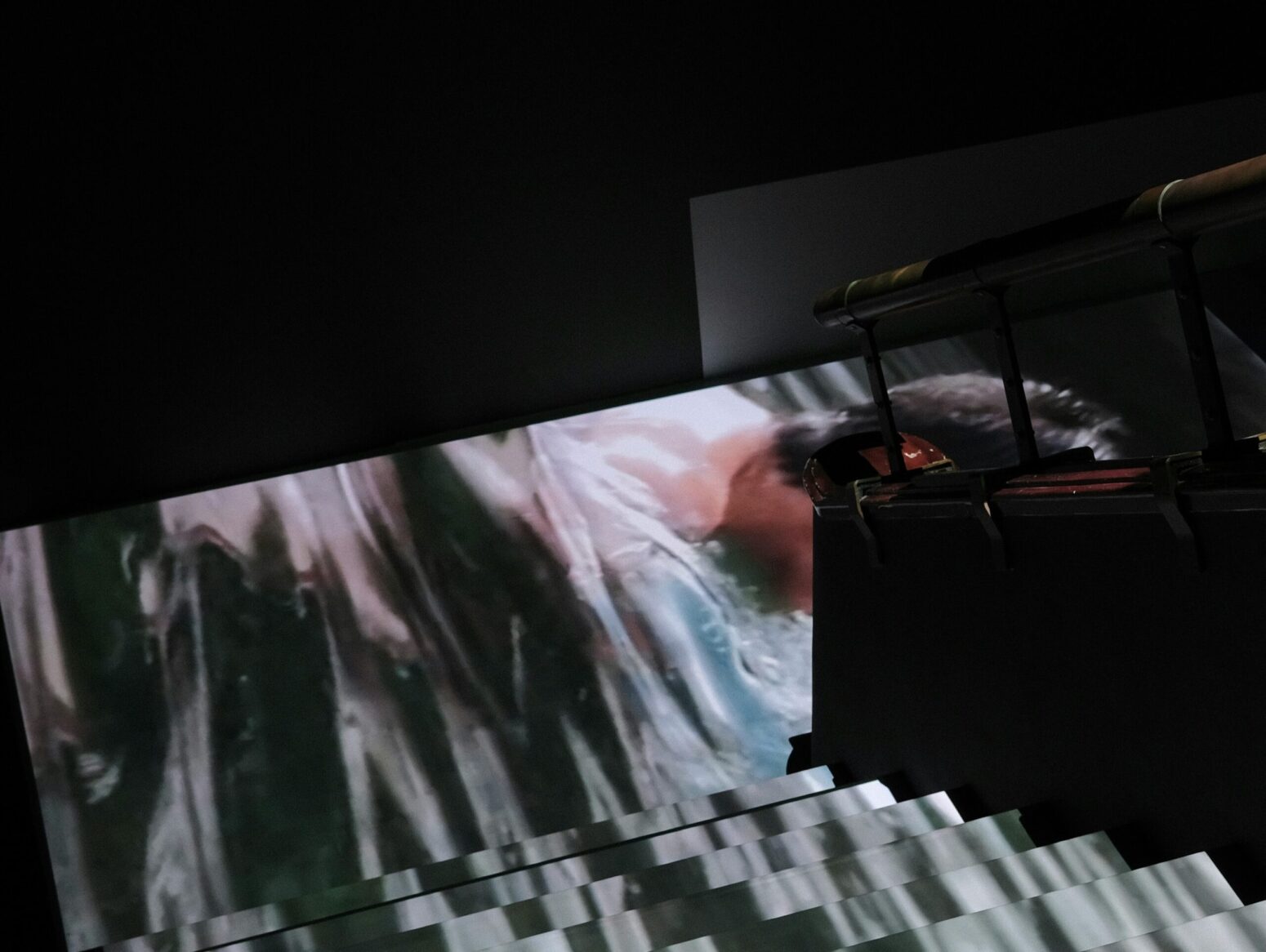
Cocktails, food, and conversation dominate the main hall, but to actually see Aunt Mi’s work you have to enter small dark rooms, sectioned off through mazelike entrances. Each photo takes up one whole room, surrounding the viewers. This “afterlife” part of the exhibit, I’m informed by the brochure, is achieved with two technologies: projection mapping throws the image across all four walls, the ceiling, and floor—immersing you in the world of the photo, like a silent observer, like a ghost. And since Aunt Mi’s photos existed only in a limited frame of two dimensions, a sophisticated AI extends the images, generates new, aligned material so seamlessly you can’t tell where the original photo ends and the remix begins. Almost as if, the introductory text proclaims, new life is being breathed into these images of 1980s small-town Southern life.
Most people are going through the exhibition in chronological order, watching the boy in the photos grow older. But the lines are shorter farther back in the hall, and I figure I know the end; there’s nothing to spoil. I am the end, I think. The thought amuses me. The hallway is a timeline of my childhood in Biloxi. I wonder if these people would be disappointed if they knew. I decide to begin in the last room.
A couple nearly bumps into me, exiting as I enter, holding each other by the elbows. “Provocative,” one says. “Mmm hmmm,” says the other, “the consideration of form is reminiscent of—”
For a moment the hidden projectors catch my eye with a blinding glance of light, prismatic and direct, like stepping into a beam of sunshine in a dark garage. I hear them humming. Somehow this room, even its corners, overflows with warmth and color. Obviously it is not real. But it is easy to put on this reality.
What I see first is me. Not as I am but as I was. Skinny is the first thing I notice. Fragile. I could pick up that boy and throw him. In the picture, the boy-me is floating face up, surrounded by dark water: the pool at our complex, at night. The lamps in the background are blurred to halos. The water, though, is focused and sharp, looks almost cutting. You can see goosebumps on the boy’s skin. The boy is frowning, and his thin arms are thrown out to keep him afloat. Almost christlike, which is a weird thing to think about myself. He, I, must have been about fourteen. Though I can still hear the cocktail party and enthusiastic chatter around me, I have entered a different world for a moment. My brain accepts the illusion, sinks into it.
I remember being embarrassed when she took this one. My body, on display, a subject, even if she didn’t plan to do anything with the pictures. I was exhausted by the floating, and cold. I’d rather have been with my friends. But instead I treaded water, tried out different poses, waited for her to release me, to have captured whatever it was she was looking for.
The boy in front of me is searching the dark sky. Because the sky was outside the frame of the original photo, the algorithm has stitched together a plausible sky, based on the play of light in the original photograph. Thin, high clouds, a brilliant half-moon. Look, they put a plane up there. I suppose it is statistically likely there was a plane above me that night. Its wings artfully reflect the spread of the teenaged boy against the dark water. I try to remember if there really was a plane there but I cannot. Can you remember the sky from a day thirty years ago? This sky, this childhood isn’t mine. Whose is it, now? How dare they add a sky, a plane, these clouds to Aunt Mi’s photograph? To my memory?
I am angry. I am fascinated. I look to the face of the floating boy and recognize the same expression in his face: anger at his circumstances, his body, the cold water, his aunt, but something in the sky has caught his eye and despite himself, despite his best efforts to be brooding, he is caught looking, caught in wonder, by what he sees in the sky. He’s hungry, but hopeful. Maybe life won’t always be this way, this mundane, this closed-in. He can see beyond it. You’re made to root for him.
I turn to look where Aunt Mi should be, the photographer’s vantage point at the edge of the pool. She should be there, crouching against the wet pavement to get low and create the expansiveness of the sky. But the AI has stitched in a waterslide instead, one that was never there before. She’s been skipped over, erased. Of course, she was so implausible, so one of a kind, so herself. That’s what made her so intoxicating, and so frustrating: her unpredictability, her unwillingness to budge or compromise or explain herself. A waterslide is in every way a more plausible part of the picture than Aunt Mi.
She was a heavy woman in many ways, not obese but inelegant, cloddish, always wearing a men’s blazer, or maybe it was a little boy’s, so tight on her shoulders it could never close, over a black turtleneck and stockings, so she was always flushed. Now that she’s famous, people are labeling her as lesbian, butch: easy terms to write away the things that stalked her all her life. A kook my mother called her. I’m sure some scholar is now writing a thesis on this very topic. “The Sexuality of Miriam Ackerman.” Poring over her photos and her letters like they’re clues.
I flinch; this is all my doing. I put her photos online. Most of them were of me, or I was in them, even if it was a picture of something else. I picked a few negatives and brought them to Walgreens. I posted my favorites to my socials. When people from Finland and Hong Kong started commenting, I knew something bigger than me had been let loose. Someone chimed in from Brazil, in Portuguese. I instantly translated it: The look in that boy’s eyes. Haunting. That boy was me.
I sold the rights to the photos after they went viral. The lawyers I found said there could be serious money. The kind of money that would let me pay off the house, Angie’s degree—the kind of money that I never had growing up, the kind of money that would let me travel to somewhere unreasonable. The northern lights, I thought. I’d like to see the northern lights.
I worried someone would use them in commercials. But the lawyers laughed that off. Imagine someone trying to sell deodorant or a Mercedes with an image of me screaming at a seagull flying off with a pitiful Mylar balloon of a circus elephant. I put the photos up for auction. We’d make more that way, the lawyers said. A feeding frenzy; make the most of the momentum, of the moment. Surely she’d want them to be seen, the appraiser said. So many negatives. Or else why take them?
But I’d known even before then her work was good.
Her makeshift darkroom was the bathroom between our two bedrooms, hers and mine, that we were meant to share. It was stocked with trays and chemicals she’d pilfered from the local community college. We developed a secret knock. Wait for the return knock, then you know it’s safe to come in. I’d turn off the lights in my own room before entering; I’d pee surrounded by that vinegar smell and spools of film bathing, so often it seemed normal. So many negatives, hanging like vine tendrils off the shower rail, obscuring the mirror. She developed all the negatives, cut her favorites out with scissors, but never made prints, never tried to sell them, never submitted them to anything or anyone for approval.
A polite chime sounds: it is time to move on to the next room. The lines to enter the photo-rooms are lengthening. A man pauses to crouch for a selfie with the floating teenager in the photo, making like he is splashing him. Someone else guffaws drunkenly. I say goodbye to myself.
I enter more pictures and encounter myself at ages twelve, eleven, nine.
There’s one of me at my bar mitzvah, frowning in concentration at the Torah. The boy looks nervously out at the audience. The room he is looking out into is far bigger than our actual synagogue—Beth El in Biloxi had just a series of chairs in a room like a rec center, but this is some grand, pewed synagogue with a high roof. “A bar mitzvah in the style of Miriam Ackerman,” but not my own, not the one I actually lived through. The crowd is full of unfamiliar faces, not my family or friends or neighbors. Plausible, believable, but utter strangers. Maybe they aren’t real people at all but composites.
The thing that made Aunt Mi’s work special—made people from Lagos and Amsterdam and Madison, Wisconsin, interested—was that she was unpredictable: in her frames, in her angles, in what she centered. Here nothing is centered. The AI is trying to learn her style, to reduce her to something that is predictable. Predict, and steal. Stab, and twist.
I stand there trying to remember what she was really like. I remember she sped through yellow lights, like all of us I guess, only she made a big deal of it, leaning forward and reaching for my hand like she was taking a great risk, like maybe we’d die right then and she wanted to be holding my hand.
I feel a buzz. <CarelessWishbone91>: 👌
Not yet, I send back. I want to see a little more.
I know this photo. It’s a controversial one. Aunt Mi was always photographing me at my most vulnerable. The cold pool, an injury, a tantrum. I’d stubbed my toe against a curb—snap snap snap. Hot nights in the Biloxi house when the AC had broken down and we’d all lounge around, them in slips and me in briefs—snap snap. I crashed my bike into a parked van while learning to ride, and before tending to my scrapes, Mi photographed me looking down at the crack in my new helmet with wet eyes.
This one is from after Hurricane Elena in ’85. The dumpster had sat at the end of our block for weeks, as people carried soggy trash to it. Aunt Mimi photographed me playing in the bottom of that dumpster, sunlight pooling in from high above.
The boy, who is at our eye level, seems surrounded, wistful. He sifts through the sharp wreckage of the storm: broken windows and their frames, bent-sharp blinds, a blue tarp, shingles. The curators and their AI have extended the walls of the dumpster to wrap around all four walls of the room, generating likely trash to surround the viewers and the boy: there, a fridge on its side, and a sled? In Biloxi.
The boy looks so alone. You want to hug him, you want to protect him, or at least I do.
I skip ahead to the first room, the youngest iteration of me. As my eyes adjust to the dark I see a high chair in our tight Biloxi kitchen. SpaghettiOs are dribbling down my chin while I turn around to try to watch a TV show behind me. A curl of smoke from my mother’s cigarette drifts up toward the single overhead kitchen-table light. The smoke makes an eerie approximation of my toddler shape, my gesture, so it looks like there are two of us there, keeping each other company. I start to pivot, to see the rest of the image that has been stitched together. They got the sink right: it’s full of dishes. The curtains are drawn, yes, but they are the wrong pattern, some other 1970s fabric.
In the original photo my mother is cut off; just her wrist appears holding the lit cigarette. That framing, excluding her, seemed to me to be commentary on Mi’s part. No one else can be in on her little joke, because the jokes are gone, scrubbed away.
But in this version my mother is reinvented. The face the algorithm has given her is not her face; it’s a magazine-mother face, an amalgamation sourced from advertisements. My real mother is in assisted living in Bay Saint Louis, and this one does not look anything like her. Here her hair looks like it is collaged-in from a shampoo commercial, bouncy and shiny. Her face is full of attentiveness and enthusiasm I don’t recognize.
There are no answers in that false face. I’m done looking for them.
I reach into my pocket and message all yours to <CarelessWishbone91>, who, unlike everyone else at this exhibit, is not a stranger, though I’ve never seen their face. Back in July, when I’d asked the message boards what could be done to take the photos back, to throw a wrench in the exhibit, <CarelessWish-bone91> had appeared as a ✋ and sent me a link to a more secure channel.
Now they message: 👊🤞
I take that to mean they have set it loose.
The first sign of change I notice is in the voices of the gallery-goers. Surprise and amusement: “Hey, look!” Throughout the tucked-away rooms, the boys in the photographs are changing. The audience sees familiar faces, perhaps their own, cast into the photos.
“That’s so cool,” someone says.
“Did you know this would happen?”
“How is it doing that?”
A nervous giggle.
<CarelessWishbone91> and I have unleashed a new algorithm. It mines the pockets and purses of the audience—no longer just audience, now subject. It is sifting through their files, their photos, and the images—already collages—start to morph and twist further.
I’m still standing in the kitchen, which now shudders with rapid changes. The twist of smoke becomes a ribbon becomes a flame becomes a curled lock of hair. The gesture of the mother’s hand changes, from holding a cigarette to an open palm to a manicured claw to a fist. Then a caress. So many pictures of hands in this room for the algorithm to process and weave. Each iteration flashes only for a moment before it becomes fodder for the next run-through. I don’t know where it will end. Will it all blur together into mud? Will the algorithm ever be satisfied?
I don’t linger long. I step out of the dark, cluttered kitchen of my not-mother.
I want to see this unfold. I want to watch them catch on. I hurry back through the rooms.
The waters of the dark pool are merging with images of oceans and ponds and rivers. The floating boy goes from christlike to actual crucifix. The crinkled crests of the water become wrinkled sheets. The bare chest of the central figure is replaced by nudes pulled from the audience’s phones, morphing and merging, cobbled together but still recognizable.
“What the fuck?” someone hisses, close by.
In the bar mitzvah photo, the Hebrew on the Torah becomes receipts, contracts, screenshots of text messages, any words the algorithm can find, grasping for semblance without meaning. The crowd in the synagogue is dancing with the faces of the gallery-goers and their loved ones, their pets even: I notice a Pomeranian in a suit. Any place the original photo showed exposed skin, it is beginning to be speckled by ingrown hairs, nipples, bruises, odd growths, and bugbites—all the embarrassing bodily phenomena we document daily.
The pictures are moving, they are moving because they are changing, linking like to like and jumping, lily pad to lily pad between related forms, becoming new at every raw edge.
Someone yells. The audience doesn’t like seeing what was theirs and theirs alone being on display, or worse, being twisted and combined with other lives: a familiar head grafted onto an unfamiliar body.
As I walk through the gallery, people are moving quickly, no longer at cocktail pace, dashing from room to room to figure out what is happening, to find someone to complain to, to demand they fix it. The exhibit is going to shit around me. Let off the leash, the AI is biting the hands of its supposed masters; the AI is just hunger, undiscriminating. I take another canapé from the platter of a confused waiter. I duck into the next room: back into the dumpster.
The high walls flicker: into a cathedral, into a slick cave, into a cenote, the light like we are at the bottom of a great barrel. A well. The boy is shifting: into other children, older, younger, faces covered in banana mush, eyes wide, mouth smiling, hands reaching. Maybe our new algorithm has set the boy free. The curators have the rights to the pictures. But I held on to the originals, thousands of them.
I turn and stroll toward the spot where I remember Aunt Mi standing with her camera. From here I could reach out and hug the boy.
I remember that Miriam grabbed my hand and we climbed out of the dumpster together. We went out after for cheeseburgers, the chargrilled ones at the stand that was my favorite, and she dipped her french fries in a mint milkshake, and I told her she was crazy. She dangled a green-tipped fry in my face, and we laughed.
The boy wasn’t alone at all. He was with the person who saw him the most, who relished the wildness in him, who gave him a few moments to breathe, to wonder at the dark and the light, before helping him out of the hole.
I look to the spot where the Aunt Mi should be, remembering the flicker of her grin as she lowered her camera, the gesture that meant she thought she’d gotten it. Captured it, the something wild. The algorithm runs through a thousand sensible guesses for what to put in that spot next to me, the one she stood in. None of them are right.
Read more from Issue 21.2.