Good to Be Busy
19 Minutes Read Time
Listen to Myle Yan Tay read “Good to Be Busy”:
We do not bury our dead in Singapore. We store them—in urns, in stacks, stacks too high to reach. We drop them in the ocean, little vessels sinking to the seafloor.
My grandfather on my father’s side, who I call Kong Kong, is in a stack in the Choa Chu Kang Columbarium on the west side of Singapore. When he first moved in, the cubbyhole felt too large for his single urn. But the family had paid more, to reserve a space for his wife, my grandmother, who I call Ma Ma. The family niche costs 900 Singapore dollars or 656 USD. It can be booked and paid for online, for your convenience. The niche is covered by a pane of ceramic, adorned with a single black-and-white portrait of Kong Kong. He faces a laminated sign on the opposite wall that lists the different tiers of niches and their respective prices. There is an asterisk; all prices are subject to change without notice.
My maternal grandmother, Ammama, rests in a ceramic urn at the bottom of the ocean, a few miles off Singapore’s coast. It cost 480 Singapore dollars or 355 USD, less than the columbarium because she is not occupying any space, Singapore’s top commodity.
Both my grandparents could have been buried if we had insisted. But like all land in Singapore, it would be a rental. Kong Kong and Ammama would not keep the hole. They would lose it in fifteen years when the lease ran out.
It is the same as Singapore’s public housing, all doled out through loans from the Housing & Development Board. Getting an apartment from HDB is the only affordable way to have your own space in Singapore. But you have to prove you are married or about to be married so you can get the government subsidy on what is otherwise a seven-figure investment. The HDB high-rises are about thirty to fifty stories of dull concrete; the higher the level, the higher the cost. The country is so cramped and stuffed to the gills that we build up and down, because there is no more space to build across. If you are not getting married, for non-heterosexual reasons or otherwise, you cannot apply for a subsidy until you are thirty-five.
Still, you would not own the home. You would only rent it for ninety-nine years. You’d collect your keys—which for many Singaporean couples is a more momentous occasion than their wedding date—and ninety-nine years later, the keys would go back to the government. Sometimes it happens even sooner. Sometimes, if all the tenants of the building agree, the building can be sold en bloc at an increased value, each tenant getting a hefty settlement, the government paying everyone out, before they tear down, build anew, restart the process all over again.
The urns at the columbarium consider colluding. They are on valuable land. They could get a great resale price. But they decide not to. This is the first place in Singapore they have ever actually owned. The urns look to the souls in Choa Chu Kang Cemetery. Eighty thousand bodies exhumed to make room for an expanding air base. They look to the fools in Bukit Brown Cemetery, forty-five thousand moved for an eight-lane highway. No, the columbarium is the right place for them. A good investment. The land will only appreciate in time.
Kong Kong and Ma Ma lived in an HDB in Bishan, about a forty-minute drive from my family’s home, a very long trip for Singapore: Our diamond-shaped country is only thirty-one miles across east to west, seventeen miles north to south. Every Saturday, we would go to Bishan to visit Kong Kong and Ma Ma. They had six children, my dad being the youngest son. Four girls, two boys. They had a third boy, but Ma Ma gave him away to another family who had yet to have a son. We call him Di Pek. It is a marvel to me that his place in the family is so common that there is a specific term in Hokkien for my relationship with him. Or maybe it just means young uncle. I do not speak Hokkien, nor did I know Kong Kong’s real name when he passed.
Kong Kong bought me a set of plastic teeth for Christmas when I was a child. I would turn the set around in my hands, examine the shape of each tooth, the grooves in the gums. Within a few weeks, I had already lost some of the little molded teeth, each removable from the synthetic jaw. I locked the set back into its translucent yellow box to prevent any further losses, to keep my grandfather’s gift safe.
Kong Kong used to be the dentist of his village, or his kampung as it was called. The word is an oft-referenced ideal, the collective spirit of days of yore, the kampung spirit, an essence lost in Singapore’s rapid modernization. The kampung spirit is most often touted by the government, to urge Singaporeans to be kinder to one another, more forgiving of tardy trains, more communal and gregarious. They say that in the kampungs, everyone used to speak a little bit of every language; they knew their neighbors, their neighbors’ parents, they would watch one another’s kids, every door was left unlocked. Now, people send in complaints to HDB when their neighbor’s kitchen is too smelly. Recall the kampung spirit, implore the ministers, but leave behind its poor sanitation, unemployment, and rampant poverty.
My father talks about the kampung sometimes. He tells me how he would go to the creek and catch frogs. But our drains are concrete now, funneling our sewage efficiently from home to ocean. My father’s marsh, my grandfather’s kampung, they are long gone, supplanted by glass towers for a thriving econ- omy and by beige buildings for a growing, exacting people.
During dinner at their house, Kong Kong would cut Ma Ma’s curry chicken with a pair of industrial scissors. They clacked with each snip, bone and cartilage snapping under their mighty pressure, the curry splashing slightly out of the white porcelain bowl. When I was done eating, I would take my place at the wooden stool in the corner of the living room and read novels about American teenage boys destined for grand adventure. Shortly after dinner, Kong Kong would retire early to his bedroom. He usually left the door wide open, sounds of his period dramas about Imperial China wafting into the living room. Sometimes I got the good chair, the one with the backing, where I could peek at his massive screen. At the end of the evening, my sister and I would go say goodbye to Kong Kong, his drooping cheeks lifting for a second as he smiled, his lips tight, his teeth concealed as he waved.
A few days before he passed away, Kong Kong gestured to my oldest aunt, holding up one thumb on one hand and five fingers on the other. Six, for six children. It is a good thing he and Ma Ma did not have eleven.
The six siblings and countless grandchildren streamed into Kong Kong’s room and stood beside his bed. At the foot of the room was his giant television. I had never seen it switched off before.
Kong Kong was too weak to speak. No final words for the family.
Two days later my mother texted me and my sister in our smaller group chat, not wanting to disturb my father.
Do you both want full names for Kong2’s obituary?
Has he died? my sister asked.
There was no reply from my mother. My sister texted again: I am confused.
Kong Kong was still with us. But my mother knew the impending bureaucracy of morbidity and mortality, of the mortuary. There were forms to be filled out, many irksome decisions to be made, payments to be made before Kong Kong could rest.
The next day, he passed away in silence. He weighed eighty-four pounds.
He rests in the columbarium on a shelf so high Ma Ma needs a ladder to see him. When her time comes, she can join him in their new forever home.
Ammama, my mother’s mother, Ponmalar Mylvaganam, lived alone for almost two decades. My grandfather had passed away from a sudden heart attack when I was seven. Ammama prided herself on being an independent woman: She insisted on driving, on doing her own groceries, on taking the bus after she was no longer allowed to drive, on spending hours in shopping centers during a pandemic, on not drinking enough water, on renewing her passport despite closed borders, on eating leftovers, eating the leftover’s leftovers, becoming ill from the leftover’s leftovers, playing solitaire till her fingers hurt, living her life her way. After seeing a world war, Singapore’s independence, our nation’s meteoric economic rise, our country locked down by a pandemic, she passed away from pneumonia. The nation no longer looked like the one she was born into.
My mother hired a video crew for Ammama’s funeral at our relatives’ behest, so they could stream the procession without having to attend. Some were too old to travel, some were too far to fly. The crew wore black T-shirts and black pants to blend in. But the back of their shirts had the company’s name emblazoned in white. They stood in front of my sister for half the service. She joked, “At least I know who to call.”
Later, we proceeded to the crematorium where the coffin awaited, resting on the slats of a custom-made forklift, designed to only go forward and backward across slim tracks, smoothly moving its single passenger. Five years prior I’d seen Kong Kong’s coffin in the same position, ready to be ushered onward. Back then in 2017, the viewing area was filled with Kong Kong’s children, grandchildren, maids, nieces, nephews, cousins, every relation. For Ammama’s funeral, only a select few could enter. Squares were demarcated on the floor with white tape to indicate the minimum distance for safety, new regulations because of the pandemic.
The forklift followed its tracks, cradling Kong Kong’s body. A door opened at the far end of the room, and Kong Kong sailed away. The door closed almost pensively. The observation gallery was quiet, except for a few sniffles. A chirping tune cut through: a phone’s ring. Everybody went still, then immediately checked their pockets. Some relatives clicked their tongues, disgruntled by my aunt who had forgotten to silence her phone. My father said, “It’s Kong Kong calling.” Some light laughter.
My uncle chimed in, “He’s saying he reached already,” which is Singlish for “Kong Kong has arrived at his destination.” Proper laughter then, with cheeks still damp. The joke was repeated multiple times over the rest of the day, each time with different words, attributed to different people.
Ammama went silently at her cremation. The door closed swiftly behind her. No phone rang. The crew were not allowed to record. The Zoom ended.
The funeral director for Ammama, a chipper man named Jeffrey, told us that in a few days we could arrange for her sea burial. Jeffrey, after years of practice, had mastered the art of balancing efficiency and solemnity. He had short teeth and wore a persistently pressed white shirt. He apologized to my mother for the priest saying the wrong name during the service.
“That won’t happen again, ma’am. So sorry.”
My dad and I sat opposite each other on the boat as it surged away from the jetty. There were nine of us onboard, including my mum’s two sisters; Jeffrey, the boat captain; and Ammama, recently turned to ash. Her urn was almost the size of my torso. I could not tell if it was heavy because of the urn itself or because Ammama had been unexpectedly dense. Jeffrey handed it to me before we boarded, instructing me to take it with two hands. I was the only one in my family who could carry its weight. I clutched onto it, tight.
Jeffrey asked my father how his work was going, reminding him they had actually met before at a prior funeral. My dad could not remember which one.
“It’s been okay. A bit busy.”
The funeral director nodded, his body bouncing with the rhythm of the waves. “Ya. Me too. But it’s good to be busy. Good to be busy.”
Each time the boat stopped, my mother asked Jeffrey if we could go farther. She did not like that we could still see the figures of people relaxing on the beach. Hardly the peace she wanted for her mother. After two more bounds, Jeffrey said that it was as far as we could go. The Mylvaganam sisters were still not satisfied, but it would have to do. We hoped Ammama would be undisturbed in the depths, far enough from the frolicking beachgoers. Jeffrey beckoned me to stand and join him at the back of the boat. I waited for him to remove the lid of the urn so we could scatter Ammama’s ashes into the ocean. Instead, he told me to squat, which I tried to do as gracefully as I could while cradling the ungainly weight. He fastened one end of a red ribbon to my hand, and with the other constructed a harness for the urn. His eyes were downcast, somber. He lowered his chin.
“You can put her in now.”
I looked at my family, confused. My mother and her two sisters were crying, my sister stared at me perturbed, and my father shrugged. I put Ammama in the water. Maybe it was easier to spread the ashes if the urn was already inside. Less chance of a blowback, of us catching traces of Ammama in our open mouths.
“Now lower her.”
I looked at Jeffrey. And he nodded, pursed lips, as if I was looking to him for comfort and not out of confusion. He said to me with his eyes, “Let her go.” I was trying to say back to him, “Are you sure you have this right?”
He nodded again, turned away from me, and began the service, reciting the prayer for Ammama. I decided to trust the busy funeral director and began unlooping the ribbon from my hand. I had no idea how long the prayer would be. I wanted to make sure I hit the right cues, that I did not prematurely let Ammama plummet. It would be awkward if Jeffrey had some final words for Ammama, only to find her fifty feet underwater. So I unfurled the ribbon slowly and with great concentration.
Jeffrey spoke of the Mother Mary and how we all will go back to where we began. Some were crying, others were holding back tears. Sniffles and tissues. A phone rang. Specifically, the clamor of marimbas, one of the iPhone’s default ringtones.
From my squatting position at the boat’s stern, still clutching onto Ammama, I turned toward the source of the noise. I saw the boat’s driver, an older Chinese man in shorts and an undershirt, leaning on his controls, realized it was a call for him. I watched my mum’s face morph from sorrow to horror as the driver slowly lifted his phone, my aunt’s faces go from mourning to rage as he gently slid his finger across, and my sister start to laugh as he answered the phone with the percussive volume of cannon fire, barking in Hokkien to the person at the other end of the line. Jeffrey continued with his service but flitted his arms at the ship’s captain, hoping he would notice and hang up the phone. To everyone’s dismay, and to my amazement, this captain had the peculiar habit of speaking on the phone with his eyes closed. Jeffrey soldiered on, simultaneously trying to signal to the captain while reciting the blessings of the Holy Trinity. My mother waved frantically with one hand, the other catching her tears. The captain continued on his call, facing all of us with his ever-present big grin, his eyes sealed shut, releasing bursts of Hokkien, while I clung to the ribbon, trying to resist the waves grasping at Ammama’s urn. The water was impatient.
Then he hung up his phone, not once noticing the frenzy of the family before him. My aunts muttered while Jeffrey tried to continue with his miniature sermon.
I sensed that Jeffrey’s words were coming to a close as he talked of the bounties of Heaven, the eternal reward of joining our Lord. I unfurled the ribbon faster. I could already see the crease in my skin where the ribbon had been pulling into my palm.
Jeffrey started to sing “Amazing Grace,” the same song they had played from the hearse as Ammama’s coffin arrived at the funeral. There, it had left everyone in tears.
He motioned for the grieving to join in. We sang together, a makeshift choir, while the boat rocked. “Amazing Grace, how sweet the sound that saved a wretch like—”
Marimbas again.
Without waiting a beat, my mum snapped.
“OI!”
The driver opened his eyes and, for the first time, saw the famous Mylvaganam death glares trained on him. He put his phone away, still without losing his perpetual grin.
Jeffrey continued singing after this brief interruption. I let Ammama sink into the water, drifting deeper and deeper until there was no more ribbon to hold.
On the drive home, my sister laughed until she cried when my dad mimicked the captain’s face with his wide grin and shut eyes. My mother was not amused initially but eventually gave in when my aunts started laughing too. Ammama would not have found it funny. You do not interrupt “Amazing Grace.” That is blasphemy piled upon blasphemy.
Kong Kong now shares the niche with Ma Ma. She went quietly, six years after him. She was my last grandparent, and her last rites were uneventful. When I was choosing what to wear to her funeral, I caught myself wondering whether Ma Ma would say that I had lost or gained weight. The habits of memory trumped mortality.
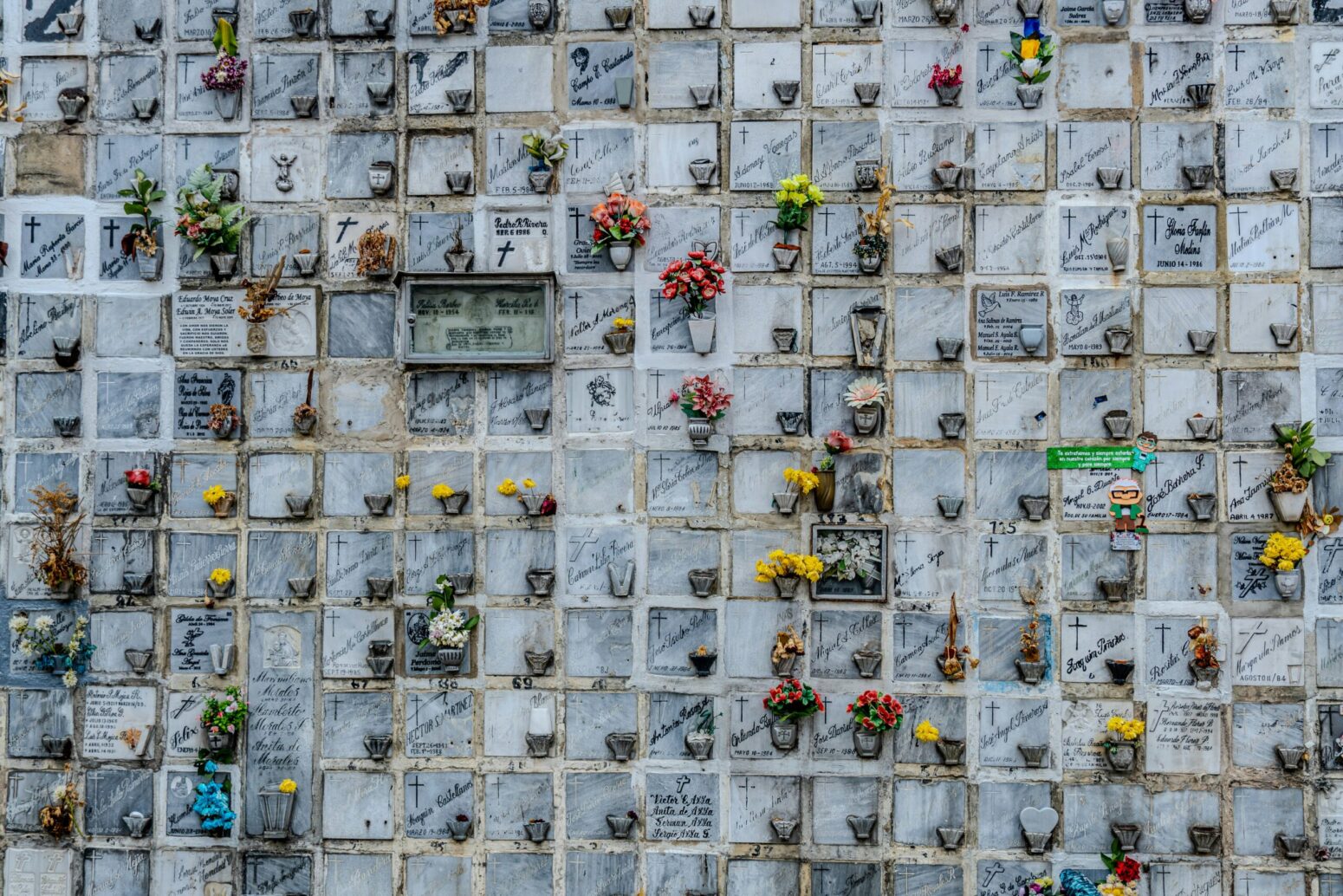
We went to Choa Chu Kang Columbarium, driving an hour from our home. The attendant, a stout man with cropped hair, unsealed Kong Kong’s niche with grace and care, using suction cups to remove the ceramic facade. He placed Ma Ma inside, tucking her in snugly beside Kong Kong’s urn, and then resealed the niche. We had not decided on the portraits yet, so they placed a sheet of A4 paper on the cream-colored stone. Printed on it were my grandparents’ names. Tay Kong Eng: Kong Kong. Young Chang Bee: Ma Ma.
The man’s work was done quickly but the family lingered. I wandered off. The surrounding niches were adorned with artificial flowers, wooden angels, plastic magnets of pizza and dumplings. Symmetrical black-and-white portraits smiled at me. The numbers below the names spun stories: men who had lived through World War II, women who had seven children, teenagers who did not get to see their eighteenth birthdays. Many rows were full. They were stored as they lived—stacked atop one another, near enough to their neighbors to hear them but not close enough to speak.
My family called out to me, not sure where I was hidden between the shelves. When I came out from the labyrinth, at an egress far away from Ma Ma and Kong Kong, my sister asked me what I was doing.
“Looking around,” I said.
House-hunting, I thought.
Interment is, and will continue to be, an oversaturated market in Singapore. Like many expensive nations, we are an aging society. By 2030, 25 percent of Singaporeans will be over sixty-five years old, including my parents. And as a community, we must face the fact that eventually, our columbaria will run out of space.
So we should innovate, try new solutions. Without fireplaces, we may not have the mantels. But we could adjoin a shelf to every air-conditioning unit. Or we could tie a harness to every ceiling fan. We can try to keep them in our homes, close to us. Close as we can, even though they are already gone.
Or we can adopt the ideas of others. We could practice sky burials like the Tibetans, where bodies are carried to heaven in the bellies of vultures, ready for reincarnation. But the Singapore house crow is too petty and picky. We could, like the Jamaicans, heave soil and dirt in the family yard and have our loved ones rest beneath where they lived. But there are scant few backyards here; only the wealthy have the acreage to spare. Or we could look nearer, to our Tagalog neighbors in the Philippines. In some rural areas of Cavite, when an elderly person senses death’s hand on their shoulder, they wander into the forest and pick a tree. Their community hollows the tree out. And when that person’s soul leaves, the community moves the body into this vertical casket. They return to earth. They return to life.
A forest of your people, resting upright. A forest where they grow upward, on their own terms. A forest to visit, when you want to spend time with people you never got to know while they were here.
I have not visited the columbarium since Ma Ma moved in. I have gone swimming on our coast several times since. I have yet to see any urns on the seafloor. But that’s all right. At some point, I’ll likely join Ammama. One day, I’ll bob down, my urn buffeted by the sea’s drifting eddies, my powdered remains capped in ceramic, hitched to a red ribbon, lowered into the ocean blue. By then, Ammama will likely be the base of a grand aquatic pyramid of Singaporean souls. It might be a little cramped. But I don’t think Ammama will mind. It is the kampung spirit.
Read more from Issue 22.2.