Follow the Signs
16 Minutes Read Time
Listen to Alice McCormick read “Follow the Signs”:
Eons ago, when I was young, my family and I went yard sale-ing. That was what we called it. We started about Memorial Day and finished about Labor Day. On clear, sunny Saturday mornings when the hot dew boiled off the fresh lawns, all four of us piled into the station wagon with our large white husky named Goat. He shed all day and blew humid, rotten air in our faces. His teeth were yellow-brown, and his drool was like glue. Mixed with the circulating fur, it formed a fetid plaster around our little tan legs. We loved him anyway.
My father, clean-shaven, wearing a Hanes T-shirt and dungarees, drove. My younger sister and I rode in the back. She’d spot a yard-sale sign, crank her window down, and stick her head out, then most of her torso. In ’84 my sister was five, and her favorite color was purple; that October, she would be a unicorn for Halloween. Each time Shirley leaned out, my mother, in the passenger seat, would say something like, “Shirley, I swear! One of these days you’re going to get hung up on a mailbox!” I always wondered what it would be like if she did get hung up on a mailbox. Years later there’d be a plane incident where an engine part hit a window behind the wing. The glass shattered, and a window-seat passenger was sucked out. Just sucked right out—fwoop— into the atmosphere. I imagined Shirley and the mailbox would work some- thing like that.
We each got five dollars to buy anything that would fit in the station wagon. Once, I got an organ. It was only an electric one, but with all the knobs and levers to create anything from an angelic chorus to the floor-vibrating brim- stone vibes of a real Old Testament organ. I learned how to play “Für Elise” and “Phantom of the Opera” and then repeated them over and over in different octaves until my mother cried, “Jesus, God—enough!” from the kitchen. I bet the organ is still in the corner of the living room. We sold it with my parents’ house; that bugger was heavy.
Most of the sales were duds. We’d perfected the slow-down-and-stare, the driveway assessment, the polite nod as we beat a quick retreat without opening our doors. If we weren’t sure, we’d send Shirley out to look. It kept her from getting antsy. But she wasn’t the best surveyor and was easily distracted by useless items like pocketbooks and Raggedy Ann dolls. Not that I had any specific idea of what I was after. Just not what Shirley picked out.
We’d follow sale signs off the main road and end up in towns we didn’t even know existed. We’d pack a lunch or stop at whatever roadside stands smelled the best, and eat soft-serve ice cream and onion rings. Goat would stop panting for a moment and inhale, his lower jaw half-open, knobby gums pooling saliva. Shirley inevitably spilled something sticky on the seat belt. That was why she had to stay on the right side.
Once, from Eden, we made it all the way to the ocean. That day, the onion rings turned into fried clams, and then into lobsters. You could plop me down anywhere in the middle of New England, and I could tell you where I was by the roadside shacks alone. To give you an idea of where we lived, right down the road from our house was a place called Joseph’s Spaghetti Shed.
My father didn’t say much and didn’t buy much of anything I can remember. He liked to squint into the sun and curl his brown arm out the driver’s window. He’d turn up the radio, and we’d all dance in our seats to Bruce Springsteen or Dire Straits. My sister and I would unbuckle our seat belts to really spring and jive, but once we started ricocheting into the front seat, my mother would turn back and shout, “Mary Elizabeth! Shirley! Get those seat belts on lickety-split.” We obeyed, but only because we were good kids. My mother’s tone lacked an underline. She was giddy. She didn’t really care right then if we put our seat belts on or not.
A faint, replete smile splayed the corners of my father’s mouth and followed a crease up his tan cheek until it lit his eyes. He was in his thirties then. I can imagine how much he must have wanted to break loose. He worked at the mill, the mill that was always threatening to close, that laid off more workers every year. They made golf tees and tongue depressors. My father kept his job because he’d been working there since he was sixteen.
In his thirties, he’d probably reached that edge where he’d done all he’d set out to do. He’d climbed all the hills and seen their views. He looked around and wondered—is this all there is? He must have wanted something beyond the hay-scented evenings and the white lace drapery on the bedroom windows. Something more than the hibachi in the backyard, the House of Pizza on Main Street, and the same people he’d known all his life. He was born in Eden. He lived and died there too.
My mother grew up in the low Cape Cod with teal asbestos siding where the road curves after the old stone library and the Mobil station. There’s a bed of black-eyed Susans out front and a big picture window looking out onto the street. She and my dad went to junior prom together and got married in a snowmobile hangar the March before they graduated, once they were both eighteen. I think they loved each other, but how can anyone outside of them truly know? They didn’t yell or fight a whole lot that I remember. But my father had an air of duty about him, like he’d signed up for the army.
He’s been gone for years—twelve. My children have all grown up and left, all three of them. Everything is quiet again, at least on the outside. I still have Glen. And he still has me. But maybe that’s why I’m thinking about the yard sales and my father’s life now. To time-travel. To live through someone else’s eyes, a life that has already been lived.
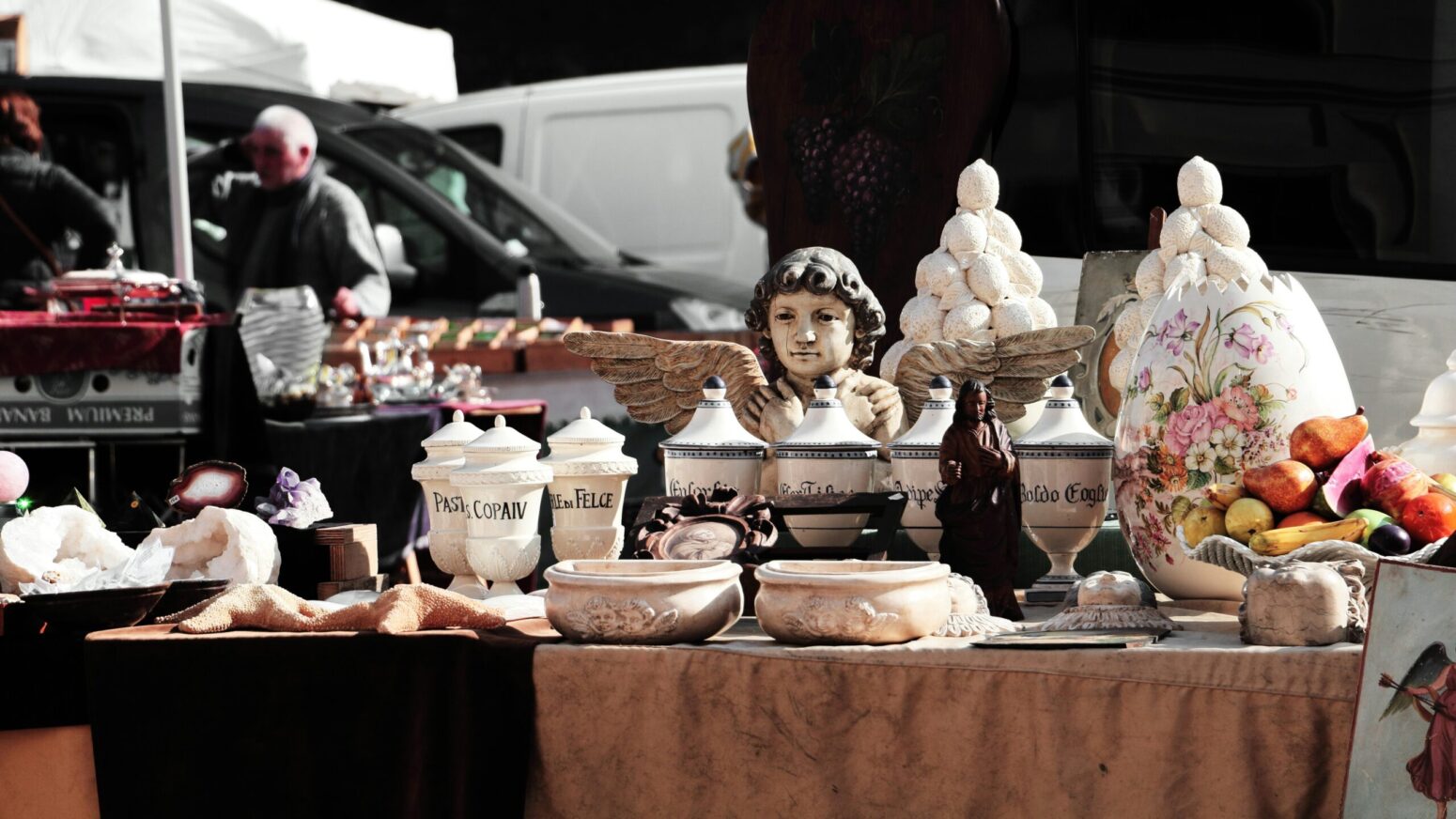
Even when I was ten, I knew there was something beyond the browsing and the buying, the long drives and the open windows. Of course, the yard sales were a little bit about the stuff—who doesn’t thrill and tingle at finding that tiny school desk with an inkstand, that almost pristine porcelain figurine of a tiger? It’s some sort of hunter-gatherer instinct: acquire, store, return for more. Once you find what you’ve been looking for, you lose the bow you’ve had in your hands, the scent disappears. There’s no thin, taut sinew to draw back, no shooting that long arcing arrow through the minutes and the hours, the sunsets and the sunrises. As long as I was searching, there was a fullness behind the blast of the wind on my face, a delight building as the car squealed around the off-camber bends of country roads. Goat must have felt it too. He scratched our bare legs with his overgrown claws, always seeking the window.
The summer of ’84, there was this one yard sale I remember in particular. The sign for it was on the main highway out of town. Sometimes you can tell a lot about the quality of a sale by the type of sign they put up, and it was a good one: large, multicolored, and clean. Not one of those small premade signs you find at the drugstore. The handwriting was so neat it looked machine printed. It said, “Moving sale. Sunrise to sunset. Follow the signs.” It was that last line that drew us.
We turned left onto a dirt road. My father rolled up his window as dust billowed in the sun. We passed fields of Holsteins and barns with old tedders and windrowers and balers pouring from the doorways. The junk wallowed in the grass at various distances, as if rust over time produced an endless, slow explosion. Goat sat down in the middle seat and smacked his lips. My mother asked if we were hungry and passed us each a box of raisins. We opened them reluctantly. Raisins reminded me of folded-up pieces of dirt. Shirley said they were an old man’s dried boogers. Half of them went to Goat. They say raisins are poisonous to dogs, but they never bothered him one bit. He lived to seventeen and died in his sleep.
Shirley sucked her thumb and rested her cheek on the window. Every couple miles there was another sign, the same neat handwriting, the same size, the same words. I nodded off here and there, lulled by the undulant line of fields and forests. All I can tell you is what I remember.
Some hours later, I noticed a distinct and consistent throbbing coming from the car. We were ascending something large. The road was wide and packed with gravel. At first it went straight up, up and up without turning. My father stared out the windshield and drummed his fingers on the center console. My mother filed her nails. After some amount of time that seemed especially long to me then, the road began to weave back and forth. The gradient was becoming steeper, the switchbacks tighter.
The motion reminded me of a whale watch I’d done with the Girl Scouts when I was young. The sea was rough, and I stood on deck floating on the huge rollers, my legs light underneath me, my organs rising within me, until I was brought down by a tremendous drop of the deck, as if a huge rubber band were pulled through my innards. It was like being in an elevator that never went anywhere, just accelerated and decelerated in place. I was the only one who didn’t need Dramamine. For some reason, that made my mother proud.
Shirley awoke in the car looking green. She got this apologetic look on her face and yawned. I watched her from the corner of my eye. Out the window, the cliffs on the side of the road were lengthening. Small prickly bushes clung to sandy, bleached soil. I wasn’t sure we were in New England anymore.
After several more curves, Shirley said she had to go to the bathroom. My mother looked back and said we were almost there, she could probably hold it. My mother was a big believer in the power of suggestion. A couple more turns, and Shirley called out weakly that she felt sick. My father rolled his head to glance into the back seat as he threw the wheel to the right.
Shirley lurched forward and whispered something. The only word I could make out was hurl.
My mother said calmly, “Dave, stop the car.”
“Stop the car?” he repeated nonsensically.
“Stop the car!” my mother shouted.
He stopped the car. Shirley opened the door and vomited in one smooth motion.
“Sometimes life makes you sick,” my mother said, stroking Shirley’s hair. She had a whole quiver of stock phrases. Later, I learned most were from Shakespeare.
I held Goat by his collar and stared out the window. Shirley began crying. I’d never seen country like this before. Hill upon hill of dry, crumbled rock and short scrubby brush blended into a hazy horizon. The haze was thick and orange as if, upwind, great forest fires raged.
“Where are we?” I asked.
“Dunno!” my dad said. He slapped the steering wheel affectionately a couple times. “Somewhere west of Eden.”
“High up?”
He turned to me with this wild grin on his face. It was the same sort of grin he got when he unexpectedly had a day off, or when he told me about drag racing on the Underhill Flats in high school.
“So high, Mary Elizabeth, we’re making a hole in the ozone.”
I nodded. I liked when he spoke to me as his confidante, like I was a different breed than my mother and sister, able to handle a different flavor and complexity of information. Shirley climbed back in the car and shoved her face into the corner between the seat and the window. We drove on.
We had stopped ascending and were on a long, flat plateau of sand. Red rocks reared up in the distance, sloped and curved like giant camels. They reminded me of pictures I’d seen of Uluru in Australia. There was something mythic about them. Like beasts once alive had been captured and turned to stone. I wanted to see them close up but knew when I got there, I wouldn’t be able to find what I had understood from far away. Wind turbines appeared on the horizon and multiplied. My mother handed out dill pickles and some egg-salad sandwiches on Wonder Bread. Shirley didn’t want anything. I fed my crusts to Goat.
The road swayed between the vast fields of turbines, like a river through a forest. My mother pulled down the visor and looked in the mirror. She brushed her fingers through her hair and clenched bobby pins between her folded lips. Gravel popped as the car skirted the enormous steel bases of the turbines. Up above, their blades hummed rhythmically like the low C on my organ.
Taped to the base of a windmill was another yard-sale sign. “Follow the signs,” it said. It was reassuring. Someone had been here before us, driven this way, all the way from our small town, up the mountain to the plateau. If I had been my father, if I had been in his situation, I would have faltered, given out. I would never have kept my nerve. For years, all I’ve wanted is to have no need of nerve. I’ve grown wary of uncertainty. A map, that’s what I want.
I know, I know. Before, I said I liked the search, the bow and arrow.
I looked out the windshield. The haze was thickening. The large red rocks shimmered in the heat. It didn’t seem like there was a road anymore. The car stopped and my father got out. He squinted at the low sun, hand sheltering his eyes, calves pushed back, knees locked. He looked a little like Paul Newman then. He had the same creases around his eyes. My father’s inner life was an incalculable mystery. A black box, recorded but unearthed only in cases of dire circumstances.
“There’s the ocean down there.” He pointed to the left of the car. I couldn’t make out anything except the mirage of heat waves. But he could see things I didn’t understand. He was older, after all. When I caught up to his age, I would see them too.
My mother got out and shook her hair. She had an ivory sweater tied around her shoulders. She slipped her arm around his waist.
“My God,” she said. “It’s beautiful. I can’t see the end of it.”
They stood against the setting sun and gazed at the ocean. Through the back window, I gazed at them. They seemed like they had it all planned out, like they understood everything, like they were prepared for every single eventuality.
When my mother got Parkinson’s, the neurologist said she needed to strengthen her muscles, keep her nerves firing. By that time, she’d also developed a neurosis about leaving the property. So my father would take her by the arm and walk her around the driveway, slowly, in circles, the way you would a child on a pony. When she died, he kept an 8 × 11 picture of her on the mantel and carried on mowing the lawn and going to church. But he never smiled again the way he did when we’d gone to those yard sales.
My father died on a small bed in the hospital during a snowstorm in February. The next day, his body in the casket was like a yellowed wax cast. There was nothing left of him. The animation was what had defined him.
My parents got in the car. We drove back down the road with the angled sun framed in the rear window of the station wagon. Goat licked his lips and sighed. His sigh contained a small drawn-out groan.
“What about the yard sale?” I asked. By then, I’d imagined a yard sale in a cave through an entrance at the base of one of those red rocks. The light of our torches would uncover enormous caverns of Oriental rugs and sparkling chests overflowing with gold-laced jewels.
He rested one hand on the top of the thin blue steering wheel, the other in his lap.
“Did I ever tell you about the time I tried to drive across the country in a VW bus and broke down in Kansas?”
“Yes,” Shirley and I chimed.
“How about the time I learned to fly?”
“You made that up. It’s just a story,” Shirley said. “What about the yard sale?”
“Sometimes signs don’t lead anywhere,” he said.
“We’ve been going nowhere?” I asked.
“We went plenty of places. One sign led to another. Only, we didn’t end up anywhere.”
It wasn’t satisfying, but it was true.
Dusk fell. Goat stopped panting and the haze dissipated. A pale blue glow smoothed the top of the hills. The windmill blades sliced the air like the deep vibrations of a didgeridoo. I fell asleep to the murmur of the public radio station.
Read more from Issue 22.2.