Cells
15 Minutes Read Time
In early March 2020, on my last visit to the Carnegie Museum of Art, I waited for the one o’clock tour at the bottom of the stairs leading to the galleries. The docent arrived and led our little group up the staircase, to the galleries on the left, as she shared bits of trivia about the artists. Degas, Monet, the usual suspects. My head pivoted. My eye roved. I was restless amid all the cold stone and bronze. Nothing caught my eye until the docent stopped in front of six beat-up wooden doors standing as a not-quite-completely enclosed hexagon: Louise Bourgeois’s Cell II.
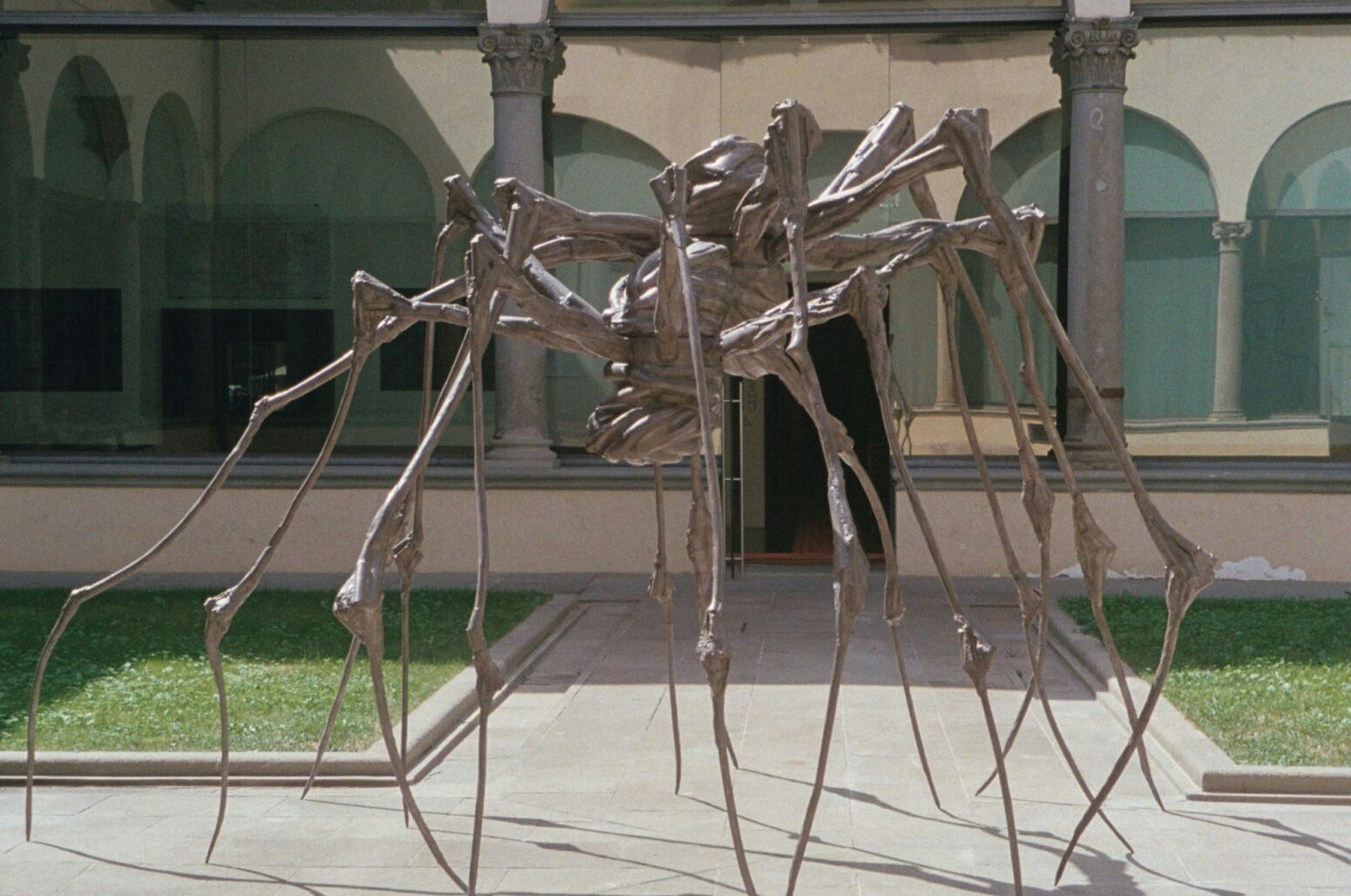
Louise Bourgeois is most famous for her sculptures of giant bronze spiders. For Bourgeois, the spider was protective, comforting. She even named her largest spider sculpture, a thirty-foot-tall behemoth worthy of a Godzilla movie, Maman. Like Maman, much of her art addresses her parents and her childhood: her father’s absence during World War I; her mother’s role as a weaver, a fixer of tapestries, who experienced a decade-long illness and eventually died from the so-called Spanish flu. And, a final affront: her father’s ongoing affair with the governess he hired to look after the young, sensitive Louise, under the same roof as her ailing mother. Spiders for Bourgeois were comforting, protective creatures, weaving webs like her mother, the weaver.
Bourgeois’s work—sculptures, prints, paintings, installations—is a deep mining of the traumas of her childhood, a hacking through the layers of memories, and a refashioning of them into art. In various statements and interviews, she highlighted that instinct:
Everyday you have to abandon your past or accept it and then if you cannot accept it you become a sculptor.

You see, you have to do something about it. If your need is to refuse to abandon the past, then you have to re-create it.

I am a woman without secrets. Simply because my life every day is a liquidation of the past.
Bourgeois carried these memories inside herself, revisited them, pulled ideas from them, produced art out of the way they rankled her, followed her, haunted her. And then if you cannot accept them, you become a sculptor.
Working from home for the past two months has forced me to closely observe the space I inhabit, my four-by-ten office off the bedroom. I’ve grown familiar with each crack in the plaster walls, the smear of bug guts on the window, the holes that are all that remain of the previous tenant’s decorations and curtain rods.
I’ve also been remembering my father’s basement office in my childhood home, though he moved out when I was three. After his affair, the divorce, my mother tried to erase him from the house she won in the settlement—a house she never wanted, a ranch in suburban New Jersey, a place she never wanted to live, with three kids she never wanted. Few traces of my father remained.
I didn’t begrudge her a bit of redecorating, even if it was extravagant and extreme: she sold or gave away or banished to the basement their collective belongings—Windsor chairs and salt-glazed pottery they’d bought on their many antiquing trips up the Hudson—and replaced them with bright white furniture, tropical plants, bamboo tables, and dark African masks on the walls. As I grew up, and grew awkward, I went underground, fleeing the judgment of the hollow sockets in the masks, playing video games in the basement, pairing the games with pot as I grew older.
I was drawn to the bookcase in the basement, the length of one wall, tall brown oak, housing the only books in our home: Winston Churchill’s six-volume history of World War II, an artifact from my father’s short-lived career as a high-school history teacher. Behind the red bindings, the mildewed pages were doors to another time, another world, another person.
At the end of the preface to the first volume, Churchill, renowned leader and notorious racist, reflects on the looming shadow of the Cold War:
The human tragedy reaches its climax in the fact that after all the exertions and sacrifices of hundreds of millions of people and of the victories of the Righteous Cause, we have still not found Peace or Security, and that we lie in the grip of even worse perils than those we have surmounted. It is my earnest hope that pondering upon the past may give guidance in days to come, enable a new generation tore pair some of the errors of former years and thus govern, in accordance with the needs and glory of man, the awful unfolding scene of the future.
My father remembered the books when I mentioned them, while I was lost in the unfolding awfulness of adolescence and deciding which parent to live with. I craved the lack of restrictions in my father’s home—bags of weed on the kitchen table, half the fridge dedicated to beer—but also was wary of leaving behind the cleanliness and comfort my mother had so long provided. I asked him if he had used the basement as his office when he lived with us. He said, Yes, a home office.
My mother laughed when I reported this to her. She said the only work he did in that office was have panic attacks in a single bed beneath the stairs. I had wondered why it was there, a lumpy, bare mattress that I could never recall someone sleeping on. She said he’d get faint and anxious every time her relatives swarmed out of Manhattan and Queens and descended on our house. To my introverted, history-obsessed father, a working-class Jew from the Bronx, they must have appeared like a horde of Parthian cavalry charging in: nosy, garrulous Iranians, forced, through revolution, out of their country and several rungs down the socioeconomic ladder. They’d arrive toting exotic food like armaments: trays of kefta kebabs, pots of stews that stank of saffron and turmeric, and fatty hunks of lamb coated in pomegranate syrup. I must have been in a baby chair at the kitchen counter cooing at my grandmother as my father suffocated on his anxiety twelve feet below, toiling in his subterranean home office. Each labored breath an indictment of all the previous decisions that had led him there. The grueling work of being.
My maternal grandmother, an acid-tongued Assyrian woman who never reconciled herself to her adopted country or, for that matter, to the fall of the Assyrian Empire twenty-four hundred years ago, disliked my father from the get-go. Perhaps she saw my parents’ incompatibility early on. As a younger woman, though, when she grew tired of her husband’s philandering in Tehran, tired of taking care of four kids, she had checked herself into a mental hospital in the calm hills outside the city. Maybe she and my father had more in common than they knew.
Cell II is not entirely closed. As I circled it, I peered inside the cracked glass window of one of the doors and into an opening, a gap where the doors failed to meet. A concrete column the height of a side table stands in the middle of the cell. Atop the column sits a mirrored tray. On the tray huddle a family of empty Shalimar perfume bottles, Bourgeois’s mother’s favorite, in descending size order. Beside the perfume, a pair of carved marble hands are clenched. The smooth, rich creaminess of the marble is in conflict with the tense fingers, interlocked as if in anxious prayer. A metamorphic rock, marble is limestone that’s been pressed and heated by the earth’s crust, often where the plates crash and converge. Limestone is the product of time, a record of death: the sediments of fish skeletons, mollusk shells, and coral. Skeletons turned to stone. Geological processes over eons molded the stone before it landed in Bourgeois’s hands, before it became a pair of cold hands.
Cell II houses memories in a fragment, a reflection, a scent. When I began building the Cells, Bourgeois said in a statement about the series, I wanted to create my own architecture, and not depend on the museum space, not have to adapt my scale to it. I wanted to constitute a real space you could enter and walk around in. Though Cell II denies physical entry, I identify with her need to forge a space of her own and not accommodate herself to the space the world does—or doesn’t—offer her. To gather what the world has discarded, to carve and shape and mold, to construct our own world in order to combat the alienation and confusion inherent in the human condition, the trauma of inhabiting a world not of our making.
For my mother, the closest thing to a home office was her vanity. A narrow polished oval white-granite tabletop on black wrought-iron legs, covered with two large mirrors and countless bottles of perfume, jars of creams, tubes of lotion, all with exotic French names. A heap of cosmetics fit for a queen. The table took up a quarter of her large bedroom. She sat at it and performed her art—the composition of a made-up self—before any outing. The chair was straight-backed oak, an uncomfortable throne that discouraged dawdling. Though mostly covered by the bottles and jars, the bright quartz in the granite could catch the light and reflect it back into the room, onto the wooden masks covering the walls.
But this space was my mother’s. Mine was perhaps our dining-room table, a slab of marble, creamy as the hands in Cell II, just off the kitchen. Situated at the nexus of the house, it commanded views of the backyard, the front door, the living room, and the hallway to the bedrooms. Scents of turmeric and saffron wafted in from the rice steaming in the kitchen, the lid of the pot wrapped in a rag. Dark rattan mats marked the places where we dined, resting our elbows on all that pricey, metamorphosed death.
Three days after my visit to the museum, I took my partner to see the Chieftains at Heinz Hall in Pittsburgh. I’m not a dedicated fan of the band or of traditional Irish music, but the tickets were cheap and, scheduled for seven p.m. on a Sunday, the perfect time for us early birds.
I seldom go downtown. It’s primarily commercial: glass skyscrapers, vacant storefronts, and empty streets. But we drove down and mingled with the other concertgoers, mostly baby boomers sipping glasses of Jameson or bottles of Guinness. We stood around on the plush red carpeting and beneath the elaborate rococo gilding on the walls. The concert was lively: fast-paced fiddling, a platoon of bagpipers, flailing Irish step dancing. In the silent moments between songs, I was acutely aware of every cough. Not as fearful as I am now when I hear a dry cough from a passing jogger, but still weighted with concern.
On the ten-block walk back to our car, we passed Agnes R. Katz Plaza, a half-acre cell on Penn Avenue, surrounded by buildings and linden trees. The docent at the Carnegie, seeing my connection with Cell II, had mentioned that Bourgeois had helped design the plaza, including the black-granite carved eyeballs that serve as seating and the twenty-five-foot bronze fountain, a sort of ziggurat with two gurgling springs on top. The water is heated and thus flows year-round. The eyes are lidded, open but sleepy.
The cold and dark spurred us on. We headed east on Penn, passing a cube of dull white light like a piece of glowing quartz. Known as the Water Cube, it’s a functional sculpture dispensing free filtered and sparkling water. Two blocks from the car we paused again before the sinkhole that opened up last fall, sucking the back half of a Port Authority bus into the earth, a gash one hundred feet long and twenty feet deep. From behind a fence it looked like a makeshift quarry, an impromptu mine in the middle of the street. I’d heard that city officials thought water caused it. Erosion. But no one knows the exact cause. Sometimes the world just crumbles.
My father’s last cell was a bed in a nursing home in Hillcrest, New York, where Alzheimer’s and poverty had put him. Delirious, feverish, incontinent, fearful, unable to speak, he was bedbound for months. My stepmother had power of attorney, but her general indecisiveness, coupled with this fresh grief, paralyzed her. So my father suffered. Another blow: MRSA, an antibiotic-resistant staph infection. And, finally, COVID-19. They took him off the ventilator and gave him morphine and oxygen to keep him comfortable until his lungs gave out and he died.
My stepmother left me a voice mail. I’m sorry for your loss, she said, voice quavering. But I was relieved: COVID-19 potentially spared him many more frightened months or years surrounded by strangers in an understaffed nursing home, a desperate life he had explicitly said, as far back as I could remember, he wouldn’t wish on his worst enemy.
My brother had a hard time making the cremation arrangements. The funeral homes in the area outside New York City were full. He finally found a place but had to pay $3,400 for the process. They said they were backed up and would need to refrigerate the body for three weeks until they could fit our father in. The future, in all its awfulness, ceaselessly unfolds.
I try to wade through the science of how COVID-19 spreads, the dangers lurking in a droplet, the way our cells are attacked, how the virus invades and replicates. The myriad vaccines and antivirals in various stages of testing. The partisan vitriol around the policies put into effect to slow the spread of the disease. I spend my days skimming the evolving science and the demoralizing news, my eyes soaking up each depressing headline and image. In between, I work from home, teaching online. Grading papers. Uploading lessons and writing prompts. Cutting and pasting. Composing and assembling.
From my home office I can see the thirty-by-ten patch of mud and grass that is my backyard, churned to pulp by my dog’s sprinting and rolling. To break up my day and exercise my dog, I take two walks, morning and late afternoon. The streets are mostly empty, though signs of life are returning. Renovations put on hold to stop the spread of COVID-19 have resumed. More cyclists seem to be coasting down Penn. The cherry trees and jasmine have bloomed, adding pastel to the palette of the world. We pass row houses with their vinyl siding flayed by the wind. Asphalt shingles litter the ground, dander shed by dilapidated roofs. Bird nests shake loose from their branches and plummet to the street. Eggs crack and reveal half-formed birds, clothed in the stubs of burgeoning feathers. My aimlessness makes me think of flaneurs, of Baudelaire and Benjamin. Coupling that with the unease of the times, I feel like Bernardo Soares, one of Fernando Pessoa’s heteronyms and the narrator of his fragmented novel, The Book of Disquiet, who wonders: Where can one think of fleeing, if the cell is everything?
Bourgeois completed her final cell in 2008. Cell (The Last Climb) uses the repurposed spiral staircase from her Brooklyn studio, where she worked and suffered and created for twenty-five years. A rusty metal mesh cage surrounds the staircase. Blue glass orbs float in the cage and above it, seemingly rising out of the opening at the top. Curators and critics think the piece symbolizes her growth as an artist and a person. She has accepted her mortality, her lifelong anxieties, the traumas of her childhood. Is she leaving them behind for that final ascent? Or is even death, here, shown as a taxing climb? Is the structure itself the truth, the lesson: if you want to escape your fears, to conquer them, you need to make them manifest, uproot them from your memories and transplant them, give them shape and weight in the wider world?
I sit at the desk in my home office, stare at the blank page, watch the cursor blink on the dusty screen. Move my fingers along the greasy keys and mine the quarry of memories I can’t accept or abandon. Is art just another cell, or can it be a way out, the written word a file you smuggle into your cell, a key you filch off your jailer’s belt?
Outside my window May has arrived. Buds bloom. Discarded latex gloves litter the sidewalks and streets. Rabbits taunt my dog from the tall grass. Children in face masks fly by on scooters. The virus is here. As is spring. The rest is an open question.
Read more from Issue 18.2.