
Body Essay
Special web feature
18 Minutes Read Time
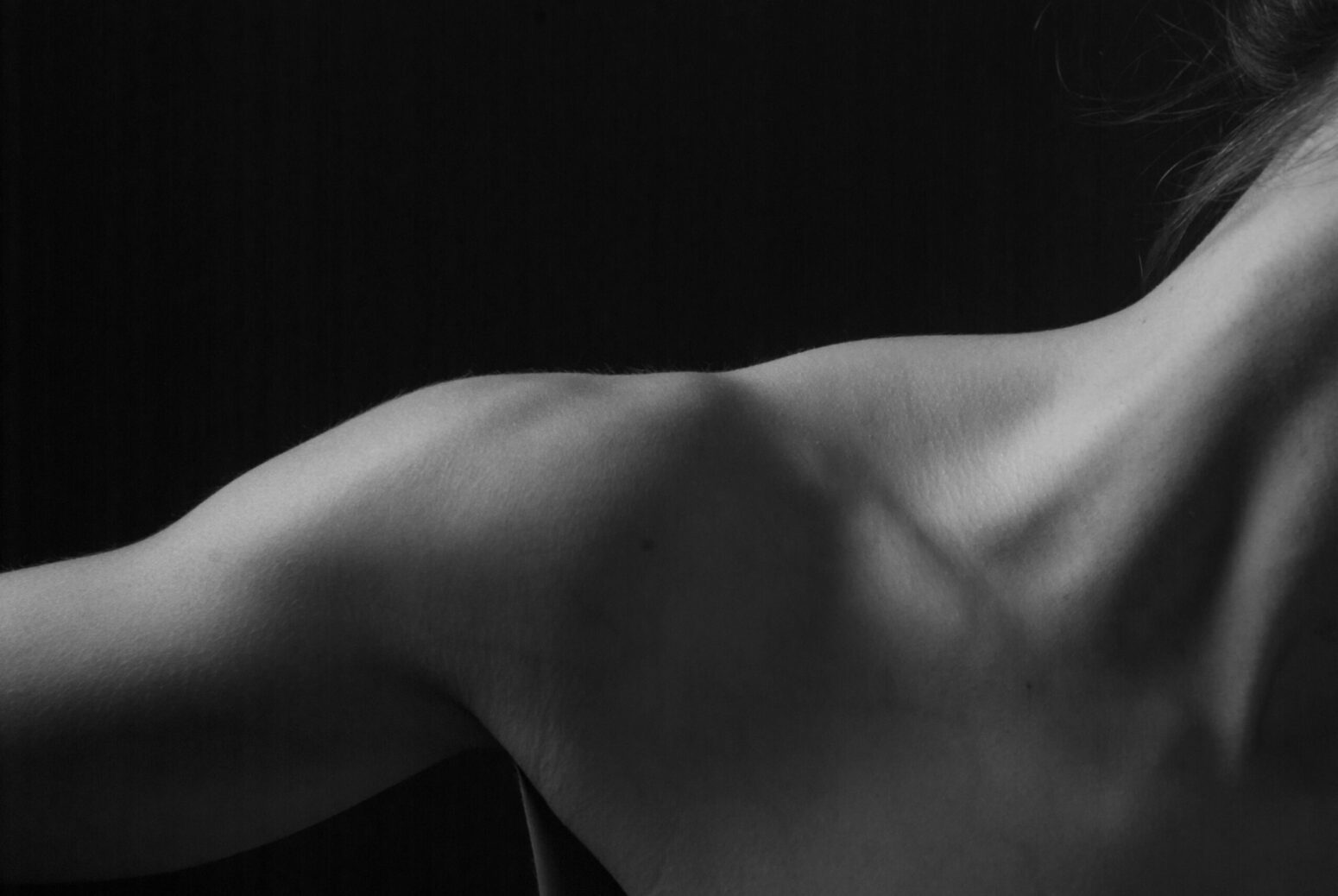
Guest Literary Nonfiction Editor David Lazar: Allison Field Bell’s “Body Essay” is, indeed, greater than the sum of its parts. This self-forensic, tonally muted work, is a Cartesian revision: We are corporeal, and therefore think about how every inch of us, each discrete part, conjoins body memory along with the memory of our bodies’ pleasures and humiliations. Field Bell stitches together moments into an essay both capacious and intimate, political and personal, at times sensuous and occasionally eerily disembodied.
Writer’s statement: Sometimes I think of the body as a house. A house full of rooms. One room is the memory of scraping my knee on pavement as a child. Another room is an orgasm. You can walk from room to room noticing details, remembering, feeling. That’s how I imagine this essay too: each body part a different room with all its corresponding associations. In the essay, I wanted to move through my body like a person might move through a house, room by room. A catalog of body. An ode to the corporeal experience.
Brain
A psychiatrist explains to you that the brain has different kinds of defects that are targeted by different kinds of medications. He uses a metaphor: neurotransmitters like tiny boats moving from one shore to another. Sometimes there are not enough beings to move from shore A. Sometimes there are not enough beings on shore B to receive the beings from shore A. Sometimes there are not enough boats.
Here’s the list: Once you maxed out your credit cards to see Hamlet at the Globe Theatre, once you threw a stone through a glass table in anger, once you slept with five different people in less than a week, once you stayed up all night putting together a photography show on separation walls, once you drank for hours in the streets of San Francisco and slept the morning away in Dolores Park, once you pretended to be pregnant to avoid confessing bulimia, once you climbed drunk between hotel balconies in Athens, once you could wear only black tank tops because your anxiety sweated through your clothes, once you even developed a stutter, every day you check the stove and the door at least three times before leaving the house, every day you used to drink a glass of bourbon or three or four.
A friend comments that the Hamlet story doesn’t seem like a brain problem at all. Doesn’t seem like part of a diagnosis. She doesn’t understand how Hamlet could possibly be manic behavior. You don’t defend yourself, but you do wonder: Is she herself also manic? Or maybe she has enough money that the idea of flying to London for a play can’t seem irresponsible. Can’t possibly result in having to move back in with your parents at the age of twenty-four. Or maybe—here’s the fear you’re always having—you’re just being dramatic. Maybe you’re performing this whole thing. Maybe you’re not ill at all. You tap your skull. The brain inside there. Tiny boats.
Hair
Blond and thick. It’s always been a feature that earns you compliments. You do nothing to it. You don’t straighten or curl or color or hair masque or whatever it is that people do. When it’s short, you don’t even brush it. You let it air-dry. You let it tangle. You let it stick up after sleep. When you have bangs, you cut them yourself. They are always uneven.
In your early twenties, when your eating disorder catches up to you, you lose clumps of hair to the drain in your shower. Malnourished. Your hair thins and releases. And soon the shower water fills up to your ankles, your shins. A plumber has to come deal with this. He suggests you don’t brush your hair in the shower. He suggests you get a special trap to catch stray hairs. He suggests you simply might just cut it.
In your late twenties, when your hair is long and to your ass, when you are living in Las Cruces, New Mexico, a man who is your lover for a night can’t stop touching it. Your hair. He admires the blondness, the realness, he says. Not bleach-blond, but genes and sunlight. Later, when you sleep together—and you can’t remember if it is sex or just whatever comes before sex—he pulls your hair hard and with desire. So hard that a clump of it comes out in his hand. You don’t say stop, not because it doesn’t hurt but because you want to be the type of woman who is game for anything. And the next morning when he says, on your second date, he wants to take you to a bull fight in Juarez, you smile serenely, knowing you will never see him again.
Face
Your face is too round. This is vanity. You hate when you gain weight because it shows up on your face. Everything shows up on your face. Anger. Disappointment. Anxiety. Your face breaks out and then you pick and pop until you have scars. Your face scowls and smiles.
When you’re younger, and your face is thin, a male therapist tells you his friend would likely want to photograph you. He says, “Once he sees your face. You have such a beautiful face.” Then he runs his hand along your jawline. This second part, you can’t remember clearly. Does he actually do this? Or does it feel like he does with his words? Does the difference even matter? The therapist—a man you trust fully—betrays your trust. Or rather, your body betrays you. Your face. This therapist man spends many hours with you. Just the two of you alone in his office. He hypnotizes you, which you think is bullshit, until you realize you’re losing time. One minute the session starts, the next it’s over. You lose half-hour chunks. What happens in those half hours? You never see this therapist again after he touches your face—with his words and hands or words or hands. You quit therapy entirely for five years. Fuck therapy. Fuck your face.
Nose
Your nose is part of your face, but it is also something of note. Mostly, this is because you’ve broken it twice and because you’re Jewish. You break your nose on a metal trapeze swing and on a pogo stick. Both ’90s toys. Your nose simply cracks straight on: two black eyes. Nothing crooked. The doctor doesn’t feel the need to x-ray or splint. It will heal straight, he decides, and it does.
In high school you pierce your nose. A weird sketchy shop behind a retail clothing store. The small blue stud comes out in your bed that first night. You find it and pop it back through. The tissue has already begun to heal: pain and a bit of blood.
The Jewish part of your nose is this. In graduate school, you work on a screenplay with a man named Nick. Nick is white and Protestant or something. Also sober, which is both confusing and refreshing. He has a nervous energy. He tells you the Jews are taking over Hollywood. You tell him you’re Jewish. He looks at you for a long time. He looks at your nose. “You don’t look Jewish,” he says. And then, he pinches his own nose: “The nose isn’t,” he says. You want to punch him or do something brave. You don’t and you don’t. You blush. You keep working on the screenplay.
Neck
You like to put perfume on it. A light spray of fragrance. You catch whiffs throughout the day—the decadence. Your partner hates perfume. He hates the falseness, the extravagance. But mostly, he just hates the specific smells. He finds them obnoxious. He particularly hates a French perfume a friend of yours gifts you for the holidays. It comes in a sleek black bottle, its scent musky, strong. He can’t stand to be in a room with you when you wear it. You have to shower. Hot water on your neck, scrubbing, scrubbing. The scent is stubborn, has soaked through to the bone, it seems.
A previous lover told you he only finds himself attracted to women with visible collarbones. The collarbone is neck-adjacent. The collarbone is visible mostly through thinness. When he says this, and when you are his lover, your collarbone is not visible.
Your current partner—the one who hates perfume—has discovered something about your neck you didn’t know before: an intimacy. Sometimes, you like his hands around you there. That pressure. That trust you have in him to be gentle. Or perhaps it is the opposite: an edge.
Back
You have scoliosis. A slight curvature in the spine. You find out when you’re young, in a trailer that is the nurse’s makeshift office at school. You are told to lean over while the nurse stares at your spine. She writes something down on a clipboard and says, “Scoliosis.” You fear the word as you would fear any word said with such coldness about your body. The nurse says, “Next,” and you are left to wonder what scoliosis is. For a long time, you believe it is fatal. You believe you will slowly become paralyzed, confined to a wheelchair, confined to bed. You live with this fear inside your body for years.
At thirty-seven, you throw out your back for the first time. You’re at the gym, squatting with a medicine ball. You have to lie down immediately. The gym’s music pounds in your ears. You’re nauseous and dizzy. You’re not sure you’ll ever leave this spot again. Just there on your yoga mat, frozen. When you do make it home, your partner is frustrated with you: You haven’t taken care of your body. You haven’t been responsible with your back or limbs or heart. You haven’t been good to yourself.
Chest
Your breasts have always been a concern. When you were a teenager, you wanted them bigger or at the very least existent. Now, thirty-seven, you could do with a little less. Now you’re a petite person with a big chest.
At nineteen in Ecuador: You find a lump beneath your left breast. This is before people have cell phones to bring abroad, before smartphones, before you consider googling symptoms. And even if you had googled: The prognosis is not great. A lump is never what you want. You touch the lump constantly. It aches and sometimes it spasms in pain. In Ecuador you also get dysentery and a bacterial infection like salmonella except more unique. This is your diagnosis when you return to the States. As for the lump, your California doctor removes it: a fatty tumor the size of a golf ball. He uses only a local anesthetic, and you can feel a tugging on your rib cage. The results say it’s benign. He says, however, that you should try to not gain weight so quickly. You don’t understand because you didn’t realize you had gained weight. Or rather: You are under the impression that you will always be small. He says, When you grow quickly, this can happen.
Arms
For so long, irrelevant. You are a runner and a soccer player. You don’t need to think about your arms. Your body does not grow there. Now, you see photographs of yourself and think your arms are too big. Not muscle, but fat is what you see.
You have many tattoos on your arms. The first one is on the inside of your right wrist: a close-up of a branch of ocotillo. It almost looks like a rose. You want to cover scars there—from self-harm. A dragging across skin and a dripping of hot wax. And you have a tattoo on the inside of your left forearm. The vulnerable place for Jews. The tattoo there is a pothos—a house plant—with a row of tiny dinosaurs. It is playful, insignificant. It was impulsive and paid for by a friend of yours. You did not think of the significance or the flouting of significance. You are only half-Jewish. Half-aware.
Your father asks your brother and you to flex your arms. Or maybe he doesn’t. Maybe your brother and you just flex. You are both young. Children. And when you flex the non-muscle there, your father laughs.
As a toddler, you dislocate your elbows easily. Your father swinging you through the air in a game: Both elbows pop out. So much pain that you do not remember. The body has a way of not remembering.
You do remember falling off a slide, almost breaking your arm. You do not break the bone, but you burst a blood vessel. Sprain it terribly. Your doctor tells you it may have been better if you had broken it: less painful. You do not get a real full cast, just a half cast and an Ace bandage.
You are thirty-seven and you have just started climbing. You are not a good climber. You have been trying for a year now, and you’ve hardly improved. You are not strong and you are not smart about your body. Its movements. You have spent so many years against it. It betrays you again and again. You try harder and fail. Your friends who began climbing at the same time as you are far better than you now. And less afraid. You are afraid.
Hands
Your small, soft hands rip open when you climb. And now you have thick mounds of calluses. This is not completely right, your partner tells you. He has been climbing for fifteen years. He suggests maybe you have the wrong body positioning or maybe you are holding on too tight. What perfect clarity.
You scar your hands with cigarettes. You are in your twenties. You put out the embers on your skin: a circle of burn that turns to scab that turns to scar. You are trying to stay awake or maybe you are trying to feel something new. Your hands scar and age.
Your hands age from bleach buckets at restaurants. Dipping a hand in to grab a rag, wiping down a table or a counter. You don’t use gloves. Your hands are also too small for restaurants: balancing plates, opening a wine bottle.
Stomach
The stomach, the gut, the belly. It feels like you’ve always had one. Like it’s just a thing that you live with. But you do remember very clearly noticing the curve of your belly after your high school graduation. You had been saving money since you started work at fourteen and wanted to spend it on for a trip to Europe with your friends: your first time going abroad. In Europe you eat gelato and pasta and drink wine and beer. You leave your bathing suit in a hostel in Portugal early on and have to buy a new one. A turquoise bikini. You think this is okay for your body. But then, afterward, you see the photographs. Who is that? It is you. Your belly in your turquoise bikini. You had been sick with mono for half a year before then, been forced to drop all your sports for fear of rupturing an organ. No running, no soccer, no skimboarding. You turn away from the images of yourself. The word fat on your tongue.
Your last year of undergraduate: You are definitively not fat. You shed weight like it’s your job. You tighten and tighten a belt around size 0 jeans. You still see a belly. Still that gut. Stupid, stupid body.
In Spain at twenty-one, not fat. But not as thin as the friend you are traveling with. At a restaurant one day: A plate of paella between you, your friend leaves to use the restroom. While she’s gone, a man beside you makes faces at you. He flattens his lips and puffs up his cheeks. He does this three times. Then he says, “La gorda.” You know enough Spanish to know immediately what this means. The fat one. You turn a deep red. Your friend returns. You stop eating from the paella plate. When the man is gone, you tell your friend. She rages. She wants to scream in his face. You smile and say it’s fine. Back at the hostel, you throw away the shirt you are wearing, but you want to throw away your whole body.
You have a tattoo on your rib cage. Under your right breast. The tattoo is the Organ Mountains, which loom over the city of Las Cruces, New Mexico. You get the tattoo to cover up some imperfect skin there: a few blemishes from some in-grown hairs or zits you picked until they scarred. The scars have faded, but here you are with a stomach tattoo. This is what a friend of yours calls it: a stomach tattoo. She says, “That’s a clear statement.” She means something about pregnancy and motherhood.
Ass
You don’t think much about it. It doesn’t occur to you to think about it until your partner jokes that this is the body part he thinks you could improve. It’s a joke: a strong ass. Still, it makes you suddenly aware of it in a new way: always swiveling at the mirror to catch a glimpse.
Pelvis
When you’re three, you have a strangulated hernia. Your left ovary. The ovary slips through abdominal tissue and catches. This is a pain you cannot quite recall. Just the sight of bricks beneath you. You are pulling a wagon full of children. Too much weight for your young, small body.
Thighs
You mostly like them. The way they curve out from your calves and in to your hips. Their strength and utility. But now the standing gap between your legs has vanished. The flesh there just being flesh. That heart of air between them gone. The way they spread out on a chair, how they bulge beneath shorts.
You run in high school and in your early twenties. You love the way your legs move you through the world. Over streets and sidewalks and trails. You love your legs. Mostly.
In high school, a young girl your age, also a runner, hates her thighs. Pulls at them in mirrors, tries to cover them up. Before her, you never considered hating a body part for its largeness. Before her, you never considered your thighs at all.
Your partner says you have great legs. Strong, he says.
When your eating disorder is most acute—in your mid-twenties—you worry about every body part, including your thighs. The fat there. You want it all gone. You don’t care about strength. You want—without knowing—to be skeletal. So thin you can disappear, break, and crumble into a fine soft dust.
Feet
Childhood: You pinch with your toes. A habit that drives your brother mad. For years, he hates flip-flops because of toes. Your toes.
Bunionectomy. You have one to help with the running. To help with the pain you experience running through your twenties. The big toe joint on the left foot. The surgery fails. The doctor puts too long of a screw through the joint, and now here you are with degenerative arthritis. With intermittent pain. You cannot drive a stick shift. Cannot wear heels. Cannot really run.
The feet are an important part of the body. A part you don’t value until you have pain there. When you run, your doctor says, the whole of your body weight is on that one toe joint. Seems like so much for such a small bone. You think about this as you run: the whole of your body drilling down through one specific spot. The whole of your body in motion. The whole of your body working together, brain to toes.
Soles
Like souls. Does one exist beyond the body? No, your body tells you. It is just us in here. Blood. Muscles. Bones. Tiny boats gliding.
A woman friend asks you: “What is it that you want to say about being a woman inside a body?” You want to tell her something profound, something you’ve learned in your thirty-seven—almost thirty-eight—years of life. But you just keep thinking about soles. How they ground you into the earth. And the earth: another body.
As a child, you wanted a bigger, stronger body. As a woman, you wanted and want to be smaller. Your body is something you inhabit but also something that inhabits you. Haunts you. Stares at you through a mirror. What does it mean to look at yourself? To gaze into your tired, baggy eyes. To love.
You like to watch footprints appear on wet sand. You like to see your soles there. A kind of bodily signature: exquisite, fleeting. You imagine the waves slipping back up the shore, erasing your soles, removing your body from the earth. Just water and sand, just memory.
Read more from Issue 22.2.